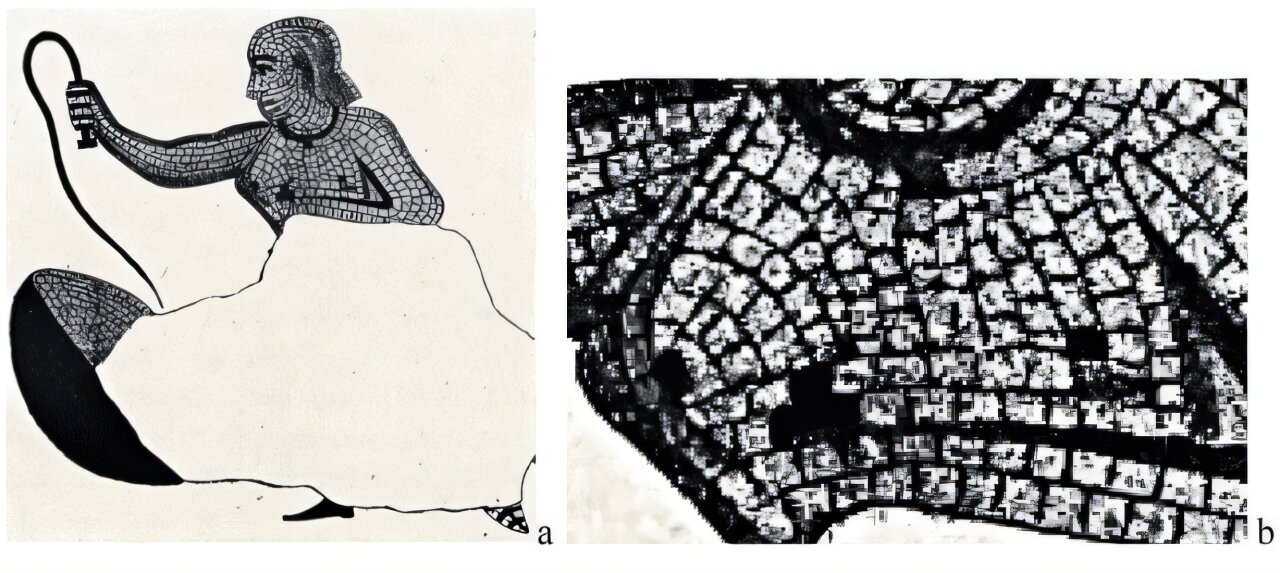
The dust of the arena floor has long since settled, but for centuries, our vision of the Roman spectacle has been dominated by a single, hyper-masculine image: the burly gladiator locked in mortal combat. While we have known that the Roman games involved more than just man-on-man violence, the specific role of women in these blood-soaked theaters has remained shrouded in mystery, often dismissed as a footnote or a theatrical novelty. However, a silent witness from the 3rd century—a vibrant mosaic unearthed in Reims—is now rewriting the history of the games.
According to a groundbreaking study by Alfonso Manas from the University of California, a single figure immortalized in stone tiles is shattering old assumptions. For years, scholars looked at this artwork and saw a secondary character—an agitator or a clown-like staff member whose only job was to whip animals into a frenzy for the “real” hunters. Manas has looked closer, and what he found wasn’t a background worker, but a venatrix: a professional, highly trained female beast-fighter.
The Secret Hidden in the Stone
To understand the weight of this discovery, one must first look at the anatomy of the art itself. The Reims mosaic depicts a figure engaged in a tense standoff with a leopard. While past researchers glossed over the figure’s identity, Manas points to a deliberate choice made by the ancient artist. The figure is shown topless, with prominent breasts clearly defined by the arrangement of the tiles. This wasn’t an accidental flourish; it was a specific anatomical marker used to distinguish this fighter from the flat-chested male figures that populate the rest of the scene.
This visual evidence directly contradicts the idea that women were merely “clowns” or “agitators” in the arena—roles that Manas notes have surprisingly little historical evidence to support their existence in the first place. Instead, the woman in the mosaic is depicted with the tools of a professional. In one hand, she grips a whip used to exert dominance and control over the predator; in the other, she appears to hold the knob at the hilt of a weapon.
These are not the markings of a “damnatio ad bestias”—a prisoner condemned to die—who would have been pushed into the sand unarmed and defenseless. This woman was a participant in Venatio, the formal sport of human-to-animal combat. She was a hunter, standing her ground against one of the most dangerous predators of the ancient world.
Chasing Shadows Through the Centuries
The discovery is particularly vital because, while Gladiatura (human-versus-human combat) has been obsessively cataloged by historians and immortalized by Hollywood, Venatio has often been left in the shadows. This academic bias has left a vacuum in our understanding of who actually fought the beasts. Before this study, our knowledge of female beast-fighters was limited to a handful of literary ghosts—only 6 excerpts in the entire written record mention women facing animals in the arena.
The timeline of these women was thought to be brief and fleeting. We know they appeared under the reign of the emperor Nero between 54 and 68 CE, and historical documents confirm that venatrices took center stage during the grand opening of the Colosseum in the summer of AD 80. But for a long time, the prevailing theory was that they vanished shortly after AD 100.
The Reims mosaic changes the calendar entirely. By comparing its artistic style to other known works, it has been dated to the 3rd century. This means that even after female gladiators were officially banned around AD 200, the female animal hunters—the venatrices—continued to command the arena for at least another hundred years. They weren’t just a passing fad of the early Empire; they were a persistent, enduring part of Roman sporting culture.
A New Lens on the Ancient World
This research does more than just add a new name to the roster of Roman athletes; it challenges the very way we perceive the gender dynamics of antiquity. By identifying the first and only known visual depiction of a female beast-fighter, Manas has provided a tangible anchor for a history that was previously only rumored in text.
The significance of the Reims venatrix ripples out into how we educate future generations. It suggests that our modern stereotypes about the “proper” roles of women in ancient societies are often narrower than the reality of the time. These findings provide the evidence needed to create more accurate museum displays and historical narratives that reflect a Roman world where women weren’t just watching from the high bleachers—they were down in the sand, weapons in hand, facing the leopard’s roar.
Study Details
Alfonso Manas, New Evidence of Women Fighting Beasts in the Roman Arena: The Woman in the Mosaic from Reims, The International Journal of the History of Sport (2026). DOI: 10.1080/09523367.2026.2632176