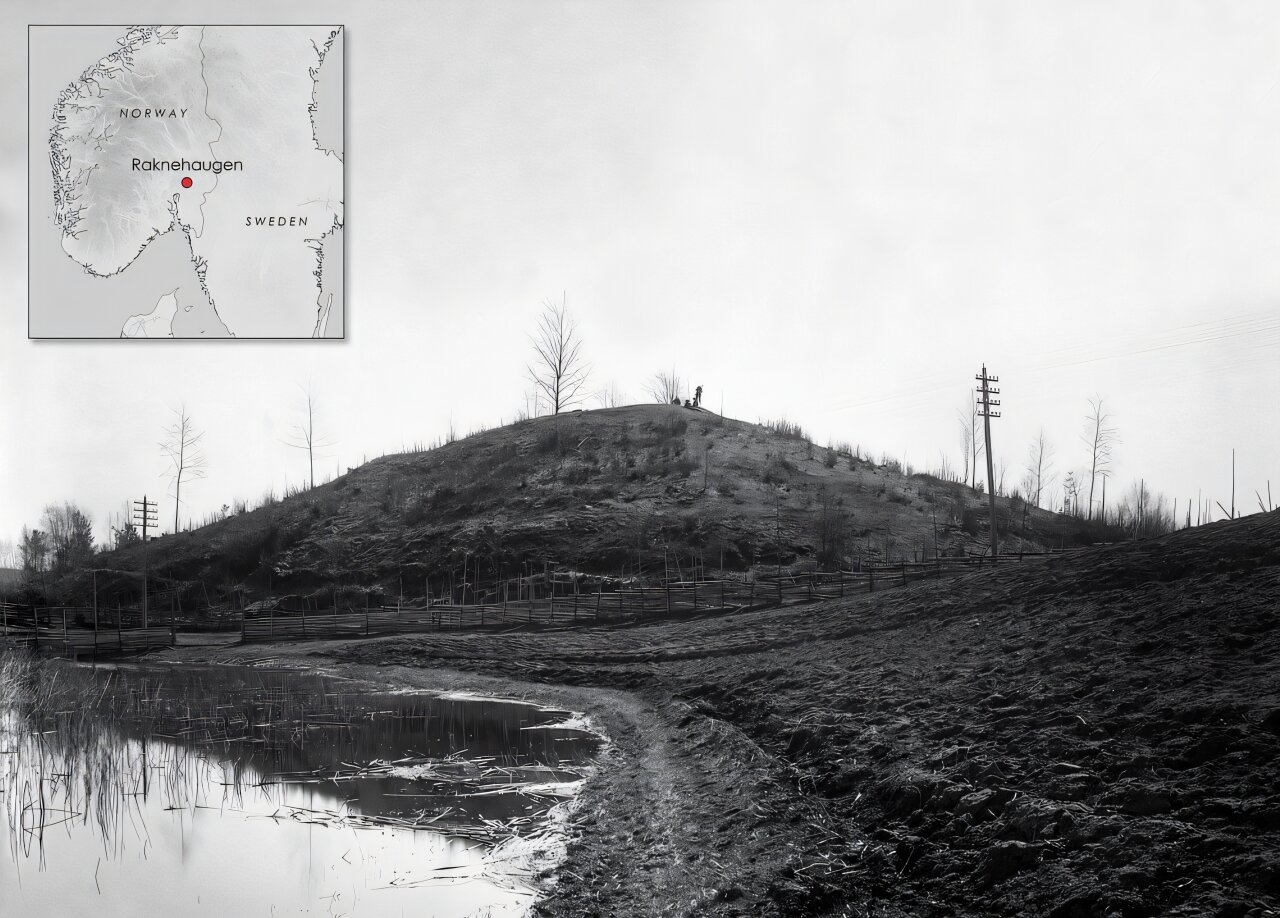
For centuries, the massive silhouette of Raknehaugen has loomed over the Norwegian landscape, roughly 40 km from Oslo. Standing 15 meters high and spanning 77 meters across, it is the largest prehistoric mound in all of Scandinavia. To the casual observer and the seasoned historian alike, its purpose seemed obvious: a monument to a forgotten king, a grand tomb designed to project power and socio-political status across the Iron Age horizon.
But the earth has a way of hiding secrets that defy our expectations. Despite its imposing size, Raknehaugen has never surrendered the treasures or the bones that define a royal burial. Instead, modern technology and a fresh look at the surrounding terrain are revealing a story not of triumph and elite lineage, but of a community grappling with a world that was literally falling apart.
The Ghost in the Earth
The search for the “King of Raknehaugen” began in earnest in 1869 and 1870, when the antiquarian Anders Lorange first broke ground. He tunneled deep into the mound’s base, expecting to find the glittering remains of a high-status individual. He found nothing. Decades later, in 1939 and 1940, Sigurd Grieg led a second major excavation. He documented the mound’s bizarre internal architecture but, once again, the central burial chamber was missing.
The mound was not a hollow shell, however. It was a complex, multi-layered puzzle. At the very base, builders had laid down a layer of turf, followed by alternating deposits of clay and sand. Within this base lay a small burnt layer containing fragments of cremated bone. For a long time, this was the “smoking gun” for the burial theory. However, modern radiocarbon dating eventually delivered a shocking blow to that assumption.
Analysis revealed that the individual in the bone fragments had lived between 1391 and 1130 BC. The mound itself, however, was built nearly two thousand years later. The remains were ancient history even to the people who built the mound; they were likely scooped up with the soil and intentionally deposited as the structure rose, rather than being the reason for its creation.
A Pyramid of Twisted Timber
If it wasn’t a tomb, what was it? The answer lay in the “unusually ugly” bones of the mound itself. Excavators discovered that the structure was built in distinct, chaotic phases. First, the builders erected a pyramid of thin, unbarked pine, branches, and moss. This was covered in sand and clay before a second, heavier timber structure of logs was stacked on top.
The final phase was a massive undertaking, involving roughly 25,000 logs stacked into a tent-like structure and sealed under layers of sand and topsoil. Researcher A. Ording was unimpressed by the craftsmanship, noting that the timberwork was poorly executed. But the strange nature of the wood told a more specific story.
Detailed dendrochronological analysis of 100 pine trees from the mound pinpointed a construction date around AD 551. This date is chillingly significant. It places the construction approximately 15 years after the Dust Veil Event, a massive volcanic eruption in AD 536 that triggered a catastrophic climate collapse across the Northern Hemisphere. This era was defined by prolonged cooling, crop failures, famine, and a staggering population decline.
The Scar Revealed by Light
While previous researchers focused on the mound’s interior, Dr. Lars Gustavsen turned his attention outward. Using LiDAR—a laser-based scanning technology that peels away vegetation to reveal the bare shape of the land—he noticed something everyone else had missed. It was a gentle dip in the terrain, nearly invisible to the naked eye but unmistakable in the data: an ancient landslide scar.
This scar measured approximately 3,800 meters long and 20 meters wide. It wasn’t just a random geological feature; it was the missing piece of the puzzle. Raknehaugen sits exactly on a geographical boundary between a glacial sandy plain to the north and rich clay soils to the south and west.
During the climate crisis of the 6th century, the local population shifted from farming to grazing, a move that stripped the land of vegetation that usually absorbed water. The combination of heavy rainfall, cooler temperatures, and the lack of ground cover likely turned the clay-rich soil into a liquid nightmare. The earth gave way, creating a catastrophic landslide that would have devastated the community.
Building Against the Chaos
The evidence within the mound suddenly made sense. The timber used to build Raknehaugen didn’t look like harvested lumber. Many logs had been snapped rather than cut; some were felled too high for natural regrowth, and others appeared to have been pulled up by the roots.
Dr. Gustavsen suggests that these trees were the debris of the disaster itself—timber sourced from the landslide. In a single, massive effort requiring between 450 and 600 people, the community gathered the wreckage of their broken world and piled it high. This was not a burial for a king; it was a disaster response.
This ritualized construction mirrors other global events, such as the large mounds built by the Nuer people in Sudan following disease outbreaks, or megalithic monuments in France and Spain erected after earthquakes. The people of the Iron Age weren’t honoring a person; they were likely trying to heal the landscape or appease the forces that had sent the earth sliding toward their homes.
Why This Discovery Matters
The reinterpretation of Raknehaugen changes how we view the ancient world. It suggests that prehistoric monuments weren’t always about the socio-political power of the elite; they were often the desperate, collective efforts of common people trying to survive and make sense of natural disasters.
By shifting the focus from mounds as “graveyards for the rich” to ritual structures built in response to climatic volatility, we gain a much more human perspective on history. It reminds us that when the world becomes unstable, humans have an ancient, deep-seated instinct to come together, gather the debris of the catastrophe, and build something permanent to mark the moment the earth moved.
Study Details
Lars Gustavsen, The Late Iron Age Mound Raknehaugen in Norway: A Ritual Response to the Sixth-Century Crisis, European Journal of Archaeology (2026). DOI: 10.1017/eaa.2025.10026