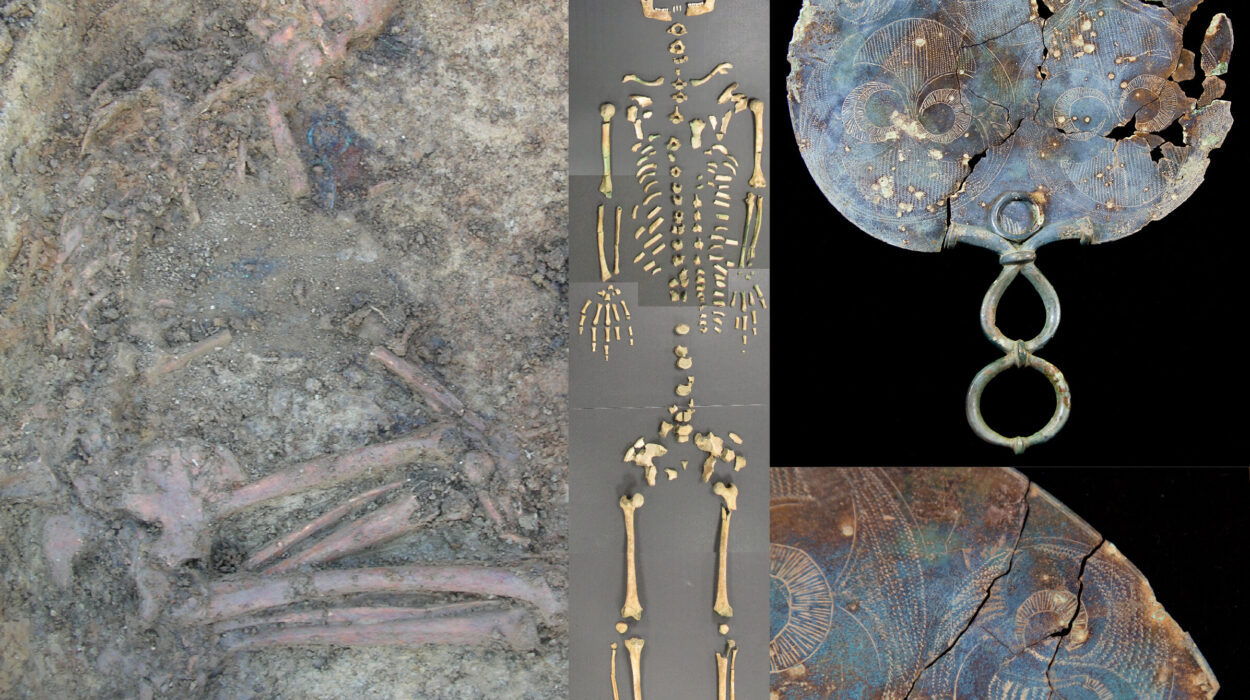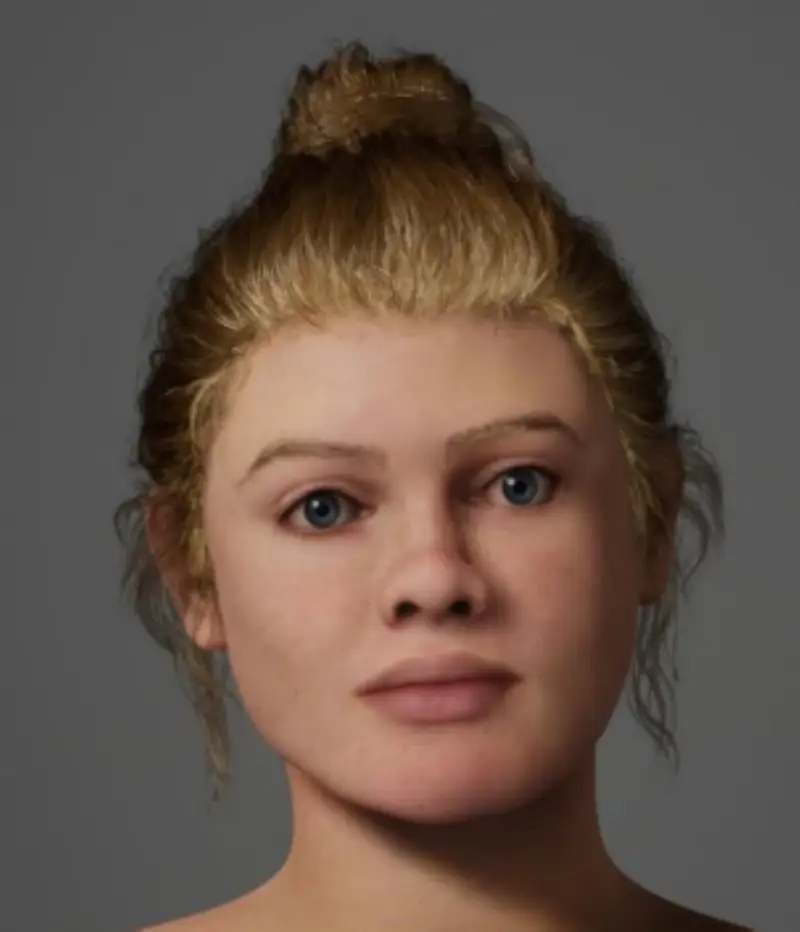
For decades, she existed as a question wrapped in bone and silence. A young woman from the Roman era, discovered not in the soil of an excavation trench but tucked away in a box, quietly waiting in the collections of Eastbourne Town Hall. No name. No written history. Only fragments of a life lived nearly two thousand years ago, and a mystery that grew larger the more people tried to explain her.
She became known as the Beachy Head Woman, after the windswept headland near southern England where she was believed to have been found in the 1950s. Yet even that detail was uncertain. The excavation records were missing. The context was gone. All that remained was her skeleton, carefully preserved but deeply enigmatic.
For years, scientists, curators, and the public wondered who she was and where she came from. Was she a traveler from far away? A symbol of long-distance movement in the Roman world? Or was her story something quieter, closer to home?
Now, after years of uncertainty, her identity has finally come into focus. Scientists at the Natural History Museum have sequenced high quality DNA from her skeletal remains, and with that breakthrough, a long-standing mystery has been resolved.
When First Impressions Rewrite History
The intrigue surrounding the Beachy Head Woman did not arise from her age or the era in which she lived. Radiocarbon dating had already placed her death between 129 and 311AD, during the Roman occupation of Britain. Her bones told a simple story of a young adult, likely between 18 and 25 years old, standing just over 4.9 feet tall. A healed wound on her leg hinted at a serious injury she had survived. Chemical signals preserved in her bones suggested a diet rich in seafood.
These details painted the outline of a life, but they did not explain her origins. That question became charged in 2012, when her remains were brought to light again and examined with morphometric analysis. The shapes and measurements of her bones led researchers to suggest that she may have originated from sub-Saharan Africa.
That conclusion transformed her from an archaeological individual into a cultural symbol. The idea of a woman from Africa living and dying in Roman-era Britain captured public imagination. It informed a display at the Eastbourne Museum and drew significant media attention. Her story seemed to speak of a far-reaching Roman world, one where people moved across continents.
But science rarely stands still, and first impressions are not always final truths.
A Second Theory, and More Questions Than Answers
As years passed, the certainty surrounding the Beachy Head Woman began to erode. In 2017, unpublished DNA work offered a different possibility. Rather than sub-Saharan Africa, she may have come from the Mediterranean, possibly Cyprus. Yet this new theory rested on limited DNA data, not enough to support robust conclusions.
Instead of clarity, it added another layer of ambiguity. Two very different origin stories, both compelling, both incomplete. The Beachy Head Woman became a figure suspended between narratives, her true ancestry still out of reach.
The problem was not a lack of interest or effort. It was a limitation of technology. At the time of her rediscovery, the tools available simply could not extract enough reliable genetic information from her remains. The science had not yet caught up to the question.
But technology evolves. And with it, the possibility of finally listening more carefully to what her bones had to say.
The Moment DNA Spoke Clearly
A nationwide team led by Dr. Selina Brace and Dr. William Marsh at London’s Natural History Museum, alongside Andy Walton of University College London, decided it was time to look again. This time, they brought the latest DNA sequencing techniques to the task.
Dr. William Marsh performed the new DNA analysis, working with material that had waited centuries for this moment. The results were decisive.
“By using state-of-the-art DNA techniques we were able to resolve the origins of this individual. We show she carries genetic ancestry that is most similar to other individuals from the local population of Roman-era Britain.”
With that statement, years of speculation collapsed into a single, grounded conclusion. The Beachy Head Woman was not from sub-Saharan Africa. She was not from the Mediterranean. She descended from the local British population living in southern England during the Roman era.
Her story did not stretch across continents. It unfolded on familiar ground.
A Life Rooted Closer Than Expected
The findings, published in the Journal of Archaeological Science, revealed a truth that was both simpler and more profound than expected. The Beachy Head Woman was local. She belonged to the same genetic landscape as other people living in Roman-era Britain.
This does not make her life smaller or less interesting. Instead, it reshapes how we understand her story. The healed injury on her leg suggests hardship and survival. Her seafood-rich diet connects her to coastal life, to rhythms of tides and fishing. Her young age at death reminds us how fragile life could be in the ancient world.
She was not a distant traveler whose bones ended up far from home. She was a young woman whose life unfolded within the same land where she was eventually laid to rest, even if the details of that burial were later lost.
In a way, this discovery brings her closer to us, not farther away.
Science That Changes With Time
For Dr. Selina Brace, the resolution of this mystery reflects something deeper about the nature of science itself.
“Our scientific knowledge and understanding is constantly evolving, and as scientists, it’s our job to keep pushing for answers. Thanks to the advancement of technology that has occurred in the past decade since Beachy Head Woman first came to light, we are excited to report these new comprehensive data and share more about this individual and her life.”
Her words underscore a critical truth. Science is not about defending old conclusions. It is about revisiting them when better tools become available. What once seemed convincing can later be refined, corrected, or completely reinterpreted.
The Beachy Head Woman did not change. The questions we asked of her did, and so did our ability to hear the answers.
From Museum Display to Living Story
For years, the Beachy Head Woman stood in the public imagination as evidence of long-distance migration in Roman Britain. That narrative shaped museum displays and conversations about the ancient past. Now, with stronger data, that story has been rewritten.
This does not erase the diversity of Roman-era Britain, nor does it deny the movement of people across the Roman world. It simply places this particular woman back into her local context, where the evidence shows she belongs.
Her case is a reminder that human remains are not symbols to be molded to modern expectations. They are individuals, each with a unique story that deserves careful, accurate telling.
Why This Discovery Matters
The resolution of the Beachy Head Woman’s identity matters because it shows how easily stories about the past can take on lives of their own, and how essential it is to ground those stories in the strongest possible evidence.
This research demonstrates the power of modern DNA analysis to clarify questions that once seemed permanently out of reach. It shows how scientific humility, patience, and technological progress can work together to restore truth to historical narratives.
Most importantly, it reminds us that the past is not fixed. Our understanding of it grows as our tools improve. The Beachy Head Woman waited nearly two thousand years for her story to be told more clearly, and when the moment finally arrived, it revealed something quietly powerful: a life lived not as an exception, but as part of a community rooted in Roman-era Britain.
In listening carefully to her DNA, scientists did more than solve a mystery. They honored an individual by letting her speak for herself, across centuries of silence, in the clearest voice science could finally provide.
More information: Andy Walton et al, Beachy Head Woman: clarifying her origins using a multiproxy anthropological and biomolecular approach, Journal of Archaeological Science (2025). DOI: 10.1016/j.jas.2025.106445