Deep in the velvet dark of the cosmos, the most massive stars in existence are engaged in a high-stakes balancing act. For millions of years, these giants burn with a ferocity that defies imagination, their internal nuclear reactions pushing outward against the crushing weight of their own gravity. In the traditional story of the universe, when such a titan finally exhausts its fuel, gravity wins the tug-of-war, collapsing the stellar core into a black hole—a point of infinite density from which nothing, not even light, can return. But an international team of researchers, led by Monash University, has discovered that some stars choose a far more dramatic exit, one that leaves the cosmic stage entirely empty.
For decades, theorists have whispered about a phenomenon known as a pair-instability supernova. Unlike a standard supernova, which leaves a dense remnant behind, this specific type of explosion is so cataclysmic that it completely disrupts the star, blowing its entire mass into the surrounding void and leaving absolutely nothing in its wake. It is the ultimate vanishing act. While these explosions were first predicted in the 1960s, they remained elusive and difficult to distinguish from the more common deaths of stars. Now, by listening to the very vibrations of the universe, scientists are finally seeing the “ghosts” of these missing giants.
The Forbidden Zone of the Deep
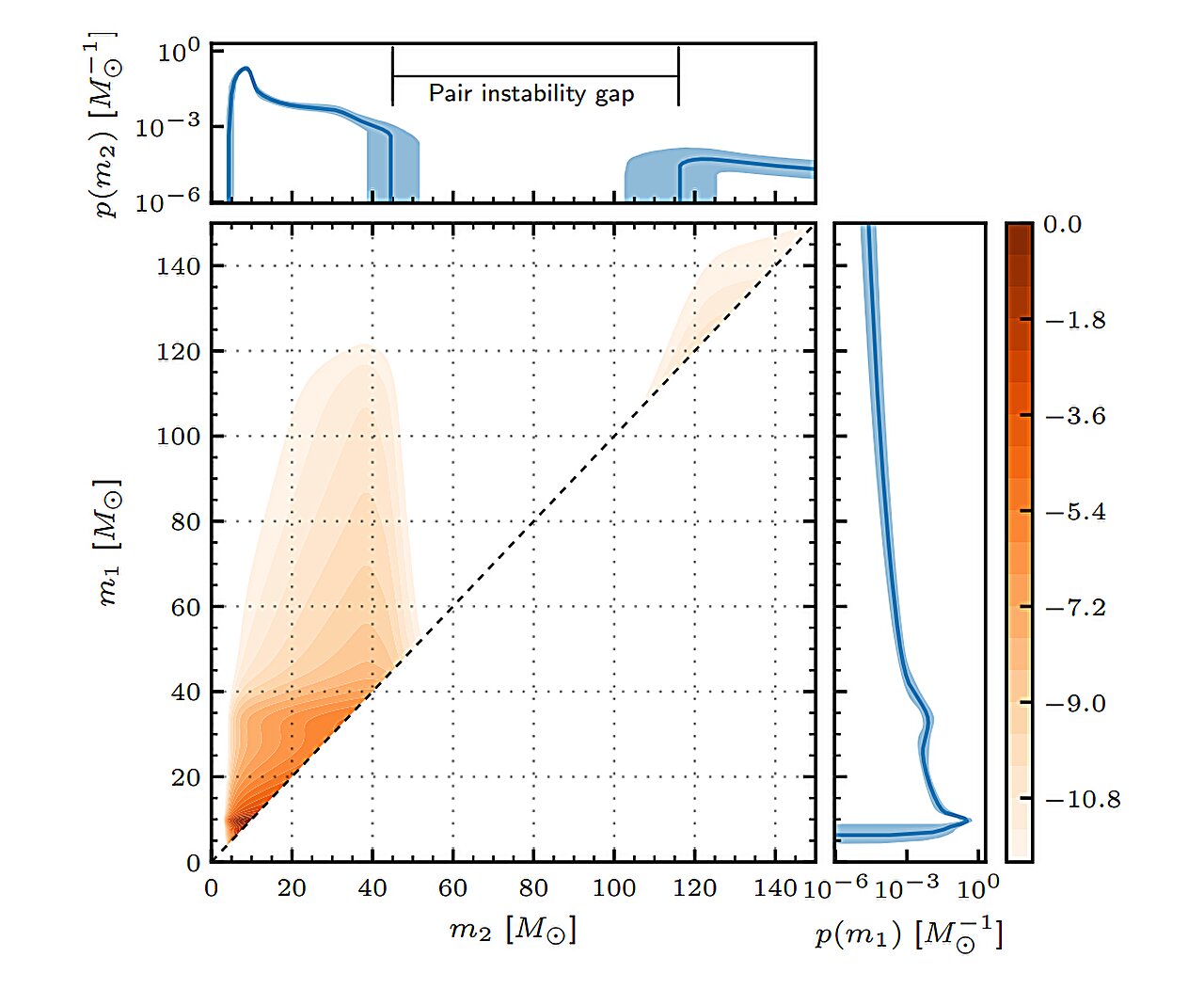
To find evidence of these invisible explosions, the research team turned to the LIGO-Virgo-KAGRA observatory network. These facilities do not look for light; instead, they sense gravitational waves, which are literal ripples in the fabric of spacetime caused by the most violent collisions in space. By analyzing these ripples, the team, including lead researcher Hui Tong, was able to measure the masses of black holes across the sky. What they found was a strange, haunting silence in the data—a forbidden range where black holes simply do not seem to be born.
The data revealed that stellar-origin black holes with masses greater than 45 times the mass of the sun are exceptionally rare. This gap in the cosmic census is not a coincidence. It is the footprint of the pair-instability supernova. When a star is massive enough, it becomes so incredibly hot that its core can no longer support itself, leading to an explosion so intense that the star is “blown apart” before it ever has a chance to collapse into a dark remnant. This discovery effectively draws a line in the sand, showing exactly where stars stop becoming black holes and start becoming pure energy and dust.
The Secret Lives of Giants
This research suggests that the “forbidden zone” is a biological record of a star’s final moments. If a star is heavy enough to potentially create a massive black hole, it instead enters a state of instability. The heat within the core reaches such extremes that it triggers a runaway reaction, leading to the titanic blasts that define this rare supernova. Because the star is completely obliterated, no black hole is ever formed directly from its death. As Hui Tong explains, the lack of black holes in this specific mass range is the clearest evidence yet that these stars are undergoing this total disruption.
However, the universe has a way of filling the void. While stars may not be able to give birth to black holes in this forbidden range, the researchers found that such objects do exist—they just have a different origin story. These massive black holes are not born; they are built. They are the result of repeated mergers, where smaller black holes, born from less massive stars, collide and fuse together over eons. This distinction allows scientists to use black holes as a window into the nuclear reactions that occur deep inside the hearts of stars, providing a bridge between the study of the very small and the unimaginably large.
Why This Galactic Ledger Matters
Understanding the gap in black hole masses is about more than just cataloging the dead; it is about solving one of the most fundamental mysteries of astrophysics. This research helps settle a major question regarding how the most massive stars in our universe live and die. It provides a definitive map of stellar evolution, showing us the limits of what a star can endure before it destroys itself entirely. By confirming the existence of pair-instability supernovae, scientists can now better understand the origin of black holes and the chemical enrichment of the universe, as these massive explosions scatter heavy elements across the cosmos to become the building blocks of future worlds.
Furthermore, this study highlights the incredible power of gravitational wave astronomy. By using these ripples to probe the “afterlives” of stars, researchers like Professor Maya Fishbach and Professor Eric Thrane are uncovering secrets that light alone could never reveal. We are no longer just watching the stars; we are weighing their remains and listening to the echoes of their most violent ends. This work ensures that even the stars that leave nothing behind are still able to tell their stories, helping us piece together the history of the most cataclysmic events in the known universe.
Study Details
Hui Tong et al, Evidence of the pair-instability gap from black-hole masses, Nature (2026). DOI: 10.1038/s41586-026-10359-0. On arXiv: DOI: 10.48550/arxiv.2509.04151