Across the sun-drenched landscapes of eastern Senegal, near the winding Falémé River, a team of international researchers has spent years unearthing a story written in metal and fire. For decades, the history of iron metallurgy in sub-Saharan Africa has been a puzzle with many missing pieces. While we know a technological revolution swept the continent at least 3,000 years ago, providing the agricultural tools necessary to feed growing populations, the exact origins of these skills have remained shrouded in mystery. In Europe, the Iron Age is a familiar timeline stretching from roughly 800 BCE to the 1st century CE, while the earliest evidence of iron production traces back to the 2nd millennium BCE in Anatolia and the Caucasus. But did these techniques travel across deserts and oceans, or did African smiths ignite their own independent spark of innovation?
A Silent Sentinel in the Red Earth
The answer began to emerge in 2018 at a site known as Didé West 1, or DDW1. Here, an international team led by the University of Geneva and the Institut Fondamental d’Afrique Noire in Dakar stumbled upon something truly exceptional: a metalworking workshop so well-preserved it felt as though the smiths had only just stepped away. This wasn’t merely a temporary camp; it was a center of industry that breathed life into the region for nearly eight centuries. Carbon dating revealed the workshop opened its doors in the 4th century BCE and remained active until the 4th century CE. To find a site used for such an immense span of time is incredibly rare in archaeology, as most metallurgical centers were abandoned after only a few generations.
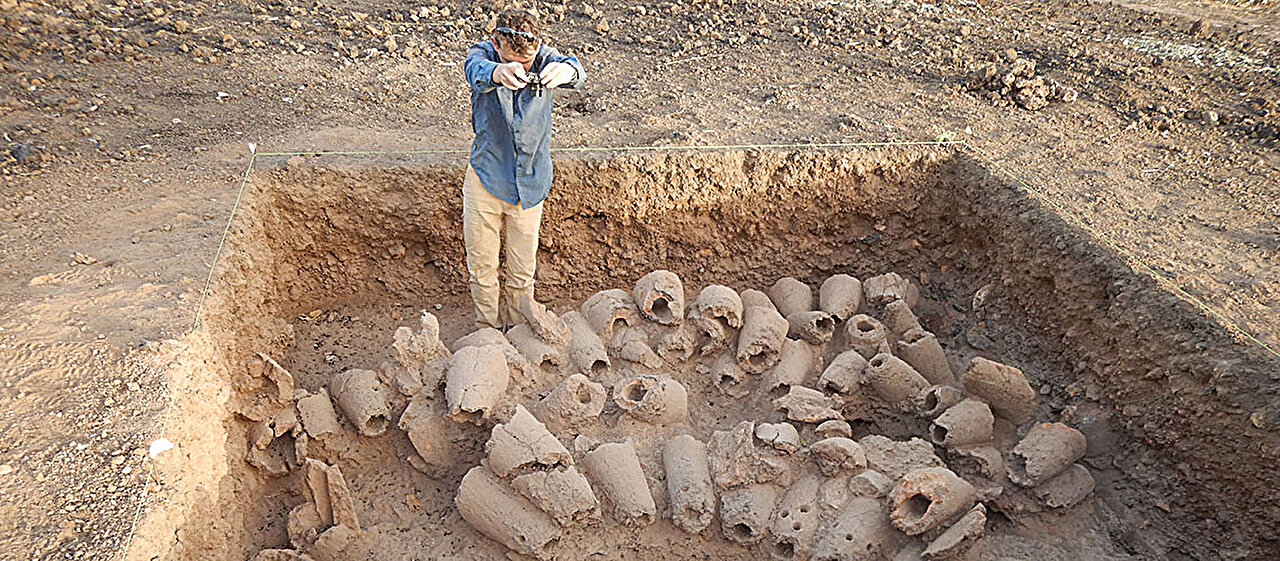
What the team uncovered was a massive monument to human labor: a heap containing approximately one hundred tons of slag, the stony waste matter separated from metals during the smelting process. Nestled alongside this waste was a semicircular arrangement of thirty used tuyères—specialized clay pipes designed to breathe air into the heart of a fire. Most striking were the 35 circular furnace bases, each plunging about 30 centimeters into the earth. These weren’t the towering industrial furnaces of the modern age, but intimate, small-scale operations designed to meet the specific needs of the local community, forging the hoes and blades that tamed the surrounding soil.
The Secret Language of the Forge
As the researchers meticulously brushed away the dust of two millennia, they realized they weren’t just looking at holes in the ground; they were looking at a specific technical signature known as the FAL02 tradition. This ancient method of iron-ore smelting is defined by its architectural elegance. The smiths constructed small, circular furnaces and topped them with removable chimneys, a design that allowed for flexibility and repair. The tuyères found at the site were equally sophisticated. Unlike standard pipes with a single exit for air, these clay tubes featured multiple small openings connected to a main channel by perpendicular side ducts. This clever engineering allowed the smiths to distribute air evenly across the bottom of the furnace, ensuring the fire reached the intense, consistent temperatures required to birth iron and steel.
But the most surprising discovery lay at the very bottom of the furnace pits. Among the charcoal and debris, archaeologists found evidence of a practice never before documented in the history of metallurgy: the use of palm nut seeds as packing material. These organic remnants suggest a deep connection between the industrial process and the local environment, showing how early metallurgists adapted their surroundings to stabilize their furnaces. Despite the eight hundred years that passed, this tradition remained remarkably stable. While empires rose and fell elsewhere, the smiths at DDW1 continued their craft with only minor technical adjustments, displaying a cultural and technical continuity that stands in stark contrast to the rapidly shifting metallurgical landscapes seen in other parts of Africa.
Why the Smoke of the Past Still Matters
This discovery is far more than a collection of old pipes and burnt seeds; it is a vital window into the technical and cultural choices made by early African societies. Across the vast expanse of West Africa, only about a dozen sites from the first millennium BCE have been reliably dated and documented. This makes Didé West 1 a unique laboratory for studying how ironworking techniques developed and spread. By understanding the longevity of the FAL02 tradition, researchers can better appreciate the stability and sophistication of prehistoric African communities.
The workshop at Didé West 1 proves that the transition into the Iron Age in Africa was not a fleeting moment of change, but a sustained era of mastery. It highlights a long-term adaptation of technology that allowed for the production of agricultural tools on a scale that supported life for centuries. As the team continues to investigate other sites in Senegal, they are slowly connecting the dots of a continental story—one that celebrates the ingenuity of ancient metallurgists who transformed the red earth of the Falémé Valley into the very foundation of West African civilization.
Study Details
Mélissa Morel et al, Evolution of an Early and Long-Lasting Iron Smelting Technique at Didé West 1, Falémé Valley, Eastern Senegal, African Archaeological Review (2026). DOI: 10.1007/s10437-026-09653-z