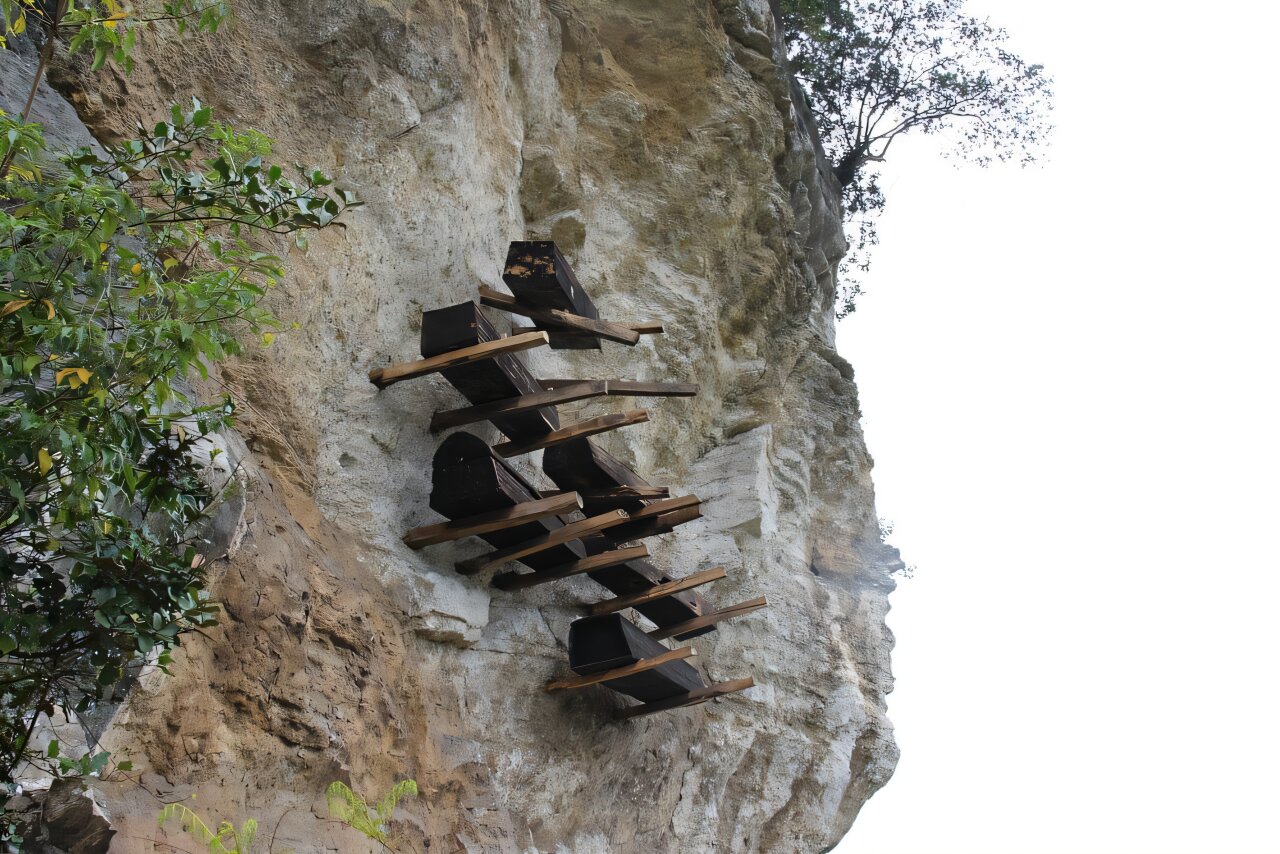
For centuries, the steep river gorges and mountain walls of Southeast and Southern Asia kept a silent vigil over a vanished world. Wooden coffins clung to sheer cliffs, suspended in places no ordinary person could reach, preserving a tradition so enigmatic that later generations would call its practitioners “Subjugators of the Sky.” Today, a new genetic study published in Nature Communications brings these cliffside legacies back into view, revealing the deep ancestry of the Hanging Coffin tradition and the people who lived — and died — within it.
Echoes from the Wuyi Mountains
The story begins in the Wuyi mountains of Fujian Province, where some of the earliest Hanging Coffins date to around 3445 ± 150 and 3370 ± 80 years before present. Their appearance aligns with the arrival of the first farmers in the region, suggesting that the practice emerged in a period of sweeping cultural change. From this coastal cradle, the ritual journeyed outward across southern China and deep into mainland Southeast Asia, ultimately touching places as far as Thailand and Taiwan.
These were no simple burials. The practice required hauling heavy wooden coffins into cliffside openings, caves, and precarious rock crevices positioned high above the ground. The Bo people — known in folklore as “Sons of the Cliffs,” and in some tales, as individuals capable of flight — were among the groups who practiced it most famously. Yet even with their mythic reputation, the physical mechanics of placing the coffins remain a puzzle.
One of the study’s authors, Dr. Xiaming Zhan, notes that scholars still debate how such feats were accomplished. As he explains, “Based on syntheses from Chinese archaeological reports and regional museum displays, scholars generally accept three main hypotheses for how coffins were placed on cliff faces:
a) Scaffolding method. [Here] Temporary wooden scaffolds were likely erected using logs and crossbeams. This method would allow individuals to carry and insert the coffins or beams into pre-carved notches or holes in the cliff.
b) Rope-lowering or raising system. [Here] Large hemp or rattan ropes, possibly with pulley systems, could have been used to lower coffins from the top of the cliff or raise them from below, depending on geography. This is more feasible on steep overhanging cliffs or vertical faces where scaffolding is impractical.
c) Rock ledge or trail access. In some locations (e.g., Yunnan and Guangxi), natural ledges or man-made trails may have allowed access to shelf-like recesses, especially where the cliff is not vertical. Coffins could be dragged or carried along these paths and slid into place horizontally.”
Even with these possibilities, unanswered questions linger. The Bo themselves largely vanished from historical records during the Late Ming Dynasty, after persecution forced them into flight and eventual cultural absorption in neighboring regions. Only scattered descendants remained to carry fragments of their story.
Unraveling the Ancient Genomes
To illuminate this tradition’s origins, Dr. Hui Zhou and colleagues turned to the genomes of the practitioners themselves. Their analysis examined 14 ancient Hanging Coffin individuals recovered from sites across southeastern China and northern Thailand, alongside newly sequenced genomes from modern Bo communities.
The ancient DNA told a remarkably consistent story. Populations from Yunnan, Guangxi, and other regions showed strong genetic similarities to each other and to ancient coastal groups from southeastern China. This pattern reinforces the idea that the practice began in the coastal areas around Mount Wuyi before radiating inland and southward.
A striking detail emerged from Thailand’s Log Coffin people. Though their genomes carried traces of Hanging Coffin ancestry, their mitochondrial DNA — passed only through mothers — showed almost none of it. This absence implies that the tradition likely spread through male migration. Men from southern China traveled into Southeast Asia, married local women, and brought with them not just their genes but the elaborate funerary customs of their homelands. Cultural and biological lineages interwove in ways that reshaped communities across an immense region.
The Bo Who Remain
Today, Bo descendants live in 42 natural villages within the Wenshan Zhuang and Miao Autonomous Prefecture of Yunnan. Their genetic connection to the ancient cliff-burial practitioners had long been suspected, but now it can be measured directly.
The study analyzed 32 modern Bo genomes, ultimately working with 21 after removing closely related individuals to avoid duplication. Their DNA revealed a clear inheritance from the ancient Hanging Coffin populations, supported by the large number of shared drift alleles. These small, random shifts in gene frequencies act like fingerprints of population history, indicating deep continuity between the Bo and their cliff-dwelling ancestors of thousands of years ago.
Rather than a vanished people, the Bo emerge as a resilient thread woven through millennia of migration, adaptation, and cultural change. Their ancestors crafted rituals that demanded both engineering skill and spiritual commitment, and their genetic legacy preserves that story even as written records fade.
Toward a Fuller Portrait of the Past
For researchers like Dr. Zhang, the story is only beginning to unfold. He envisions a broader scientific effort that draws on multiple lines of evidence to reconstruct the lived realities of these ancient communities. As he explains, “We envision a comprehensive multi-omics program combining isotope geochemistry, ancient proteomics, high-resolution dating, and deeper genomic inference to reconstruct not just where Hanging Coffin populations came from, but how they lived, moved, ate, interacted, and remembered their dead. Such work promises to refine models of ethnic continuity, migration, and ritual behavior in ancient East and Southeast Asia.”
This vision reflects a shift in archaeological science: human stories are no longer read through bones alone but through the chemistry, proteins, and genomes embedded within them. Each new approach adds dimension, turning static artifacts into traces of real lives.
Why This Research Matters
The Hanging Coffin tradition has long stirred curiosity because of its breathtaking physicality and haunting beauty. But understanding it is not merely a matter of decoding a ritual. It is a way of tracing how ancient peoples moved across landscapes, carried their ideas with them, and forged new identities through cultural exchange. The genetic connections uncovered in this study reveal migrations that reshaped entire regions and highlight how traditions can illuminate the paths our ancestors walked.
By linking modern Bo communities to ancient practitioners, the research restores continuity to a story once thought broken. It shows that the past is not lost; it endures in living populations whose heritage reaches back to the cliffs where their ancestors laid their dead. And with new scientific tools, researchers are poised to transform these echoes into a richly detailed understanding of how human history unfolds across thousands of years.
More information: Hui Zhou et al, Exploration of hanging coffin customs and the bo people in China through comparative genomics, Nature Communications (2025). DOI: 10.1038/s41467-025-65264-3