Researchers have identified a distinct group of metal-poor stars located within the Milky Way’s galactic plane that likely originated from a single, short-lived dwarf galaxy named Loki. This ancient system merged with our galaxy during its early formation, leaving behind a specific chemical fingerprint that differs from other primordial stars found in the outer galactic halo.
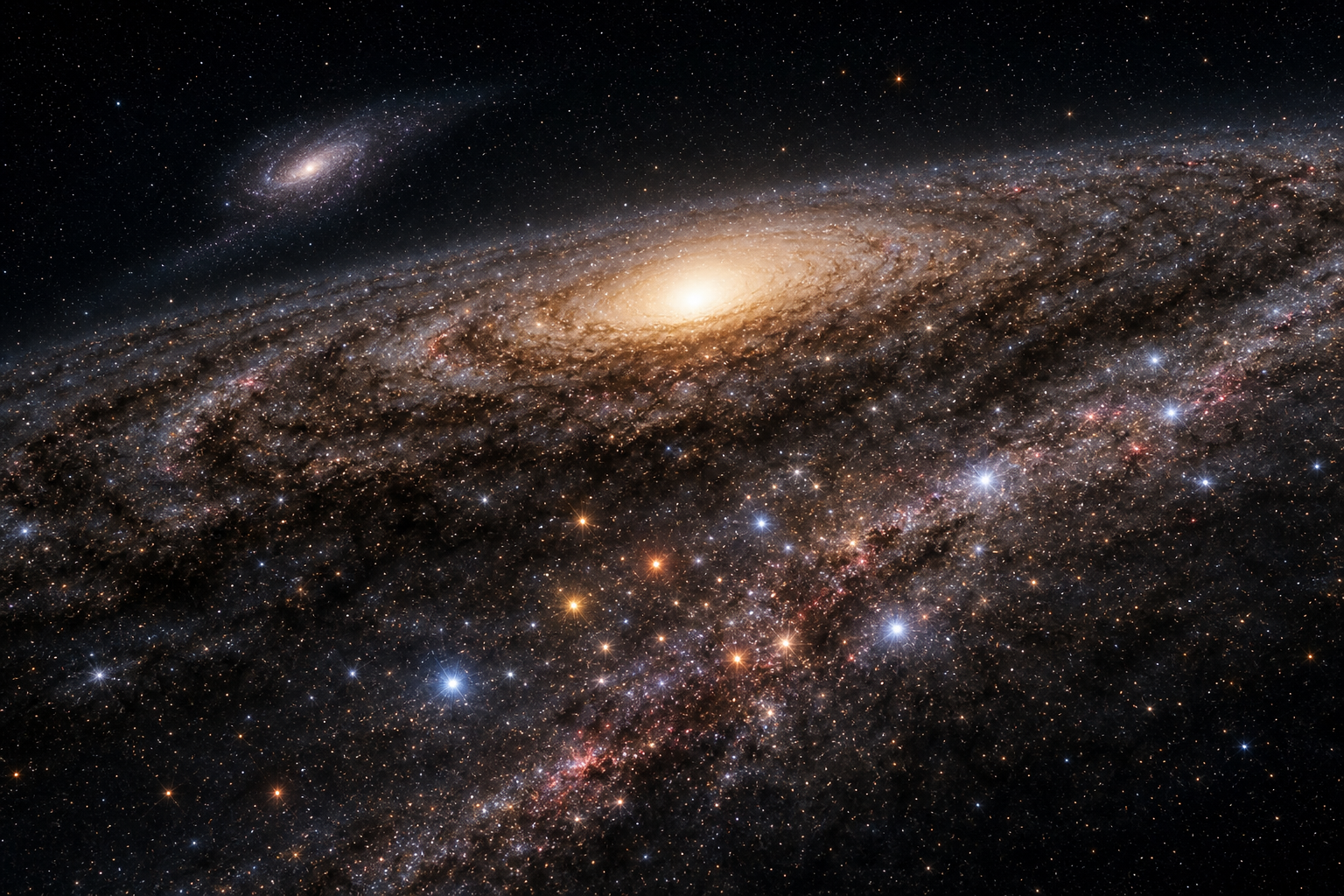
Deep within the crowded, spinning disk of the Milky Way lies a chemical ghost of the ancient universe. For decades, astronomers have viewed our galaxy not as a static object, but as a cosmic scavenger that grew to its massive proportions by consuming smaller, neighboring galaxies. While the remnants of these galactic mergers are often found scattered in the sparse, outer reaches of the galactic halo, a new study has pinpointed a cluster of celestial immigrants hiding in plain sight within the Milky Way’s primary plane. This discovery, centered on a group of stars nicknamed Loki, provides a rare glimpse into the violent and energetic building blocks that assembled our home galaxy billions of years ago.
Identifying the Building Blocks of the Early Universe
The history of the cosmos is written in the chemistry of its stars. The very first stars to ignite after the Big Bang were composed almost entirely of hydrogen and helium. As these massive pioneers lived and died, they fused those light elements into heavier ones, which were then dispersed into space to be incorporated into the next generation of stellar bodies. Astronomers use the term metal-poor to describe stars that contain relatively small amounts of elements heavier than helium, such as iron. These stars serve as chronological markers; the fewer “metals” a star contains, the earlier it likely formed in the history of the universe.
Small, metal-poor galaxies acted as the foundational building blocks of the early universe. As these systems merged, they deposited their stars, gas, and dark matter into the forming proto-galaxy that would eventually become the Milky Way. Scientific models suggest that the stars from the very earliest mergers should be concentrated in the inner regions of our galaxy, while those that joined later would be dispersed throughout the outer halo. However, finding these ancient relics within the dense galactic plane is a significant challenge, as they are often obscured by younger, more metal-rich stars.
The Chemical Fingerprint of a Short-Lived Galaxy
A team of astronomers recently turned their attention to a specific sample of 20 stars located in the Milky Way’s galactic plane. While these stars are metal-poor, their chemical compositions set them apart from the typical metal-poor stars found in the galactic halo. By analyzing the chemical abundances of this group and comparing them to halo stars, known dwarf galaxies, and computer-simulated populations, the researchers uncovered a unique narrative of birth and destruction.
The data revealed that the Loki stars were enriched by a specific set of high-energy cosmic events. Their chemical signatures pointed to an environment shaped by high-energy supernovae, hypernovae, fast-rotating massive stars, and neutron star mergers. Notably, the analysis found no evidence of white dwarf explosions, which typically occur in older, more established stellar populations. This absence suggests that the stars originated in a short-lived, energetic dwarf galaxy that evolved quickly before being absorbed by the Milky Way.
The study, published in Monthly Notices of the Royal Astronomical Society, highlighted that these stars show a much narrower dispersion in their element-to-iron ratios compared to stars in the galactic bulge or halo. This tight chemical consistency is a hallmark of a “closed system,” indicating that all 20 stars likely shared a single point of origin rather than being a random collection of captured celestial wanderers.
Solving the Puzzle of Galactic Orbits
One of the most intriguing aspects of the Loki sample is the motion of the stars themselves. The group includes both prograde stars, which orbit in the same direction as the Milky Way’s rotation, and retrograde stars, which move in the opposite direction. Furthermore, all of these stars exhibit high eccentricities, meaning their orbits are stretched into elongated ovals rather than perfect circles.
Initially, this mix of directions might suggest that the stars came from two different systems that were swallowed at the same time. However, the researchers argue that the evidence points toward a single progenitor. Their models indicate that the total mass of the stars and gas involved matches the expected scale of a single dwarf galaxy. If the stars had come from two separate systems, those systems would have had to possess nearly identical chemical histories and evolution—a scenario deemed less likely than a single-source origin. By concluding that these stars are part of the same ancestral family, the researchers have strengthened the case for Loki being a primary contributor to the Milky Way’s early assembly.
Why This Matters
Understanding the identity of systems like Loki is fundamental to reconstructing the “family tree” of the Milky Way. By identifying these specific stellar groups, scientists can map out the timeline of how our galaxy reached its current size and complexity. This research proves that significant remnants of the Milky Way’s early building blocks are still trapped within the galactic plane, waiting to be decoded.
As future spectroscopic surveys like WEAVE and 4MOST begin to collect even larger sets of data, astronomers will be able to refine these findings and potentially discover more hidden galaxies woven into the fabric of our own. These studies don’t just tell us about distant stars; they provide the essential blueprint of how galactic evolution functions across the universe, showing how the destruction of small galaxies leads to the creation of the massive cosmic structures we inhabit today.
Study Details
Federico Sestito et al, An ancient system hidden in the Galactic plane?, Monthly Notices of the Royal Astronomical Society (2026). DOI: 10.1093/mnras/stag563