The universe is filled with wonders that stretch the limits of human imagination. There are stars that shine brighter than billions of suns, galaxies that spin slowly through cosmic time, and nebulae where new stars are born from clouds of gas and dust. Yet among all these magnificent phenomena, few are as mysterious, fascinating, and terrifying as black holes.
A black hole is one of the most extreme objects known to science. It is a region of space where gravity becomes so powerful that nothing—not even light—can escape its pull. Once something crosses the boundary of a black hole, it is lost to the outside universe forever.
This idea sounds almost like science fiction, yet black holes are real objects predicted by the laws of physics and confirmed by astronomical observations. They exist throughout the cosmos, hiding in the centers of galaxies and forming in the violent deaths of massive stars.
Black holes challenge our understanding of space, time, and the very nature of reality. They bend the fabric of the universe, distort the flow of time, and trap matter in a gravitational prison from which there is no return.
For decades, scientists have tried to uncover the secrets of these cosmic enigmas. Every discovery reveals something astonishing, but also deepens the mystery.
Black holes are not simply objects in space. They are laboratories where the laws of physics are pushed to their absolute limits.
The Birth of the Black Hole Idea
The concept of a black hole did not emerge suddenly in modern astronomy. Its roots reach back centuries, long before telescopes could detect such objects.
In the eighteenth century, scientists began to think about gravity and light in new ways. Some thinkers wondered what would happen if a star became so massive that its gravitational pull prevented light from escaping. If light could not escape, such a star would be invisible to observers far away.
This early idea was remarkable, but it remained mostly theoretical because scientists lacked a deeper understanding of gravity and the nature of light.
The true breakthrough came in the early twentieth century when new ideas about space and time began to reshape physics. These ideas revealed that gravity was far more powerful and strange than previously imagined.
According to modern theory, massive objects can bend the structure of space and time around them. When enough mass is compressed into a small region, this curvature becomes so extreme that space itself collapses inward.
At that point, a black hole is born.
The idea was initially so strange that many scientists doubted whether such objects could exist in reality. Over time, however, evidence began to accumulate, and black holes moved from theoretical curiosity to astronomical reality.
Gravity and the Collapse of Stars
To understand how black holes form, we must first understand the life cycle of stars.
Stars are enormous spheres of gas held together by gravity. Inside their cores, nuclear reactions generate tremendous energy. This energy produces outward pressure that balances the inward pull of gravity.
For millions or billions of years, this balance allows stars to shine steadily.
But stars do not live forever.
Eventually, the nuclear fuel in a star’s core begins to run out. When this happens, the outward pressure weakens. Gravity, which never rests, begins to dominate.
For many stars, the collapse stops before a black hole forms. The star may shrink into a dense object known as a white dwarf or a neutron star.
However, when a star is extremely massive, gravity becomes unstoppable. The collapsing core compresses into an incredibly small region, and its density rises to unimaginable levels.
If the mass is great enough, the collapse continues until a black hole forms.
At that moment, gravity overwhelms all other forces in nature.
The star disappears from view, leaving behind a dark gravitational well in space.
The Event Horizon: The Point of No Return
One of the most fascinating features of a black hole is its event horizon.
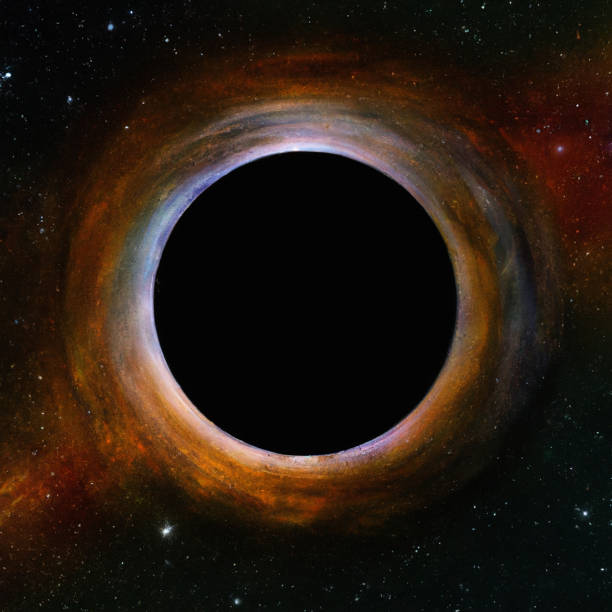
The event horizon is the invisible boundary surrounding a black hole. It marks the point beyond which nothing can escape.
If a spacecraft or a beam of light crosses this boundary, it cannot return to the outside universe. The gravitational pull becomes so strong that every possible path leads deeper into the black hole.
To an outside observer, the event horizon appears as a perfectly dark sphere. No light emerges from it, and no information escapes.
Yet the event horizon is not a physical surface like the surface of a planet. It is a boundary in space defined by gravity itself.
Crossing it would not necessarily feel dramatic to someone falling in. There might be no sudden barrier or wall. Instead, the traveler would simply pass the point where escape becomes impossible.
From that moment onward, the journey leads inevitably toward the mysterious interior of the black hole.
The Singularity: Where Physics Breaks Down
At the heart of every black hole lies a region known as the singularity.
The singularity is believed to be a point where matter collapses into an infinitely small space and density becomes infinitely large. In this region, the known laws of physics break down.
The equations that describe gravity, space, and time no longer behave in predictable ways.
This presents one of the greatest challenges in modern science. Physicists have extremely successful theories describing gravity and the microscopic world of particles. However, these theories become incompatible in the extreme conditions inside a black hole.
Understanding what truly happens at the singularity requires a new theory that unites gravity with quantum physics.
Such a theory remains one of the greatest goals of modern physics.
The singularity therefore represents both a mystery and an opportunity. It is a place where the deepest secrets of the universe may eventually be revealed.
The Strange Flow of Time Near Black Holes
One of the most astonishing aspects of black holes involves the behavior of time itself.
According to modern physics, time does not flow at the same rate everywhere in the universe. Strong gravitational fields can slow the passage of time.
Near a black hole, this effect becomes dramatic.
To an observer far away, time near the black hole appears to move extremely slowly. A clock placed close to the event horizon would tick much more slowly than a clock on Earth.
If someone were falling toward the event horizon, outside observers would see their motion gradually slow down. The person would appear to freeze near the edge of the black hole, never quite crossing the boundary.
From the perspective of the falling traveler, however, time would feel normal. They would cross the event horizon without noticing anything unusual about the flow of time.
This strange difference between perspectives reveals the deep connection between gravity and time.
Black holes are not merely gravitational traps. They are distortions in the very fabric of spacetime.
The Violent Environment Around Black Holes
Although black holes themselves are invisible, the regions around them can be among the most energetic places in the universe.
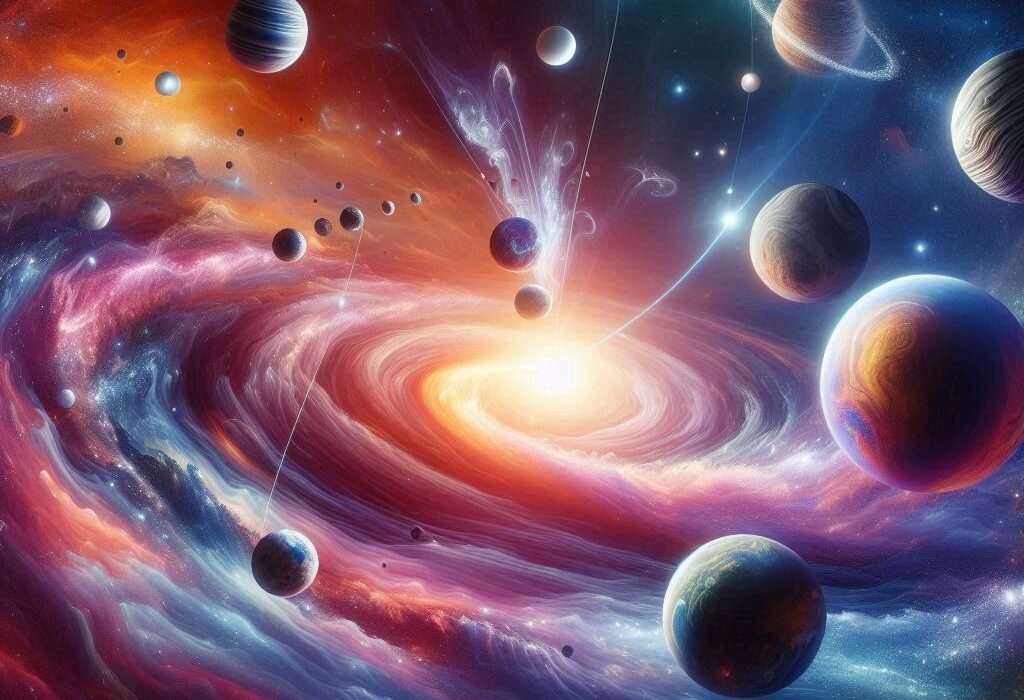
When matter falls toward a black hole, it rarely plunges straight in. Instead, it forms a swirling disk known as an accretion disk.
Inside this disk, gas and dust spiral inward at incredible speeds. Friction and gravitational forces heat the material to extreme temperatures.
The result is a blazing ring of radiation surrounding the black hole.
Some accretion disks shine brighter than entire galaxies.
In certain cases, powerful jets of energy shoot outward from the poles of the black hole. These jets travel at nearly the speed of light and extend across vast distances in space.
Such phenomena reveal that black holes, despite their darkness, can influence the universe in dramatic ways.
Supermassive Black Holes and Galactic Centers
Black holes are not all the same size. Some are only a few times more massive than the Sun, while others contain millions or even billions of solar masses.
The largest of these are known as supermassive black holes.
These enormous objects reside at the centers of most galaxies, including our own Milky Way.
The supermassive black hole in the Milky Way is called Sagittarius A*. It lies about twenty-six thousand light years from Earth and has a mass millions of times greater than the Sun.
Astronomers discovered its presence by observing the motion of stars near the center of the galaxy. These stars orbit an invisible object whose gravity is far too strong to be explained by anything other than a black hole.
Supermassive black holes play a major role in shaping galaxies. Their gravitational influence affects the motion of stars and the behavior of gas clouds in galactic cores.
Some scientists believe that the growth of galaxies and the growth of supermassive black holes are deeply connected.
Seeing the Unseeable
For many years, black holes remained purely theoretical because they could not be observed directly.
However, astronomers learned to detect them through their effects on surrounding matter.
If a star orbits an invisible object that exerts enormous gravitational force, that object may be a black hole. If a cloud of gas emits intense radiation while spiraling inward, it may be feeding a black hole.
One of the most dramatic achievements in modern astronomy occurred in 2019 when scientists produced the first direct image of a black hole’s shadow.
Using a global network of radio telescopes, researchers observed the supermassive black hole at the center of a distant galaxy. The resulting image revealed a glowing ring of gas surrounding a dark central region.
This dark region was the shadow of the event horizon.
For the first time in history, humanity had glimpsed the silhouette of a black hole.
The Quantum Mystery of Black Hole Radiation
Black holes were once thought to trap everything forever. However, modern physics suggests that they may slowly lose energy over time.
Quantum theory predicts that black holes can emit tiny amounts of radiation from their edges. This phenomenon arises from the strange behavior of particles in the vacuum of space.
Near the event horizon, pairs of particles can briefly appear and disappear. In certain cases, one particle falls into the black hole while the other escapes.
The escaping particle becomes radiation that carries energy away from the black hole.
Over extremely long timescales, this process could cause a black hole to shrink and eventually disappear.
This surprising prediction transformed the understanding of black holes. Instead of eternal cosmic traps, they may be temporary features in the universe.
The Information Paradox
One of the most puzzling questions in modern physics involves the fate of information inside a black hole.
In physics, information about a system—such as the arrangement of particles—cannot simply vanish. Yet if a black hole evaporates over time, what happens to the information about everything that fell into it?
Does the information disappear forever, violating the laws of physics?
Or is it somehow preserved in subtle ways?
This dilemma is known as the black hole information paradox.
Resolving this paradox may require a deeper understanding of quantum gravity, a theory that unites quantum mechanics with the physics of spacetime.
Many physicists believe that solving this puzzle could lead to one of the greatest breakthroughs in science.
Black Holes and the Future of Discovery
Black holes remain among the most mysterious objects in existence.
Every year, new observations and theoretical insights reveal surprising aspects of their nature. Scientists continue studying gravitational waves produced when black holes collide, measuring the motions of stars near galactic centers, and analyzing radiation from distant accretion disks.
Each discovery brings us closer to understanding these cosmic enigmas.
Yet the deeper we explore, the more profound the questions become.
Black holes challenge our understanding of space, time, matter, and the ultimate structure of reality.
They remind us that the universe still holds secrets far beyond our current knowledge.
The Cosmic Mirror of Curiosity
In many ways, black holes represent the spirit of science itself.
They began as strange predictions of mathematical theory, objects so extreme that many doubted their existence. Over time, observation and experimentation revealed that these mysterious entities are real.
Their study has pushed the boundaries of physics and inspired new ways of thinking about the universe.
Black holes are both terrifying and beautiful. They are regions where gravity reigns supreme and where the known laws of nature reach their limits.
But perhaps their greatest significance lies in the questions they inspire.
Every black hole is a reminder that the universe is deeper, stranger, and more fascinating than we once believed.
And as long as humanity continues to gaze into the darkness of space with curiosity and wonder, the mystery of black holes will continue to guide us toward new horizons of understanding.