The universe often keeps its best secrets hidden behind a veil of ancient ice and cosmic dust, but sometimes, a bit of bad luck for a scientist turns into a front-row seat to a celestial vanishing act. This was the case for a team of researchers who, due to technical constraints with their original subject, had to scramble for a new target to observe with the Hubble Space Telescope. What they found instead was a once-in-a-lifetime accident: a traveler from the outer reaches of our solar system, known as C/2025 K1 (ATLAS), or simply K1, literally falling apart before their eyes.
A Serendipitous Fracture in the Dark
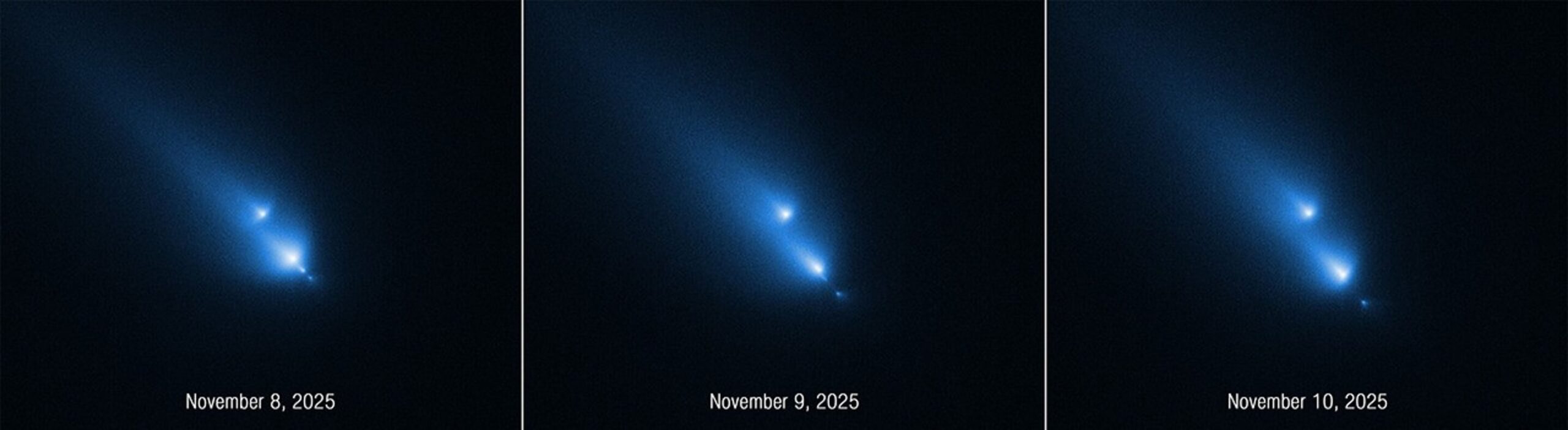
The discovery was not planned. In fact, the research team, led by investigators from Auburn University, had spent years trying to intentionally catch a comet in the act of disintegrating, but the timing never lined up. The irony was not lost on the scientists when their backup target—a seemingly “regular” comet—began to crumble the moment the telescope’s lens was trained upon it. When the data arrived, the initial expectation of seeing one solid object was shattered. Instead of a single point of light, the images revealed four distinct comets where there should have been only one.
This was a moment of extraordinary scientific fortune. While ground-based telescopes could only see blurry, indistinguishable blobs of light, Hubble’s sharp vision was able to cleanly resolve the individual pieces. Each fragment had developed its own coma, the fuzzy envelope of gas and dust that shroud’s a comet’s icy nucleus. By the time the team processed the images, they realized they were witnessing the death throes of a primordial object that had existed since the dawn of our planetary neighborhood.
The Brutal Physics of the Sun’s Embrace
To understand why K1 fell apart, one must look at its recent itinerary. Just one month before these images were captured, the comet reached perihelion, its point of closest approach to the sun. This journey brought it deep into the inner solar system, passing inside the orbit of Mercury—roughly one-third the distance from the Earth to the sun. At this proximity, a comet undergoes its most intense heating and survives under a state of maximum physical stress.
Before its structural failure, K1 was a significant object, estimated to be about five miles across. However, the thermal pressure of the sun was too much to bear. The researchers estimate the disintegration began approximately eight days before Hubble started its observations on November 8, 2025. Over the course of three days, the telescope captured 20-second snapshots that tracked the carnage. In a further display of instability, even as the scientists watched, one of the smaller, newly formed pieces fractured yet again, breaking into even tinier debris.
Peering Beneath the Primordial Skin
For astronomers, a breaking comet is more than just a spectacular show; it is a rare opportunity to perform a “cosmic autopsy.” Comets are essentially time capsules made of primordial materials—the “old stuff” left over from the formation of the solar system. However, the surfaces of these objects are often misleading. Over billions of years, they are “processed” by cosmic rays and solar radiation, which alters their outer chemistry.
By cracking open, K1 exposed its ancient material that had been shielded from the sun for eons. This allows scientists to differentiate between a comet’s primitive properties and the changes caused by evolution. Yet, this exposure created a new mystery. Usually, when a comet cracks and reveals fresh ice, it is expected to brighten almost instantly. With K1, there was a strange delay between the physical breakup and the subsequent outbursts of light seen by observers on Earth.
The Ghostly Chemistry of a Dying Traveler
The delay in brightness has led to new theories about the physics of a comet’s surface. Most of what we see as “brightness” is actually sunlight reflecting off dust grains. The researchers suspect that when the ice is first exposed, it might take time for a dust layer to form or for heat to penetrate deep enough to build up the pressure needed to blast that dust into space. This short window of time—just days after the split—is providing data on the timescale of dust ejection that has never been captured so clearly before.
Beyond the physics of its debris, the chemistry of K1 is proving to be an anomaly. Early analysis suggests the comet is significantly depleted in carbon compared to its peers, making it chemically “strange.” Using specialized instruments like the Space Telescope Imaging Spectrograph (STIS) and the Cosmic Origins Spectrograph (COS), the team is now analyzing the gases escaping from the fragments. These chemical signatures serve as a fingerprint for the environment in which our solar system was born.
Why This Crumbling Giant Matters
This research is vital because it provides a rare, high-resolution look at the structural limits of the solar system’s oldest building blocks. By catching K1 so soon after its fragmentation, scientists can observe the immediate transition from a solid body to a collection of debris, offering clues about how planetary materials behave under extreme heat. It bridges the gap between our understanding of a comet’s “pristine” interior and its “weathered” exterior.
Today, the remains of K1 exist as a scattered collection of fragments drifting through the constellation Pisces, roughly 250 million miles from Earth. As they head out into the cold reaches of deep space, they are unlikely to ever return. Though the comet itself is fading away, the data it left behind in its final moments will help rewrite our understanding of the icy architects that helped build the world we live on today.
Study Details
D. Bodewits et al, Sequential fragmentation of C/2025 K1 (ATLAS) after its near-sun passage, Icarus (2026). DOI: 10.1016/j.icarus.2026.116996