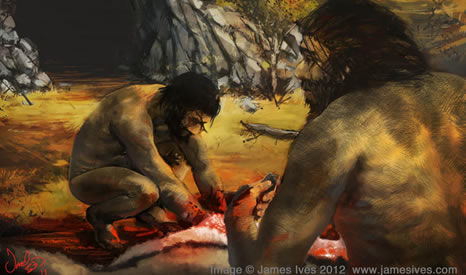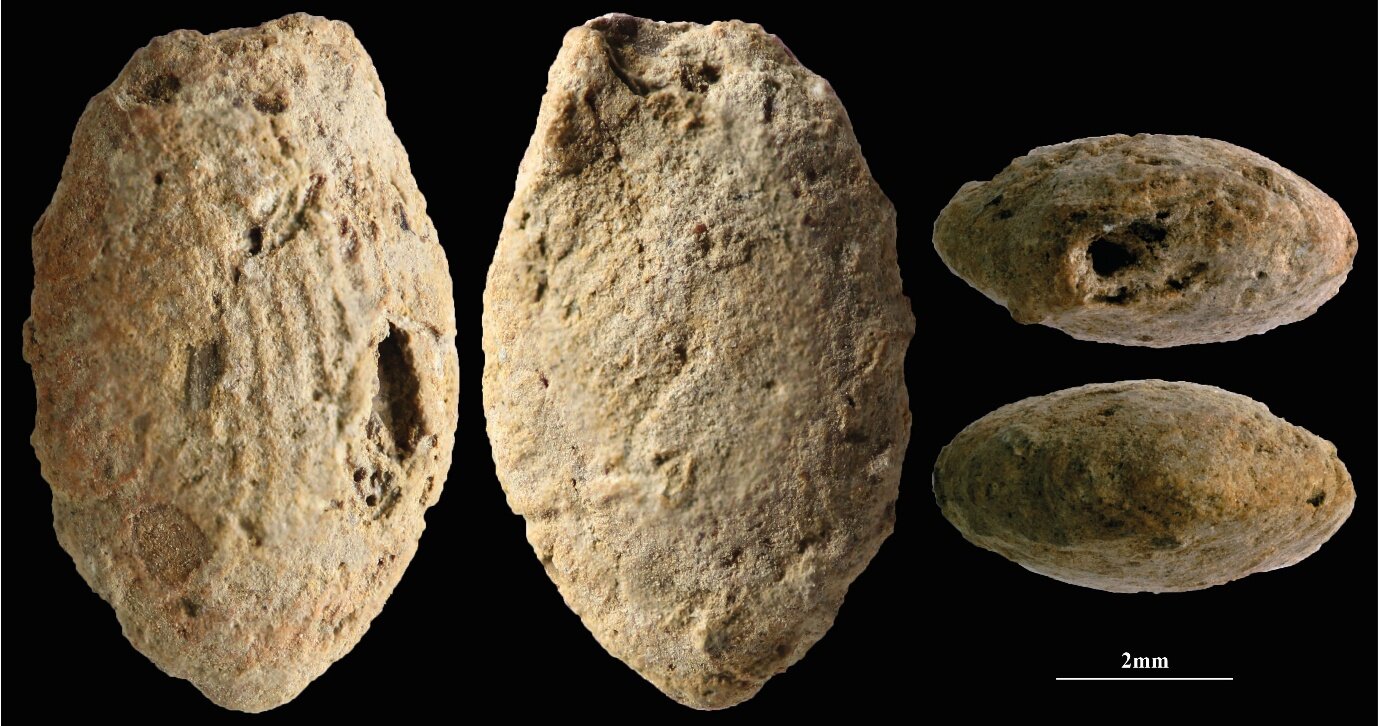
The story of human civilization is often told through the lens of the “big” transitions—the invention of the wheel, the taming of fire, or the first harvest of golden wheat. But long before the first plow touched the earth, in the sun-drenched landscapes of the Levant, a quieter revolution was taking place. It was a revolution of the hands and the heart, occurring in a time when the first villages were just beginning to take shape. Here, among the Natufian hunter-gatherers, people were discovering that the earth beneath their feet could do more than hold their weight; it could hold their stories.
The Earth Remembers the First Villages
Roughly 15,000 years ago, in what is now modern-day Israel, a group of pioneers known as the Natufians did something radical: they stayed. While their ancestors had spent millennia following the migrations of beasts, these communities became the first in the world to settle permanently in one place. They built stone foundations and watched the seasons change from a single vantage point. This shift to sedentarization—living in one place year-round—sparked a profound change in how humans viewed themselves and their environment.
For a long time, archaeologists believed that clay only became important to humans much later, specifically when farmers needed sturdy pots to store grain. However, a groundbreaking study led by Laurent Davin and Prof. Leore Grosman from the Hebrew University of Jerusalem has shattered that timeline. By examining four distinct archaeological sites—el-Wad, Nahal Oren, Hayonim, and Eynan-Mallaha—the team uncovered a hidden tradition of clay ornaments that pushes back the symbolic use of this material by thousands of years.
Before this discovery, the world knew of only five clay beads from this era. Now, researchers have documented a staggering 142 beads and pendants, proving that the use of clay was not a fleeting experiment but a deeply rooted cultural practice. These were the world’s earliest known clay ornaments in Southwest Asia, and they tell a story of a people who were beginning to express their identity through the very soil they lived upon.
A Language Made of Mud and Ochre
The ornaments found at these sites are small enough to be cradled in a child’s palm, yet they carry the weight of a shifting human consciousness. The Natufian artisans shaped unbaked clay into a variety of forms, including cylinders, disks, and ellipses. To make these objects truly stand out, they applied a sophisticated technique known as engobe. This involved coating the ornaments in a thin layer of liquid clay mixed with red ochre, a natural pigment that gave the beads a vibrant, earthy hue.
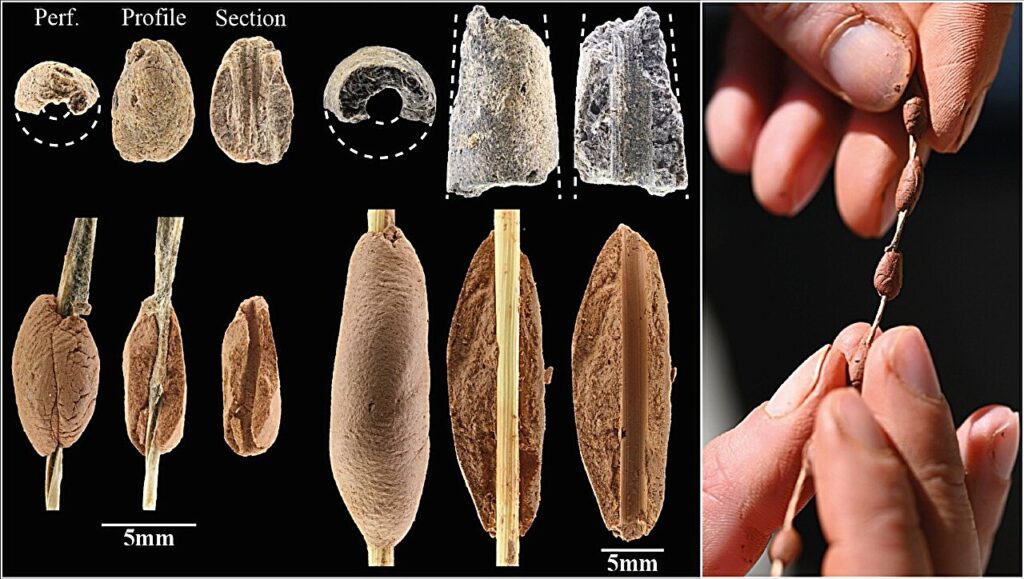
This represents the earliest known use of the engobe coloring technique anywhere on the planet. By Smoothing this liquid slip onto the surface, the Natufians created a uniform, aesthetic finish that transformed simple mud into a symbol of status or belonging. The sheer diversity of the collection is remarkable, with nineteen distinct bead types identified by the research team. These shapes were not chosen at random; they were a mirror held up to the world the Natufians inhabited.
Many of the beads echo the geometry of the botanical world. There are forms that mimic wild barley, einkorn wheat, lentils, and peas. These were the primary plants that the Natufians harvested and consumed with increasing intensity. It is a poetic irony of history: long before they became farmers, these people were wearing the likeness of their food around their necks. The plants that would eventually drive the agricultural revolution were already central to their symbolic culture, serving as icons of the life-sustaining bond between the community and the land.
Fingerprints Across Ten Millennia
Perhaps the most moving aspect of this discovery is the literal touch of the past. On the surfaces of these ornaments, researchers found 50 preserved fingerprints. Using modern forensic techniques, the team was able to identify the makers of these objects—not as a nameless collective, but as individuals of different ages. The prints belong to children, adolescents, and adults, marking the first time archaeologists have been able to directly identify the specific makers of Paleolithic ornaments.
This “fingerprint assemblage” is the largest of its kind from this period, and it suggests that the creation of these beads was a communal, intergenerational activity. In the shade of a stone hut or by the warmth of a communal fire, elders likely sat with children, teaching them how to roll the clay and smooth the red ochre. This was a process of socialization, where the values and aesthetics of the group were passed down through the act of making.
One find in particular highlights this intimate connection: a tiny clay ring measuring only 10 millimeters wide. Its diminutive size suggests it was crafted specifically for a child. These objects were more than just jewelry; they were tools for learning and imitation. By participating in the creation of these ornaments, Natufian children were learning how to communicate who they were to the rest of the world. They were learning the visual language of their tribe.
The Organic Threads of Belonging
While the clay itself has survived the passage of fifteen thousand years, the materials used to wear these ornaments were far more fragile. However, the study revealed a rare treasure: microscopic traces of plant fibers preserved on some of the beads. These tiny remnants provide a “ghost” of the organic materials—the strings and cords—that have long since vanished from the archaeological record.
These fibers show how the beads were strung together to create necklaces or sewn onto clothing as pendants. It transforms our image of the Natufian people. We can now see them not just as survivalists, but as people who cared about their appearance, who used visual communication to signal their affiliation and social relationships. The beads were a public declaration of identity, a way to say “I belong to this place” and “I am part of this people.”
The discovery at Nahal Ein Gev II of a clay figurine, alongside these 142 ornaments, further cements the idea that a symbolic revolution was well underway before the first seed was ever planted in a tilled field. This was a time of “profound social and cognitive changes,” as Prof. Grosman notes. The human mind was expanding, finding new ways to store meaning outside of the brain and in the material world.
Why These Tiny Beads Matter Today
This research is far more than a catalog of ancient jewelry; it is a fundamental rewrite of the human timeline. For decades, the “symbolic revolution”—the moment humans began using materials like clay to represent ideas—was tethered strictly to the rise of farming in the Neolithic era. This study proves that the roots of that revolution lie much deeper in our history.
It demonstrates that the move toward a settled life immediately triggered a need for new forms of expression. When humans stopped moving, they started making. They used the earth to define their boundaries, their beliefs, and their bonds. By documenting the world’s oldest tradition of clay adornment, the research reframes the Natufians as master innovators. They weren’t just the ancestors of farmers; they were the architects of a symbolic world that we still inhabit today. Every time we wear a piece of jewelry to express who we are, we are echoing a tradition started by a group of hunter-gatherers and their children, pressing their thumbs into the mud of the Levant 15,000 years ago.
Study Details
Laurent Davin, Modelling identities among the first-sedentary communities: emergence of clay personal ornaments in Epipaleolithic Southwest Asia, Science Advances (2026). DOI: 10.1126/sciadv.aea2158. www.science.org/doi/10.1126/sciadv.aea2158