The cosmos is a crowded place, teeming with billions of stars, but the most common neighbors in our celestial subdivision are the M dwarfs. These small, dim, crimson suns are the most prolific hosts of terrestrial exoplanets in the galaxy. Yet, for all their abundance, these worlds exist in a state of constant atmospheric peril. Astronomers have long sought a “Rosetta Stone”—a specific world that could explain how rocky planets survive the temperamental nature of their tiny stars. Now, a team led by Francis Zong Lang of the University of Bern believes they have found it.
A Crimson Sun and Its Lonely Sentinel
Deep in the expanse of space, roughly 91 light-years away from our own solar system, sits a star cataloged as TOI-4616. It is a classic mid-M dwarf, a stellar category characterized by its petite stature and cool demeanor. To look at its vitals is to see a star that is a mere fraction of our own Sun: it possesses a mass of about 0.1881 solar masses and a radius of 0.1889 solar radii. Its surface glows at a relatively chilly 3150 Kelvin.
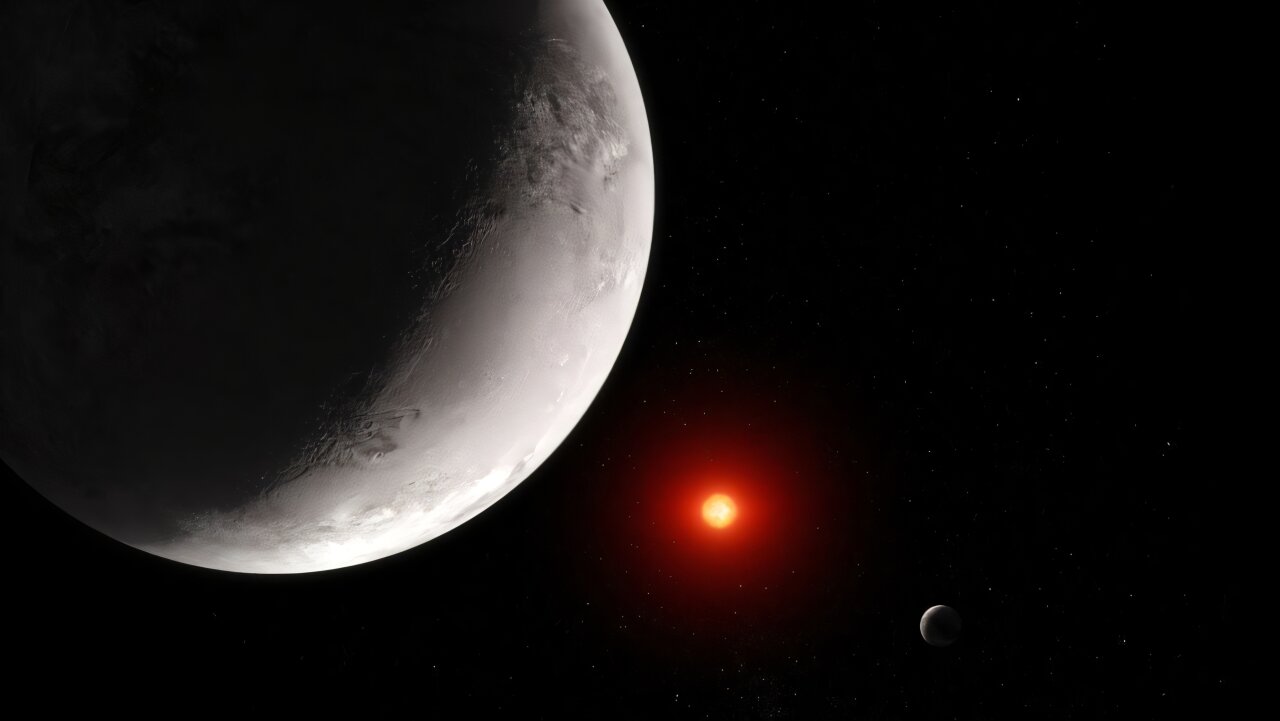
While this star might seem unassuming, it hosts a newly validated world that has caught the attention of the international scientific community. Dubbed TOI-4616 b, this Earth-sized planet was first spotted by the Transiting Exoplanet Survey Satellite (TESS) as it cast a tiny shadow while passing across the face of its host. With a radius of 1.22 Earth radii, it is a rocky sibling to our home world, but its life is defined by a much more chaotic relationship with its sun.
TOI-4616 b is locked in a frantic dance, completing a full orbit in just 1.55 days. This proximity creates an environment of extreme irradiation, where the planet is constantly blasted by the energy of its host star. With an equilibrium temperature of approximately 525 Kelvin, it sits in a unique “middle ground” of planetary classification—hotter than Earth-like worlds orbiting cooler stars, but distinct from those found around the largest M dwarfs.
The Gauntlet of Fire and Survival
The central mystery of worlds like TOI-4616 b lies in their history of survival. M dwarfs are notorious for being difficult parents. Before they settle into the stable “main sequence” phase of their lives, they spend 1 to 2 billion years in a state of high luminosity. During this long adolescence, they exert massive dissipative pressure on any nearby planets, often acting like a cosmic blowtorch that can strip away a planet’s primordial hydrogen-rich atmosphere.
For TOI-4616 b, the question is not just what it is made of, but what it has managed to keep. While the original gases from its formation may be long gone, the researchers suggest several paths to resilience. A planet might cling to a secondary atmosphere formed through volcanism and outgassing long after the star has calmed down. Alternatively, a sufficiently strong magnetic field might act as a shield, or a thick atmosphere dominated by CO2 might prove heavy enough to resist being swept away into the void.
Because TOI-4616 b resides in such an intense radiation environment, it serves as a “test case.” By studying this world, scientists can stress-test their models of atmospheric escape and volatile retention. It is a laboratory in the sky, showing us the absolute limits of what a rocky planet can endure before it is reduced to a barren, naked ball of stone.
A Legacy Written in Decades of Light
What sets this discovery apart from the more than 6,000 confirmed exoplanets is the sheer depth of information we already have about its star. Often, when astronomers find a promising planet, they know very little about the sun it orbits. TOI-4616 is different. It is a star with a history.
Archival data on this system stretches back as far as 1954, providing a 70-year longitudinal look at its behavior. More modern eyes have also been fixed upon it; the PanSTARRS survey observed it in 2011, and more recently, the SNO/Artemis project tracked it in 2025. Because the star’s properties—its size, mass, and temperature—are so well-constrained and precisely measured, scientists don’t have to guess about the environment the planet is sitting in.
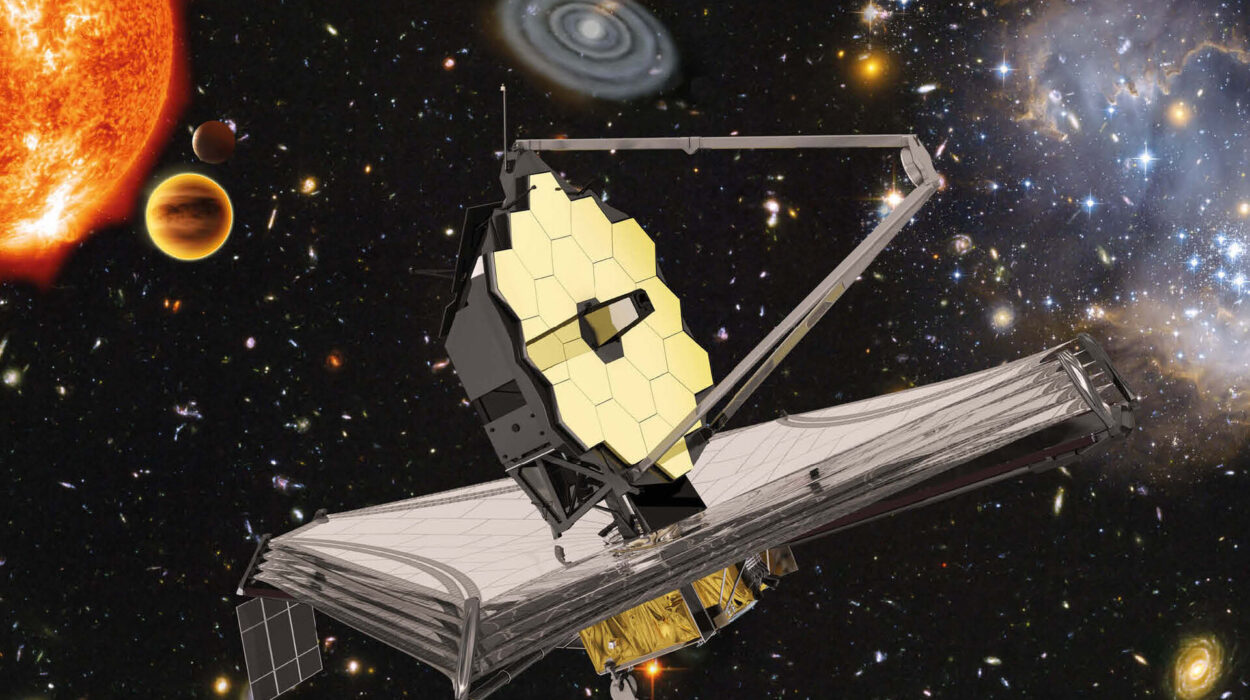
This wealth of consistent multiband transit measurements makes the system a rare gem. Many potential targets for the James Webb Space Telescope (JWST) are discarded because the host stars are too mysterious or the data is too thin. TOI-4616, however, is bright and well-understood, making it a “benchmark system” that is perfectly suited for comparative investigations of how planets evolve under pressure.
Why This Distant Rock Matters
The discovery of TOI-4616 b is a milestone because it provides a standard of measurement for the most common type of planet in the universe. We know that M-type stars are the most prolific hosts for terrestrial exoplanets, including famous systems like TRAPPIST-1 with its seven rocky worlds. If we want to understand if life or even stable air can exist across the galaxy, we must first understand the relationship between these stars and their children.
By acting as a reference system for highly irradiated rocky planets, TOI-4616 b allows astronomers to compare “apples to apples” when they look at other worlds. It sits in a crucial regime that helps bridge the gap between different types of M-dwarf systems. This research isn’t just about one planet; it’s about refining the search for exoplanet atmospheres and understanding the interior composition of worlds that are similar to Earth in size, but vastly different in experience. As we look toward future atmospheric investigations, this benchmark planet will be the yardstick by which we measure the diversity of the cosmos.
Study Details
F. Zong Lang et al, TOI-4616 b: a benchmark Earth-sized planet transiting a nearby M4 dwarf, arXiv (2026). DOI: 10.48550/arxiv.2603.10905