For years, scientists have puzzled over Mars’ transformation from a warm, potentially habitable world to the barren desert it is today. But the latest discovery from NASA’s Perseverance rover has just brought an exciting clue to light—one that could rewrite the history of the Red Planet.
On Mars’ reddish-orange surface, scattered white rocks—once just faint, mysterious dots—have turned out to be more than just curious features. These rocks, made of kaolinite clay, tell an unexpected story: one of ancient, rain-soaked oases, climates much like Earth’s tropical regions, and a time when Mars may have supported the kind of wet environments where life could have thrived.
The White Rocks That Sparked a Revelation
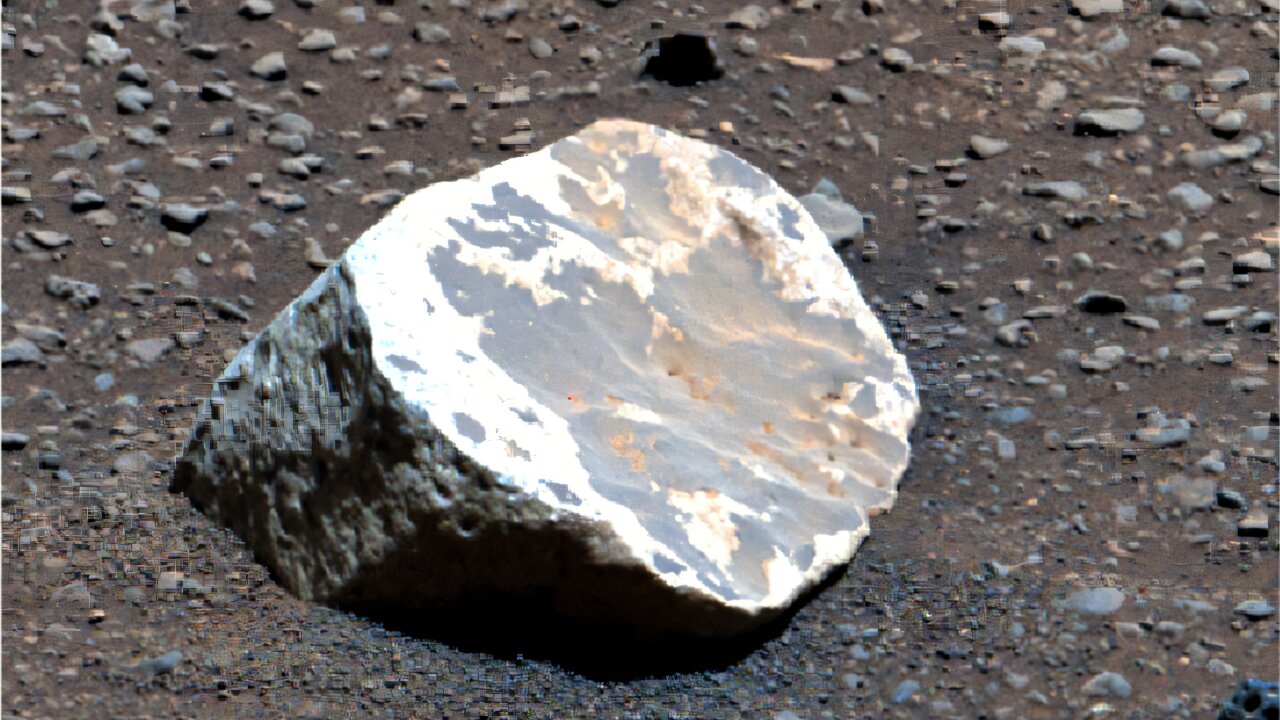
The discovery was made by Perseverance, which has been exploring the Jezero crater since February 2021. These small, white rocks caught the attention of scientists because of their unusual composition. The rocks are rich in aluminum and are primarily composed of kaolinite, a clay that forms on Earth under very specific conditions. On our planet, kaolinite is typically created in humid, tropical environments, where rainfall leaches minerals from rocks over millions of years.
For scientists like Adrian Broz, a postdoctoral researcher at Purdue University and a collaborator on the Perseverance mission, the discovery was like finding a time capsule of Mars’ wetter past. “Tropical climates like rainforests are the most common environments to find kaolinite clay on Earth,” Broz explained. “So when you see kaolinite on a place like Mars, where it’s barren, cold and with certainly no liquid water at the surface, it tells us that there was once a lot more water than there is today.”
These white fragments, some as small as pebbles and others as large as boulders, aren’t just any rocks. They are ancient witnesses to a time when Mars may have been drenched in rain, much like Earth’s tropical rainforests.
The Search for Answers
But even as exciting as this discovery is, it raises more questions. Where did these kaolinite-rich rocks come from? How did they end up scattered across the Martian surface? According to Briony Horgan, a planetary scientist at Purdue University and a long-time planner on the Perseverance mission, the answer remains elusive.
Horgan pointed out that despite the abundance of these kaolinite fragments, there isn’t a major outcropping nearby that could have been their source. “They’re clearly recording an incredible water event, but where did they come from?” she asked. “Maybe they were washed into Jezero’s lake by the river that formed the delta, or maybe they were thrown into Jezero by an impact and they’re just scattered there. We’re not totally sure.”
The rover’s SuperCam and Mastcam-Z instruments have been instrumental in studying these rocks, and initial examinations suggest that they could be evidence of an ancient, warmer and wetter Mars. “You need so much water that we think these could be evidence of an ancient warmer and wetter climate where there was rain falling for millions of years,” Horgan said.
This theory is further supported by satellite imagery that has spotted large outcroppings of kaolinite in other areas of Mars. However, until Perseverance reaches these locations, these small rocks are all scientists have to work with. “Until we can actually get to these large outcroppings with the rover, these small rocks are our only on-the-ground evidence for how these rocks could have formed,” Horgan explained. For now, these scattered pieces may be the best clue we have to understanding how Mars’ climate once supported liquid water.
The Earth Connection
To better understand the Martian kaolinite, Broz turned to Earth’s own tropical climates. He compared the Perseverance rover’s samples to rocks found in regions like San Diego, California, and South Africa. What he found was a striking similarity. The chemical signatures in the Martian rocks closely resembled those found in tropical environments on Earth, suggesting that Mars may have had a climate much like Earth’s rainforests long ago.
But kaolinite can also form under different conditions, such as in hydrothermal systems, where hot water leaches rocks. However, the kaolinite on Mars showed no evidence of such processes. “We used datasets from three different sites to compare the hydrothermal leaching scenario to the Mars rocks,” Broz said. The results pointed to one thing: the Martian kaolinite formed through rainfall—a crucial clue to Mars’ ancient climate.
Why This Matters for the Search for Life
The implications of these findings are profound, particularly when it comes to the search for life. Broz emphasized the importance of water in the search for habitable environments, saying, “All life uses water. So when we think about the possibility of these rocks on Mars representing a rainfall-driven environment, that is a really incredible, habitable place where life could have thrived if it were ever on Mars.”
The discovery of these kaolinite rocks may help scientists narrow down the search for signs of past life on Mars. If rain once fell in such abundance, it suggests that conditions on the planet may have been more Earth-like than we ever imagined. The presence of kaolinite is a strong indicator that Mars was once much wetter and warmer, a stark contrast to the harsh, dry world we see today.
But this discovery is also a reminder of the fragility of habitable environments. Mars, once a potential cradle for life, gradually lost its water and transformed into the frozen desert it is now. Understanding how this process occurred—and whether life could have flourished before it was too late—remains one of the central questions in planetary science.
The Bigger Picture
What makes this discovery even more exciting is how it fits into the broader puzzle of Mars’ history. The kaolinite fragments found by Perseverance may just be small pieces of a much larger, still-hidden picture of the planet’s past. If future missions can find larger deposits of this clay, they could offer new clues about Mars’ ancient climate and its potential for supporting life.
For now, scientists are piecing together the fragments, building a picture of Mars’ past that is both familiar and alien. “They’re clearly recording an incredible water event,” Horgan said, but the mystery of their origin remains. Until we know more, these rocks from Perseverance serve as a key to unlocking the secrets of Mars’ distant past—a reminder that the search for life is not just about finding signs of life today, but understanding how planets like ours evolve over time.
The Future of Mars Exploration
As scientists continue to analyze these Martian rocks and the data collected by Perseverance, the hope is that more answers will emerge. Each new discovery brings us one step closer to understanding whether Mars ever had the conditions to support life. And with the possibility of future missions to Mars, including potential sample returns, we may one day hold in our hands pieces of the planet’s distant past—pieces that could change our understanding of the universe and our place in it.
In the end, the discovery of kaolinite on Mars may be more than just a fascinating geological find. It may be a glimpse into a world that once held water, warmth, and perhaps, even the possibility of life.
More information: A. P. Broz et al, Alteration history of aluminum-rich rocks at Jezero crater, Mars, Communications Earth & Environment (2025). DOI: 10.1038/s43247-025-02856-3