For more than a decade, a distant cosmic beacon sat in near silence, its immense power hidden behind a calm exterior. Then, without warning, it awoke. In late 2023, astronomers watching the far reaches of the universe noticed a dramatic surge of energy from a blazar known as OP 313, a signal so intense it marked the object’s most active period ever recorded in high-energy gamma rays. This sudden revival wasn’t just spectacular. It offered a rare opportunity to peer into the inner workings of one of the universe’s most extreme objects.
An international team of astronomers decided to follow this awakening back through time. By examining fifteen years of observations across multiple wavelengths, from radio waves to gamma rays, they set out to understand what caused OP 313 to shift from long dormancy to explosive activity. Their findings, shared on January 18 through the arXiv preprint server, reveal a story of hidden buildup, powerful jets, and delayed consequences playing out across cosmic distances.
What Makes a Blazar So Extreme
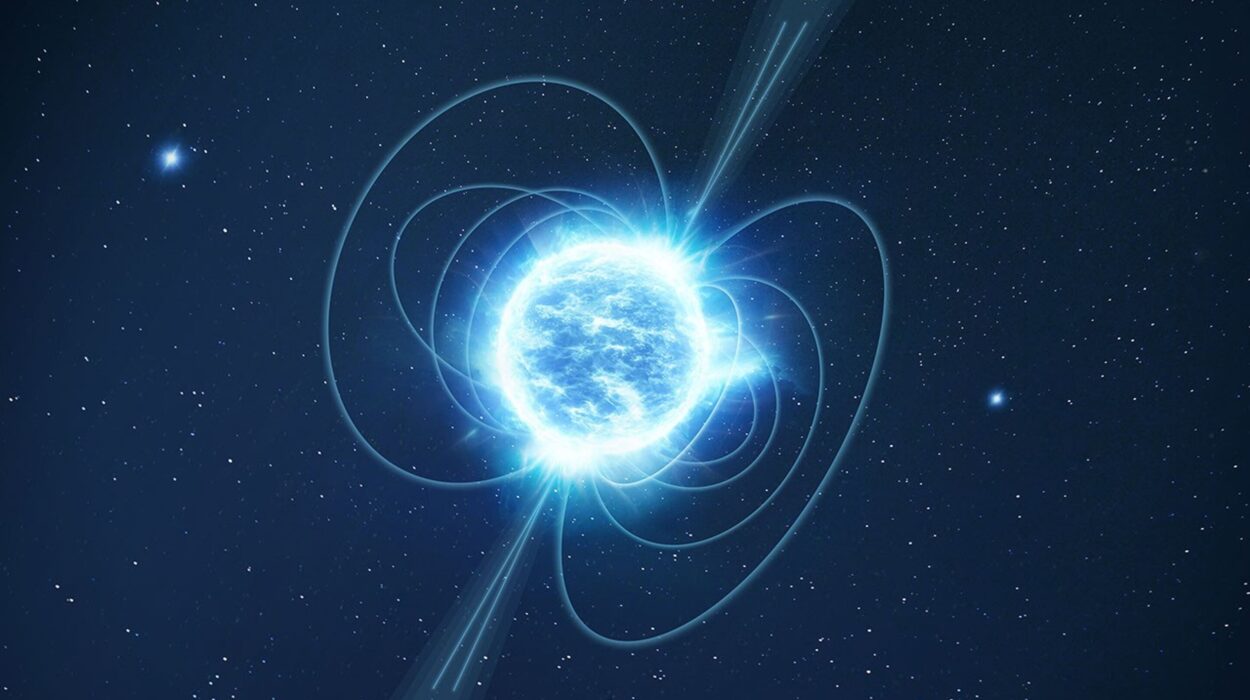
Blazars are among the most intense objects astronomers know. They belong to a family called compact quasi-stellar objects, or quasars, which are powered by supermassive black holes at the centers of massive elliptical galaxies. What makes blazars especially dramatic is their orientation. They launch highly collimated relativistic jets, streams of particles moving at speeds close to light, aimed almost directly toward Earth.
Because of this alignment, their light appears amplified and wildly variable. Even small changes near the black hole can translate into enormous flares across the electromagnetic spectrum. Blazars are divided into classes based on their optical emissions. Flat-spectrum radio quasars show strong, broad emission lines, while BL Lacertae objects lack them. OP 313 belongs to the flat-spectrum radio quasar category, already placing it among the most powerful and energetic known.
A Blazar with a Long Memory
OP 313, also known as B2 1308+326, has been intriguing astronomers for decades. First identified in 1959, it was initially mistaken for a variable star. Only later did its true nature emerge. With a redshift of approximately 0.997, it lies at an immense distance, making it the most distant quasar ever detected at very high energy gamma rays.
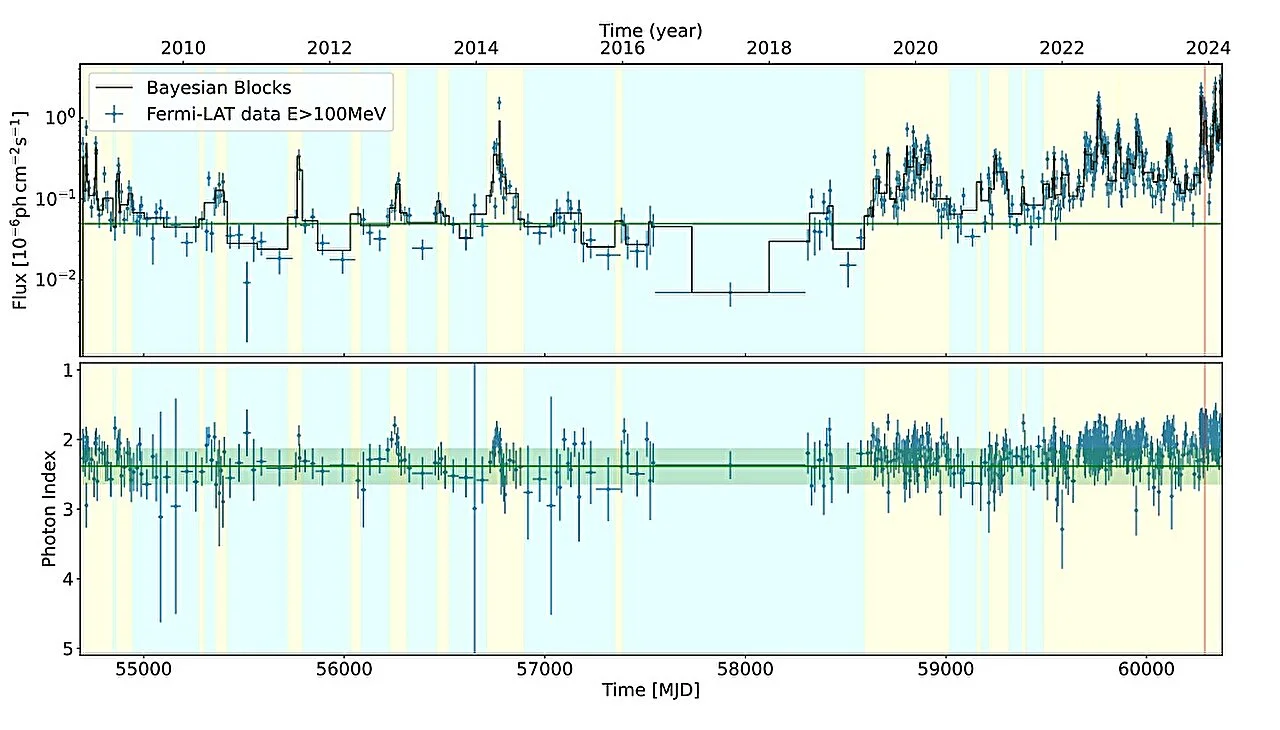
For years, OP 313 remained relatively quiet. Then, beginning in 2022, subtle signs of renewed activity appeared. By November 22, 2023, the blazar erupted into its strongest high-energy gamma-ray state on record, a phase that lasted until March 2024 and included two major gamma-ray flares. This dramatic shift raised a compelling question. What changed after more than ten years of calm?
Looking Back to Understand the Outburst
To answer that question, a team led by Chiara Bartolini of the University of Trento turned to the past. Rather than focusing only on the spectacular flares themselves, they examined the quieter years that came before. Their approach relied on long-term multiwavelength monitoring, gathering fifteen years of data that traced OP 313’s behavior across radio, optical, ultraviolet, X-ray, and gamma-ray bands.
The researchers were particularly interested in the blazar’s so-called quiescent phase. If the recent flares were the climax of a longer process, the clues might be hidden in subtle trends that unfolded slowly over time. As Bartolini’s team explained, OP 313 showed persistent high-state activity starting in 2022, following more than a decade of relative calm. That made the long view essential.
Patterns Written in Light Across the Spectrum
What emerged from the data was a picture of growing unrest. The team detected strong variability from the optical band all the way up to gamma rays, with a steady increase in brightness beginning in 2022. The light curves in the optical, ultraviolet, X-ray, and gamma-ray bands rose and fell together, suggesting they were linked by a common physical process.
The radio band, however, told a different story. Radio emission from OP 313 had been high as early as 2008, long before the recent flaring episode. It also showed a new increasing trend starting in 2019, but without a clear correlation to the other wavelengths. This mismatch hinted that different regions of the blazar’s jet might be contributing to different parts of the spectrum, evolving on their own timelines.
Eight Flares and the Birth of a New Jet Component
When the team focused on the gamma-ray data, they identified eight distinct flaring periods over the years. Among these events, one discovery stood out. On April 13, 2021, astronomers detected a new, well-defined jet component emerging from the blazar’s core. This feature marked a turning point, appearing before the most intense gamma-ray activity and offering a possible trigger for what came next.
Jets in blazars are not static structures. They are dynamic, shaped by shocks, collisions, and bursts of energy launched from the vicinity of the black hole. The appearance of a new jet component suggested that something deep in OP 313 had shifted, injecting fresh energy into the system.
Loops in Time Reveal Hidden Physics
To dig deeper, the researchers explored how particles inside the jet gained and lost energy. They did this by looking for a hysteresis pattern, a loop-like structure seen when brightness and energy changes lag behind one another during flares. Such patterns provide insight into the balance between particle acceleration and radiative cooling within the jet.
Hints of this loop-like behavior appeared during three flaring periods. These subtle signatures suggested that particles were being rapidly energized and then cooling as they emitted radiation, tracing a cycle that unfolded over time. Although not present in every flare, these patterns added weight to the idea that complex processes inside the jet were driving the observed variability.
A Shock Encounter Far from the Black Hole
Bringing all these clues together, Bartolini’s team proposed a coherent explanation for OP 313’s recent behavior. According to their analysis, the renewed activity was triggered when new jet components emerged from the blazar’s core and traveled outward. Along the way, they interacted with a standing shock already present in the jet.
This interaction acted like a cosmic traffic jam, compressing particles and boosting their energy. Importantly, the team concluded that the gamma-ray emitting region is located far from the central engine, not close to the black hole itself. In this region, the dusty torus surrounding the core becomes the dominant source of seed photons, which are then energized to gamma-ray levels through interactions with fast-moving particles.
Why This Awakening Matters
The story of OP 313 is more than a tale of a single blazar flaring after a long sleep. It demonstrates the power of patience in astronomy. By combining years of quiet observations with moments of explosive activity, researchers can reconstruct the physical processes that govern some of the universe’s most extreme environments.
This study shows that dramatic outbursts may be the result of long-term changes, not sudden accidents. The delayed rise in radio emission, the emergence of a new jet component, and the eventual gamma-ray flares all point to a system that evolves over years before revealing its full intensity. Understanding these timelines helps astronomers pinpoint where and how energy is released in relativistic jets.
Most importantly, OP 313 reminds us that even the quietest corners of the cosmos can harbor immense power, waiting for the right moment to break free. By listening carefully across the spectrum and over time, astronomers are learning not just when the universe speaks loudly, but how it prepares to do so.
Study Details
Chiara Bartolini et al, A long-term multiwavelength study of the flat spectrum radio quasar OP 313, arXiv (2026). DOI: 10.48550/arxiv.2601.12474