In the deep darkness of the early universe, only about a billion years after everything began, something astonishing was already taking shape. Astronomers peering into that distant time have now found evidence that the universe was far more ambitious in its youth than anyone expected. A colossal structure, larger than anything previously confirmed from that era, was already assembling itself while the cosmos was still in its infancy.
This discovery centers on a newly identified cosmic object known as JADES-ID1, a name that sounds technical but carries a profound story. It represents a moment frozen in time, captured by powerful telescopes, when one of the universe’s largest kinds of structures was just beginning to come together. The finding suggests that the universe wasted no time in building complexity, growing up faster than scientists had believed possible.
A Giant Appears Where No Giant Should Be
Astronomers have long thought that massive galaxy clusters took several billion years to form. The early universe, they believed, was simply too young and too sparsely populated with galaxies for such enormous structures to exist. That assumption has now been shaken.
JADES-ID1 appears at a time corresponding to only about one billion years after the Big Bang, which is one to two billion years earlier than astronomers expected to see something like this. The object carries a staggering mass of about 20 trillion times that of the sun, placing it firmly among the heavyweights of cosmic history.
Akos Bogdan, who led the new study published in Nature, described the surprise clearly. He explained that this may be the most distant confirmed protocluster ever observed, offering new evidence that the universe was “in a huge hurry to grow up.” The phrase captures the emotional weight of the discovery: the cosmos, it seems, did not take its time.
The Violent Birth of a Cosmic City
JADES-ID1 is not yet a finished galaxy cluster. Astronomers classify it as a protocluster, meaning it is caught in an early and turbulent stage of formation. Over billions of years, it is expected to evolve into a massive galaxy cluster like those seen much closer to Earth today.
Galaxy clusters are immense cosmic cities. They can contain hundreds or even thousands of individual galaxies, all bound together by gravity. Between those galaxies lies vast amounts of superheated gas, glowing brightly in X-rays, along with large quantities of unseen dark matter. These clusters are so massive and influential that astronomers use them to study how the universe expands and to understand the roles of dark energy and dark matter.
Seeing a protocluster in the act of forming is rare. Catching one at such an early time is extraordinary.
Gerrit Schellenberger, a co-author of the study, compared it to watching a factory assembly line in action rather than examining a completed car. Observing how galaxy clusters grow, rather than only studying their final forms, allows scientists to understand the processes that shape the universe itself.
Two Telescopes, One Extraordinary View
This discovery was only possible because two of the most powerful space observatories ever built were focused on the same patch of sky. NASA’s Chandra X-ray Observatory and the James Webb Space Telescope worked together to reveal the true nature of JADES-ID1.
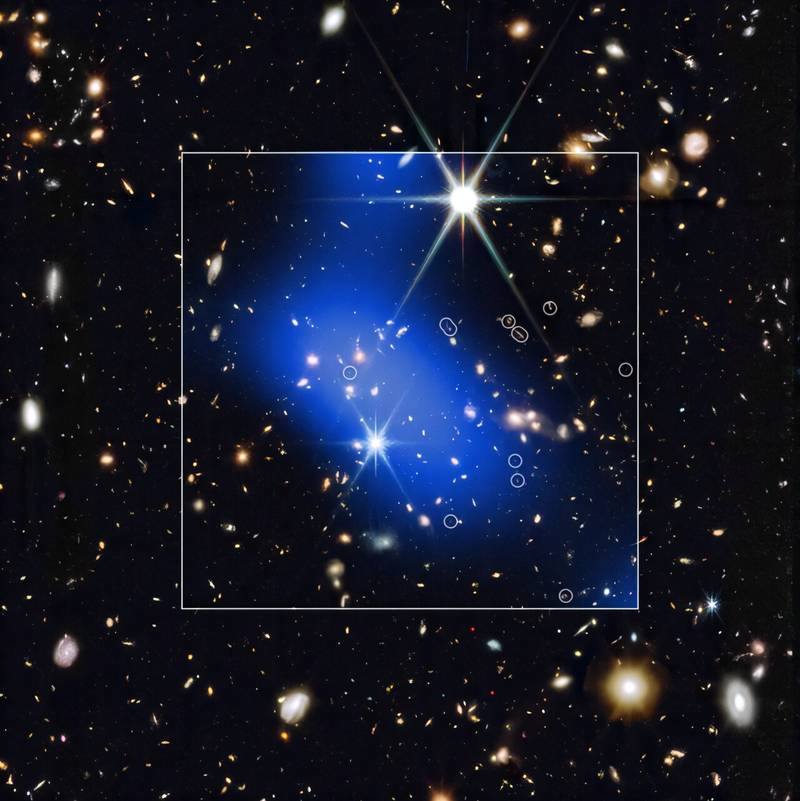
Webb’s sharp infrared vision identified at least 66 potential galaxies packed closely together in this region of space. On its own, that clustering was intriguing but not definitive. What turned suspicion into confirmation was Chandra’s detection of a vast cloud of hot gas enveloping those galaxies.
As a protocluster forms, gas falls inward under gravity. The infalling material is violently heated by shock waves, reaching temperatures of millions of degrees. At those temperatures, the gas emits X-rays, which Chandra is designed to detect. The presence of both a dense collection of galaxies and glowing hot gas provides the two key signatures astronomers need to confirm a protocluster.
Only one place in the sky made such a discovery possible. The JWST Advanced Deep Extragalactic Survey, known as JADES, overlaps with the Chandra Deep Field South, the site of the deepest X-ray observation ever conducted. This rare overlap created a unique cosmic window, allowing astronomers to see both the galaxies and the hot gas at the same time.
A Mystery That Shouldn’t Exist
What makes JADES-ID1 so unsettling is not just its size, but its timing. Most models of the universe predict that there simply would not be enough time for a structure this massive to form so early. The density of galaxies should have been too low, the cosmic clock too young.
Before this discovery, the most distant protocluster confirmed through X-ray emission was observed at a time about three billion years after the Big Bang. JADES-ID1 pushes that record dramatically backward.
Qiong Li, who led an earlier study that first reported this object using deep Webb data, expressed the shift in expectations plainly. Astronomers thought they would find a protocluster like this two or three billion years after the Big Bang, not just one billion. First came surprisingly large galaxies and black holes appearing early in cosmic history. Now, entire clusters of galaxies are joining that list of early overachievers.
The universe, it seems, was building big things much sooner than anyone anticipated.
From Early Chaos to Future Grandeur
JADES-ID1 will not remain in this chaotic, youthful state forever. Given enough time, it is expected to grow and settle into a massive galaxy cluster like those seen in the nearby universe today. The discovery offers a glimpse of a familiar cosmic structure at a shockingly unfamiliar age.
In earlier work, researchers led by Li and Professor Christopher Conselice of The University of Manchester identified five other protocluster candidates in the JADES field. However, only JADES-ID1 showed galaxies embedded in hot gas. That distinction matters because it indicates that only JADES-ID1 has accumulated enough mass for the gas to heat up and glow in X-rays.
This makes JADES-ID1 not just another candidate, but a uniquely powerful example of early structure formation.
Conselice emphasized how rare such findings are. Discoveries like this happen when telescopes such as Chandra and Webb stare at the same region of sky at the very limits of their capabilities. Even then, chance plays a role. The universe must cooperate by placing something extraordinary in exactly the right spot.
Why This Discovery Changes the Cosmic Story
JADES-ID1 is more than a distant object. It is a challenge to long-standing ideas about how the universe grew and evolved. If massive protoclusters can form only a billion years after the Big Bang, then astronomers must rethink the timeline of cosmic structure formation.
Galaxy clusters are essential tools for understanding the universe. They help scientists measure how space itself is expanding and explore the mysterious influences of dark matter and dark energy. Knowing when and how these clusters first emerged is crucial for interpreting everything that came later.
This discovery suggests that the universe was efficient, aggressive, and remarkably fast at building complexity. It did not ease into structure slowly. It surged forward.
As astronomers continue to study JADES-ID1 and search for others like it, they are not just filling in gaps in a cosmic timeline. They are rewriting the opening chapters of the universe’s story, revealing that even in its earliest moments, the cosmos was already dreaming big.
Study Details
Ákos Bogdán, An X-ray-emitting protocluster at z ≈ 5.7 reveals rapid structure growth, Nature (2026). DOI: 10.1038/s41586-025-09973-1. www.nature.com/articles/s41586-025-09973-1