Approximately 233 million years ago, in the lush landscapes of what is now southern Brazil, a tiny creature broke through the shell of its egg and took its first breath of Triassic air. It was a member of the rhynchosaurs, a group of remarkably successful archosauromorph herbivores that once dominated the planet. This particular individual, however, did not survive to see the age of giants. Instead, it became a silent witness to deep time, buried in the earth until a team of paleontologists uncovered its remains at the Buriol Site in Rio Grande do Sul State.
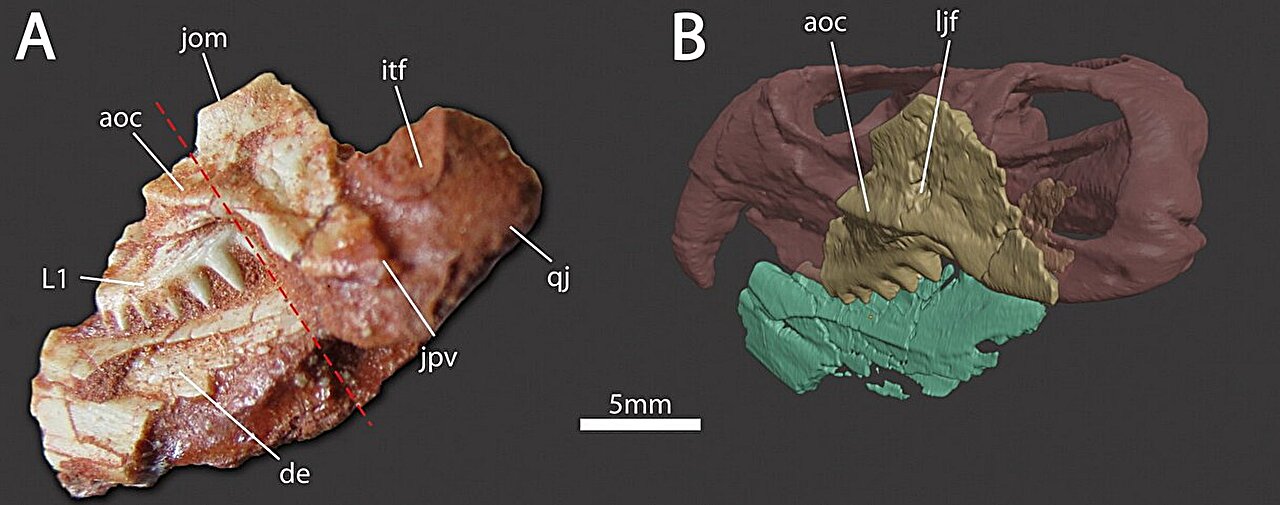
The discovery, recently detailed in the Journal of Systematic Palaeontology, introduces the world to a specimen known as CAPPA/UFSM 0295. While most fossil finds celebrate the massive and the imposing, this discovery is significant for its diminutive scale. Measuring only about 2.5 centimeters—roughly one inch—the reconstructed skull of this animal represents the smallest rhynchosaur fossil ever recorded in Brazil. It is a rare glimpse into the very beginning of a prehistoric life: a perinate, or a hatchling that had only just begun its journey.
A Tiny Masterpiece Preserved in Stone
The rhynchosaurs were not the apex predators of their time, but they were biological marvels in their own right. They are characterized by a specialized dental system designed to conquer the toughest flora of the Late Triassic. Their maxillary tooth plates featured dozens of teeth arranged in rows, divided by a groove known as a sulcus. This “blade-and-sulcus” mechanism functioned like a pair of high-powered scissors, allowing the animals to shear through fibrous vegetation that other herbivores might find indigestible.
Finding a hatchling of this group is a stroke of incredible luck for researchers. The Buriol Site is famous for its fossil richness, but specimens this small and delicate are often lost to the elements or the crushing weight of millions of years of sediment. When the team found the two small rock fragments containing the skull and lower jaw, they knew they were holding something precious. The bones were so fragile that traditional mechanical tools—the hammers and needles usually used to clear away stone—were deemed too risky.
To peek inside the stone without destroying the treasure within, the researchers turned to technology. They employed micro-CT scanning, a process that uses X-rays to create a detailed three-dimensional map of the fossil. As co-author Dr. Flávio Pretto explained, the digital approach was the only way to ensure the fossil’s safety. Any accidental break during physical preparation would have been permanent. The scans did more than just preserve the bone; they revealed hidden internal structures, such as the way the teeth were implanted in the jaw, providing a level of detail that would have been invisible to the naked eye.
The Growing Pains of Ancient Reptiles
As the digital model of the skull came to life on their screens, the researchers began to notice a curious mix of features. Despite its infancy, the tiny rhynchosaur already possessed the “family look.” It displayed a well-developed anguli oris crest and a ventrally closed infratemporal fenestra, traits that signaled its place within the Hyperodapedontinae subfamily. However, there was a glaring difference between this baby and the adults of its kind: the number of tooth rows.
In the world of paleontology, the number of tooth rows is a primary tool used for phylogenetic analysis—the scientific method of determining where a species fits on the family tree. When the team first plugged the data from CAPPA/UFSM 0295 into their models, the results were chaotic. Because the hatchling had fewer tooth rows than an adult, the computer placed it in a much more “primitive” position on the evolutionary timeline than it likely belonged. Even more confusingly, the presence of this single juvenile specimen in the data caused three other established species of Hyperodapedontinae to be kicked out of their proper places on the tree.
This discrepancy highlighted a fascinating biological reality called ontogenetic variation. Just as a human baby looks different and has fewer teeth than an adult, rhynchosaurs changed physically as they grew. It became clear that the number of tooth rows in these reptiles was not a fixed trait set at birth, but one that increased as the animal aged.
Solving a Prehistoric Puzzle
Realizing that the hatchling’s youth was skewing the results, the researchers conducted a second analysis. This time, they treated the number of tooth rows as an “unknown” factor, preventing the animal’s age from biasing the evolutionary map. The results were immediate and clarifying. The three excluded species returned to their rightful branches, and CAPPA/UFSM 0295 shifted into a more logical position within the Hyperodapedontinae group.
Through this careful adjustment, the team was able to tentatively identify the tiny creature as a Macrocephalosaurus mariensis. This identification carries significant weight for understanding the ecosystem of ancient Brazil. If this hatchling is indeed a Macrocephalosaurus, it proves that at least two different species of these specialized herbivores lived side-by-side at the Buriol Site. This suggests a much higher level of rhynchosaur diversity in this specific locality than previously understood, painting a picture of a vibrant, crowded environment where different species thrived together.
The study serves as a cautionary tale for the scientific community. It underscores the fact that juvenile specimens can provide misleading signals if they are treated exactly like adults in evolutionary studies. For rhynchosaurs, a feature as important as a tooth row must be interpreted with extreme caution, taking the animal’s stage of life into account.
Why This Small Discovery Matters
This research is vital because it challenges and refines the way scientists reconstruct the history of life on Earth. By identifying one of the oldest archosauromorph hatchlings ever found, researchers gain a rare baseline for how these successful animals developed from birth to adulthood. It reminds us that the fossil record is not just a collection of static “types,” but a record of living, growing organisms that changed over the course of their lives.
Furthermore, the success of the micro-CT scanning in this study opens the door for the preservation of other “invisible” fossils—specimens too small or too brittle to be handled by human hands. Every time a new fossil is recovered from the Buriol Site, it adds a new piece to the puzzle of the Late Triassic. As Dr. Pretto and his team continue their annual visits to the site, the tiny skull of CAPPA/UFSM 0295 stands as a testament to the fact that even the smallest fragments of the past can fundamentally change our understanding of the ancient world. Through the eyes of a one-inch hatchling, we see a clearer picture of a world that existed over 200 million years ago.
Study Details
Jossano Rosso Morais et al, A post-hatchling rhynchosaur from the Brazilian Triassic and the ontogenetic development of key characters within Hyperodapedontinae, Journal of Systematic Palaeontology (2025). DOI: 10.1080/14772019.2025.2581267