For generations, the story of human evolution has begun with a simple but powerful idea: at some point in ancient Africa, our ancestors rose onto two legs and began walking upright. This shift to bipedalism has long been seen as one of the defining moments in human history, a transformation that eventually set our species apart from the rest of the animal kingdom.
Scientists have traditionally believed that this change happened around 6 million years ago, somewhere in Africa, marking the earliest steps toward becoming human.
But a quiet discovery in Bulgaria is now challenging that long-held narrative.
Hidden within ancient sediments, researchers uncovered a fossil thighbone that appears to belong to a creature that was already walking on two legs more than 7 million years ago. If the interpretation is correct, the fossil could push the timeline of upright walking further back in time and place one of the earliest human ancestors not in Africa, but in southeastern Europe.
The find is already stirring debate among scientists, and it raises a tantalizing possibility: what if the story of our earliest steps began somewhere entirely different from what we once imagined?
The Ancient Thighbone From Azmaka
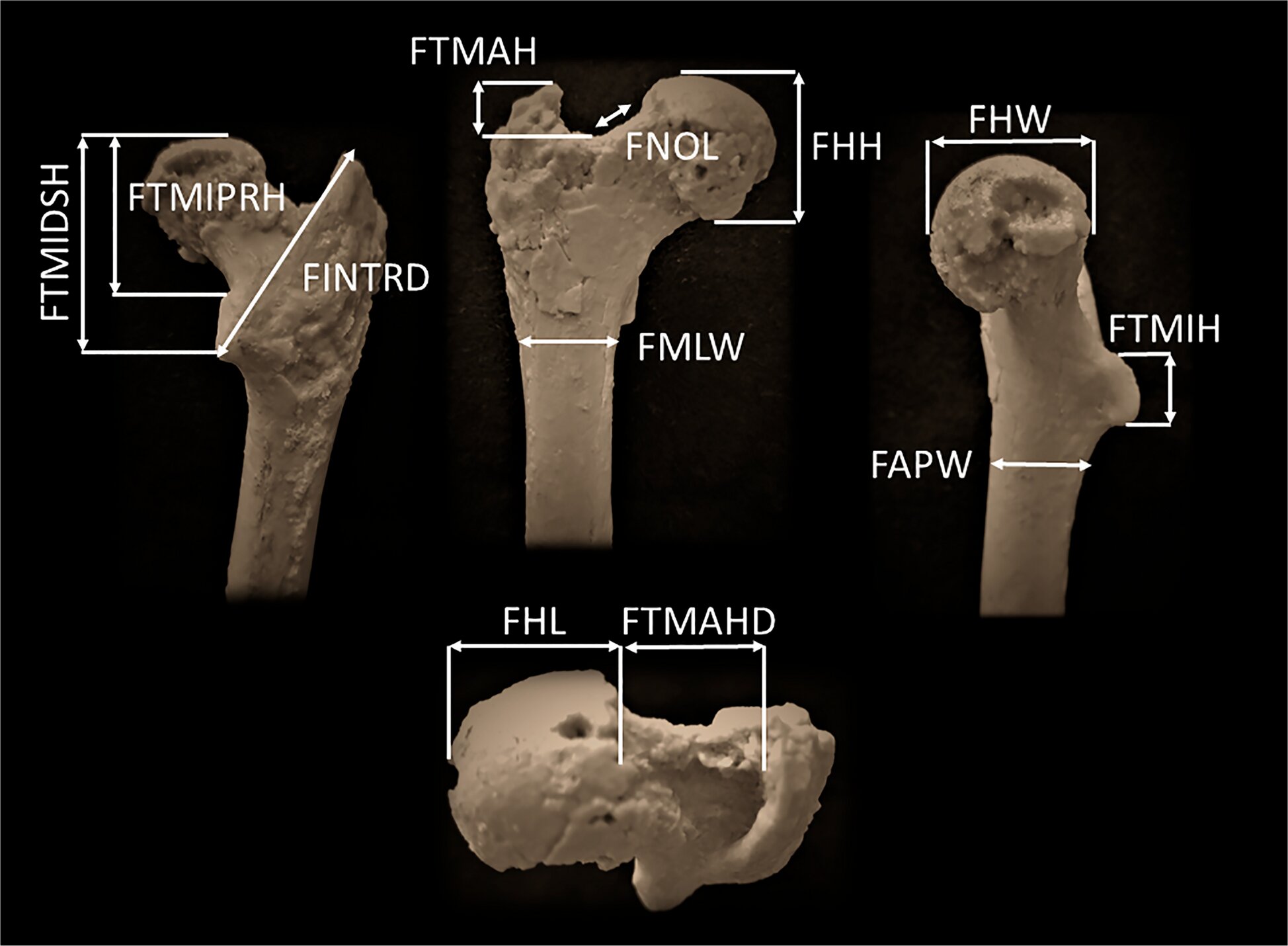
The fossil comes from the Azmaka excavation site, located near the town of Chirpan in Bulgaria’s Upper Thracian Plain. There, researchers uncovered a remarkably important bone: a fossil femur, the large thighbone that connects the hip to the knee.
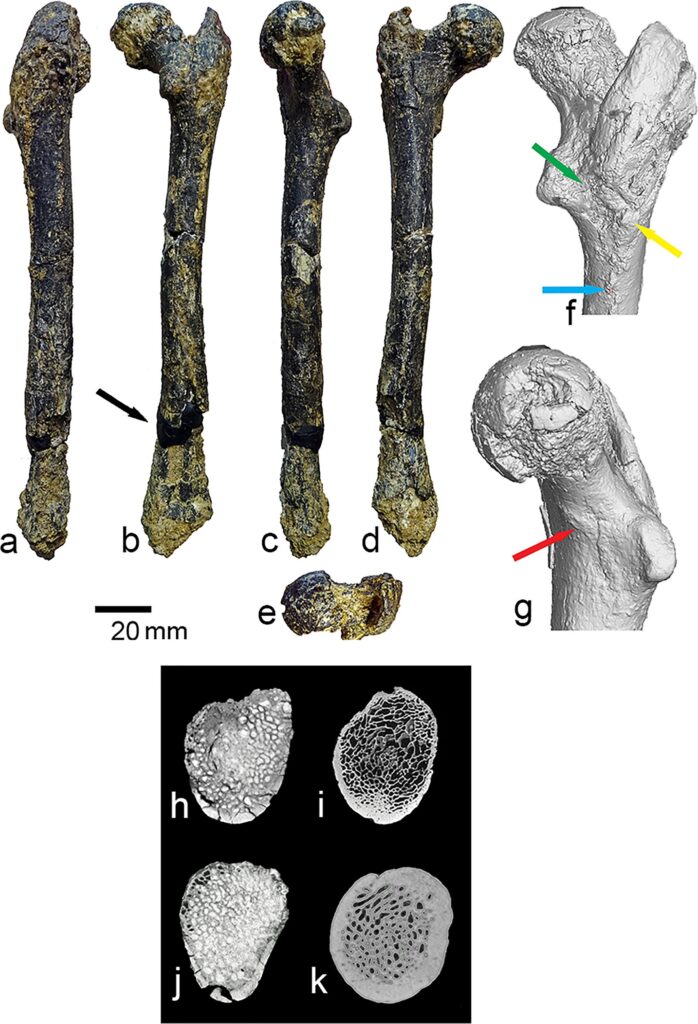
The discovery was described in a scientific paper published in the journal Palaeobiodiversity and Palaeoenvironments, the result of a collaboration between scientists from several institutions, including Bulgaria’s National Museum of Natural History, Aristotle University of Thessaloniki, the Senckenberg Center for Human Evolution and Palaeoenvironment at the University of Tübingen, and the University of Toronto.
What makes the fossil so extraordinary is its age. Researchers estimate the bone to be about 7.2 million years old.
That alone would make it remarkable. But the true surprise lies in the shape of the bone itself.
According to the researchers, the femur carries several features strongly associated with creatures that walk upright.
Clues Hidden in the Shape of a Bone
The anatomy of a thighbone can reveal a great deal about how a creature moved through its environment. Subtle curves, angles, and attachment points can tell scientists whether an animal spent most of its life in trees or walking on the ground.
In this case, the Azmaka femur contains a combination of features that caught researchers’ attention immediately.
Among the most striking details is the elongated neck of the femur, which points upward between the shaft and the rounded head of the bone. This structure resembles the anatomy found in bipedal fossil human ancestors and in modern humans.
The bone also contains specialized attachment areas for gluteal muscles, the muscles that help stabilize the body while walking upright. In addition, scientists observed the particular thickness of the outer bone layer, another characteristic linked to upright movement.
Together, these features suggest something remarkable: the creature that once carried this bone may have walked on two legs.
Professor Nikolai Spassov of the Bulgarian National Museum of Natural History explains that these anatomical clues distinguish the fossil from the thighbones of tree-dwelling apes.
Yet the bone is not identical to the anatomy of modern humans either.
Instead, it appears to represent something in between.
A Creature Between Two Worlds
The fossil’s owner was likely a female weighing about 24 kilograms, a relatively small individual compared with modern humans.
She lived beside a river in a landscape that researchers describe as a savanna environment, similar in many ways to the savannas of present-day East Africa.
The femur suggests that she was capable of walking upright, but not in exactly the same way humans do today.
According to the researchers, the bone combines characteristics seen in African apes with traits found in later bipedal species. It represents a transitional stage, a moment in evolution when movement on the ground was becoming more important but traces of an earlier tree-dwelling past still remained.
This mixture of traits hints at a creature that lived between two worlds—partly adapted to life on the ground, yet still connected to an arboreal ancestry.
That evolutionary position has led scientists to connect the fossil to a little-known ancient primate.
Meet Graecopithecus, a Possible Early Human
Researchers believe the femur may belong to a member of the genus Graecopithecus.
This enigmatic primate first entered the scientific spotlight years earlier when a fragment of a lower jaw was discovered at a site near Athens. When scientists examined that jaw in 2017, they noticed something unusual in the structure of its tooth roots. The shape suggested that the animal might belong to the human evolutionary line.
But the jaw alone could not answer one crucial question: how did this creature move?
The newly discovered femur from Bulgaria provides the missing piece of that puzzle.
If the bone truly belongs to Graecopithecus, it offers the first direct evidence that this ancient primate may have been capable of bipedal movement.
Professor David Begun from the University of Toronto notes that the fossil’s age makes it especially significant.
At 7.2 million years old, he says, this species “could be the oldest known human ancestor.”
A Possible Missing Link
In evolutionary research, scientists often search for transitional forms—species that bridge the gap between earlier and later groups. These fossils can illuminate how major changes unfolded over millions of years.
The Azmaka femur may represent one such transitional form.
Begun describes Graecopithecus as a stage between earlier arboreal ancestors and later human relatives that lived in Africa.
One earlier species mentioned by researchers is Danuvius guggenmosi, a primate from southern Germany that lived almost 12 million years ago. Fossils of Danuvius suggest a creature that combined climbing with forms of upright movement.
Between those ancient apes and later African ancestors lies a long evolutionary journey.
The Bulgarian thighbone appears to fall somewhere in the middle of that journey, capturing a moment when upright walking was beginning to emerge.
Because of this position in the evolutionary timeline, Begun suggests that Graecopithecus could reasonably be described as a “missing link.”
The Climate That Changed Everything
The story of this ancient primate is tied not only to anatomy but also to the changing environment of the ancient world.
Between eight and six million years ago, large-scale climate changes swept across the eastern Mediterranean and western Asia. These shifts periodically transformed parts of the region into extensive semi-deserts and deserts.
According to Professor Madelaine Böhme from the Senckenberg Center for Human Evolution and Palaeoenvironment, these environmental changes triggered major movements of animal populations.
Waves of Eurasian mammals began spreading toward Africa, gradually shaping the wildlife communities that would later dominate African savannas.
Researchers suspect that great apes may have been part of these migrations as well.
If that is true, the ancestors of humans may have followed similar routes.
A Journey From Europe to Africa?
The fossil raises an intriguing possibility.
If Graecopithecus lived in southeastern Europe around 7.2 million years ago, it might represent a population that eventually moved southward into Africa.
From about 6 million years ago, Africa becomes the stage for the next known chapter of human evolution. Early ancestors belonging to the genus Orrorin appear in the fossil record, followed later by Australopithecus afarensis, the species that includes the famous fossil known as Lucy.
Scientists are still unsure whether the ancestors of chimpanzees, gorillas, and humans had already separated into distinct lineages before these migrations occurred.
It is also unclear whether the movements triggered by climate shifts helped isolate those lineages genetically.
But the new fossil suggests that southeastern Europe could have played a far more important role in this story than previously imagined.
Searching for More Clues in the Balkans
The discovery at Azmaka is only the beginning.
Researchers continue to excavate the site and explore other locations across the Balkans, hoping to uncover additional fossils of Graecopithecus.
Each new specimen could help scientists understand how this ancient primate lived, what environments it occupied, and how it fits into the broader picture of human evolution.
Even a single bone can open an entirely new line of questions. But multiple fossils could begin to reveal a fuller portrait of a species that lived more than seven million years ago.
The answers may lie buried beneath layers of ancient soil, waiting for patient excavation.
Why This Discovery Matters
For more than a century, the origins of human evolution have largely been framed around Africa as the starting point of the human lineage.
The Azmaka femur does not overturn that idea entirely, but it introduces a bold new possibility.
If Graecopithecus truly represents an early bipedal human ancestor, then the roots of upright walking—and perhaps even the earliest stages of the human family tree—may extend into Europe.
This discovery pushes the timeline of bipedalism back beyond 7 million years and suggests that the path toward walking on two legs may have begun earlier and in more complex geographic settings than once believed.
The fossil also highlights how environmental change, migration, and evolution can intertwine across continents over millions of years.
Most importantly, it reminds us that the story of human origins is still unfinished.
Somewhere beneath ancient landscapes, fragments of our past remain hidden. And sometimes, all it takes is a single bone to make scientists look again at one of humanity’s oldest questions: where did we truly begin?
Study Details
Nikolai Spassov et al, An early form of terrestrial hominine bipedalism in the Late Miocene of Bulgaria, Palaeobiodiversity and Palaeoenvironments (2026). DOI: 10.1007/s12549-025-00691-0 link.springer.com/10.1007/s12549-025-00691-0