Long before birds ruled the skies and long before bats fluttered through the night, the air above ancient Earth belonged to a different kind of creature. These were the pterosaurs—reptiles that evolved the remarkable ability to fly. Among them was a particularly strange and fascinating animal whose appearance has puzzled scientists and captivated fossil lovers for nearly two centuries. That creature is known as Dimorphodon.
Dimorphodon lived roughly 190 to 200 million years ago, during the early part of the Jurassic Period, a time when dinosaurs were beginning to dominate the land while marine reptiles patrolled the oceans. High above these prehistoric landscapes, Dimorphodon soared on leathery wings, gliding between cliffs and forests with a body that seemed almost mismatched—large head, small body, short wings compared to later pterosaurs, and a mouth filled with two distinctly different types of teeth.
It is precisely this unusual combination of features that gave the animal its name. To modern eyes, Dimorphodon might appear awkward or even comical, yet this creature represents a crucial chapter in the evolution of flight. Its fossils reveal how early pterosaurs lived, hunted, and adapted to a world still recovering from one of Earth’s greatest mass extinctions.
Understanding Dimorphodon means stepping into a distant past where life was experimenting with new forms and possibilities, where evolution was testing what it meant for a reptile to master the skies.
The World of the Early Jurassic
To appreciate Dimorphodon fully, we must imagine the world it inhabited. The Early Jurassic Period began about 201 million years ago, shortly after the catastrophic event known as the Triassic–Jurassic extinction event. This extinction wiped out many species and reshaped ecosystems across the planet.
In the aftermath, surviving groups diversified rapidly. Dinosaurs expanded their dominance on land, while early mammals remained small and mostly nocturnal. Crocodile relatives thrived in rivers and swamps, and the seas were filled with marine reptiles such as ichthyosaurs and plesiosaurs.
The continents were still joined together in the vast supercontinent known as Pangaea. This enormous landmass created long coastlines, dry interior regions, and shifting climates. Coastal cliffs, lagoons, and forests formed habitats ideal for flying reptiles.
The skies themselves were relatively empty compared to later periods. Birds had not yet evolved, and pterosaurs were the first vertebrates to achieve powered flight. Within this pioneering group, Dimorphodon represented an early experiment in aerial adaptation.
The Discovery That Started It All
The scientific story of Dimorphodon begins in the early nineteenth century along the rugged coastline of southern England. The cliffs of Lyme Regis in Dorset are famous for their rich fossil deposits dating to the Jurassic Period.
In 1828, the remarkable fossil collector Mary Anning discovered the first known remains of Dimorphodon. Anning was already renowned for finding marine reptiles such as ichthyosaurs and plesiosaurs, but this new fossil was something different.
The skeleton belonged to a strange flying reptile with a massive skull and elongated finger bones that supported wings. At first, scientists struggled to understand what the creature was. It was eventually described and studied by the influential British paleontologist Richard Owen.
Owen recognized that the animal possessed two different types of teeth—an unusual feature among pterosaurs. Because of this, he gave the creature the name Dimorphodon, meaning “two-form tooth.”
The discovery helped reveal that early flying reptiles were far more diverse and unusual than previously imagined.
A Body That Defies Expectations
At first glance, Dimorphodon appears oddly proportioned. Compared with later pterosaurs, its anatomy seems almost clumsy.
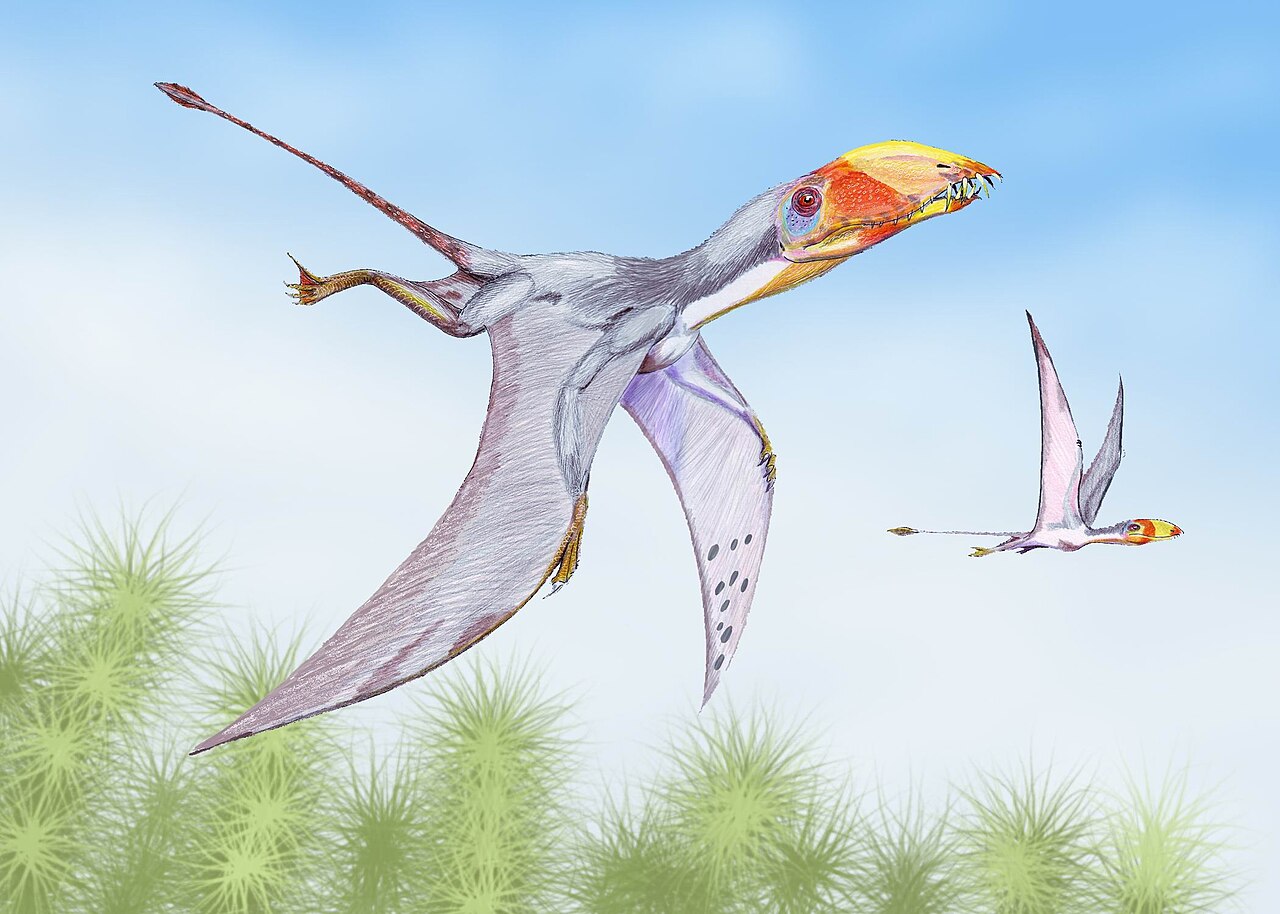
The creature had a relatively small wingspan of around 1.4 meters, roughly the width of a large seabird’s wings. Yet its skull was enormous compared with the rest of its body. The head alone could reach about 23 centimeters long, making it disproportionately large.
The body itself was compact and lightweight, with a stiff tail extending behind it. This tail was longer than that of most later pterosaurs and likely helped stabilize the animal during flight.
The wings of Dimorphodon were supported by an elongated fourth finger, a defining feature of all pterosaurs. A thin membrane of skin stretched from this finger down the side of the body and possibly to the hind limbs. This membrane formed the wing surface that allowed the animal to generate lift.
Despite these familiar pterosaur features, Dimorphodon’s short wings and heavy head would have made its flight style quite different from that of later species. Rather than soaring effortlessly across oceans like some giant pterosaurs, Dimorphodon probably flew in short bursts, gliding between elevated perches.
Its body structure suggests a lifestyle that combined flying with climbing and walking.
The Mystery of Two Kinds of Teeth
The feature that truly distinguishes Dimorphodon from other pterosaurs is its remarkable dentition.
The front of its jaws held large, fang-like teeth. These teeth were pointed and robust, ideal for gripping prey. Behind them were many smaller teeth that formed a dense row along the rest of the jaw.
This combination gave the creature two distinct types of teeth—hence the name Dimorphodon.
The large front teeth likely helped capture prey quickly, preventing escape. The smaller rear teeth may have been used for gripping and processing food before swallowing.
Such specialized dentition suggests a varied diet. Dimorphodon may have eaten insects, small reptiles, and possibly fish. Its large eyes indicate strong vision, useful for spotting prey from the air or while perched on rocks.
The two-tooth system represents a fascinating evolutionary adaptation, revealing how early pterosaurs experimented with feeding strategies.
Wings Built for an Ancient Sky
The wings of Dimorphodon were both similar to and different from those of modern flying animals.
Unlike birds, whose wings are feathered structures supported by multiple bones, pterosaur wings were formed by a membrane stretched across elongated bones. The key support came from the fourth finger, which extended dramatically outward to hold the wing membrane.
This design created a lightweight but flexible wing capable of generating lift.
However, Dimorphodon’s wings were relatively short and broad compared with those of later pterosaurs. This suggests the animal was adapted for maneuverability rather than long-distance gliding.
It likely launched itself from cliffs or trees, flapping vigorously before gliding to another perch. Its flight may have resembled that of certain modern birds that combine bursts of flapping with gliding, such as crows or pigeons.
The structure of its shoulder and chest bones indicates strong flight muscles, suggesting that despite its odd proportions, Dimorphodon was an effective flier within its ecological niche.
Fur-Like Covering and Warm-Blooded Possibilities
For many years, scientists assumed pterosaurs were cold-blooded reptiles similar to modern lizards. However, fossil evidence has gradually changed this view.
Some pterosaur fossils show hair-like filaments covering their bodies. These structures, known as pycnofibers, resemble a primitive form of fur.
Although direct evidence in Dimorphodon specimens is limited, many paleontologists believe it likely possessed similar coverings.
If so, this would suggest that Dimorphodon had a relatively high metabolic rate and possibly warm-blooded physiology. Flight requires enormous energy, and insulation would help maintain body temperature.
The presence of pycnofibers also hints that pterosaurs occupied an evolutionary position closer to birds and dinosaurs than once believed.
This insight transforms our image of Dimorphodon from a scaly reptile into a more dynamic, active creature—perhaps covered in fuzzy filaments and capable of sustained activity.
Life on the Jurassic Coast
Dimorphodon’s fossils are most famously found in the cliffs of Lyme Regis, which during the Early Jurassic formed part of a coastal environment.
Imagine steep limestone cliffs rising above a restless sea. Waves crash below while dense vegetation spreads inland. Insects buzz through the air, and small reptiles scurry across rocks warmed by the sun.
In this landscape, Dimorphodon likely nested on cliff ledges or in sheltered crevices. These elevated locations would provide safety from many ground predators.
From these perches, the animals could launch into the air, scanning for prey along the shoreline or in nearby forests.
They may have been social creatures, gathering in colonies similar to modern seabirds. Fossil evidence cannot fully confirm this behavior, but the nesting environments suggest the possibility.
The coastal ecosystem would have provided abundant food, making it an ideal home for early flying reptiles.
Movement on Land
One of the most intriguing questions about Dimorphodon concerns how it moved when not flying.
Early depictions imagined pterosaurs as awkward creatures that could barely move on land. Modern research paints a different picture.
The limbs of Dimorphodon suggest it could walk on all fours. When grounded, it likely used its wings as forelimbs, supporting itself on the knuckles of its folded wings while the hind legs carried part of the weight.
This posture would resemble a bat moving across the ground.
The curved claws on its limbs also suggest climbing ability. Dimorphodon may have scrambled up tree trunks or rocky surfaces to reach launch points for flight.
These abilities would allow the animal to transition smoothly between ground, perch, and air—a versatile lifestyle suited to the dynamic environments of the Jurassic coast.
The Brain of an Early Flyer
Flight requires precise coordination, balance, and spatial awareness. As a result, flying animals tend to have well-developed brains, particularly in regions responsible for vision and movement.
Studies of pterosaur skulls show that the brain of Dimorphodon was relatively advanced for a reptile.
The regions associated with vision were particularly large, suggesting excellent eyesight. This would be essential for spotting prey and navigating through complex environments while flying.
The inner ear structures also indicate strong balance control, allowing the animal to maintain stability during flight.
Though small by modern standards, the brain of Dimorphodon reflects the evolutionary demands of powered flight.
Evolutionary Importance
Dimorphodon occupies an important position in pterosaur evolution. It belongs to a group known as early or basal pterosaurs, which display primitive features compared with later species.
Later pterosaurs developed longer wings, shorter tails, and more specialized skulls. Some eventually reached enormous sizes, with wingspans exceeding ten meters.
Dimorphodon represents an earlier stage in this evolutionary journey, preserving traits that reveal how flight first evolved among reptiles.
Its unusual anatomy demonstrates that early pterosaurs experimented with many different body plans before settling into the forms seen in later periods.
In this sense, Dimorphodon is not just an oddity—it is a window into the early evolution of one of Earth’s most remarkable adaptations.
Fossils and Scientific Investigation
Fossils of Dimorphodon remain relatively rare but scientifically valuable. Most specimens come from England, though related pterosaurs have been found elsewhere.
These fossils often include partial skeletons, skulls, and wing bones preserved in fine-grained limestone.
Modern techniques such as CT scanning allow scientists to examine the internal structures of these fossils without damaging them. This technology reveals details of the brain cavity, bone density, and muscle attachment sites.
Each new discovery refines our understanding of how Dimorphodon lived and moved.
Paleontology is a detective story played out over millions of years, and Dimorphodon remains one of its most intriguing characters.
Dimorphodon in Popular Imagination
Because of its unusual appearance, Dimorphodon has captured public imagination. It appears in books, documentaries, and even films portraying prehistoric life.
Artists often depict it with an oversized head, leathery wings, and sharp teeth, giving it a dramatic and slightly monstrous look.
While such portrayals sometimes exaggerate its features, they reflect the genuine strangeness of the animal.
Dimorphodon reminds us that evolution does not always produce elegant or symmetrical designs. Sometimes it creates creatures that seem almost improbable—yet they thrive within their environments.
The Legacy of an Early Sky Pioneer
Today, the skies are filled with birds and bats, creatures whose ancestors evolved long after Dimorphodon vanished. Yet these modern flyers owe something to the earlier pioneers of the air.
Pterosaurs were the first vertebrates to achieve powered flight, and species like Dimorphodon were among the earliest members of this extraordinary lineage.
For tens of millions of years, their wings ruled prehistoric skies.
Dimorphodon itself disappeared long before the end of the age of dinosaurs, but its fossils continue to inspire curiosity. They remind us that life’s history is filled with unexpected forms and bold evolutionary experiments.
In the cliffs of southern England, where Mary Anning once searched for fossils with tireless determination, the stone still holds fragments of that ancient world.
Within those rocks lies the memory of a small flying reptile with two kinds of teeth, a giant head, and wings that carried it across Jurassic skies.
Dimorphodon may look strange to modern eyes, but in its time it was a master of its environment—a symbol of nature’s creativity and the endless possibilities of evolution.
And as long as we continue to study the past, its story will keep soaring.