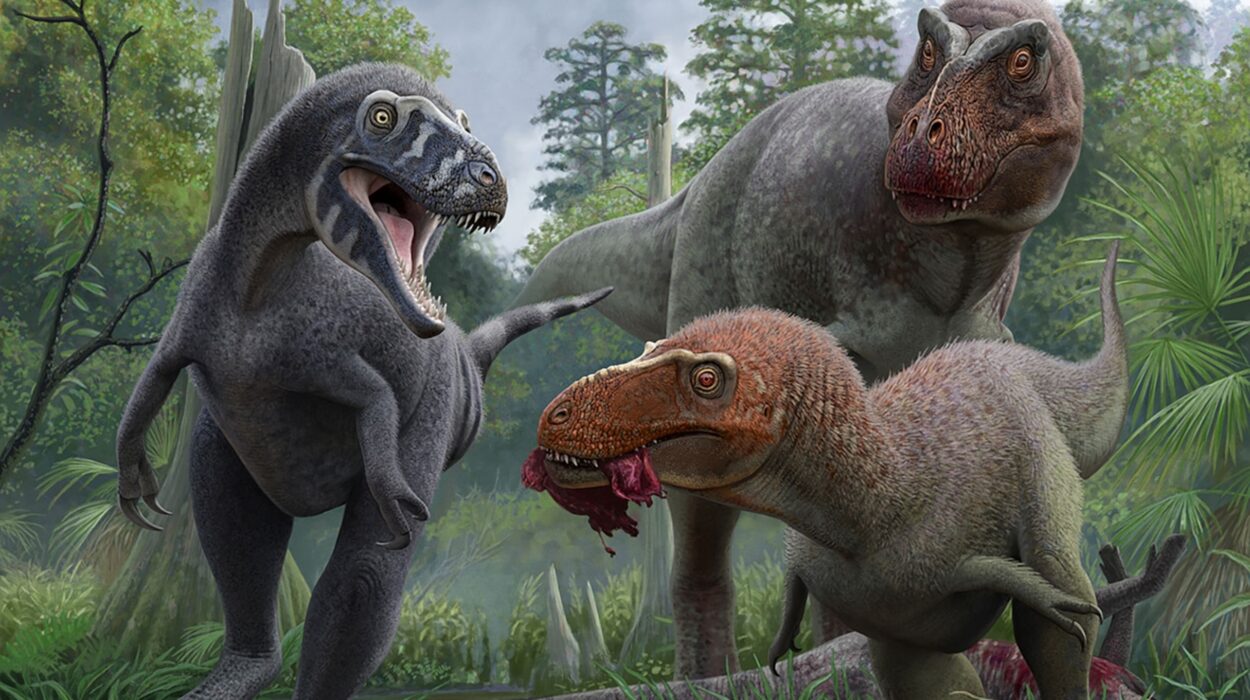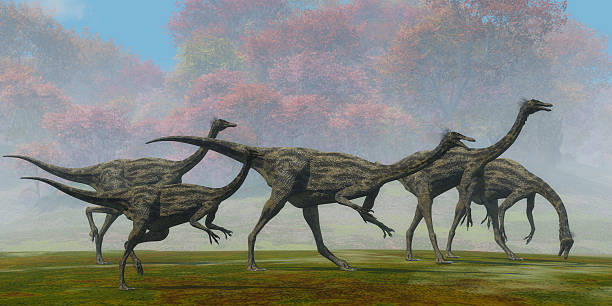
Across the ancient landscapes of the Late Cretaceous period, long before grass covered the plains or humans walked the Earth, herds of strange, elegant dinosaurs raced across the dusty floodplains of what is now Mongolia. They moved with astonishing speed, their long legs stretching like those of modern ostriches, their slender necks balancing lightweight bodies, and their toothless beaks snapping at anything edible in their path. At first glance, one might imagine a giant prehistoric bird sprinting through a primeval desert.
This remarkable dinosaur was Gallimimus—one of the most fascinating and unusual creatures of the dinosaur world. Its name literally means “chicken mimic,” a title that perfectly captures its bird-like appearance. Yet despite the humorous image its name evokes, Gallimimus was not a small creature. It could reach lengths of nearly six meters and tower over a human when fully grown. It was graceful, fast, and perfectly adapted for life in a harsh environment.
Gallimimus was a member of a group of dinosaurs known as ornithomimids, often called “ostrich dinosaurs.” These animals shared several features with modern birds: long legs, light bodies, elongated necks, and beaked mouths. But Gallimimus stood out even among its relatives. It was one of the largest and possibly the fastest member of its family, capable of running at speeds that may have rivaled modern flightless birds.
For decades, Gallimimus has captured the imagination of scientists and the public alike. Fossils discovered in the deserts of Central Asia revealed a creature that combined grace, speed, and evolutionary intrigue. Its skeleton tells a story of survival in a challenging environment, adaptation to a unique ecological niche, and a glimpse into the evolutionary path that would eventually lead to birds.
Understanding Gallimimus is not just about studying a dinosaur. It is about reconstructing an ancient world, one in which strange animals roamed vast landscapes, ecosystems thrived in unfamiliar forms, and evolution experimented with body plans that still fascinate us today.
Discovery in the Mongolian Desert
The story of Gallimimus began in one of the most famous fossil-rich regions on Earth: the Gobi Desert. In the late twentieth century, international paleontological expeditions began exploring this vast and harsh landscape, where wind-carved cliffs expose layers of rock dating back to the age of dinosaurs.
In 1963, a joint Polish-Mongolian expedition uncovered a remarkable set of fossils in the Nemegt Formation, a geological formation dating to the Late Cretaceous period roughly seventy million years ago. The skeletons belonged to a large, bird-like dinosaur that had never been described before.
The new dinosaur was formally named by the Polish paleontologist Rinchen Barsbold along with colleagues. They gave it the name Gallimimus bullatus. The genus name Gallimimus combines Latin words meaning “chicken” and “mimic,” referring to the animal’s bird-like appearance. The species name bullatus refers to distinctive balloon-like structures in the bones near the skull.
The discovery was extraordinary for several reasons. The fossils included multiple skeletons preserved in remarkable detail, allowing scientists to study the dinosaur’s anatomy with unusual precision. Unlike many dinosaurs known only from fragmentary remains, Gallimimus was represented by nearly complete skeletons.
These fossils revealed a creature unlike the heavy, armored, or massive predators often associated with dinosaurs. Instead, Gallimimus appeared built for speed. Its limbs were long and slender, its bones lightweight, and its head small compared to its body.
The environment preserved in the rocks of the Nemegt Formation suggested a landscape very different from today’s desert. During the Late Cretaceous, the region likely contained rivers, floodplains, and patches of forest. This environment supported a rich ecosystem of dinosaurs, including massive predators like Tarbosaurus bataar and giant plant-eaters such as Saurolophus.
In this diverse ecosystem, Gallimimus played a unique role.
The Anatomy of a Speed Specialist
One look at the skeleton of Gallimimus immediately reveals its most striking feature: its extraordinary proportions. The body appears almost aerodynamic, designed for rapid movement across open ground.
The skull of Gallimimus was long and narrow, ending in a toothless beak. Unlike many carnivorous dinosaurs, it lacked sharp teeth. Instead, the beak may have been used to pick up small food items, filter water, or clip vegetation.
The eye sockets were large, suggesting good vision. Large eyes would have been advantageous for detecting predators in open landscapes. Vision likely played a critical role in survival.
The neck was long and flexible, allowing the animal to reach the ground easily while moving or feeding. This feature also helped maintain balance during rapid running.
But the most remarkable part of Gallimimus’s anatomy was its legs. They were extremely long relative to the body, with elongated lower limb bones that resemble those of modern running birds. The tibia, or shinbone, was longer than the femur, a feature typical of animals adapted for speed.
The feet had three main weight-bearing toes, each tipped with claws. These toes would have provided excellent traction on sandy or muddy ground.
The arms were shorter than the legs but still relatively long compared to many theropod dinosaurs. The hands had three fingers with curved claws, though they were not particularly suited for capturing large prey.
The tail was long and stiffened by tendons. This structure likely served as a counterbalance while running, helping maintain stability during rapid turns or sprints.
Overall, the body of Gallimimus was light and efficient. Its bones were hollow in places, reducing weight while maintaining strength.
Everything about its anatomy suggests an animal designed to move quickly.
How Fast Was Gallimimus?
The question of Gallimimus’s speed has fascinated paleontologists for decades. While it is impossible to measure the exact running speed of an extinct animal, scientists can estimate it using anatomical clues and comparisons with modern animals.
The long legs, lightweight build, and bird-like proportions of Gallimimus strongly suggest it was an exceptional runner. Biomechanical studies indicate it may have been capable of reaching speeds between fifty and sixty kilometers per hour.
This would make it one of the fastest dinosaurs known.
To put this into perspective, modern ostriches—the fastest living birds on land—can reach speeds of about seventy kilometers per hour. Gallimimus likely ran in a similar style, using long strides and powerful leg muscles to propel itself forward.
Speed would have been an essential survival tool. In the Late Cretaceous ecosystem, predators such as Tarbosaurus bataar roamed the same landscapes. A dinosaur without teeth or armor needed another defense.
Running was its protection.
A herd of Gallimimus could have erupted into motion at the first sign of danger, scattering across the plains in a cloud of dust.
What Did Gallimimus Eat?
The diet of Gallimimus has long been debated among paleontologists. Its toothless beak suggests it was not a typical meat-eating theropod.
Some scientists believe Gallimimus was omnivorous, meaning it ate both plant and animal material. Its beak may have been used to pick up small animals such as insects, lizards, or crustaceans.
Evidence from related ornithomimid dinosaurs suggests some species may have had filter-feeding adaptations, allowing them to strain small organisms from water or mud. In such a scenario, Gallimimus might have fed along riverbanks or shallow pools.
Other researchers propose that Gallimimus may have eaten seeds, fruits, leaves, and other plant matter.
The structure of the jaw suggests it was well suited for quickly snapping up small food items rather than tearing flesh.
It is likely that Gallimimus had a flexible diet, consuming whatever food sources were available in its environment. Such adaptability would have been beneficial in the changing climates of the Late Cretaceous.
Life in Herds
One of the most intriguing aspects of Gallimimus is the possibility that it lived in groups. Fossil sites have revealed multiple individuals preserved together, suggesting herd behavior.
Herd living offers many advantages. A group of animals can detect predators more easily than a solitary individual. When danger appears, the entire herd can flee together.
Running in herds may also confuse predators, making it harder to single out one target.
If Gallimimus behaved like modern herd animals, it may have migrated across the landscape in search of food and water. Seasonal movements would have been common in environments with fluctuating resources.
Young Gallimimus likely stayed close to adults, learning survival strategies from the herd.
This social behavior adds another layer to the dinosaur’s story. Instead of isolated individuals wandering alone, Gallimimus may have formed dynamic communities moving across ancient floodplains.
The World of the Late Cretaceous
To truly understand Gallimimus, we must imagine the world it inhabited.
During the Late Cretaceous, the region that is now Mongolia was part of a vast ecosystem of rivers, wetlands, forests, and open plains. The climate was warmer than today, and dinosaurs dominated the land.
Towering conifers and flowering plants covered the landscape. Rivers carved winding paths through the terrain, creating fertile floodplains.
In these environments lived a wide variety of dinosaurs.
Large duck-billed herbivores grazed on vegetation. Armored dinosaurs moved slowly through forests. Predatory theropods hunted across open ground.
Gallimimus occupied a niche somewhere between predator and plant-eater. Its speed allowed it to roam widely, searching for food and avoiding danger.
It was neither the most powerful nor the most heavily armored dinosaur. Instead, it relied on agility and adaptability.
Gallimimus and the Evolution of Birds
One of the most fascinating aspects of Gallimimus is its relationship to birds.
Birds are now known to have evolved from small theropod dinosaurs. Many features once thought unique to birds—such as hollow bones and three-fingered hands—also appear in dinosaurs like Gallimimus.
Although Gallimimus itself was not a direct ancestor of modern birds, it belonged to the same broad evolutionary lineage.
Its bird-like skeleton demonstrates how diverse theropod dinosaurs became during the age of dinosaurs. Some evolved into giant predators, others into swift runners, and still others eventually developed feathers and flight.
Fossil discoveries over the past few decades have strengthened the connection between dinosaurs and birds. Many theropods are now known to have possessed feathers or feather-like structures.
While direct evidence of feathers on Gallimimus remains uncertain, it is possible that it had some form of feather covering, especially during early life stages.
If so, the sight of a herd of Gallimimus sprinting across a Cretaceous plain may have resembled a flock of enormous prehistoric birds.
Gallimimus in Popular Culture
Gallimimus became widely known to the public through the film Jurassic Park. In one memorable scene, a herd of Gallimimus stampedes across an open field while fleeing a pursuing predator.
The scene captured the grace and speed of these dinosaurs and introduced millions of viewers to the concept of fast, bird-like theropods.
While the film took some artistic liberties, it succeeded in portraying Gallimimus as a swift herd animal.
The popularity of the film helped bring attention to ornithomimid dinosaurs and sparked interest in paleontology among a new generation.
Continuing Scientific Research
Even decades after its discovery, Gallimimus continues to be studied by scientists.
New technologies such as CT scanning allow researchers to examine fossil bones in extraordinary detail. Computer simulations help reconstruct how dinosaurs moved and behaved.
Each new study adds pieces to the puzzle of Gallimimus’s life.
Paleontologists are particularly interested in understanding how ornithomimids evolved and how they fit into dinosaur ecosystems.
Fossil discoveries in Asia and North America continue to reveal new species related to Gallimimus, expanding our understanding of this remarkable group.
The Legacy of the “Chicken Mimic”
Gallimimus may not have had the terrifying teeth of a tyrannosaur or the massive horns of a ceratopsian, but its story is no less fascinating.
It represents a different kind of dinosaur success—one based on speed, agility, and adaptability.
Its graceful skeleton tells the story of evolution experimenting with bird-like body plans long before birds dominated the skies.
In the windswept deserts of Mongolia, the fossils of Gallimimus still lie buried in ancient rock layers, waiting to reveal more secrets.
They remind us that the age of dinosaurs was not only about giants and predators. It was also about elegant runners racing across prehistoric landscapes under skies filled with pterosaurs and ancient clouds.
Gallimimus stands as a symbol of the incredible diversity of dinosaur life and the endless curiosity that drives scientists to uncover the past.
In every fossil bone, every reconstructed skeleton, and every scientific study, Gallimimus continues to run—swift, graceful, and unforgettable—through the pages of Earth’s history.