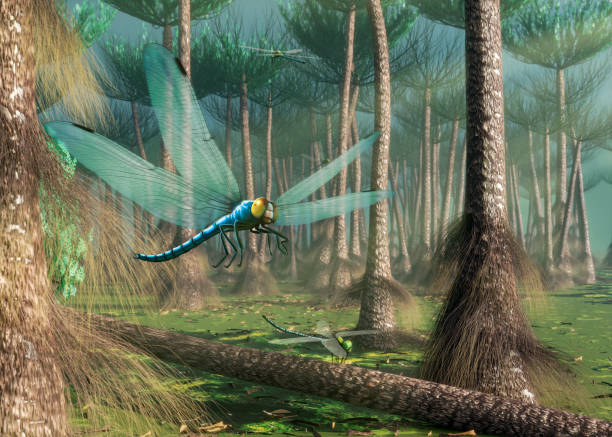
Long before human footsteps pressed into soil, before dinosaurs thundered across plains, and even before flowering plants colored the land, Earth belonged to creatures that seem almost unreal today. They crawled through dense forests of towering club mosses and giant ferns. They glided over vast swampy wetlands under a sky richer in oxygen than the one we breathe now. They skittered along the ground with armor-plated bodies and piercing mouthparts. They were insects and their relatives, but not as we know them. They were enormous.
The prehistoric world was not only a kingdom of giant reptiles. It was also an age of oversized arthropods. Some had wingspans rivaling modern birds. Others stretched longer than a human adult. Their size challenges our assumptions about insects as small, fragile creatures. Instead, they were formidable presences in ancient ecosystems.
Much of their gigantism is linked to atmospheric conditions during the late Paleozoic Era, especially the Carboniferous Period, roughly 359 to 299 million years ago. At times, oxygen levels in the atmosphere rose significantly higher than today’s approximately 21 percent. Because insects breathe through a system of air-filled tubes called tracheae rather than lungs, higher oxygen concentrations may have allowed their bodies to grow larger while still delivering sufficient oxygen to tissues. Climate, lack of large terrestrial vertebrate predators in earlier intervals, and ecological opportunities also likely played roles.
Fossils preserved in ancient sediments reveal this lost world. Impressions of wings, fragments of exoskeletons, and entire articulated bodies offer glimpses into ecosystems that feel almost mythical. Yet they are entirely real, grounded in paleontological evidence. Here are nine prehistoric insects and close arthropod relatives that were terrifyingly large, scientifically fascinating, and unforgettable.
1. Meganeura
Among the most famous of giant prehistoric insects is Meganeura, a dragonfly-like predator that soared through Carboniferous skies. Fossils discovered in what is now France reveal wingspans reaching up to about 70 centimeters, nearly the size of a modern seagull. To imagine a dragonfly that wide gliding silently overhead is to feel a shiver of ancient unease.
Meganeura belonged to an extinct order known as Meganisoptera, often informally called griffinflies. Although they resembled modern dragonflies, they were not true dragonflies. Their long, slender bodies and two pairs of large membranous wings suggest they were agile fliers. The structure of their mouthparts indicates they were predators, likely feeding on other insects and possibly small amphibians.
The Carboniferous world offered vast swamp forests teeming with invertebrate life. With high oxygen levels and limited competition from flying vertebrates, Meganeura occupied the top tier of aerial insect predators. Its compound eyes would have given it excellent vision, crucial for hunting. When it launched from a branch and took to the air, it was a master of its domain.
The disappearance of Meganeura and its relatives is linked to environmental changes and the rise of vertebrate fliers in later periods. As oxygen levels declined and ecosystems shifted, such immense winged insects could no longer thrive. Today’s dragonflies, impressive in their own right, are distant echoes of these Paleozoic giants.
2. Meganeuropsis
Even larger than Meganeura was Meganeuropsis, known from fossils in what is now the United States and dating to the early Permian Period. With wingspans estimated at up to around 75 centimeters, Meganeuropsis is considered one of the largest flying insects ever discovered.
Like Meganeura, Meganeuropsis was part of the griffinfly lineage. Its immense wings would have stretched outward like living sails. The veins in its wings, preserved in fossil impressions, reveal complex structures that strengthened them for flight. Despite their size, these insects were likely capable of powerful, controlled flight, supported by the oxygen-rich air of their time.
Imagining a forest clearing in the Permian, with towering vegetation and a humid atmosphere, it is not hard to picture Meganeuropsis gliding from tree to tree. Its predatory lifestyle would have shaped the behavior of smaller insects, influencing ecological dynamics much as birds of prey do today.
Meganeuropsis stands as a reminder that the limits we see in modern ecosystems are not absolute. Evolution has explored possibilities that now seem almost fantastical.
3. Arthropleura
Though not technically an insect but a millipede-like arthropod, Arthropleura deserves a place among these giants. Living during the late Carboniferous and early Permian, Arthropleura reached lengths of over two meters, making it the largest known land invertebrate in Earth’s history.
Its segmented body, covered by protective plates, would have rippled as it moved across the forest floor. Fossil trackways suggest it traveled through dense vegetation, likely feeding on decaying plant matter. Unlike predatory giants such as Meganeura, Arthropleura appears to have been a detritivore or herbivore.
The sight of a creature longer than a human, with dozens of legs moving in coordinated waves, would have been both mesmerizing and intimidating. Yet Arthropleura likely posed little direct threat to other animals. Its massive size may have offered protection from predators and allowed efficient processing of abundant plant material in swamp forests.
Arthropleura’s eventual extinction coincided with climatic changes and the drying of Carboniferous coal swamps. As environments transformed, so too did the opportunities for giant arthropods.
4. Titanoptera
During the Permian Period, another group of large insects emerged: the Titanoptera. These extinct insects are known from fossil remains primarily in what is now Asia. Some species are estimated to have had wingspans exceeding 35 centimeters.
Titanopterans resembled a blend of modern grasshoppers and mantises, though they were not direct ancestors of either. Their powerful forelegs may have been adapted for grasping prey. Their wings show structural features suggesting they were capable fliers.
One intriguing aspect of Titanoptera is evidence that some species possessed sound-producing structures, possibly used in communication. If so, ancient forests might have echoed with deep, resonant calls unlike anything heard today.
Though smaller than Meganeuropsis, Titanoptera were still formidable by modern insect standards. Their presence highlights the diversity of large insect lineages that flourished in prehistoric times.
5. Pulmonoscorpius
Pulmonoscorpius, a giant prehistoric scorpion from the Carboniferous, could reach lengths of about 70 centimeters. Though scorpions are not insects but arachnids, they are arthropods and share a close evolutionary relationship.
Fossils found in Scotland reveal a creature with large pincers and a segmented tail ending in a venomous stinger. In the humid, swampy environments of its era, Pulmonoscorpius would have been an apex invertebrate predator.
Its name reflects evidence suggesting it possessed book lungs, indicating it was well adapted to terrestrial life. The idea of a scorpion nearly the size of a small dog prowling ancient forests is enough to unsettle the imagination.
Pulmonoscorpius likely preyed on other arthropods and possibly small vertebrates. Its size and predatory tools demonstrate that gigantism was not limited to flying insects but extended across multiple arthropod groups.
6. Jaekelopterus
Jaekelopterus was not an insect but a eurypterid, often called a sea scorpion. Living during the Devonian Period, it reached lengths of up to about 2.5 meters, making it one of the largest arthropods ever to exist.
Unlike terrestrial giants, Jaekelopterus inhabited aquatic environments. Fossils discovered in Europe reveal a creature with large grasping claws and a streamlined body adapted for swimming.
As a top predator in ancient freshwater ecosystems, Jaekelopterus would have hunted fish and other marine organisms. Its size and weaponry positioned it as a formidable force.
Although separated from insects by evolutionary distance, eurypterids illustrate how arthropod body plans could scale to enormous proportions under favorable conditions.
7. Mazothairos
Mazothairos was a large bristletail insect from the Carboniferous Period. Fossils from France indicate it could reach lengths of around 5 to 6 centimeters, substantial for a primitive wingless insect of its time.
While not gigantic in comparison to Meganeura, Mazothairos represents early insect experimentation with body size and form. Its elongated body and bristle-like appendages suggest it lived among leaf litter and vegetation.
Mazothairos helps scientists understand early insect evolution, including the development of wings and terrestrial adaptations. It stands as a reminder that even the ancestors of modern insects once pushed size boundaries relative to their ecological niches.
8. Phasmomimidae Relatives
During the Carboniferous, some early stick insect relatives reached impressive sizes compared to their modern descendants. Fossil evidence suggests that certain prehistoric phasmid-like insects had wingspans and body lengths larger than most living stick insects.
These insects likely relied on camouflage among dense vegetation, blending with stems and leaves. Their increased size may have offered advantages in avoiding predation or accessing food resources.
Though not as dramatic as griffinflies or giant scorpions, these oversized stick insects illustrate the broader pattern of insect gigantism during periods of high oxygen and ecological opportunity.
9. Grylloblattid Relatives and Early Orthopterans
Early relatives of modern grasshoppers and crickets in the late Paleozoic also included species significantly larger than many of today’s forms. Fossil orthopterans with wingspans exceeding 20 centimeters have been documented.
These insects likely inhabited forested environments, feeding on plants and interacting with a web of predators and competitors. Their enlarged bodies and wings hint at evolutionary experimentation during a time when insects were diversifying rapidly.
The presence of these large orthopterans reinforces the idea that gigantism was not limited to a single lineage but occurred across multiple insect groups.
Why Were They So Large?
The repeated emergence of giant arthropods in the Paleozoic raises a profound question. Why did evolution allow such sizes then, but not now?
One leading hypothesis involves atmospheric oxygen. During parts of the Carboniferous Period, oxygen concentrations may have exceeded 30 percent. Insects rely on passive diffusion through tracheae to deliver oxygen. Higher atmospheric oxygen would have allowed larger body sizes without requiring radically different respiratory systems.
Additionally, ecological factors played roles. Before the rise of large terrestrial vertebrate predators and flying reptiles or birds, insects occupied ecological spaces with fewer constraints. Abundant plant life provided food and habitat.
As climates shifted, oxygen levels declined, and new predators evolved, selective pressures changed. Gigantic insects may have become less viable in the new conditions.
Echoes of a Giant Past
Today’s insects are smaller, but they remain extraordinarily diverse and ecologically essential. Dragonflies still patrol wetlands. Millipedes still recycle plant matter. Scorpions still lurk in deserts. Though diminished in size, they carry ancient legacies.
Fossils of giant insects and arthropods remind us that Earth’s history is filled with chapters stranger than fiction. The forests of the Carboniferous were alive with the buzz of enormous wings and the rustle of armored bodies. These creatures were not monsters in a mythical sense; they were products of natural laws operating under different conditions.
To study them is to expand our sense of possibility. It reveals that life adapts to planetary circumstances in ways both predictable and astonishing. Physics, chemistry, and biology intertwine to shape the boundaries of what is possible.
In the end, the terrifyingly large insects of prehistory are not merely curiosities. They are windows into deep time, into atmospheres long vanished and ecosystems long buried. They challenge our imagination and enrich our understanding of evolution.
When we look at a delicate dragonfly hovering above a pond today, we are glimpsing the distant descendant of giants. In its transparent wings flickers the memory of Meganeura. In the soil beneath our feet, in the ancient rocks that hold fossil imprints, lies the story of a world where insects ruled not only in number, but in size.