There was a time, not so long ago in geological terms, when humans did not stand alone at the top of the food chain. The world was colder then. Vast ice sheets spread across North America, Europe, and Asia. Winds swept over open steppe-tundra landscapes where grasses bent under frost and herds moved like living rivers across the plains. This was the Pleistocene epoch, often called the Ice Age, a time when glaciers advanced and retreated in rhythmic pulses and when Earth’s ecosystems looked both familiar and fantastically alien.
Early humans walked these lands. They painted on cave walls, shaped stone tools, tended fires, and watched the horizon carefully. And they shared their world with giants—creatures so massive and powerful that even today they seem almost mythical. These were not dinosaurs from a distant, unimaginable past. They were mammals much like those we know today, only larger, hairier, more formidable. Some of them vanished only thousands of years ago, overlapping directly with our own species.
The story of these Ice Age giants is not just about extinction. It is about coexistence, adaptation, survival, and transformation. It is about how humans learned to hunt, to strategize, and to tell stories in a world where danger and wonder walked side by side. Here are six of the most remarkable giants that once lived alongside us.
1. Woolly Mammoth
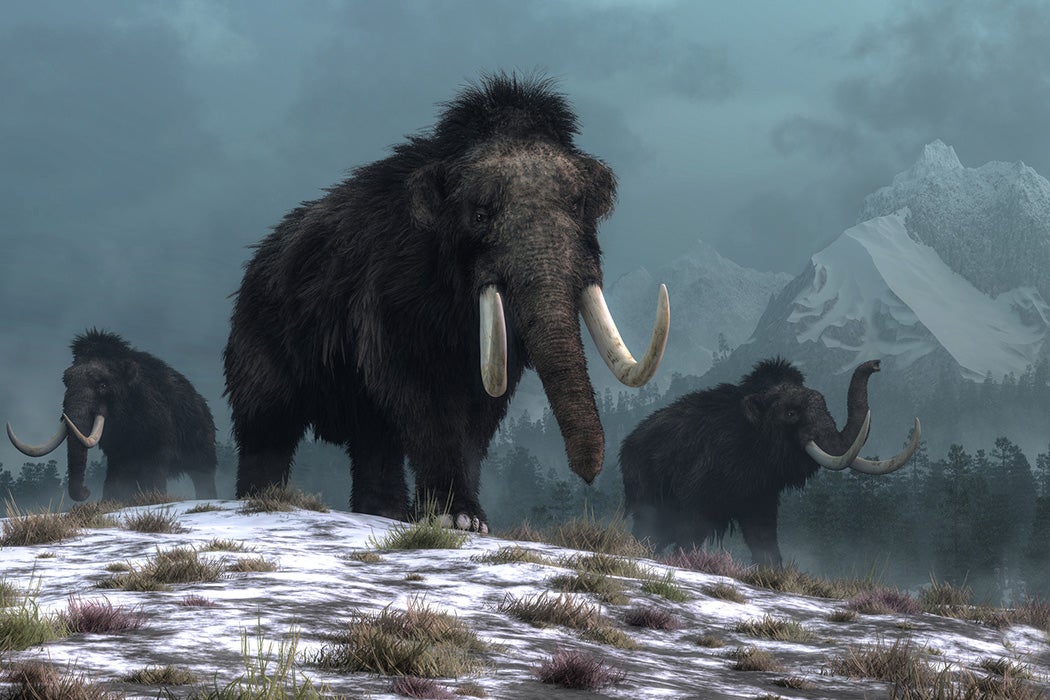
Few Ice Age creatures capture the imagination like the Woolly Mammoth. Towering up to four meters tall at the shoulder, draped in thick brown fur, and armed with long, spiraled tusks that could stretch several meters, mammoths were icons of the frozen north. They roamed across vast stretches of Eurasia and North America, grazing on grasses and shrubs that thrived in cold, dry steppe environments.
Despite their intimidating size, woolly mammoths were herbivores, closely related to modern elephants. Their thick undercoat and insulating fat layer protected them from harsh Ice Age winters. Even their ears were smaller than those of African elephants, reducing heat loss in frigid climates. Everything about their anatomy whispered adaptation to cold.
Humans and mammoths shared landscapes for tens of thousands of years. Archaeological sites across Europe and Siberia reveal mammoth bones bearing cut marks from stone tools. Some ancient dwellings were even constructed from mammoth bones, arranged into circular frameworks and covered with hides. To early humans, mammoths were not just animals; they were lifelines. Their meat fed communities, their hides provided warmth, their bones and tusks became tools and art.
Cave paintings in places such as France depict mammoths with surprising accuracy, capturing the curve of their tusks and the hump of fat over their shoulders. These artworks remind us that humans observed these giants carefully, perhaps with awe and fear intertwined.
The extinction of the woolly mammoth occurred around 4,000 years ago on isolated Arctic islands, though most populations disappeared earlier. Climate change at the end of the last Ice Age transformed grasslands into forests and wetlands, shrinking their habitat. Human hunting likely added pressure. The mammoth’s disappearance marked the fading of one of the Ice Age’s most majestic presences.
2. Woolly Rhinoceros
If mammoths were the lords of the frozen plains, the Woolly Rhinoceros was their armored counterpart. Covered in thick fur and equipped with two formidable horns—one long and curved, the other shorter—the woolly rhinoceros was built for survival in harsh steppe conditions.
This massive herbivore could weigh over two tons. Its broad, flattened horn was likely used to sweep aside snow, uncovering grasses beneath. Like mammoths, woolly rhinos were specially adapted to cold climates, with compact bodies and short limbs to conserve heat.
Humans encountered these animals across Eurasia. Evidence suggests that early hunters pursued them, though doing so must have been perilous. A charging woolly rhinoceros would have been an overwhelming force. Cave art again provides testimony to this coexistence. Detailed depictions show rhinos with prominent horns and shaggy coats, suggesting close observation.
Unlike modern rhinoceroses that inhabit warmer climates, the woolly rhinoceros vanished around 10,000 years ago. As temperatures rose and Ice Age ecosystems dissolved, their specialized adaptations may have become liabilities. Changing vegetation and expanding human populations likely contributed to their decline.
The image of a woolly rhino striding across snowy plains evokes a world balanced on the edge of ice and resilience, a world in which survival demanded strength and adaptability.
3. Saber-Toothed Cat
Predator and legend, the Smilodon—commonly called the saber-toothed tiger—was one of the most formidable carnivores of the Ice Age. Despite the nickname, it was not a true tiger. It belonged to a distinct lineage of cats characterized by elongated canine teeth that could reach over 20 centimeters in length.
Smilodon’s build was powerful and muscular, with robust forelimbs designed to grapple and subdue large prey. It likely hunted massive herbivores such as bison and young mammoths. Its long canines were not built for crushing bone but for delivering precise, fatal bites to soft tissue.
Humans and Smilodon overlapped in the Americas. While direct evidence of frequent encounters is limited, it is almost certain that early human communities were aware of these predators. To meet a saber-toothed cat in the wild would have been a moment of pure tension—a clash between two intelligent, cooperative species navigating the same landscape.
Fossils from places like the La Brea Tar Pits in California reveal a vivid snapshot of Ice Age ecosystems. Thousands of Smilodon individuals have been found there, preserved after becoming trapped in sticky asphalt seeps. These fossils show healed injuries, suggesting social behavior and group living.
Smilodon vanished around 10,000 years ago, near the end of the last Ice Age. The disappearance of large herbivores, climate shifts, and human expansion may all have played roles. With its extinction, the world lost one of its most dramatic predators.
4. Giant Ground Sloth
The Megatherium defies modern expectations of what a sloth should be. Unlike the small, tree-dwelling sloths of today, Megatherium was enormous—comparable in size to an elephant. It stood upright on powerful hind legs and used massive claws to pull down branches or defend itself.
Native to South America, giant ground sloths later spread into North America. They were herbivores, feeding on leaves and vegetation. Despite their size, they were not particularly fast. Their survival strategy likely depended on sheer bulk and strength rather than speed.
Humans arriving in the Americas encountered these giants. Archaeological evidence suggests that people hunted them. It is not difficult to imagine the tension of such an encounter: a towering sloth rising on its hind legs, claws glinting, while hunters advanced cautiously with spears.
Megatherium and related ground sloths disappeared roughly 10,000 years ago. Their extinction coincided with human arrival in many regions, as well as significant climate change. The loss of these strange, lumbering titans altered ecosystems in ways we are still trying to understand.
5. Irish Elk
With antlers stretching up to 3.5 meters from tip to tip, the Irish Elk was one of the largest deer ever to live. Despite its name, it ranged far beyond Ireland, inhabiting much of Europe and parts of Asia.
Standing over two meters tall at the shoulder, the Irish elk was a symbol of Ice Age grandeur. Its enormous antlers were likely used in display and combat during mating season. Such extravagant features required significant energy to grow, indicating access to rich grazing lands.
Humans shared territory with Irish elk for thousands of years. Their bones have been found at archaeological sites, sometimes bearing marks of butchery. To witness a herd of these animals moving across open grasslands would have been to see a spectacle of branching silhouettes against the sky.
The reasons for their extinction are debated. Climate change may have reduced the availability of nutrient-rich plants needed to sustain large antlers. Human hunting could have added further stress. By about 7,000 years ago, the Irish elk had vanished.
Yet their fossilized antlers, discovered in peat bogs and sediments, still inspire awe. They remind us of a time when the scale of life seemed amplified.
6. Short-Faced Bear
Among the most imposing predators of the Ice Age was the Arctodus simus. Standing up to 3.5 meters tall when upright, this North American bear was one of the largest terrestrial mammalian carnivores ever to exist.
Its long legs and relatively short snout distinguished it from modern bears. Some scientists believe it was an active predator capable of chasing prey over long distances; others suggest it may have been an opportunistic scavenger, using its size to intimidate other predators.
Humans entering North America would have encountered this towering bear. Imagine meeting such a creature across an open plain: a massive silhouette moving with unsettling speed. Survival would have required caution, cooperation, and ingenuity.
Arctodus simus disappeared around 11,000 years ago, near the end of the last Ice Age. As megafauna populations declined and ecosystems shifted, the short-faced bear’s ecological niche may have vanished with them.
The End of an Era
The extinction of Ice Age giants marks one of the most dramatic transitions in Earth’s recent history. Between about 50,000 and 10,000 years ago, many large mammals vanished from multiple continents. Climate change reshaped habitats as glaciers retreated. Forests replaced grasslands. Sea levels rose.
At the same time, humans spread into new territories, armed with increasingly sophisticated tools and social strategies. The precise balance between climate and human impact remains a subject of scientific debate, but it is clear that these forces interacted in complex ways.
The disappearance of mammoths, saber-toothed cats, giant sloths, and others transformed ecosystems. Large herbivores influence vegetation patterns. Top predators regulate prey populations. When such giants vanish, the ripple effects echo through food webs and landscapes.
Echoes in the Present
Though the giants are gone, their legacy endures. Fossils tell their stories. Ancient DNA extracted from bones reveals genetic secrets. Cave art preserves their outlines in charcoal and ochre. Modern elephants, rhinos, and bears carry echoes of their Ice Age relatives.
And humans? We are the last survivors of that shared world. We remember the giants not because we saw them with our own eyes, but because our ancestors did. In their hunts, their fears, their art, and their myths, the presence of these enormous creatures shaped our evolution.
The Ice Age was not merely a frozen chapter of prehistory. It was a living, breathing world of wind and ice, of thunderous footsteps and flickering firelight. To understand these six giants is to glimpse a time when humanity was young and the world was immense beyond imagination.
Their bones rest in museums and sediments, but their story continues to stir something deep within us—a reminder that we once walked among giants.