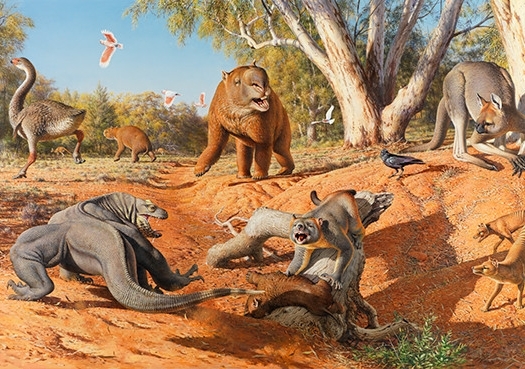
At the end of the last Ice Age, the Earth was home to a breathtaking collection of enormous animals. Vast grasslands and cold steppes stretched across continents, and through them moved herds of creatures so large and powerful that modern ecosystems seem modest by comparison. Towering mammoths roamed frozen plains. Giant ground sloths lumbered through forests. Saber-toothed cats stalked prey across open landscapes. Armored glyptodonts, giant bison, and massive elk filled the wild corners of the planet.
These animals are collectively known as Ice Age megafauna. The word “megafauna” simply means “large animals,” usually referring to species weighing more than about 44 kilograms. During the Pleistocene epoch, which lasted from about 2.6 million years ago until roughly 11,700 years ago, megafauna flourished across the globe.
Then something extraordinary happened. Within a relatively short span of geological time—thousands rather than millions of years—many of these giants vanished. Entire ecosystems lost their largest animals. North America alone lost mammoths, mastodons, giant beavers, saber-toothed cats, American lions, and many others. Similar disappearances occurred in South America, Australia, and parts of Eurasia.
The question has fascinated scientists for more than a century: why did the Ice Age megafauna go extinct?
The answer is one of the most complex puzzles in natural history. Evidence points to a combination of climate change, ecological transformation, and the arrival of a new and powerful predator: humans. Untangling these factors requires careful investigation into fossils, ancient DNA, climate records, and archaeological evidence.
What emerges is not a simple story, but a dramatic chapter in Earth’s history—one where shifting climates, fragile ecosystems, and human expansion collided.
The Ice Age Environment
To understand the disappearance of megafauna, it is necessary to understand the world they inhabited. During the Pleistocene epoch, Earth experienced repeated glacial cycles. Enormous ice sheets expanded across large parts of North America, Europe, and Asia, then retreated again during warmer interglacial periods.
These cycles dramatically reshaped landscapes. When glaciers expanded, sea levels dropped as water became locked in ice. Land bridges appeared between continents. The most famous of these was Beringia, a vast region connecting Siberia and Alaska when sea levels were lower.
The climate was colder overall, but the environment was not simply a frozen wasteland. In many regions, vast grasslands known as “mammoth steppe” dominated the landscape. These dry, windswept plains stretched from Western Europe across northern Asia and into North America.
The mammoth steppe supported immense populations of grazing animals. Among them were the iconic Woolly mammoth, a shaggy elephant relative adapted to cold climates. Herds of these giants traveled across open tundra and steppe in search of grasses and sedges.
Another massive herbivore was the American mastodon, which inhabited forests and wetlands. Unlike mammoths, mastodons browsed on shrubs and leaves rather than grazing grasses.
Large predators thrived alongside these herbivores. One of the most famous was Smilodon, the formidable saber-toothed cat whose elongated canine teeth could exceed 20 centimeters in length. Smilodon hunted large prey, likely relying on ambush tactics and powerful forelimbs.
North America also hosted dire wolves, American lions, giant short-faced bears, and other formidable predators. In South America lived giant ground sloths and armored glyptodonts. Australia supported enormous marsupials such as Diprotodon and giant kangaroos.
For hundreds of thousands of years, these ecosystems remained remarkably stable. Megafauna evolved together with their predators and environments. Yet by the end of the Ice Age, many of these species had disappeared.
The Timing of the Extinctions
One of the most important clues in solving the megafaunal mystery lies in timing. Radiocarbon dating of fossils shows that many large animals vanished near the end of the Pleistocene epoch, roughly between 50,000 and 10,000 years ago depending on the region.
In North America, the majority of megafaunal extinctions occurred around 13,000 years ago. This period corresponds closely with the spread of early human cultures across the continent, including the archaeological tradition known as the Clovis culture.
In Australia, large animals disappeared much earlier, roughly between 50,000 and 40,000 years ago, which also aligns with the arrival of humans on the continent.
In South America, extinctions occurred somewhat later but still coincided broadly with human expansion.
This pattern led many researchers to suspect that humans played a significant role. Yet the climate at the end of the Ice Age was also undergoing dramatic changes. Temperatures rose rapidly as glaciers melted and ecosystems transformed.
Determining which factor mattered most has been the central challenge of this scientific debate.
The Climate Change Hypothesis
One major explanation for megafaunal extinction is climate change. The end of the Ice Age was a period of intense environmental transformation.
As glaciers retreated, global temperatures increased. Sea levels rose by more than 100 meters. Forests spread into areas that had previously been grasslands. Many habitats changed rapidly within a few thousand years.
For animals adapted to cold, open landscapes, such changes could have been devastating.
The mammoth steppe ecosystem, for example, depended on dry, windy conditions that limited tree growth and supported grasslands. As the climate warmed and precipitation increased, forests expanded. Grasslands shrank, reducing the available habitat for large grazing animals.
Fossil pollen preserved in sediments reveals these shifts in vegetation. Regions once dominated by grasses gradually became covered by birch, spruce, and other trees.
Animals such as mammoths and woolly rhinoceroses may have struggled to adapt to these new environments. Reduced food availability could have caused population declines over generations.
Climate instability also produced sudden cold reversals, such as the Younger Dryas, a period beginning about 12,900 years ago when temperatures in the Northern Hemisphere temporarily dropped again. Rapid fluctuations like these may have placed additional stress on already vulnerable populations.
Yet climate change alone cannot fully explain the pattern of extinctions. Similar climate shifts occurred during earlier glacial cycles without causing such widespread losses. Many scientists believe another factor must have amplified the impact.
The Human Arrival Hypothesis
The second major explanation focuses on the arrival of modern humans.
Our species, Homo sapiens, evolved in Africa roughly 300,000 years ago and gradually spread across the globe. By the end of the Pleistocene, humans had reached nearly every continent except Antarctica.
Wherever humans arrived, megafaunal extinctions often followed.
Humans were highly adaptable hunters equipped with tools, social cooperation, and advanced cognitive abilities. Even with relatively simple weapons such as stone-tipped spears, coordinated groups of humans could potentially hunt large animals.
Some researchers proposed the “overkill hypothesis,” suggesting that human hunting drove megafauna to extinction.
According to this idea, newly arrived humans encountered animals that had never evolved alongside human hunters. These animals may not have recognized humans as dangerous predators, making them easier targets.
Even relatively low levels of hunting could destabilize populations if animals reproduced slowly. Many megafauna, including mammoths and mastodons, had long lifespans and low reproductive rates. Losing just a few individuals per year might have pushed populations into decline.
Archaeological sites provide some evidence for human hunting. Fossil bones bearing cut marks from stone tools have been discovered in several locations, indicating that humans butchered large animals.
However, clear evidence of widespread hunting remains limited. Not every extinct species shows direct signs of human predation. This has led scientists to consider more complex interactions between humans and ecosystems.
The Ecological Cascade
Modern ecological research suggests that even small human impacts can trigger large environmental consequences.
Humans do not simply hunt animals; they transform landscapes. Early human populations used fire, altered vegetation, and competed with predators for food resources.
In Australia, for example, evidence indicates that human-set fires may have changed vegetation patterns. Repeated burning can convert forests into grasslands or shrublands, dramatically altering habitats.
Such environmental modifications could have disrupted food webs and forced megafauna into decline.
Large animals also play essential roles in ecosystems. They disperse seeds, trample vegetation, and shape landscapes. When megafauna disappear, ecosystems can shift dramatically in response.
The extinction of giant herbivores might have altered plant communities, which in turn affected other animals. Predators dependent on large prey may have declined as well.
In this way, the disappearance of a few key species could cascade through entire ecosystems.
Evidence from Ancient DNA
Recent advances in genetic research have added new insights to the megafaunal mystery.
Scientists can now extract ancient DNA from fossil remains and analyze the genetic history of extinct species. These studies reveal population trends thousands of years before extinction.
Research on the Woolly mammoth, for example, shows that mammoth populations declined gradually over time as habitats shrank. Genetic diversity decreased, suggesting populations were becoming fragmented and vulnerable.
Some mammoths survived in isolated refuges long after mainland populations vanished. A small group persisted on Wrangel Island in the Arctic Ocean until about 4,000 years ago.
These isolated populations eventually died out due to a combination of environmental stress and genetic deterioration.
Ancient DNA studies suggest that megafaunal extinction was rarely caused by a single event. Instead, populations were often already weakening when other pressures appeared.
Regional Differences in Extinction Patterns
One of the most intriguing aspects of megafaunal extinction is how differently it unfolded across continents.
In Africa, where humans evolved alongside large animals for hundreds of thousands of years, many megafaunal species survived into the modern era. Elephants, rhinoceroses, giraffes, and large antelope still inhabit African ecosystems today.
In contrast, continents where humans arrived relatively late—such as Australia and the Americas—experienced much more dramatic losses.
This pattern suggests that animals in Africa evolved defenses against human hunting over long periods of coexistence. Animals elsewhere may not have had the same evolutionary experience.
The fossil record in Australia reveals the disappearance of enormous marsupials, giant reptiles, and massive flightless birds soon after human arrival roughly 50,000 years ago.
In North and South America, dozens of large species vanished around the time humans spread across the continents.
These patterns strengthen the argument that human activity played at least some role in megafaunal extinction.
The Role of Disease and Environmental Stress
Some researchers have proposed additional factors contributing to extinction.
One possibility is the spread of diseases carried by humans or domesticated animals. Newly introduced pathogens could have affected megafauna populations lacking immunity.
Another idea involves environmental stress caused by habitat fragmentation. As climates shifted and human populations expanded, animals may have been forced into smaller, isolated habitats.
Small populations are more vulnerable to extinction because they suffer from reduced genetic diversity and greater susceptibility to random events such as droughts or severe winters.
These pressures could have acted together with climate change and hunting to accelerate decline.
The Last Survivors
Not all megafauna vanished immediately at the end of the Ice Age. Some species survived for thousands of years in isolated environments.
Island ecosystems often served as refuges. Mammoths on Wrangel Island and St. Paul Island survived long after mainland populations disappeared.
These remnant populations eventually succumbed to environmental changes, limited resources, or genetic problems caused by small population size.
Their survival into relatively recent times highlights how extinction can be a slow process, unfolding over centuries or millennia.
Lessons from the Past
The extinction of Ice Age megafauna remains one of the most significant biological events of the late Quaternary period.
Scientists now widely agree that no single factor explains the phenomenon. Climate change altered habitats and stressed ecosystems. Human expansion introduced new predators and environmental changes. Ecological cascades amplified the effects.
Together, these forces reshaped the world.
Understanding this ancient extinction is more than an academic exercise. It offers valuable lessons about the fragility of ecosystems and the profound influence humans can have on the natural world.
Today, many large animals face similar pressures: habitat loss, climate change, and human activity. The disappearance of megafauna in the past reminds us that even dominant species can vanish when ecological balances are disrupted.
The Continuing Mystery
Despite decades of research, the story of the Ice Age megafauna is not fully solved. New discoveries continue to refine our understanding.
Improved dating techniques, climate reconstructions, and genetic analyses provide fresh clues. Some researchers are exploring the possibility that certain extinctions occurred earlier or later than previously thought.
Others investigate the complex relationships between vegetation, climate, and animal populations.
The scientific debate continues, but one thing is certain: the end of the Ice Age marked a turning point in Earth’s biological history.
Echoes of the Lost Giants
Imagine standing on a windswept plain in North America 20,000 years ago. In the distance, a herd of mammoths moves slowly across the steppe, their massive forms silhouetted against a pale sky. A saber-toothed cat waits in the shadows of a rocky outcrop. Giant ground sloths browse among scattered trees.
This world was real, vibrant, and full of life.
Today, only bones and frozen carcasses remain to tell its story. Yet through the work of paleontologists, archaeologists, and geneticists, we continue to reconstruct the lives of these vanished creatures.
Their extinction reminds us that the history of life on Earth is dynamic and ever-changing. Species rise, adapt, and sometimes disappear.
The giants of the Ice Age may be gone, but the questions they left behind continue to inspire exploration and wonder.