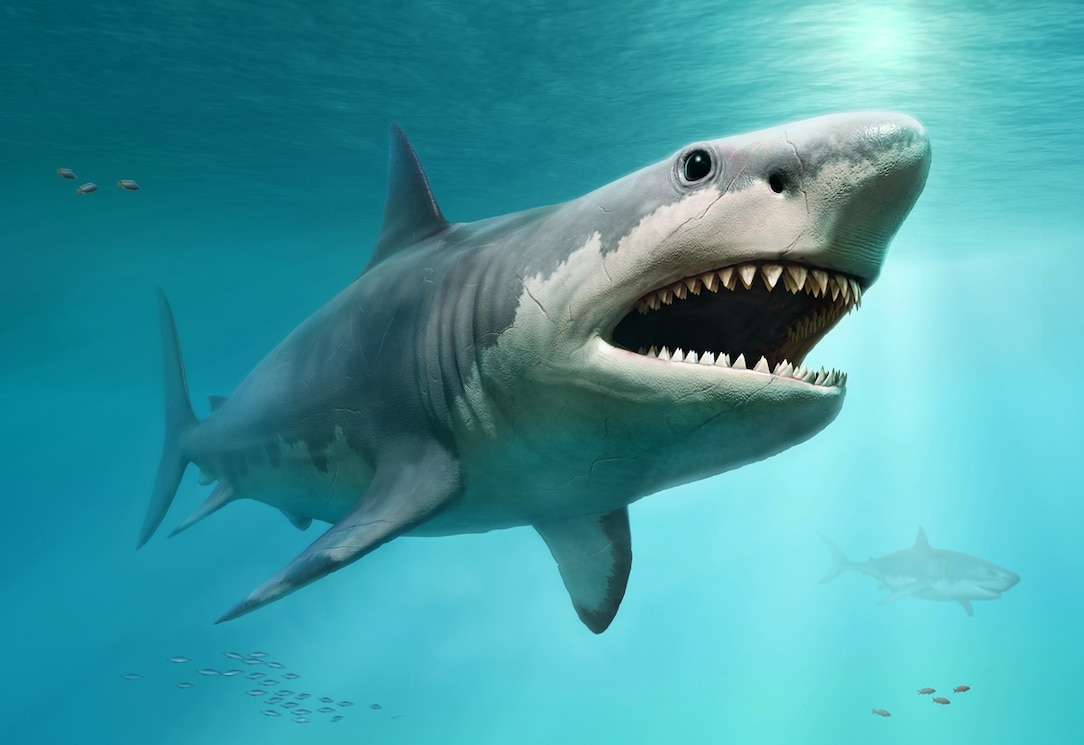
Imagine an ocean where the largest predators of today would appear small and cautious. Picture a shark so immense that a modern great white might seem like its smaller cousin swimming in its shadow. For millions of years, such a creature truly existed. It was one of the most powerful predators the Earth has ever seen—a shark known scientifically as Otodus megalodon.
Often simply called Megalodon, meaning “big tooth,” this prehistoric shark dominated the world’s oceans for millions of years. It was not merely large. It was colossal. Scientists estimate that Megalodon could reach lengths of up to 15–18 meters, possibly even longer. Its jaws were massive enough to swallow a human whole, and its teeth—serrated, triangular, and larger than a human hand—were designed for slicing through flesh and bone.
But despite its immense power, Megalodon disappeared. Around 3.6 million years ago, the giant predator vanished from the fossil record. The oceans that once belonged to it moved on without it.
Today, Megalodon lives on in documentaries, museums, and popular imagination. Some people even speculate that it still lurks somewhere in the deep sea, hidden in the darkest trenches of the ocean. But science tells a very different story.
The extinction of Megalodon is not a mystery filled with secret survivors. Instead, it is a fascinating scientific narrative about climate change, ecological shifts, evolutionary competition, and the fragile balance of life in the oceans.
A Predator Built for Dominance
To understand why Megalodon vanished, it is important to first understand how it lived. Megalodon was not simply another shark. It was an apex predator—an animal sitting at the very top of the food chain.
Its enormous body required enormous amounts of energy. This meant it needed a steady supply of large prey. Fossil evidence shows that Megalodon primarily hunted marine mammals. Early whales, seals, and large fish likely formed the foundation of its diet.
Its teeth reveal a great deal about its hunting style. Megalodon teeth are thick and serrated, built to slice through dense flesh and bone. Bite marks discovered on fossil whale bones show patterns consistent with attacks from these massive sharks. Some bones even show healed wounds, suggesting that whales sometimes survived encounters with the predator.
The bite force of Megalodon may have been the strongest of any known animal. Modern biomechanical estimates suggest it could exert a force exceeding 100,000 newtons—many times stronger than the bite of a modern great white.
Such power allowed Megalodon to attack prey that other predators could not challenge. It likely targeted the flippers or tails of whales, crippling them before delivering a fatal bite.
For millions of years, this strategy worked perfectly. Megalodon ruled the seas during the Miocene and early Pliocene epochs, a time when warm oceans supported abundant marine life.
But ecosystems do not remain static forever.
The Changing Oceans of the Pliocene
The world Megalodon evolved in began to change dramatically about 5 million years ago. During the transition from the Miocene to the Pliocene epoch, Earth’s climate started cooling.
Ocean temperatures gradually dropped. Polar ice sheets expanded. Sea levels shifted. These changes reshaped marine ecosystems across the globe.
Warm coastal waters—prime habitats for many marine animals—became less extensive. These areas were especially important because they served as nursery grounds where young Megalodons could grow safely.
Juvenile Megalodons likely depended on warm, shallow coastal regions rich in food and relatively free of larger predators. Fossil evidence suggests that these nursery areas existed in places like ancient coastal seas of what is now North and South America.
As climates cooled, many of these habitats disappeared or changed drastically. Losing safe nursery grounds would have made survival much more difficult for young sharks.
Without enough juveniles reaching adulthood, populations would inevitably decline.
Climate change alone may not have doomed Megalodon, but it created the first cracks in its dominance.
The Disappearance of Its Prey
A predator is only as successful as the prey it hunts. Megalodon’s immense size meant it needed very large animals to sustain itself.
During the Miocene epoch, the oceans were filled with diverse whale species. Many of these whales were relatively small compared to modern giants. These mid-sized whales likely provided ideal prey for Megalodon.
But as the Pliocene progressed, whale evolution shifted.
Some whale species disappeared entirely, while others grew much larger. Large baleen whales migrated toward colder waters where Megalodon may have been less adapted to hunt effectively.
This shift created a problem for the giant shark. The prey it specialized in hunting became scarcer or moved to regions outside its preferred environment.
If a predator cannot easily find food, its survival becomes uncertain. For Megalodon, a creature that required vast amounts of energy, even small reductions in prey availability could have had enormous consequences.
The oceans were changing in ways that no longer favored the giant hunter.
The Rise of New Competitors
While Megalodon struggled with changing climates and shifting prey populations, new predators were emerging in the oceans.
One of the most important competitors was the ancestor of the modern great white shark, Carcharodon carcharias.
Great white sharks were much smaller than Megalodon, but they possessed several advantages. They were faster, more agile, and required far less food to survive.
They also had a powerful evolutionary innovation: regional endothermy, a partial warm-blooded system that allows certain sharks to maintain body temperatures higher than the surrounding water.
This ability allowed great whites to hunt effectively in colder waters, expanding their range.
Young Megalodons and adult great whites may have competed for similar prey such as seals, fish, and smaller marine mammals. Because great whites needed less food and could reproduce more efficiently, they may have gradually outcompeted juvenile Megalodons in many ecosystems.
Competition does not always happen through direct combat. Often it occurs silently, through subtle ecological pressures. When two predators rely on similar resources, the one with greater adaptability usually survives.
Over time, the balance began to shift away from the giant shark.
The Arrival of a New Apex Predator
Another powerful competitor emerged during the same period: the ancestors of modern killer whales.
Today’s Orcinus orca are among the most intelligent and cooperative predators in the ocean. Fossil evidence suggests that earlier forms of these whales evolved during the late Miocene and Pliocene.
Unlike sharks, killer whales hunt in coordinated groups. They use communication, strategy, and teamwork to bring down large prey.
Group hunting offers enormous advantages. A pod of killer whales can attack animals much larger than any individual predator could handle alone.
Some researchers believe early killer whales may have competed directly with Megalodon for food. They may even have attacked juvenile Megalodons or stolen kills from adult sharks.
Even if direct confrontations were rare, the rise of cooperative marine mammal predators would have added additional pressure on Megalodon populations.
The ocean food web was becoming more complex and competitive.
The Problem of Being Too Big
Gigantism can be a powerful evolutionary strategy. Large size can deter predators, allow access to new food sources, and improve hunting success.
But gigantism also comes with risks.
Large animals require large amounts of energy. They reproduce slowly and often need stable ecosystems to thrive. When environmental conditions shift, large specialists are often among the first to struggle.
Megalodon was the ultimate example of this trade-off.
Its enormous body gave it unmatched power, but it also tied its survival to a delicate ecological balance. It needed warm waters, abundant large prey, and safe nursery habitats.
When those conditions began to change, Megalodon could not adapt quickly enough.
Smaller predators with broader diets and wider environmental tolerances had a better chance of survival.
Evolution does not reward size alone. It rewards adaptability.
The Fossil Record Tells the Story
Unlike bones, shark skeletons are made primarily of cartilage, which rarely fossilizes. For this reason, most Megalodon fossils consist of teeth.
Fortunately, Megalodon produced enormous numbers of teeth during its lifetime. Like modern sharks, it constantly replaced worn or broken teeth.
Thousands of these fossil teeth have been discovered around the world—from North America to Europe, Africa, Asia, and Australia. Their distribution reveals that Megalodon once inhabited oceans across the globe.
But the fossil record also reveals something else.
After about 3.6 million years ago, Megalodon teeth disappear. Layers of sediment deposited after that time contain no trace of the giant shark.
This sudden absence strongly suggests extinction rather than survival.
If Megalodon still existed today, its teeth would continue appearing in modern marine sediments. They do not.
The geological record is remarkably clear.
Why Megalodon Cannot Be Hiding in the Deep Ocean
Despite overwhelming scientific evidence, the idea that Megalodon still lurks somewhere in the deep sea remains popular in movies and internet stories.
But the biology and ecology of Megalodon make this scenario extremely unlikely.
Deep ocean trenches are cold, dark environments with limited food resources. They are not suitable habitats for enormous warm-water predators that require vast quantities of prey.
Megalodon was likely adapted to relatively warm, productive coastal and open-ocean environments where whales and other marine mammals thrived.
Furthermore, a population of giant predators would leave unmistakable evidence. They would leave teeth, carcasses, bite marks on prey, and frequent sightings.
The oceans are extensively studied today. Satellites track marine animals, research vessels explore deep waters, and underwater cameras monitor ecosystems across the globe.
No credible evidence of living Megalodons has ever been discovered.
The legend is entertaining, but the science is clear.
A Lesson in Evolutionary Change
The extinction of Megalodon was not caused by a single catastrophic event. It was the result of a complex web of environmental and ecological changes.
Climate cooling altered ocean habitats. Whale populations shifted. New predators emerged. Competition increased. Nursery areas disappeared.
Together, these pressures gradually pushed the giant shark toward extinction.
Extinction is not unusual in the history of life. Over 99 percent of species that have ever lived on Earth are now gone.
Yet each extinction tells a story about how ecosystems evolve and how life responds to change.
Megalodon’s story is particularly powerful because it reminds us that even the most formidable creatures are not immune to the forces of evolution.
The Legacy of the Giant Shark
Although Megalodon vanished millions of years ago, its legacy remains.
Its fossils continue to inspire scientific research into ancient oceans. By studying Megalodon teeth and associated fossils, scientists can reconstruct ancient marine ecosystems and understand how climate shifts influence predator-prey relationships.
Its image also captures the imagination of the public. Few extinct animals evoke the same mixture of fascination and awe.
Standing in a museum beside a reconstructed Megalodon jaw can be a humbling experience. The sheer scale of the animal reminds us of how extraordinary life on Earth can be.
It also reminds us that the world we inhabit today is only one chapter in a much longer story.
The Ever-Changing Ocean
The oceans Megalodon once ruled no longer exist in the same form. Over millions of years, continents have shifted, currents have changed, and ecosystems have evolved.
New predators have risen. New species have appeared.
The disappearance of Megalodon did not end the story of the oceans. Instead, it allowed new ecological roles to emerge and new evolutionary paths to unfold.
In many ways, this constant change is the defining characteristic of life on Earth.
No species—no matter how powerful—remains dominant forever.
Remembering the True Megalodon
The real Megalodon does not need myths to be extraordinary. It was a genuine giant, a predator unlike anything alive today.
It ruled the oceans for millions of years. It shaped marine ecosystems and hunted creatures that dwarfed modern sharks.
And yet, like so many species before and after it, it eventually disappeared.
Its extinction was not mysterious or sudden. It was the natural outcome of environmental change, ecological competition, and evolutionary pressure.
The deep sea does not hide surviving Megalodons. What it hides instead are countless fossils, silent witnesses to ancient worlds long gone.
Those fossils tell a story of a giant shark that once dominated Earth’s oceans—and of a planet that is always changing.
In that sense, Megalodon is not merely a relic of the past. It is a reminder that life is dynamic, fragile, and endlessly evolving.
And somewhere in the ancient layers of rock beneath our feet, the massive teeth of the greatest shark that ever lived still wait to be discovered, whispering the story of a time when the oceans belonged to a giant.