More than two thousand years after her death, the name Cleopatra still glows with a strange power. She is one of history’s most famous women, a queen whose life has been retold through poetry, theater, scholarship, and film. She ruled during one of the most dramatic periods in Mediterranean history, when the ancient world trembled between old kingdoms and the rising dominance of Rome.
Yet the historical figure behind the legend remains elusive.
Cleopatra lived at a time when politics, propaganda, and myth were deeply intertwined. Many surviving descriptions of her were written by Roman authors who viewed her as an enemy of Rome, shaping their narratives through political bias. Archaeological evidence from her reign is fragmentary. Important sites have been buried, destroyed, or submerged beneath the sea.
Science has tried to uncover the truth—through archaeology, linguistics, forensic studies, and historical analysis. But many questions about the last ruler of Ptolemaic Egypt remain unanswered.
Here are ten enduring mysteries about the legendary queen Cleopatra VII that modern science still struggles to solve.
1. What Did Cleopatra Really Look Like?
Perhaps the most famous mystery surrounding Cleopatra concerns her physical appearance.
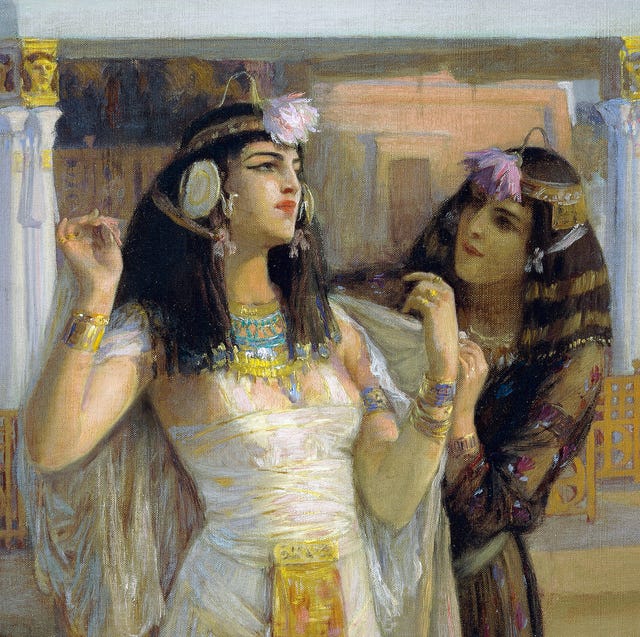
Popular culture often portrays her as an extraordinary beauty. Films and paintings frequently depict her with striking features, luxurious clothing, and mesmerizing eyes. Yet historical descriptions are surprisingly ambiguous.
Ancient writers like Plutarch suggested that Cleopatra’s beauty alone was not the key to her influence. Instead, he emphasized her intelligence, charisma, and the power of her voice. According to Plutarch, her presence and personality captivated those around her more than conventional physical beauty.
Scientific attempts to reconstruct her appearance rely on coins, sculptures, and reliefs from the Ptolemaic period. These images show a woman with a prominent nose, strong jawline, and distinctive facial structure. However, artistic conventions of the time often stylized rulers in symbolic ways, making accurate interpretation difficult.
Even modern digital reconstructions vary widely because the available sources are limited and sometimes contradictory.
Without a confirmed portrait or preserved remains, Cleopatra’s true appearance remains uncertain—a mystery shaped by both history and imagination.
2. Where Is Cleopatra’s Tomb?
One of the greatest unsolved archaeological puzzles is the location of Cleopatra’s final resting place.
Historical accounts suggest that after her death in 30 BCE, Cleopatra was buried with the Roman general Mark Antony. Ancient sources indicate that their tomb was magnificent and built according to Cleopatra’s instructions.
But the tomb has never been found.
Many historians believe it lies somewhere near ancient Alexandria, Cleopatra’s capital city. However, parts of that ancient city now lie underwater due to earthquakes, subsidence, and rising sea levels.
Archaeologists have explored sites near the temple complex at Taposiris Magna, west of Alexandria, where some researchers suspect the tomb may exist. Excavations have uncovered tunnels, statues, and coins from the Ptolemaic era, fueling speculation.
Yet no definitive evidence has been discovered.
Until Cleopatra’s tomb is located, the final resting place of one of history’s most famous rulers remains hidden somewhere beneath sand, ruins, or sea.
3. How Exactly Did Cleopatra Die?
The story of Cleopatra’s death is one of history’s most dramatic scenes.
After the defeat of her forces by the future Roman emperor Augustus at the Battle of Actium, Cleopatra returned to Alexandria. When Roman troops captured the city, she chose death rather than humiliation in a Roman triumph.
According to the traditional account, Cleopatra committed suicide by allowing herself to be bitten by an asp—a venomous snake often associated with Egyptian royalty.
But historians and scientists have long debated whether this story is accurate.
Some scholars argue that a snakebite might not produce death quickly or reliably enough for the dramatic scenario described. Others suggest she may have used a carefully prepared poison mixture instead.
Ancient sources disagree on details. Some mention ointments or concealed toxins. Others describe multiple attendants dying alongside her.
Without physical remains to examine, forensic science cannot confirm the exact cause of death.
Cleopatra’s final moments remain one of the most enduring mysteries of ancient history.
4. What Was Cleopatra’s True Ethnic Background?
Cleopatra ruled Egypt, spoke the Egyptian language, and embraced aspects of Egyptian culture. Yet her family origins were Macedonian Greek.
Her dynasty was founded by Ptolemy I Soter, one of the generals of Alexander the Great.
The Ptolemaic rulers traditionally married within their own family to preserve dynastic purity. Cleopatra’s father, Ptolemy XII Auletes, followed this tradition.
However, the identity of Cleopatra’s mother—and possibly her grandmother—remains uncertain. Because of this gap in historical records, scholars cannot fully determine her genetic ancestry.
Some historians believe she was almost entirely of Macedonian Greek descent. Others suggest there may have been Egyptian or other Mediterranean ancestry in her lineage.
Without DNA evidence from confirmed remains, the question remains open.
Cleopatra’s cultural identity was undoubtedly complex, blending Greek heritage with Egyptian political symbolism. But her precise ethnic background continues to intrigue historians and scientists alike.
5. How Many Languages Could Cleopatra Really Speak?
Ancient sources claim Cleopatra possessed remarkable linguistic abilities.
She was said to speak multiple languages and communicate directly with various peoples of her empire without interpreters. Some accounts suggest she knew as many as nine languages, including Egyptian, Greek, and languages of neighboring regions.
If true, this would have been extraordinary among Ptolemaic rulers, who often relied on translators and did not learn Egyptian.
Yet verifying this claim is difficult.
Ancient historians sometimes exaggerated the abilities of famous rulers, either to praise or criticize them. Written records from Cleopatra’s own court are scarce, leaving historians dependent on later Roman and Greek writers.
Modern linguistic analysis cannot confirm exactly how many languages she spoke or how fluently she used them.
Nevertheless, Cleopatra clearly possessed exceptional education and diplomatic skill, enabling her to negotiate with diverse cultures and political leaders.
The full extent of her linguistic talent remains uncertain.
6. What Happened to the Library of Alexandria During Her Reign?
The Library of Alexandria is one of history’s most legendary institutions.
For centuries, it symbolized the pursuit of knowledge, housing hundreds of thousands of scrolls covering science, philosophy, mathematics, and literature. Scholars from across the Mediterranean studied there.
But the library’s fate remains mysterious.
Some historical accounts suggest that during the civil war between Julius Caesar and his enemies in 48 BCE, fires in Alexandria may have damaged parts of the library. Cleopatra was involved in these political struggles, and the city itself became a battlefield.
Yet the exact extent of the destruction is debated.
Some historians believe only a storage area of scrolls burned. Others think much of the library survived and declined gradually over centuries.
Because archaeological remains of the original library are limited, scientists cannot determine precisely what happened to it during Cleopatra’s lifetime.
The fate of the ancient world’s greatest repository of knowledge remains one of history’s most haunting questions.
7. How Powerful Was Cleopatra’s Political Strategy?
Cleopatra is often portrayed primarily through her relationships with powerful Roman men—especially Julius Caesar and Mark Antony.
But modern historians increasingly view her as a strategic and capable ruler in her own right.
She stabilized Egypt’s economy, reformed currency systems, and strengthened trade networks across the Mediterranean and Near East. She also maintained Egypt’s independence for nearly two decades during a period when Rome absorbed many neighboring kingdoms.
Yet the full extent of her political strategy is difficult to reconstruct.
Many historical sources describing Cleopatra were written by Roman authors after her defeat. These accounts often depict her as manipulative or seductive rather than politically skilled.
Archaeological evidence from her reign suggests effective governance, but the surviving records are incomplete.
How much of Cleopatra’s success was personal charisma, how much was calculated diplomacy, and how much resulted from geopolitical circumstance remains a matter of scholarly debate.
8. What Did Cleopatra’s Alexandria Truly Look Like?
Cleopatra ruled from Alexandria, one of the most magnificent cities of the ancient world.
Founded by Alexander the Great, the city was famous for its grand architecture, bustling harbors, and cultural diversity. The Pharos Lighthouse—one of the Seven Wonders of the Ancient World—stood at its entrance.
But much of ancient Alexandria now lies underwater.
Earthquakes and coastal subsidence caused sections of the ancient city, including royal palaces and harbor structures, to sink beneath the Mediterranean Sea. Underwater archaeology has revealed statues, columns, and ruins in the submerged royal quarter.
Despite these discoveries, large portions of Cleopatra’s Alexandria remain unexplored or inaccessible.
Scientists continue to map underwater structures and recover artifacts, but the full layout and splendor of the city during Cleopatra’s reign remain only partially known.
The queen’s capital—once the intellectual heart of the Mediterranean—is still hidden beneath waves and centuries of sediment.
9. Did Cleopatra Truly See Herself as a Goddess?
Egyptian rulers often associated themselves with divine figures. Pharaohs were seen as intermediaries between gods and humans.
Cleopatra embraced this tradition with unusual enthusiasm. She presented herself as the living embodiment of the goddess Isis, adopting religious imagery and rituals that reinforced her authority.
But historians debate how literally this identification was meant.
Was Cleopatra claiming actual divine status in the religious sense? Or was this primarily political symbolism designed to strengthen her legitimacy among Egyptian subjects?
Ancient religious beliefs were complex, and the distinction between divine symbolism and literal divinity was often blurred.
Without direct writings from Cleopatra explaining her beliefs, scientists and historians can only interpret archaeological and textual evidence.
The depth of Cleopatra’s religious identity remains uncertain.
10. Why Does Cleopatra’s Story Endure So Powerfully?
Perhaps the greatest mystery of Cleopatra is not historical but cultural.
Why does her story continue to fascinate humanity across centuries?
Many rulers were powerful. Many queens were intelligent. Yet Cleopatra occupies a unique place in historical imagination.
Part of the answer lies in the dramatic narrative of her life. She ruled during a turning point in world history when the ancient kingdoms of the Mediterranean collided with the rising power of Rome. Her alliances with Julius Caesar and Mark Antony intertwined personal relationships with global politics.
Her death marked the end of the Ptolemaic Kingdom and the beginning of Roman Egypt.
But another reason lies in how stories about her were shaped by Roman propaganda, medieval retellings, Renaissance art, and modern media. Each generation has reinvented Cleopatra according to its own values and fantasies.
Science can uncover artifacts, analyze texts, and reconstruct historical contexts. Yet the cultural mythology surrounding Cleopatra continues to evolve.
The historical woman may never be fully separated from the legend.
The Queen Behind the Legend
Cleopatra lived during a time of immense change. Kingdoms rose and fell, empires expanded, and cultures blended across the Mediterranean world. She was educated, politically astute, and determined to preserve her kingdom’s independence.
But the passage of two millennia has blurred the details of her life.
Her tomb remains hidden. Her true appearance remains uncertain. Her final moments remain debated. Even her ancestry and voice are partly lost to time.
Yet these mysteries do not diminish Cleopatra’s significance. They deepen it.
History often preserves the outlines of great lives but leaves the finer details scattered like fragments of pottery buried beneath desert sand. Archaeologists dig. Scientists analyze. Historians compare texts and inscriptions.
Piece by piece, the portrait grows clearer.
But Cleopatra herself remains partly veiled by time—a queen whose life stands at the boundary between history and legend, where science continues its patient search for truth.