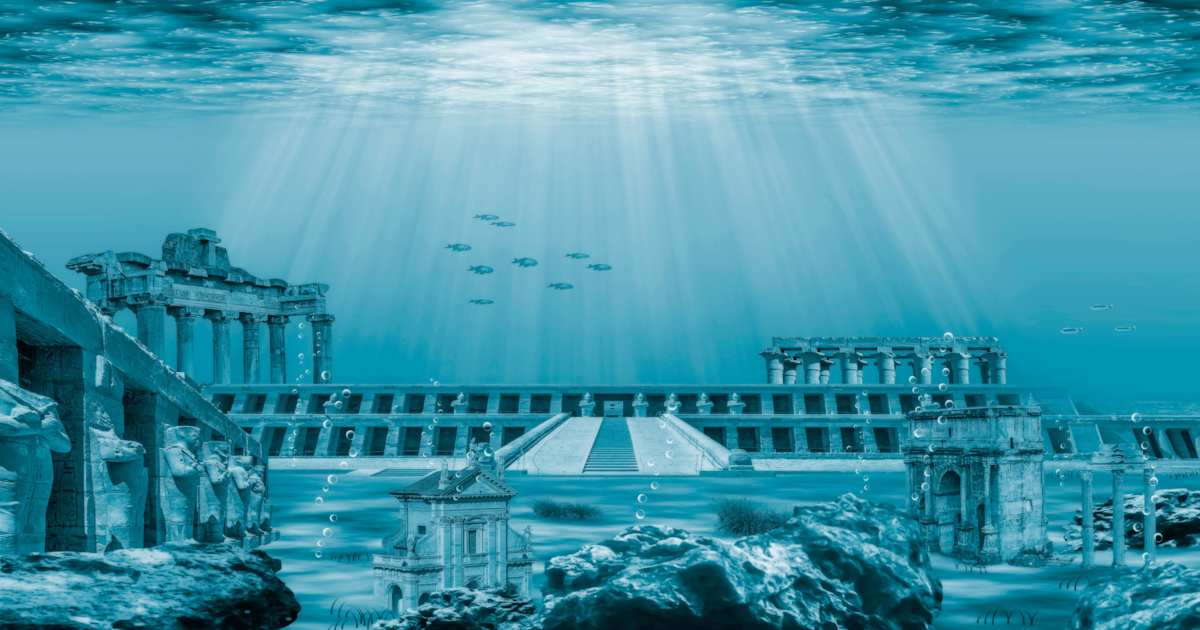
Few stories in human history have captured the imagination as powerfully as the legend of Atlantis. For centuries, people have wondered whether it was a real place—an advanced civilization swallowed by the sea—or merely a philosophical tale invented to teach moral lessons. The mystery of Atlantis lives somewhere between history, myth, and human longing for lost worlds.
Across generations, explorers have searched for its ruins beneath the ocean. Writers have imagined glittering temples and vast canals. Scientists have debated whether fragments of the story might preserve memories of ancient disasters. Yet despite endless speculation, the truth remains elusive.
Atlantis exists in a strange place in our cultural memory. It is both deeply familiar and deeply uncertain. The story appears simple at first: a powerful island civilization destroyed in a single catastrophic event. But behind that simple narrative lies a complex web of philosophy, ancient history, geology, and imagination.
To understand the mystery of Atlantis, we must begin not with the ocean floor, but with a philosopher in ancient Greece.
The First Appearance of Atlantis in Ancient Texts
The earliest and most detailed description of Atlantis comes from the writings of the Greek philosopher Plato. Around 360 BCE, Plato described Atlantis in two dialogues titled Timaeus and Critias.
In these philosophical conversations, Plato introduces a story told by the Athenian statesman Solon. According to the account, Solon heard the tale from priests in Egypt, who claimed that the story had been preserved in their temple records for thousands of years.
The priests described a vast island empire located beyond the “Pillars of Hercules,” a name the ancient Greeks used for the strait now known as the Strait of Gibraltar. This island, they said, was larger than Libya and Asia Minor combined and ruled over many surrounding lands.
Atlantis, according to Plato’s description, possessed immense wealth and technological sophistication. Its capital city was arranged in concentric rings of land and water connected by bridges and canals. The island contained fertile plains, majestic mountains, and abundant natural resources.
But Atlantis was not only powerful. It was also proud.
Plato describes how the Atlanteans gradually became corrupted by greed and ambition. They attempted to conquer much of the Mediterranean world, including ancient Athens. The Athenians resisted and defeated them, demonstrating courage and virtue.
Soon afterward, Atlantis suffered a catastrophic fate. In a single day and night of terrible earthquakes and floods, the island sank beneath the sea and disappeared forever.
With that dramatic ending, the story concludes—leaving readers to wonder whether Plato was describing history or crafting a philosophical allegory.
Atlantis as a Philosophical Allegory
Many historians believe that Plato never intended Atlantis to be taken literally. Instead, they argue that the story served as a moral and political lesson.
Plato often used fictional settings in his dialogues to illustrate philosophical ideas. In his famous work The Republic, he describes an ideal state governed by philosopher-kings. Atlantis may have served a similar purpose.
In Plato’s story, Atlantis represents a powerful but morally corrupted society driven by ambition and material wealth. Athens, in contrast, represents virtue, discipline, and justice. The victory of Athens over Atlantis symbolizes the triumph of moral integrity over arrogance.
From this perspective, the destruction of Atlantis is not merely a geological disaster. It is a warning about the dangers of pride and imperial ambition. Civilizations that lose their moral foundation may ultimately collapse.
Many classical scholars point out that no Greek writer before Plato mentions Atlantis. Historians such as Herodotus, who documented numerous legends and distant lands, never refer to such a civilization.
This absence suggests that Atlantis might have originated entirely within Plato’s philosophical imagination.
Yet the story’s vivid details—its geography, architecture, and history—have convinced many readers that it might contain fragments of real events.
The Geography of the Lost Island
Plato places Atlantis beyond the Pillars of Hercules, in the Atlantic Ocean. This geographic clue has fueled centuries of speculation.
Some researchers interpret the location literally, suggesting that Atlantis once existed somewhere in the Atlantic. Others believe the description might refer to regions within the Mediterranean itself.
Plato describes Atlantis as a large island with a central plain surrounded by mountains. The capital city was built around a hill, where the god Poseidon was said to have created a sacred sanctuary.
The city’s layout is one of the most famous elements of the legend. According to Plato, it consisted of alternating circular rings of land and water connected by bridges. Ships could travel through these canals to reach the central harbor.
The surrounding plains were divided by irrigation channels, producing abundant crops. Vast armies and fleets were supported by the island’s wealth.
These descriptions sound remarkably specific. Yet they raise a key question: could any real ancient civilization have built such a city?
Archaeologists have discovered impressive engineering achievements across the ancient world—massive pyramids, elaborate irrigation systems, and carefully planned cities. But no known archaeological site matches the exact description given by Plato.
Ancient Catastrophes and the Birth of the Legend
Although Atlantis itself remains unverified, history does contain examples of civilizations destroyed by natural disasters.
One of the most dramatic occurred around 1600 BCE on the island of Thera, now known as Santorini. There, a massive volcanic eruption devastated the region and sent tsunamis across the eastern Mediterranean.
The eruption was one of the largest volcanic events in human history. Entire settlements were buried under layers of ash, and the explosion reshaped the island’s landscape.
Archaeologists have uncovered the remains of a sophisticated Bronze Age town at Akrotiri. The site reveals multi-story buildings, advanced plumbing systems, and vibrant frescoes depicting ships, landscapes, and daily life.
The civilization associated with Akrotiri was connected to the broader Minoan civilization, one of the most advanced cultures of the ancient Mediterranean.
Some researchers believe that memories of this catastrophic eruption may have survived in oral traditions. Over centuries, those memories could have evolved into the legend of a powerful island destroyed by natural disaster.
While this theory cannot prove the existence of Atlantis, it demonstrates how real events can inspire enduring myths.
Atlantis in Ancient and Medieval Imagination
After Plato’s time, the story of Atlantis spread through Greek and Roman literature. Some writers treated it as history, while others viewed it as fiction.
The philosopher Aristotle reportedly dismissed the story entirely, claiming that the same man who invented Atlantis had also destroyed it.
During the Middle Ages in Europe, interest in Atlantis faded as classical texts became less widely studied. But the legend returned with renewed enthusiasm during the Renaissance, when scholars rediscovered ancient Greek writings.
Explorers sailing across the Atlantic Ocean began to wonder whether the lost island might lie somewhere beneath those vast waters.
The Age of Exploration transformed Atlantis from a philosophical tale into a geographical mystery.
The Rise of Atlantis Theories in the Modern Era
In the nineteenth century, the Atlantis story experienced a dramatic revival. A writer named Ignatius L. Donnelly published a book titled Atlantis: The Antediluvian World.
Donnelly argued that Atlantis was a real civilization that had influenced cultures around the world. He claimed that similarities between ancient monuments—such as pyramids in Egypt and Central America—could be explained by a shared Atlantean origin.
Although Donnelly’s ideas captured public imagination, archaeologists and historians found little evidence to support them. Many of his conclusions were based on speculation rather than scientific analysis.
Nevertheless, the book inspired a wave of fascination with Atlantis that continues today.
Throughout the twentieth century, countless theories proposed locations for the lost city: the Atlantic Ocean, the Mediterranean, the Caribbean, and even Antarctica.
Yet none have been supported by conclusive archaeological evidence.
The Scientific Search for Atlantis
Modern science approaches the Atlantis question cautiously. Archaeologists rely on physical evidence—artifacts, structures, and geological data—to reconstruct ancient civilizations.
Despite extensive exploration of the seafloor and ancient coastlines, no verified remains of a civilization matching Plato’s description have been found.
Marine geology has also revealed that large continental islands do not simply sink beneath the ocean in the dramatic way described in the legend. Earth’s crust moves slowly through processes such as plate tectonics, but entire continents do not vanish overnight.
However, local land subsidence, earthquakes, and volcanic eruptions can cause dramatic regional changes. Coastal cities have been destroyed by tsunamis or submerged by rising sea levels.
These real processes may help explain how ancient stories of vanished lands could arise.
Atlantis and Human Fascination with Lost Worlds
Why does the Atlantis story continue to capture imagination after more than two thousand years?
Part of the answer lies in humanity’s fascination with lost civilizations. Stories of forgotten worlds appear across cultures. They remind us that history is fragile and that entire societies can disappear.
Atlantis also reflects our curiosity about what might lie beneath the ocean. More than seventy percent of Earth’s surface is covered by water, and much of the deep ocean remains unexplored.
The idea that an advanced civilization might rest hidden beneath the waves speaks to a powerful sense of mystery.
Atlantis also embodies a deeper theme: the rise and fall of civilizations. Every great culture—from ancient empires to modern nations—faces the challenge of sustaining its values and institutions.
In Plato’s story, Atlantis falls because it loses its moral balance. The myth serves as a cautionary tale about power, ambition, and responsibility.
Atlantis in Literature, Film, and Popular Culture
Over the centuries, Atlantis has inspired countless works of fiction. Writers, filmmakers, and artists have imagined the lost city in many forms.
Some portray it as a utopian society filled with wisdom and technology. Others depict it as a tragic civilization destroyed by its own arrogance.
The legend appears in novels, comic books, documentaries, and films. It has become a symbol of mystery and possibility, a canvas on which storytellers project visions of ancient grandeur.
Yet even as fiction expands the myth, historians continue to return to the original texts of Plato, searching for clues about what he intended.
The Continuing Debate
Today, scholars remain divided over the meaning of Atlantis. Some view it purely as allegory, a philosophical invention created by Plato to illustrate moral ideas. Others suspect that it might preserve distant memories of real disasters, perhaps reshaped by centuries of storytelling.
What most scientists agree on is that no evidence currently supports the existence of a vast advanced civilization that vanished beneath the Atlantic Ocean as described in Plato’s account.
But the absence of evidence has never fully extinguished curiosity.
Atlantis occupies a unique space between history and imagination. It invites us to question how myths form, how memories of disasters evolve, and how storytelling shapes our understanding of the past.
Lost City or Ancient Myth?
The mystery of Atlantis ultimately reveals as much about humanity as it does about ancient history. Whether it was inspired by real events or entirely imagined, the story reflects our enduring desire to understand the past.
It speaks to our fascination with hidden worlds and forgotten knowledge. It reminds us that even great civilizations can vanish, leaving only fragments of memory behind.
In the end, Atlantis may never be discovered beneath the ocean floor. Yet its legend continues to sail through human imagination like a ghostly island on the horizon—always distant, always intriguing.
Perhaps that is the true power of the story.
Atlantis challenges us to look deeper into history, to question what we think we know, and to remain curious about the mysteries that still lie beneath the surface of our world.