Few dinosaurs capture the imagination quite like Stegosaurus. With its double row of towering plates running along its back and a dangerous tail armed with spikes, this ancient creature looks almost mythical—like something imagined by a fantasy artist rather than reconstructed from fossils. Yet Stegosaurus was very real. It walked the Earth roughly 150 million years ago during the Late Jurassic period, sharing its world with giants such as sauropods and fearsome predators like Allosaurus.
Despite its instantly recognizable appearance, Stegosaurus remains one of the most mysterious dinosaurs ever discovered. Scientists continue to debate the purpose of its plates, the role of its spikes, how it lived, and even how it behaved socially. What seems at first glance like a strange and almost comical dinosaur turns out to be a fascinating puzzle that has challenged paleontologists for more than a century.
Stegosaurus is not just a dinosaur with unusual features. It is a symbol of how science works—how ideas evolve as new evidence emerges, how theories change, and how even the most famous prehistoric animals can still hold secrets.
Discovery in the Wild West
The story of Stegosaurus begins in the late nineteenth century, during a dramatic period in American science often called the “Bone Wars.” At that time, fossil hunters were scouring the American West in search of prehistoric bones buried in ancient rock formations. Two rival paleontologists, Othniel Charles Marsh and Edward Drinker Cope, competed fiercely to discover and name new dinosaur species.
In 1877, Othniel Charles Marsh described a new dinosaur based on fossil remains found in Colorado. He named it Stegosaurus, a name derived from Greek words meaning “roof lizard.” Marsh believed the dinosaur’s plates lay flat along its back like overlapping roof tiles. This early reconstruction turned out to be incorrect, but the name remained.
As more fossils were uncovered in places such as Colorado, Wyoming, and Utah, scientists realized that the plates actually stood upright along the dinosaur’s back. The realization transformed Stegosaurus from a relatively ordinary reptile into one of the most visually striking dinosaurs ever discovered.
The rocks that preserved Stegosaurus fossils belong to the Morrison Formation, a vast geological region that contains some of the richest dinosaur fossil beds in the world. This ancient environment was a landscape of rivers, floodplains, forests, and seasonal droughts—a world where enormous plant-eating dinosaurs roamed and predators stalked the land.
A Dinosaur Like No Other
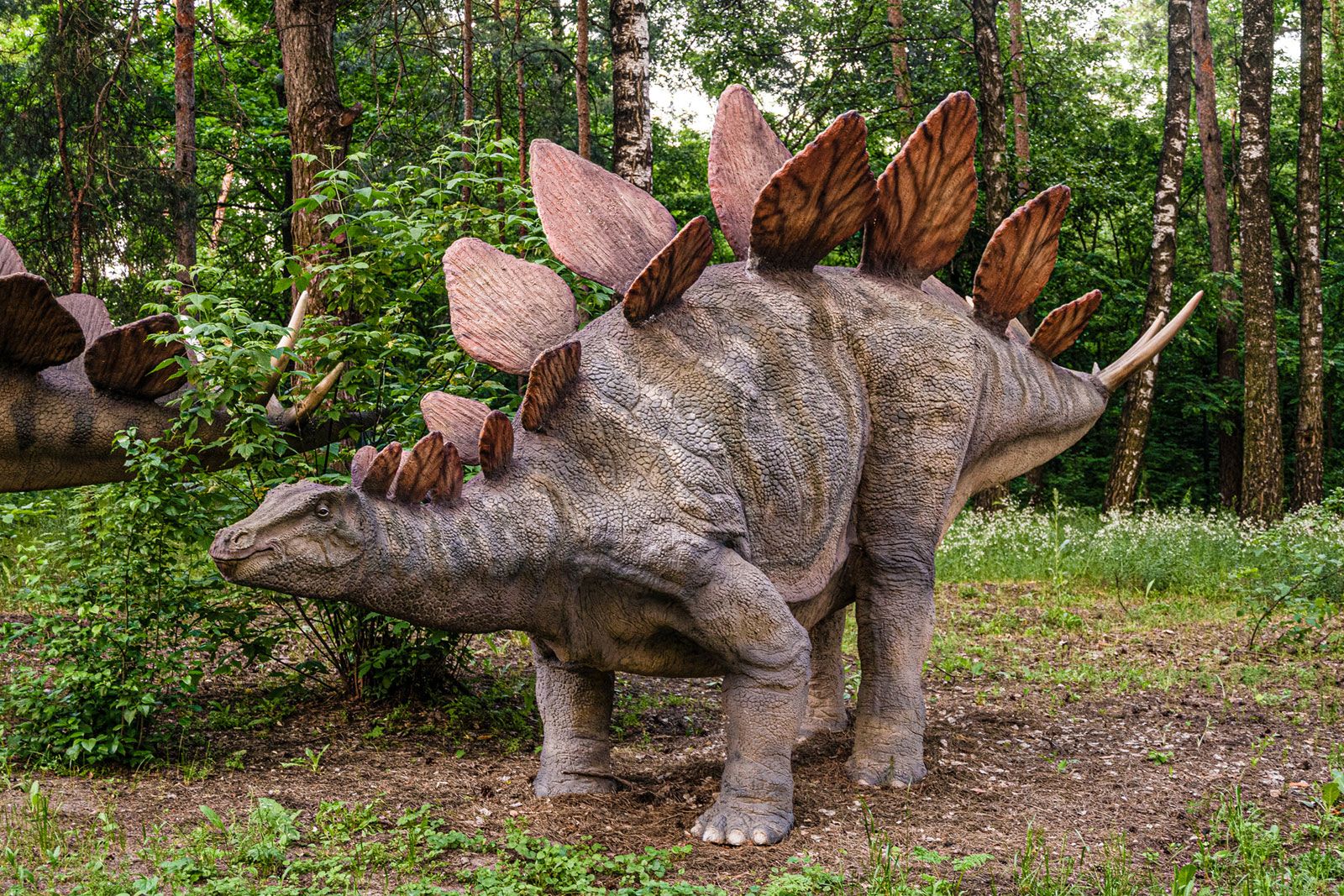
Stegosaurus was unlike most other dinosaurs. It was a large herbivore, reaching lengths of about nine meters and weighing several tons. Its body shape was distinctive. The front legs were shorter than the hind legs, giving the animal a slightly sloping posture. Its head was small compared to its body, with a beak designed for cropping vegetation.
What truly made Stegosaurus unique, however, were the plates along its back and the spikes at the end of its tail. The plates formed two rows running from the neck down to the tail, each plate shaped somewhat like a flattened triangle or leaf. The tail ended in four sharp spikes that could be swung as a formidable weapon.
The plates were not randomly arranged. Evidence from fossils suggests that they alternated from side to side rather than forming perfectly symmetrical pairs. This alternating pattern created a striking silhouette that would have made Stegosaurus instantly recognizable even from a distance.
The spikes at the end of the tail are sometimes informally called the “thagomizer,” a humorous name that originated from a comic strip but was later adopted by scientists. These spikes could grow more than half a meter long and were capable of inflicting serious injury.
The combination of plates and spikes created one of the most unusual body plans in dinosaur evolution.
Life in the Jurassic World
To understand Stegosaurus, we must imagine the world it inhabited. The Late Jurassic period was a time when dinosaurs dominated terrestrial ecosystems. Massive sauropods such as Diplodocus and Apatosaurus wandered across the landscape, feeding on tall vegetation. Predatory dinosaurs like Allosaurus hunted these giants and other herbivores.
Stegosaurus lived alongside these creatures, but it occupied a different ecological niche. Its low head suggests that it fed primarily on vegetation close to the ground. Ferns, cycads, horsetails, and other primitive plants likely made up its diet.
Unlike towering sauropods that reached high into the trees, Stegosaurus probably browsed among shrubs and low-growing plants. Its beak would have allowed it to clip vegetation efficiently, while rows of small teeth helped process plant material.
The Jurassic landscape was not a peaceful paradise. Predators lurked nearby, and survival required constant vigilance. Stegosaurus, despite its bulky body, needed effective defenses to protect itself.
This is where its remarkable spikes and plates come into the story.
The Function of the Plates
One of the greatest mysteries surrounding Stegosaurus is the purpose of its plates. At first glance, they appear to be defensive armor. However, closer study reveals that they were actually quite thin and fragile. They were not solid shields capable of withstanding heavy attacks.
So why did Stegosaurus evolve such large plates?
Scientists have proposed several possible explanations. One idea is that the plates were used for thermoregulation. The plates contained many blood vessels, suggesting that they could help regulate body temperature. Blood flowing through the plates might release heat when the dinosaur was too warm or absorb heat when it was cool.
This theory imagines Stegosaurus using its plates like giant biological radiators. By turning its body toward or away from the sun, it could control how much heat it absorbed.
Another possibility is that the plates served as display structures. Their large size and prominent placement would have made them highly visible. If the plates were brightly colored in life, they could have been used to attract mates or intimidate rivals.
Display structures are common in animals today. Many birds have elaborate feathers, and some reptiles display colorful crests or frills. The plates of Stegosaurus may have served a similar purpose.
There is also the possibility that the plates combined multiple functions. They might have helped with temperature regulation while also playing a role in visual communication.
The truth is that scientists are still investigating this question, and the plates remain one of the most intriguing puzzles in dinosaur biology.
The Weaponized Tail
While the plates may have been more for display than defense, the tail spikes of Stegosaurus were clearly weapons. Fossil evidence suggests that these spikes could deliver devastating blows.
Some fossils of predatory dinosaurs show injuries that may have been caused by Stegosaurus spikes. In at least one case, a vertebra from an Allosaurus shows signs of a puncture wound consistent with a spike attack.
This evidence suggests that Stegosaurus was capable of defending itself effectively against predators.
The tail was flexible and muscular, allowing the dinosaur to swing it from side to side with considerable force. The spikes could pierce flesh and bone, making the tail a dangerous deterrent.
Even large predators would have thought twice before attacking an adult Stegosaurus.
The presence of this weapon hints at an evolutionary arms race between herbivores and carnivores. As predators evolved more effective hunting strategies, prey animals developed better defenses.
Stegosaurus represents one of the most dramatic examples of this evolutionary struggle.
A Surprisingly Small Brain
One of the most famous facts about Stegosaurus is that it had an unusually small brain relative to its body size. The brain of Stegosaurus was roughly the size of a walnut, tiny compared to its massive body.
This fact led early scientists to assume that Stegosaurus was extremely unintelligent. Some even proposed the idea that the dinosaur had a second brain near its hips to help control its body.
The “second brain” idea turned out to be a misunderstanding. The enlarged cavity in the hip region likely housed a structure called the glycogen body, which exists in modern birds and may have played a role in energy storage or nerve support.
Even though Stegosaurus had a small brain, this does not necessarily mean it was foolish. Many animals today function very effectively with relatively small brains.
Stegosaurus likely relied more on instinct than complex problem-solving. Its survival strategies were built into its anatomy—its defensive tail, its protective size, and perhaps its visual displays.
In the ancient ecosystems of the Jurassic, that combination was enough.
Movement and Behavior
The body structure of Stegosaurus suggests that it moved at a relatively slow pace. Its hind legs were longer and more powerful than its front legs, giving it a slightly hunched posture.
Despite its heavy appearance, Stegosaurus was probably capable of steady walking across the landscape as it searched for food.
Trackways discovered in fossil sites indicate that stegosaurs moved on four legs and may have traveled in small groups. If Stegosaurus lived socially, its plates could have played an important role in communication between individuals.
Perhaps the plates helped individuals recognize each other or signal readiness to mate. In the wild, visual signals can be essential for coordinating behavior within a species.
Although the fossil record does not preserve behavior directly, these clues allow scientists to build reasonable interpretations of how Stegosaurus might have lived.
Growth and Development
Like many dinosaurs, Stegosaurus likely hatched from eggs. Juvenile stegosaurs would have been much smaller and more vulnerable than adults.
Young individuals may have relied on camouflage or parental protection during their early life stages.
As they grew, their plates and spikes would have developed gradually. The plates may have started small and expanded as the dinosaur matured, eventually forming the dramatic display structures seen in adults.
Bone studies suggest that Stegosaurus grew relatively slowly compared to some other dinosaurs. Its development from hatchling to full-grown adult may have taken many years.
This slow growth pattern reflects a life strategy focused on size and defense rather than rapid reproduction.
Fossils That Tell a Story
Fossils are the primary source of information about Stegosaurus. Every bone recovered from ancient rock layers contributes another piece to the puzzle.
Over the years, scientists have discovered multiple species of Stegosaurus and related stegosaurs. These discoveries reveal that the group was more diverse than once believed.
The fossils show variations in plate shape, spike arrangement, and body size. Some species had different plate patterns or slightly different skeletal structures.
Each discovery helps refine our understanding of how these dinosaurs evolved and adapted to their environments.
The Morrison Formation continues to yield new fossils, and future discoveries may reveal even more about the life of Stegosaurus.
Stegosaurus in Popular Culture
Few dinosaurs have achieved the cultural recognition of Stegosaurus. Its distinctive silhouette appears in books, movies, toys, and museum exhibits around the world.
For many people, Stegosaurus represents the classic dinosaur image—strange, powerful, and ancient.
However, popular depictions sometimes exaggerate or simplify its features. Modern paleontology continues to refine our understanding of how Stegosaurus actually looked and lived.
As new discoveries are made, artists and scientists collaborate to create more accurate reconstructions.
The image of Stegosaurus evolves just as scientific knowledge does.
The Continuing Mystery
Even after more than a century of research, Stegosaurus remains partly mysterious. The exact function of its plates, the details of its behavior, and aspects of its biology are still being explored.
This mystery is not a weakness in science. It is a sign that science is an ongoing process.
Each new fossil discovery, each new analytical technique, and each new generation of scientists brings fresh insights.
Stegosaurus reminds us that even the most famous dinosaurs can still surprise us.
A Window into Evolution
Ultimately, Stegosaurus is more than just a dinosaur with strange plates and spikes. It is a testament to the creativity of evolution.
Natural selection produced an animal with one of the most unusual body plans in the history of life. Every plate, every spike, every bone tells a story of adaptation and survival.
Through the study of Stegosaurus, scientists learn not only about a single species but about the broader processes that shape life on Earth.
The plates that once puzzled early paleontologists now inspire deeper questions about biology, ecology, and evolution.
The Legacy of Stegosaurus
When we imagine the ancient world of dinosaurs, Stegosaurus stands among the most unforgettable creatures to have walked the Earth. Its towering plates caught the sunlight of the Jurassic forests, and its spiked tail guarded it against predators.
Millions of years later, its bones continue to speak to us through stone.
They tell us that the history of life is filled with strange experiments, unexpected designs, and extraordinary survival strategies.
Stegosaurus is one of those experiments—a creature that seems almost unbelievable yet once lived and thrived on our planet.
Its mystery remains, inviting us to keep exploring, keep questioning, and keep learning about the deep past of life on Earth.