Long before human civilization built cities, wrote stories, or even existed, Earth was home to creatures so enormous that imagining them today feels almost unreal. During the Cretaceous Period, the last chapter of the age of dinosaurs, vast landscapes were dominated by colossal herbivores that reshaped their environment simply by living within it. Among these giants was Titanosaurus, a name that evokes both myth and magnitude. Though science has refined and debated exactly what animals should bear this name, the idea of Titanosaurus represents one of the most extraordinary groups of dinosaurs ever discovered: the titanosaurs, the largest land animals that ever walked the Earth.
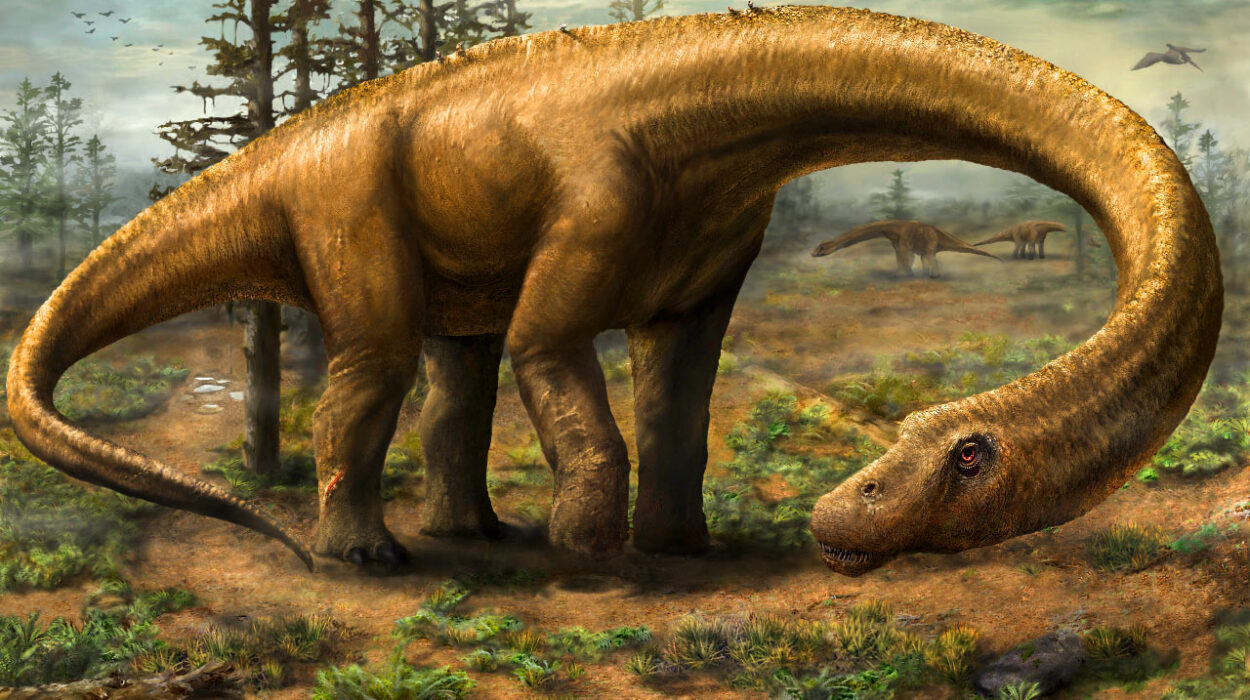
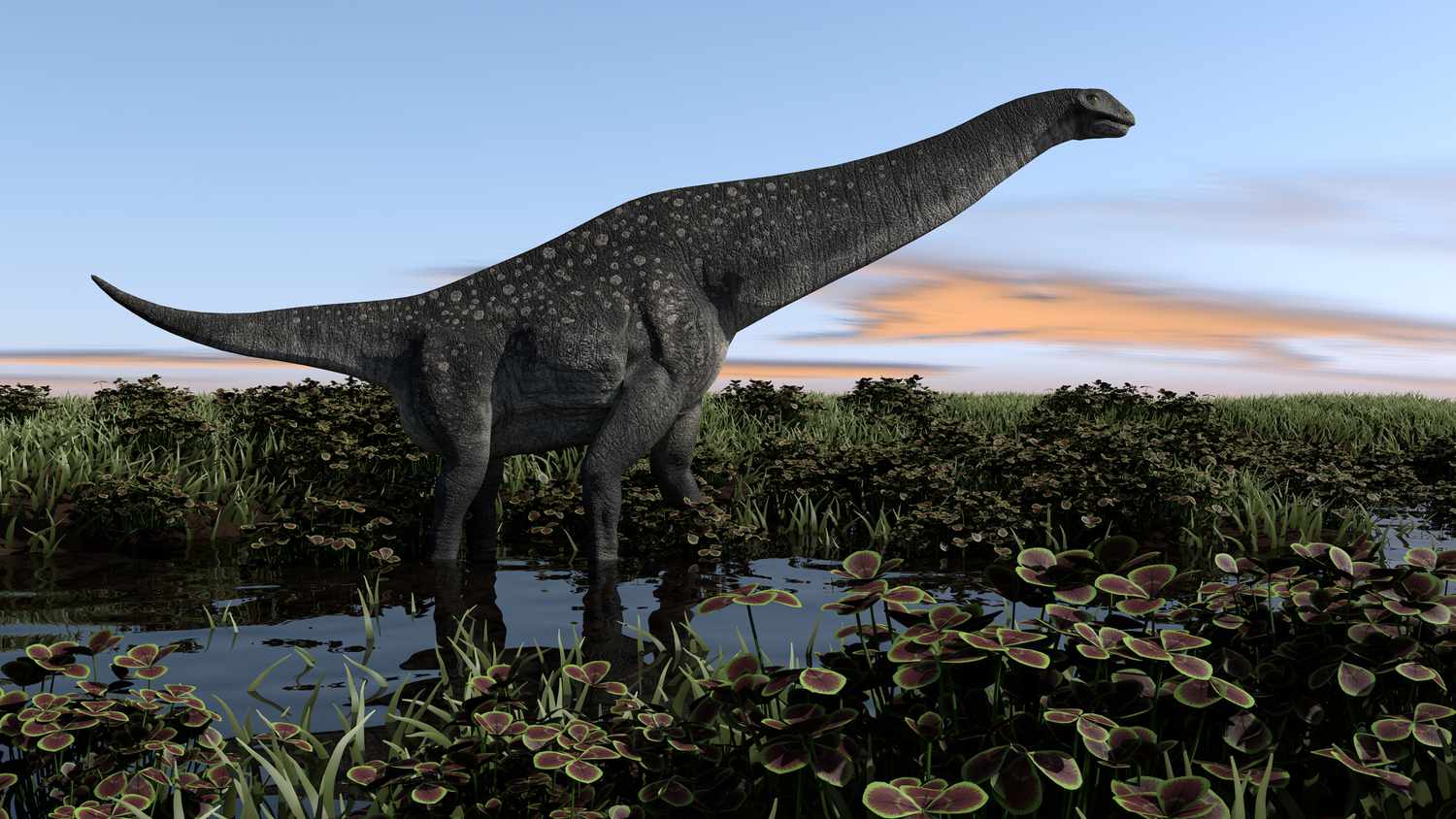
To imagine Titanosaurus is to picture a creature that dwarfed everything around it. A body as long as a passenger airplane, a neck stretching upward like a living tower, and a tail sweeping through the prehistoric forests like a slow-moving whip. When such an animal walked, the ground trembled beneath its weight. Yet despite this immense size, Titanosaurus was not a predator. It was a peaceful plant-eater, spending its days browsing leaves from trees, moving steadily across ancient continents that looked very different from the world we know today.
The story of Titanosaurus is not only the story of a dinosaur. It is the story of Earth itself during the Cretaceous Period—a time when continents were drifting apart, flowering plants were spreading across the land, and ecosystems were filled with animals both strange and magnificent. Understanding Titanosaurus means stepping into a world nearly one hundred million years removed from our own, where giants shaped the landscape and life evolved in astonishing ways.
The Meaning Behind the Name Titanosaurus
The name Titanosaurus comes from the word “Titan,” referring to the enormous beings of ancient Greek mythology. The Titans were powerful giants who ruled the world before the gods of Olympus, and the comparison was intentional. Early paleontologists who discovered the bones of these dinosaurs were struck by their immense size and chose a name that captured their overwhelming presence.
Titanosaurus was first described in the nineteenth century from fossil remains found in India. At that time, paleontology was still in its early stages, and scientists often had only fragments of bone to work with. As a result, the name Titanosaurus became something of a catch-all category for large sauropod dinosaurs with certain skeletal features.
Over time, as more fossils were discovered around the world and scientific methods improved, paleontologists realized that many animals originally placed in the genus Titanosaurus actually belonged to different genera. Today, Titanosaurus itself is considered a somewhat uncertain genus, but the broader group it represents—the titanosaurs—remains one of the most fascinating and important branches of dinosaur evolution.
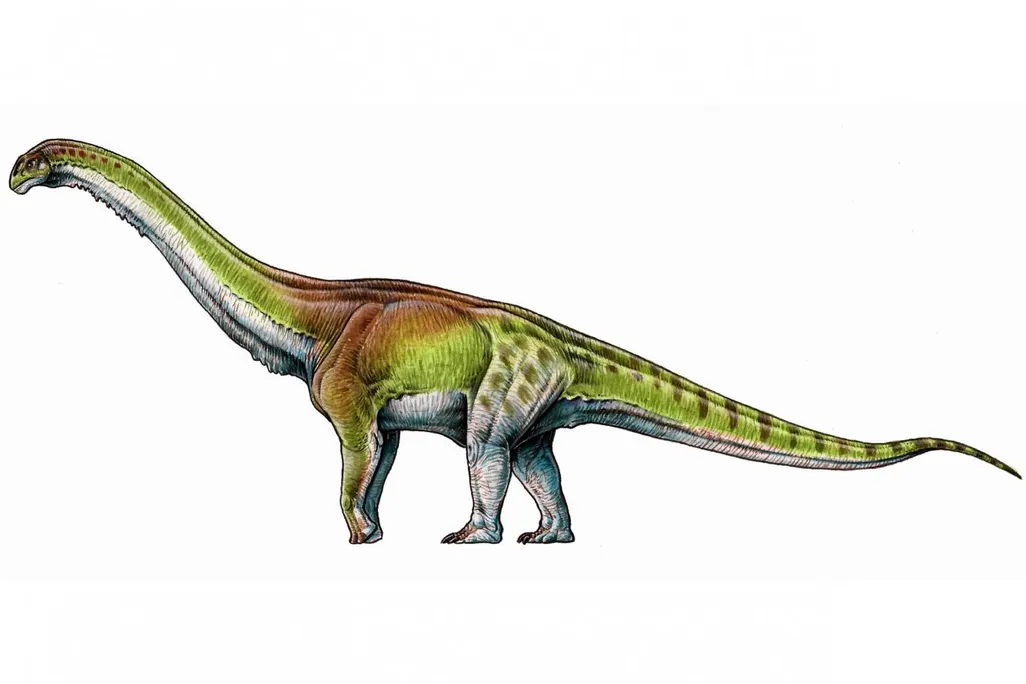
Titanosaurs included some of the largest creatures ever to live on land. Members of this group such as Argentinosaurus, Patagotitan, and Dreadnoughtus reached sizes that stretched the limits of biological possibility. Although Titanosaurus may not have been the largest among them, it symbolizes the entire lineage of giant sauropods that dominated the late age of dinosaurs.
The World of the Cretaceous Period
To truly understand Titanosaurus, one must understand the Cretaceous Period itself. This era lasted from about 145 million to 66 million years ago and represents the final chapter of the Mesozoic Era, often called the Age of Dinosaurs. It was a time of profound change on Earth.
During the Cretaceous, the supercontinent Pangaea had already begun breaking apart. The continents were drifting toward the positions they occupy today. Vast inland seas covered parts of North America and other regions, creating coastlines that stretched thousands of kilometers. Warm climates prevailed across much of the planet, and polar regions were far milder than they are today.
Vegetation was undergoing a revolution. Earlier in the dinosaur age, most plants were ferns, cycads, and conifers. But during the Cretaceous, flowering plants—known as angiosperms—began spreading rapidly. These plants would eventually dominate Earth’s ecosystems and provide the foundation for modern plant life.
This transformation of plant communities had a direct impact on herbivorous dinosaurs like Titanosaurus. New types of vegetation offered new feeding opportunities, and the immense size of titanosaurs allowed them to reach food sources that smaller animals could not access.
The Cretaceous landscape was also filled with predators. Giant theropods such as tyrannosaurs, carcharodontosaurs, and abelisaurs roamed the same ecosystems. Although titanosaurs were massive, even they had to remain cautious, particularly when young. Survival in this ancient world required both size and strategy.
The Anatomy of a Giant
Titanosaurus and its relatives belonged to a group of dinosaurs known as sauropods. Sauropods are famous for their long necks, long tails, small heads, and enormous bodies supported by four pillar-like legs. These animals were specialized for a life of herbivory on a gigantic scale.
The neck of a titanosaur could contain more than a dozen elongated vertebrae, allowing it to stretch many meters in length. This structure functioned like a biological crane, enabling the animal to sweep its head across large areas of vegetation without moving its entire body. By simply raising or lowering its neck, a titanosaur could feed from ground-level plants or tall tree canopies.
Despite their enormous bodies, titanosaurs had relatively small heads. Their teeth were typically simple and peg-like, adapted for stripping leaves rather than chewing them thoroughly. Instead of grinding food in the mouth, titanosaurs relied on massive stomachs and digestive systems to process plant material.
The limbs of titanosaurs were incredibly strong. Each leg resembled a thick column of bone and muscle capable of supporting many tons of weight. Their feet were broad and padded, distributing pressure across the ground and helping them walk across soft soils without sinking.
One unusual feature found in some titanosaurs was armor embedded in their skin. Small bony plates known as osteoderms formed a protective layer along parts of the body. This armor may have helped defend against predators or served as a mineral reservoir within the animal’s body.
The tail of Titanosaurus was long and muscular, acting as both a counterbalance and a potential defensive weapon. A sudden swing of such a tail could deter predators or signal other members of the herd.
Growth and Life Cycle
The life of a titanosaur began from an egg not much larger than a modern football. This contrast between tiny eggs and gigantic adults is one of the most remarkable aspects of dinosaur biology.
Titanosaurs likely laid eggs in large nesting grounds, sometimes with dozens or even hundreds of eggs clustered together. Fossilized nesting sites discovered in places like Argentina reveal circular nests containing multiple eggs, suggesting that titanosaurs returned to specific areas to reproduce.
Once hatched, young titanosaurs faced enormous challenges. They were small, vulnerable, and surrounded by predators eager for an easy meal. To survive, they likely grew rapidly. Evidence from bone structure indicates that many sauropods experienced accelerated growth rates, reaching enormous sizes within a few decades.
As titanosaurs matured, their sheer mass became their greatest defense. An adult weighing tens of tons would have been almost impossible for predators to bring down. Size itself became a form of survival strategy.
This rapid growth required vast amounts of food. A fully grown titanosaur may have consumed hundreds of kilograms of vegetation each day. Such an appetite meant that titanosaurs constantly moved across their environment, feeding and reshaping plant communities as they traveled.
Feeding the Giants
Feeding a body the size of Titanosaurus required remarkable efficiency. Unlike animals that chew their food extensively, titanosaurs used a different strategy. Their teeth were adapted for quickly stripping leaves from branches, allowing them to gather large quantities of vegetation in a short time.
Once swallowed, plant material entered an enormous digestive system where microbes helped break down tough fibers. This fermentation process likely occurred in large stomach chambers similar to those found in modern herbivorous mammals.
Titanosaurs may also have swallowed stones known as gastroliths. These stones, stored in the digestive tract, could help grind plant material and aid digestion. While evidence for gastrolith use in titanosaurs is debated, it remains a plausible adaptation for processing large amounts of vegetation.
Because titanosaurs did not chew thoroughly, they could feed continuously. Their strategy was based on quantity rather than efficiency. By consuming vast volumes of plant matter, they obtained enough nutrients to sustain their gigantic bodies.
Their long necks allowed them to access food sources that other herbivores could not reach. This reduced competition and enabled multiple species of plant-eating dinosaurs to coexist within the same ecosystems.
Titanosaurs Around the World
One of the most fascinating aspects of titanosaurs is their global distribution. Fossils belonging to this group have been discovered on nearly every continent, including South America, Africa, Europe, Asia, and even Antarctica.
This widespread presence reflects the changing geography of the Cretaceous world. As continents drifted apart, titanosaurs evolved in different regions, giving rise to a diverse array of species adapted to local environments.
In South America, titanosaurs reached truly gigantic sizes. Some species discovered in Argentina are among the largest animals ever known to have walked the Earth. In Africa and Madagascar, unique forms of titanosaurs evolved with distinctive skeletal features. In Europe, smaller titanosaurs adapted to island environments where resources were more limited.
The discovery of titanosaurs in Antarctica is particularly remarkable. Fossils found there indicate that even polar regions supported dinosaur ecosystems during the Cretaceous. Although the climate was cooler than in tropical areas, it was still warm enough to sustain vegetation and large herbivores.
Predators and Survival
Despite their enormous size, titanosaurs were not entirely safe from predators. Large theropod dinosaurs lived alongside them and likely targeted the young, weak, or injured members of titanosaur herds.
Predators may have used cooperative strategies or ambush tactics to attack juvenile titanosaurs. Fossil evidence suggests that bite marks from carnivorous dinosaurs appear on some sauropod bones, indicating interactions between these animals.
Adult titanosaurs, however, were formidable opponents. Their massive weight, powerful limbs, and long tails made them extremely difficult prey. A full-grown individual could stand several meters tall at the shoulder and weigh more than many modern elephants combined.
Living in herds may have provided additional protection. Groups of titanosaurs could watch for danger and defend vulnerable members, creating a community where survival chances improved.
The Fossil Record and Scientific Discovery
The story of Titanosaurus is also the story of paleontology itself. Fossils belonging to titanosaurs have been discovered for more than a century, and each new discovery adds pieces to the puzzle of their lives.
Early fossils were often fragmentary, consisting of isolated bones or partial skeletons. These remains hinted at enormous animals but left many questions unanswered. Over time, more complete specimens have been found, allowing scientists to reconstruct their anatomy with increasing accuracy.
Modern technology has transformed the study of these dinosaurs. CT scanning, digital modeling, and microscopic analysis of bone tissue reveal details about growth rates, metabolism, and biomechanics. These tools allow scientists to move beyond simple description and explore how titanosaurs actually lived.
Large excavation sites have uncovered entire bone beds containing multiple individuals. These discoveries provide insights into herd behavior, migration patterns, and even catastrophic events that may have caused mass deaths.
The End of the Age of Giants
For tens of millions of years, titanosaurs thrived across the planet. Their success was built on evolutionary adaptations that allowed them to grow large, reproduce effectively, and exploit abundant plant resources.
But their reign ended abruptly around 66 million years ago during one of the most dramatic events in Earth’s history. A massive asteroid struck the planet near what is now the Yucatán Peninsula in Mexico. The impact triggered fires, earthquakes, tsunamis, and a global climate crisis.
Dust and debris thrown into the atmosphere blocked sunlight, disrupting photosynthesis and collapsing food chains. Plants died, herbivores starved, and predators followed. Within a relatively short geological time, most dinosaur species—including the titanosaurs—disappeared.
This event, known as the Cretaceous–Paleogene extinction, reshaped life on Earth. While many species vanished, others survived and evolved into new forms. Birds, the descendants of certain small theropod dinosaurs, continued the dinosaur legacy into the modern era.
The Legacy of Titanosaurus
Although Titanosaurus itself vanished millions of years ago, its legacy remains embedded in the rocks of our planet and the imagination of humanity. Fossils preserve the physical evidence of these giants, while scientific research continues to uncover their secrets.
Titanosaurs demonstrate the extraordinary possibilities of evolution. They show how life can adapt to fill ecological roles on a scale that seems almost impossible today. Their enormous bodies remind us that Earth’s past was filled with creatures far beyond anything alive in the modern world.
Studying Titanosaurus also teaches us about the fragile balance of ecosystems. Even the largest animals are ultimately dependent on the stability of their environment. When global conditions changed dramatically, size alone could not guarantee survival.
Today, the bones of titanosaurs rest in museums and research collections around the world. Scientists continue to excavate new fossils, analyze ancient sediments, and reconstruct the landscapes where these giants once walked.
Each discovery brings us closer to understanding the age when Titanosaurus ruled the Cretaceous world. And in that understanding, we glimpse the incredible story of life on Earth—a story written across hundreds of millions of years, where giants once walked beneath ancient skies and shaped the history of our planet.