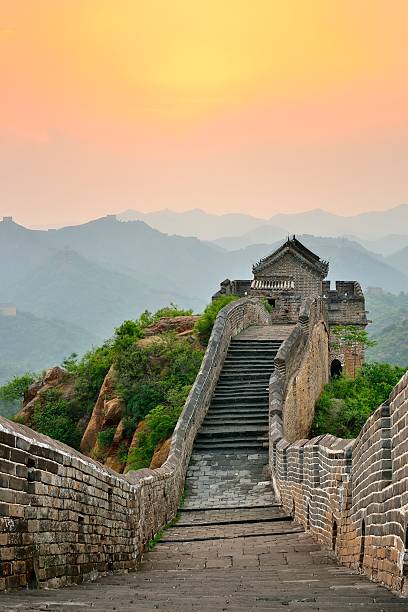
The Great Wall of China is not merely a wall. It is a vast, winding narrative carved across mountains, deserts, and plains—a story written in stone, earth, and human endurance. Stretching thousands of kilometers across northern China, the Great Wall stands as one of humanity’s most ambitious construction projects, a symbol of defense, unity, fear, ambition, and resilience.
To understand the Great Wall is to step into a deep current of history that spans more than two thousand years. It is not a single structure built at one moment in time, but rather a collection of walls, fortifications, and watchtowers constructed by different dynasties, each responding to the pressures and threats of its era.
The Wall represents both the physical and psychological boundary of ancient Chinese civilization. It guarded fertile lands from nomadic incursions, controlled trade routes, and projected imperial power. Yet beyond its practical purpose, it became something more—a monument to human determination and the cost of empire.
Its stones whisper stories of emperors and soldiers, of laborers and legends, of battles fought and lives lost. The Great Wall is both a shield and a scar, an achievement and a reminder.
The Earliest Origins of Wall Building
Long before the Great Wall took on its familiar form, early Chinese states were already experimenting with defensive walls. During the period known as the Spring and Autumn period and later the Warring States period, which lasted roughly from the 8th century BCE to the 3rd century BCE, China was divided into competing kingdoms.
These states frequently fought each other for territory and power. In response, rulers began constructing walls to protect their borders. These early walls were not built of stone but rather of tamped earth, a technique in which layers of soil were compacted tightly to create strong, durable barriers.
States such as Qin, Zhao, and Yan constructed extensive defensive systems along their northern frontiers. These walls were designed to protect against both rival states and nomadic tribes from the steppes.
Although these early structures were separate and uncoordinated, they laid the foundation for what would later become the Great Wall. They represented the first recognition that large-scale defensive architecture could shape the fate of nations.
The Vision of Qin Shi Huang
The first major unification of these scattered walls occurred under the rule of Qin Shi Huang, the founder of the Qin dynasty. In 221 BCE, Qin Shi Huang succeeded in uniting the warring states into a single empire, creating what is often considered the first unified Chinese state.
With unification came new challenges. The northern frontier remained vulnerable to incursions by nomadic groups such as the Xiongnu. To protect his newly formed empire, Qin Shi Huang ordered the connection and expansion of existing walls into a continuous defensive system.
This was an enormous undertaking. Hundreds of thousands of laborers, including soldiers, peasants, and prisoners, were conscripted to work on the project. They toiled under harsh conditions, often in remote and rugged terrain. Many died from exhaustion, hunger, and exposure.
The materials used during this period were primarily earth and wood, as stone was not always readily available. Workers compacted soil between wooden frames to create thick, durable walls.
The result was not the Great Wall as we see it today, but rather an early version—long, rough, and functional. It stretched across vast distances, marking the empire’s northern boundary.
This project demonstrated both the power of centralized authority and the immense human cost of imperial ambition.
The Han Dynasty and Expansion into the West
After the fall of the Qin dynasty, the Han dynasty rose to power and continued the work of building and maintaining the Wall. The Han rulers faced similar threats from northern nomadic groups, and they recognized the strategic importance of strong defenses.
Under the Han dynasty, the Wall was extended westward into the Gobi Desert, reaching toward Central Asia. This expansion served not only military purposes but also economic ones.
The Han dynasty established and protected trade routes that would later become known as the Silk Road. These routes connected China with distant regions, allowing the exchange of goods, culture, and ideas.
The Wall acted as a protective barrier for caravans traveling along these routes. Watchtowers and garrisons were established at regular intervals, allowing soldiers to monitor movement and send signals using smoke and fire.
This period marked a shift in the Wall’s role. It was no longer just a defensive structure but also a tool of economic control and cultural exchange.
Centuries of Neglect and Renewal
After the Han dynasty, China entered a long period of political fragmentation. Various dynasties rose and fell, and the Wall was often neglected or partially abandoned.
During some periods, rulers focused more on diplomacy or military campaigns rather than maintaining the Wall. In other times, new walls were built in different regions, reflecting changing political and military priorities.
The Northern Wei, Northern Qi, and Sui dynasties all contributed to wall construction in different forms. However, these efforts were often inconsistent and localized.
The Wall during these centuries was not a single continuous structure but rather a patchwork of defenses, some well-maintained and others crumbling into the landscape.
Yet even in neglect, the idea of the Wall persisted. It remained a symbol of protection and separation, a concept that could be revived whenever circumstances demanded it.
The Ming Dynasty and the Wall We Know Today
The most recognizable sections of the Great Wall were built during the Ming dynasty, which ruled from 1368 to 1644. This period marked a turning point in the Wall’s history.
The Ming dynasty faced persistent threats from northern tribes, particularly the Mongols. After suffering devastating invasions, the Ming rulers decided to invest heavily in strengthening their defenses.
Unlike earlier versions, the Ming Wall was constructed using bricks and stone, making it far more durable and imposing. Skilled craftsmen designed watchtowers, fortresses, and signal systems that allowed rapid communication across vast distances.
The Wall was built along mountain ridges and natural barriers, maximizing its defensive effectiveness. Its height, width, and structural complexity made it a formidable obstacle.
The Ming Wall stretched thousands of kilometers and included numerous gates and passes, some of which became major military and trade hubs.
This is the Wall most people imagine today—a grand, winding structure that snakes across the landscape with dramatic beauty and strength.
The Engineering Behind the Wall
The construction of the Great Wall required remarkable engineering ingenuity. Builders adapted their techniques to suit the terrain and available materials.
In mountainous regions, stone blocks were quarried and shaped to fit together tightly. In plains and deserts, tamped earth remained the primary material, sometimes reinforced with reeds or gravel.
Bricks became increasingly important during the Ming dynasty. Kilns were built near construction sites to produce large quantities of bricks, which were then transported and assembled with mortar.
The Wall’s design included battlements for defense, drainage systems to prevent erosion, and pathways wide enough for soldiers and horses.
Watchtowers were placed at regular intervals, allowing guards to observe the surrounding area. Signal towers enabled communication through smoke during the day and fire at night.
The scale of this engineering effort is astonishing. It required coordination across vast distances, the mobilization of enormous labor forces, and the ability to overcome challenging environmental conditions.
Life on the Wall
For the soldiers stationed on the Great Wall, life was often harsh and isolated. Garrisons were located in remote areas, far from cities and comforts.
Soldiers had to endure extreme weather conditions, from scorching summers to freezing winters. Supplies were sometimes limited, and communication with the outside world could be slow.
Despite these challenges, the Wall served as a critical line of defense. Soldiers monitored movements beyond the border, responded to threats, and maintained the integrity of the structure.
The Wall was not only a military installation but also a place where lives unfolded—where friendships formed, fears were faced, and duty was carried out under difficult circumstances.
Legendary Stories of the Great Wall
The Great Wall is not only a historical structure but also a source of powerful legends that have been passed down through generations.
One of the most famous stories is that of Meng Jiangnü. According to legend, her husband was forced to work on the Wall and died from exhaustion. When she traveled to find him, she wept so bitterly that a section of the Wall collapsed, revealing his bones.
This story reflects the human suffering associated with the Wall’s construction. It serves as a reminder that behind the grandeur lies a history of sacrifice and loss.
Another legend speaks of hidden treasures buried within the Wall, protected by spirits or curses. These tales capture the imagination and add a sense of mystery to the structure.
Stories of ghostly apparitions, heroic defenders, and secret passages have also become part of the Wall’s folklore. These legends enrich the Wall’s identity, blending history with myth.
The Wall’s Role in Shaping Identity
The Great Wall has played a significant role in shaping Chinese cultural and national identity. It represents strength, perseverance, and the ability to overcome challenges.
At the same time, it symbolizes the tension between openness and isolation. The Wall was built to protect, but it also marked a boundary between different worlds.
Over time, the Wall became a metaphor for unity and resilience. It stands as a reminder of the collective effort required to build and defend a civilization.
Its image has been used in art, literature, and modern national symbolism, reflecting its enduring importance.
Decline and Rediscovery
After the fall of the Ming dynasty, the Wall gradually lost its military significance. New political realities and changing technologies made it less relevant as a defensive structure.
Sections of the Wall fell into disrepair. Stones were taken for local construction, and natural forces eroded parts of the structure.
In the modern era, however, the Great Wall has been rediscovered as a cultural and historical treasure. Efforts have been made to preserve and restore key sections.
It has become one of the most visited landmarks in the world, attracting millions of visitors each year.
The Great Wall in the Modern World
Today, the Great Wall stands as a symbol recognized across the globe. It is often associated with the idea of monumental human achievement.
It has been designated as a UNESCO World Heritage Site, highlighting its significance as a cultural landmark.
Modern visitors walk along restored sections, experiencing the scale and beauty of the structure firsthand. The Wall continues to inspire awe, curiosity, and reflection.
It serves as a bridge between past and present, connecting modern humanity with the lives and struggles of those who built it.
The Endless Story of the Wall
The Great Wall is not just a relic of history. It is a living story, one that continues to evolve as new discoveries are made and new interpretations emerge.
Archaeologists uncover forgotten sections, historians reinterpret its purpose, and visitors add their own experiences to its legacy.
The Wall endures not only in stone but in memory, imagination, and identity.
It reminds us that history is not static. It is a dynamic tapestry woven from countless human lives, each contributing to a larger narrative.
The Great Wall stands as a testament to what humanity can achieve—and what it must endure—in the pursuit of security, power, and meaning.