For more than two centuries, dinosaurs have haunted human imagination. They rise from fragments: a tooth weathered out of rock, a single claw, a shattered vertebra. From these clues, paleontologists reconstruct creatures that once thundered across ancient landscapes. But rarely does nature grant a gift more precious than an almost complete skeleton—an animal preserved so fully that it feels less like a fossil and more like a frozen moment from deep time.
Most dinosaurs are known from partial remains. Bones scatter before burial. Scavengers disarticulate carcasses. Geological forces distort and destroy. Even a skeleton that is 50 percent complete is often considered extraordinary. So when paleontologists uncover specimens that approach total completeness—skulls intact, limbs articulated, even traces of skin or feathers preserved—the scientific and emotional impact is immense.
These fossils are not just scientific treasures; they are bridges. They allow us to move from speculation to clarity, from silhouette to living form. They give us proportions, muscle attachments, growth patterns, pathologies, and in some rare cases, behavior frozen in stone. They refine evolutionary relationships and calibrate entire branches of the dinosaur family tree.
What follows are five of the most complete dinosaur fossils ever found—specimens that transformed our understanding of prehistoric life. Each one tells a story not only of an animal but of the ancient world that entombed it and the modern scientists who carefully brought it back to light.
1. “Sue” – The Most Complete Tyrannosaurus rex
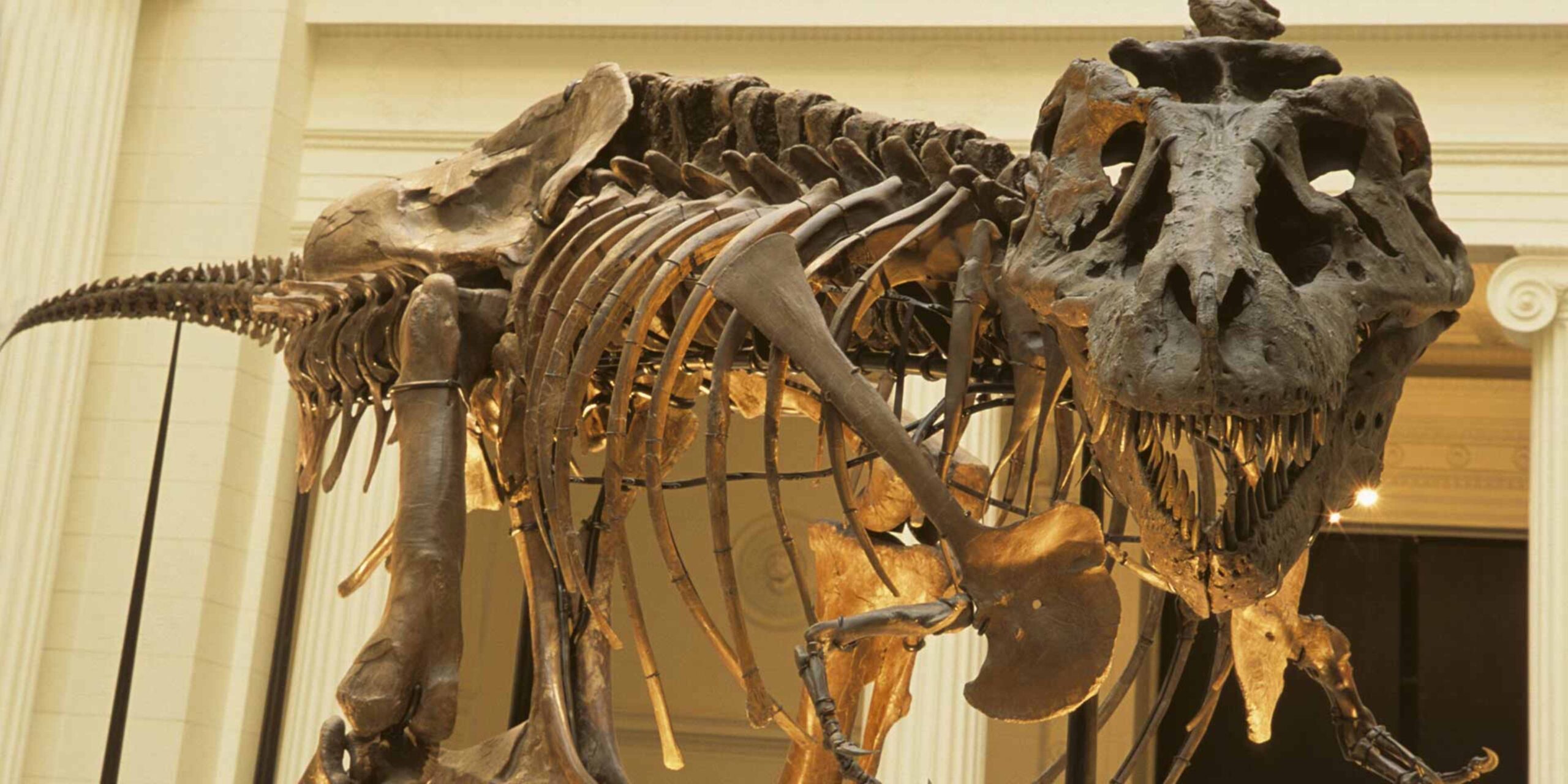
In 1990, fossil hunter Sue Hendrickson was exploring the badlands of South Dakota when she noticed bones protruding from a cliff face. The skeleton that emerged would become one of the most famous fossils in history: “Sue,” a specimen of Tyrannosaurus rex that remains the most complete and best-preserved T. rex ever discovered.
Sue is approximately 90 percent complete by bone count. That level of preservation is astonishing for an animal that lived around 67 million years ago during the Late Cretaceous. Nearly the entire skull was recovered, along with most of the vertebral column, ribs, pelvis, and limbs. For an apex predator measuring over 12 meters in length, such completeness is rare beyond imagination.
The skull alone revolutionized our understanding of T. rex. We could examine the full array of massive teeth, some over 20 centimeters long including the root. The bite force, inferred from skull structure and muscle attachment points, was immense—among the strongest of any terrestrial animal known. Pathologies on the bones revealed that Sue suffered injuries during life, including healed fractures and evidence of infection. This was not a static skeleton but a biography written in bone.
Sue also provided clarity about growth and maturity. Bone histology—thin sections studied under microscopes—revealed growth rings similar to those in trees. These rings indicated that Sue died at about 28 years of age, making her one of the oldest known T. rex individuals. Her mass, estimated at over 9 metric tons, confirmed that T. rex reached colossal proportions late in life.
Today, Sue resides at the Field Museum in Chicago, where the mounted skeleton towers above visitors. More than a museum exhibit, Sue is a benchmark specimen. Nearly every new Tyrannosaurus discovery is compared against her. She anchors our understanding of tyrannosaur anatomy, biomechanics, and variation.
Through Sue, T. rex became less myth and more measurable reality.
2. “Stan” – A Near-Perfect Tyrannosaur
Another titan of tyrannosaur research is “Stan,” also a specimen of Tyrannosaurus rex. Discovered in 1987 in South Dakota, Stan is about 65 to 70 percent complete—less complete than Sue by bone count, but exceptionally preserved and scientifically invaluable.
Stan’s skull is among the most complete ever found. Its detailed preservation allowed researchers to create high-resolution casts and digital models distributed worldwide. For decades, Stan’s skull became the standard reference for tyrannosaur cranial anatomy. Universities, museums, and research institutions relied on it to study feeding mechanics, sensory capabilities, and braincase structure.
Stan also showed clear signs of trauma. Holes in the skull suggest puncture wounds, possibly inflicted by another T. rex during combat. Healed ribs indicate survival after serious injury. These traces suggest that tyrannosaurs engaged in aggressive interactions, perhaps territorial disputes or mating competition.
Because Stan’s skeleton was well articulated and relatively undistorted, it became central to biomechanical modeling. Scientists used it to estimate locomotion speed, muscle mass, and balance. Its tail, built from interlocking vertebrae and chevrons, revealed the counterbalance system that allowed such a massive predator to move efficiently on two legs.
In recent years, Stan gained attention not only for science but also for the astonishing price it commanded at auction. Yet beyond financial headlines, Stan remains a scientific cornerstone—one of the clearest windows into the anatomy of Earth’s most iconic predator.
Together, Sue and Stan transformed T. rex from a skeletal outline into a fully realized organism with measurable biology.
3. “Dakota” – The Dinosaur with Preserved Skin
While most fossils preserve only bone, “Dakota” offered something far rarer: soft tissue impressions. Dakota is a specimen of Edmontosaurus, a duck-billed herbivore from the Late Cretaceous. Discovered in North Dakota, Dakota is not only remarkably complete but also preserves extensive skin impressions across large parts of the body.
Edmontosaurus was a large herbivore, reaching lengths of around 12 meters. Dakota’s skeleton is substantially complete, but what stunned scientists were the impressions of scaly skin along the tail, limbs, and torso. In some areas, the skin appears to wrap tightly around the bones, preserving body contours.
These impressions allowed researchers to estimate muscle mass and body shape with unprecedented precision. Traditional skeletal mounts sometimes exaggerate bulk or posture. Dakota revealed that hadrosaurs may have been more streamlined than previously thought.
Advanced imaging techniques, including laser scanning and CT analysis, helped reveal details without damaging the fossil. The texture of the skin showed a mosaic of small, non-overlapping scales. No evidence of feathers appeared on Dakota, consistent with current understanding that large hadrosaurs were primarily scaly.
Dakota’s preservation likely resulted from rapid burial in a sedimentary environment that protected the carcass from scavengers and decay. The conditions must have been exceptional—perhaps a floodplain event that sealed the body before decomposition advanced too far.
Dakota changed the way scientists reconstruct dinosaur appearance. No longer were they limited to bone frameworks. Here was tangible evidence of skin texture and body outline. For paleoartists and researchers alike, Dakota brought dinosaurs closer to flesh-and-blood reality.
4. “Leonardo” – A Natural Mummy
If Dakota astonished scientists, “Leonardo” pushed the boundaries even further. Leonardo is another specimen of Brachylophosaurus discovered in Montana. Often described as one of the best-preserved dinosaur mummies ever found, Leonardo retains not only extensive skin impressions but also evidence of internal soft tissues.
Leonardo is approximately 90 percent complete, with much of the skeleton articulated. What sets this specimen apart is the preservation of skin over large portions of the body, including intricate scale patterns. Even more remarkably, scans revealed what appear to be preserved internal structures—possible remnants of muscles and organs.
While the exact nature of these internal features continues to be studied, their presence suggests rapid burial and unique chemical conditions that inhibited decay. Unlike the classic idea of mummification through drying, Leonardo may have been buried quickly in fine sediment that sealed the body from oxygen and scavengers.
Leonardo provided extraordinary insights into hadrosaur anatomy. The crest on the skull, the shape of the beak, and the arrangement of teeth in the dental battery are all preserved with clarity. Hadrosaurs were complex herbivores with hundreds of tightly packed teeth adapted for grinding plant material. Leonardo’s jaws reveal this dental machinery in detail.
The specimen also informed understanding of growth and development. Bone microstructure indicated that Leonardo was not fully mature at death, allowing comparison between juvenile and adult stages.
In Leonardo, we see not only bones but the echo of living tissue. It stands as one of the clearest examples of how exceptional preservation can illuminate dinosaur biology beyond the skeleton.
5. “Big John” – The Colossal Triceratops
Among horned dinosaurs, one specimen stands out for both size and completeness: “Big John,” a specimen of Triceratops horridus. Discovered in Montana, Big John is estimated to be about 60 percent complete, with an extraordinarily well-preserved skull.
The skull of Triceratops is one of the most iconic structures in paleontology, featuring two long brow horns, a smaller nasal horn, and a massive frill extending from the back of the head. Big John’s skull measures approximately 2.6 meters in length, making it one of the largest Triceratops skulls ever found.
The preservation of the skull allowed detailed study of horn orientation, frill structure, and evidence of injury. A notable hole in the frill suggests trauma, possibly from combat with another Triceratops. The edges of the lesion show signs of healing, indicating survival after injury.
Triceratops lived alongside Tyrannosaurus in the final chapters of the Cretaceous. Big John helps clarify body proportions, limb posture, and weight distribution in this massive quadruped. Its robust limb bones show how ceratopsians supported immense headgear while moving efficiently.
Ceratopsian fossils are often fragmentary, especially skulls that break apart under geological stress. Big John’s relatively intact condition makes it a critical reference for understanding variation within the species.
In Big John, we see not only grandeur but resilience. The scars on the frill tell of battles fought and survived, offering rare glimpses into dinosaur behavior.
Why Completeness Matters
Completeness in a fossil is not merely a statistical achievement. It changes science. A nearly complete skeleton allows accurate measurement of body proportions, estimation of mass, and reconstruction of musculature. It reduces guesswork. It clarifies evolutionary relationships by providing a full suite of anatomical traits.
Articulated skeletons reveal posture. Pathologies reveal life history. Skin impressions reveal appearance. Growth rings reveal age. Each additional bone fills a gap in knowledge.
In fragmentary fossils, scientists must interpolate missing elements from related species. In complete specimens, interpolation gives way to observation. The animal stands before us in anatomical coherence.
These specimens also anchor public imagination. When museum visitors stand beneath Sue or gaze at Leonardo’s preserved skin, they encounter deep time made tangible. The emotional resonance of a complete dinosaur skeleton is powerful. It compresses millions of years into a single visual experience.
The Fragile Gift of Preservation
The rarity of complete dinosaur fossils underscores the improbability of their existence. For a dinosaur to become a fossil at all, it must be buried rapidly after death. It must avoid scavengers. It must survive chemical decay, tectonic distortion, and erosion. Finally, it must be exposed in a way that humans can find it.
Each step is unlikely. Combined, they are extraordinary.
That is why nearly complete specimens like Sue, Stan, Dakota, Leonardo, and Big John are celebrated. They are geological miracles. They remind us that science often advances through chance discoveries guided by prepared minds.
The Continuing Search
Despite these remarkable finds, paleontology continues its search. New technologies such as CT scanning, synchrotron imaging, and geochemical analysis are revealing details once unimaginable. Fossils long buried in museum collections are being reexamined with fresh insight.
Some of the most complete specimens may still lie hidden in rock, waiting for erosion or excavation to bring them to light. Each new discovery has the potential to challenge assumptions and refine understanding.
Dinosaurs dominated Earth for more than 160 million years. Their story is vast and complex. Yet through rare, nearly complete fossils, we glimpse them not as scattered bones but as living organisms—creatures that grew, fought, fed, healed, and died in ancient ecosystems.
These five fossils stand as milestones in that journey of understanding. They remind us that beneath our feet lies a world unimaginably old, and that with patience and curiosity, we can reconstruct its inhabitants bone by bone.
In the end, the most complete dinosaur fossils are more than scientific specimens. They are conversations across time. They are evidence that life, once vibrant and thunderous, can endure in stone long enough for another intelligent species to rediscover it and ask, with awe, who walked this planet before us.