Imagine standing in a vast prehistoric landscape millions of years ago. The air is warm, the ground stretches into open woodland, and distant mountains blur beneath a hazy sky. Suddenly, the earth seems to tremble ever so slightly beneath your feet. Out from the trees emerges a creature so enormous that it dwarfs everything around it. Its long neck rises above the treetops, its powerful legs move with slow confidence, and its immense body casts a shadow like a moving hill.
This is not a dinosaur. It is a mammal.
It is the legendary giant known as Paraceratherium — the largest land mammal that ever walked the Earth.
For millions of years during the early part of the Age of Mammals, this towering herbivore ruled the landscapes of ancient Asia. Larger than any elephant that has ever lived, heavier than several modern rhinoceroses combined, and tall enough to browse leaves from the tops of trees, Paraceratherium represents one of the most astonishing evolutionary achievements in the history of life.
To understand this giant is to journey back into a world very different from our own, a world recovering from extinction and slowly rebuilding its ecosystems after the fall of the dinosaurs.
A World After the Dinosaurs
The story of Paraceratherium begins long after the extinction of the dinosaurs. About 66 million years ago, the catastrophic event known as the Cretaceous–Paleogene extinction event wiped out the non-avian dinosaurs along with many other species. With the giant reptiles gone, ecosystems across the planet suddenly opened up.
Into these newly vacant ecological roles stepped mammals.
During the early Paleogene period, mammals diversified rapidly. Some evolved into swift predators. Others became specialized climbers, burrowers, swimmers, or flyers. But a few lineages began exploring a different evolutionary path: becoming giants.
In the forests and woodlands of Eurasia, a lineage of hoofed mammals related to modern rhinoceroses slowly began increasing in size over millions of years. Through gradual changes driven by environmental pressures, natural selection favored animals that could reach higher vegetation and travel long distances across expanding landscapes.
Eventually, this evolutionary experiment produced something extraordinary.
It produced Paraceratherium.
Discovery of a Lost Giant
The discovery of Paraceratherium began in the early twentieth century, when paleontologists started uncovering enormous fossil bones in Central Asia. The remains were unlike anything scientists had ever seen.
The fossils were first studied and described by the famous Russian paleontologist Alexei Borissiak in 1915. He recognized that these bones belonged to an extinct member of the rhinoceros family but of unimaginable size.
Since then, additional fossils have been discovered in regions including Kazakhstan, Mongolia, Pakistan, and China. These findings revealed that Paraceratherium once roamed a vast region stretching across much of Central and South Asia during the Oligocene epoch, roughly between 34 and 23 million years ago.
At first, different scientists gave these fossils different names. Some specimens were called Indricotherium, others Baluchitherium. Over time, further research showed that these were simply different names for the same remarkable animal. Today, Paraceratherium is widely accepted as the correct scientific name for this prehistoric giant.
With each new fossil discovery, scientists began piecing together the anatomy and lifestyle of this colossal mammal.
A Giant Among Giants
To grasp the scale of Paraceratherium, one must imagine an animal far larger than the largest elephants alive today.
Modern African elephants, the biggest land animals alive today, typically stand about three to four meters tall at the shoulder and weigh up to six or seven tons. Paraceratherium was far larger.
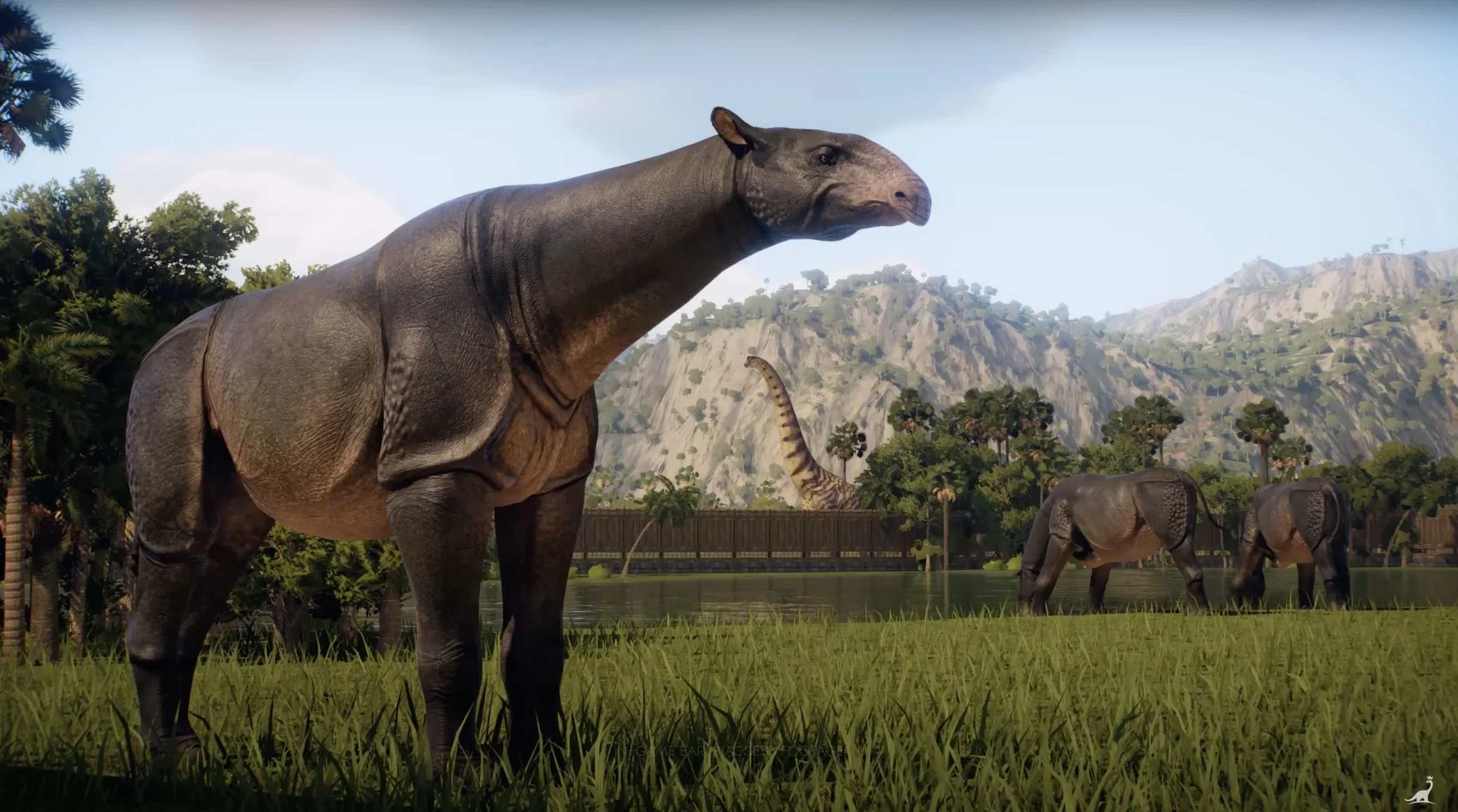
Estimates suggest that this ancient mammal may have stood around five meters tall at the shoulder and possibly reached heights of seven meters when its long neck was fully extended. In terms of mass, it may have weighed between fifteen and twenty tons, though estimates vary depending on the reconstruction.
That means Paraceratherium may have weighed as much as three large African elephants combined.
Yet despite its immense size, it was not bulky in the same way as elephants. Its body was more elongated, supported by long, pillar-like legs. Its neck stretched forward and upward, giving it the ability to reach vegetation high above the ground.
The animal resembled a strange mixture of creatures we know today: part rhinoceros, part giraffe, part giant horse. But in reality, it belonged to its own unique branch of evolutionary history.
Anatomy of a Prehistoric Titan
The skeleton of Paraceratherium reveals a creature built for both size and endurance.
Its legs were incredibly long and straight, functioning like the columns of a building designed to support enormous weight. Unlike the sprawling limbs of reptiles, the legs of Paraceratherium were positioned directly beneath its body, allowing efficient support and movement.
Its feet had three toes, similar to those of modern rhinoceroses. These toes spread the animal’s massive weight across the ground, preventing it from sinking into soft soil.
The neck of Paraceratherium was particularly remarkable. While not as long as that of a giraffe, it was still elongated enough to allow the animal to browse leaves from tall trees. This adaptation likely allowed it to exploit food sources that other herbivores could not reach.
Its skull was elongated and relatively narrow compared with that of modern rhinos. Importantly, Paraceratherium lacked the horn that we commonly associate with rhinoceroses today. Instead, its head was smooth, suggesting a lifestyle that did not depend on horn-based combat or defense.
Its teeth were designed for browsing rather than grazing. They were adapted to chew soft leaves, shoots, and branches rather than tough grasses.
Altogether, the anatomy of Paraceratherium paints the picture of a gentle giant specialized for feeding high above the ground.
Life in the Oligocene Landscape
The world Paraceratherium inhabited during the Oligocene epoch was very different from the modern landscapes of Asia.
At that time, much of Central Asia consisted of open woodland and sparse forest rather than the deserts that dominate the region today. Rivers flowed through broad valleys, and the climate was generally warmer and wetter than it is now.
Tall trees and leafy vegetation provided abundant food for large browsing animals.
Paraceratherium likely wandered across these landscapes in search of food, traveling long distances to find suitable vegetation. Its immense size would have required enormous quantities of plant material every day.
Scientists believe the animal may have consumed hundreds of kilograms of leaves and branches daily to sustain its massive body.
Despite its enormous appetite, Paraceratherium was probably a relatively peaceful animal. Like modern elephants and giraffes, it likely spent most of its time feeding, walking, and resting.
The Advantages of Gigantic Size
Why did Paraceratherium grow so enormous?
Gigantism in animals often provides several evolutionary advantages.
Large body size can deter predators, allowing animals to live with relatively little fear of attack. In the case of Paraceratherium, adults were likely too large for most predators to challenge.
Size also allows animals to travel long distances efficiently. Larger animals tend to have slower metabolisms relative to their body mass, which can make energy use more efficient over long migrations.
Another advantage involves feeding. With its long neck and great height, Paraceratherium could reach leaves from tall trees that smaller herbivores could not access. This ability likely reduced competition for food.
Gigantic size also allows animals to store energy and survive periods of scarce resources more easily.
However, such size also comes with challenges.
The Challenges of Being the Largest
Being the largest land mammal in history was not without difficulties.
A creature weighing many tons must consume enormous amounts of food to survive. If vegetation becomes scarce, such a giant can quickly face serious problems.
Reproduction is also more demanding for very large animals. Pregnancy may last a long time, and raising offspring requires great investment.
Young Paraceratherium would have been vulnerable to predators until they grew large enough to defend themselves. Although adults were nearly invulnerable, juveniles likely faced significant dangers.
Large animals also tend to reproduce more slowly, meaning their populations grow gradually and recover slowly from environmental changes.
These biological realities make giant species particularly sensitive to shifts in climate and habitat.
Predators in the Ancient World
Although adult Paraceratherium likely had little to fear from predators, the ancient ecosystems it inhabited were not free of carnivores.
During the Oligocene epoch, various predatory mammals roamed Eurasia. Some belonged to groups that no longer exist today.
Among these predators were members of a group known as the Hyaenodont, powerful meat-eating mammals that dominated predator roles before the rise of modern carnivores.
There were also early relatives of dogs and cats evolving during this time.
While none of these predators could realistically hunt a full-grown Paraceratherium, young individuals might have been targeted.
This is similar to the way modern predators sometimes attack young elephants or giraffes while avoiding adults.
Growth and Life Cycle
Though complete fossils of juvenile Paraceratherium are rare, scientists can infer aspects of its life cycle by comparing it with modern large mammals.
Young Paraceratherium were probably born relatively large but still tiny compared with adults. Like modern rhinos or elephants, they likely remained close to their mothers for protection and nourishment.
Growth would have been gradual but steady. Over many years, the young animal would increase in height and mass until it eventually reached its full colossal size.
Because large mammals often live longer than smaller ones, Paraceratherium may have had a long lifespan, possibly several decades.
During this time it would roam widely, browsing leaves and shaping the vegetation around it.
Shaping the Ecosystem
Large herbivores play a major role in shaping their environments, and Paraceratherium was likely no exception.
By feeding on tall vegetation, it may have influenced the structure of forests and woodlands. Browsing could thin out certain trees while allowing others to thrive.
Its movements across the landscape may also have helped disperse seeds, carried in its digestive system and deposited elsewhere.
Modern elephants are often described as ecosystem engineers because of their ability to transform habitats. Paraceratherium may have played a similar role in its ancient environment.
Through its daily activities, this giant would have influenced the landscape around it in subtle but important ways.
The Evolutionary Family Tree
Paraceratherium belonged to a group of mammals known as perissodactyls, or odd-toed ungulates.
This group includes modern animals such as horses, tapirs, and rhinoceroses. All share certain skeletal features, particularly the structure of their limbs and toes.
Within this group, Paraceratherium was part of a specialized lineage of hornless rhinoceroses known as indricotheres.
These animals gradually evolved larger sizes and longer necks over time. Paraceratherium represents the most extreme outcome of this evolutionary trend.
Although modern rhinos are impressive animals in their own right, none approach the scale of their ancient relative.
The lineage that produced Paraceratherium eventually disappeared, leaving no direct descendants.
Extinction of a Giant
Around 23 million years ago, Paraceratherium vanished from the fossil record.
The exact reasons for its extinction remain uncertain, but scientists believe environmental changes likely played a major role.
During the late Oligocene and early Miocene epochs, global climates began shifting. Many regions became cooler and drier. Forests and woodlands gradually gave way to more open grasslands.
These changes would have affected the availability of the tall vegetation that Paraceratherium depended upon for food.
At the same time, new types of herbivores adapted to grazing grasses were evolving and spreading across these emerging landscapes.
Large, specialized browsers like Paraceratherium may have struggled to adapt to these changing conditions.
Over time, their populations likely declined until the last of these giants disappeared.
Fossils and Modern Research
Even though Paraceratherium vanished millions of years ago, its story continues through the fossils it left behind.
Paleontologists study these fossils to reconstruct the animal’s anatomy, behavior, and evolutionary history.
Advances in technology have allowed scientists to use detailed scanning techniques to analyze fossil bones without damaging them. Computer models can simulate how the animal moved or how much weight its limbs could support.
Each new discovery adds another piece to the puzzle.
Fossils of Paraceratherium are particularly important because they help scientists understand how mammals evolved into giant forms after the extinction of the dinosaurs.
They also illustrate how ecosystems change over time and how species adapt—or fail to adapt—to those changes.
Imagining the Presence of a Giant
Standing beside a reconstructed skeleton of Paraceratherium in a museum is a humbling experience.
Its shoulder towers above the height of most rooms. Its skull alone is massive, and its legs resemble the pillars of a monument.
Yet despite its immense power, the animal was likely gentle in temperament, moving slowly across ancient forests, quietly feeding on leaves high above the ground.
It is difficult to imagine such a creature alive today, walking across landscapes that now host cities and roads.
But for millions of years, giants like Paraceratherium were part of the living world.
The Legacy of Paraceratherium
The story of Paraceratherium reminds us that evolution is capable of producing astonishing forms of life.
Nature does not follow a fixed script. Instead, it explores possibilities through endless experimentation. Sometimes those experiments lead to creatures so extraordinary that they seem almost mythical.
Paraceratherium was one of those experiments.
It was not a dinosaur, yet it rivaled the largest dinosaurs in size. It was a mammal, yet it surpassed every other land mammal in history.
Though it vanished long ago, its fossils allow us to glimpse a world where giants roamed quietly beneath ancient skies.
And in those fossils lies a powerful reminder: the history of life on Earth is far richer, stranger, and more magnificent than we often imagine.