Long before birds learned to fly and long before humans looked up and dreamed of the sky, another lineage claimed the air. They were not feathered and they were not warm-blooded aviators like modern birds. They were reptiles, shaped by evolution into living aircraft with wings of skin and bone. These were the pterosaurs, the flying reptiles of the Mesozoic Era, and among them were creatures so large, so strange, and so predatory that they deserve to be remembered as the scariest rulers the sky has ever known.
The Mesozoic Era, spanning from about 252 to 66 million years ago, was a world of extremes. Forests of giant ferns and conifers spread beneath a sun that shone on continents drifting apart. Dinosaurs thundered across plains and jungles, while marine reptiles patrolled the oceans. Yet above this chaos stretched a sky filled not with birds, but with leathery-winged predators. To live in such a world meant to fear the ground and the sea, but also the heavens.
Pterosaurs were the first vertebrates to achieve true powered flight. In doing so, they opened a new frontier of predation. They could travel faster and farther than most land animals, see prey from high above, and strike with terrifying speed. Their wings were made from a membrane of skin stretched over an elongated finger, supported by strong muscles and reinforced by fibers. Their bones were hollow but dense, balancing lightness with strength. Their skulls often bore long jaws filled with teeth or sharp beaks capable of piercing flesh.
To call them “scary” is not merely to dramatize their appearance. Their biology and their role in ancient ecosystems made them genuine aerial threats. They were not passive gliders drifting in the wind. They were hunters and scavengers, some of them large enough to prey on animals that would seem far too big for a flying creature today.
The Anatomy of Fear
Fear in nature arises from the meeting of form and function. A creature becomes terrifying not only because of how it looks, but because of what it can do. Pterosaurs combined an alien design with lethal efficiency. Their wings were vast membranes of skin that ran from the tip of an enormously elongated fourth finger down to their bodies and hind limbs. This made their wings flexible and powerful, capable of both strong flapping and effortless soaring.
Their chests were broad and reinforced to anchor powerful flight muscles. Their forelimbs were not merely wings but also functional limbs, allowing them to walk on all fours when on the ground. This quadrupedal stance gave them stability and strength during takeoff. Fossil evidence suggests that many large pterosaurs launched themselves into flight using all four limbs in a single explosive movement, like living spring-loaded machines. This ability meant that they did not need long runways or cliffs. They could rise suddenly from the ground, an unsettling thought for any animal that wandered too close.
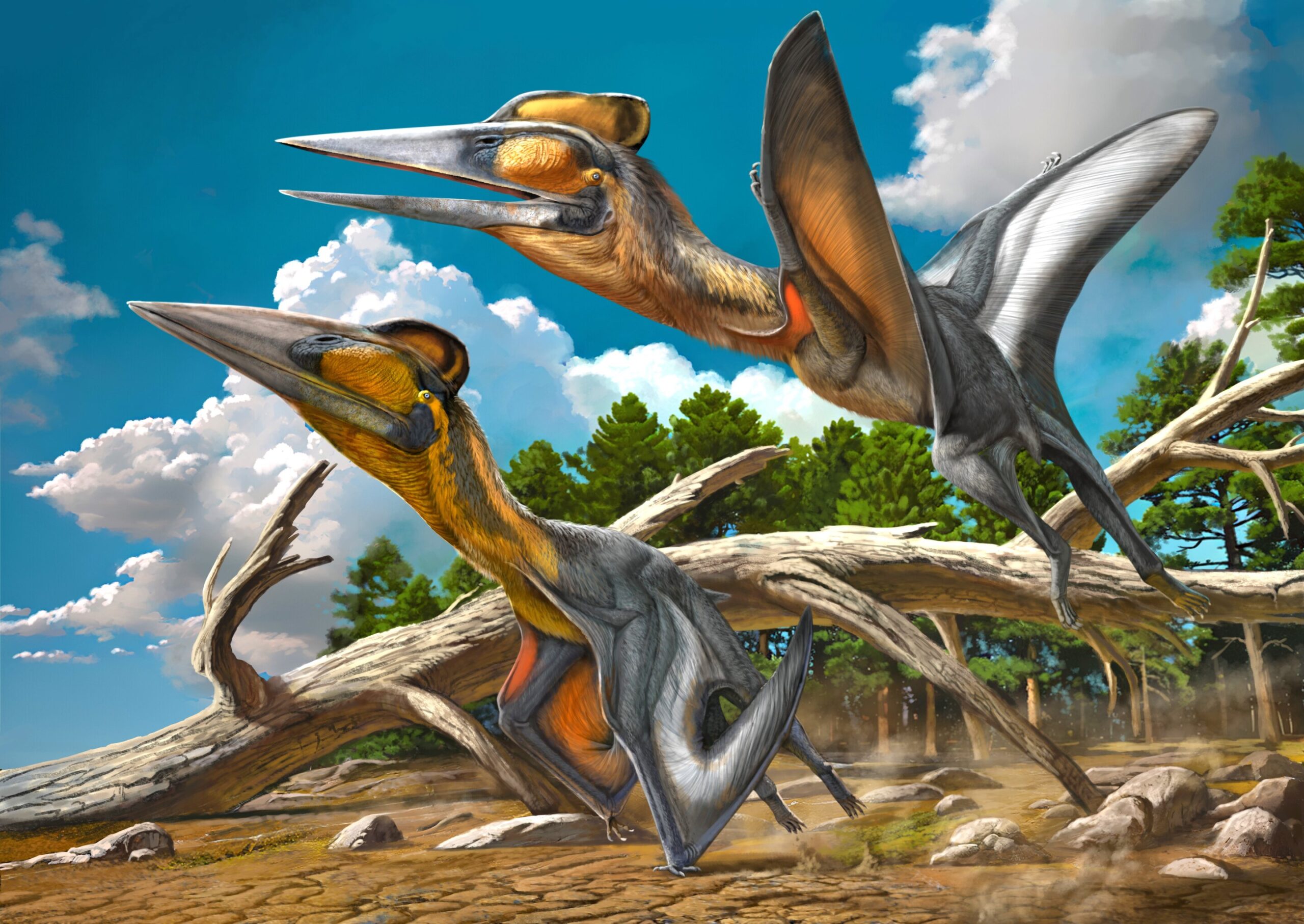
Their skulls varied widely, but among the scariest forms were those with massive jaws and elongated beaks. Some species had rows of sharp, interlocking teeth designed to grip slippery fish or struggling prey. Others lost their teeth entirely and evolved powerful, pointed beaks capable of stabbing or tearing. Many had bony crests that rose from their heads, giving them silhouettes that looked almost mythical. These crests may have been used for display, balance, or species recognition, but they also added to the visual drama of these creatures.
Large eyes set high in their skulls suggest keen vision, likely adapted for spotting prey from above. Combined with their ability to soar silently on air currents, this made them effective ambush predators. An animal grazing below might never notice the danger until a shadow swept across the ground and a beak descended like a spear.
The First Masters of the Sky
The earliest pterosaurs appeared in the late Triassic Period. They were small compared to their later descendants, but they already showed the essential features of powered flight. Their wings were supported by elongated fingers, their bodies were lightweight, and their skulls were armed with teeth. These early flyers likely hunted insects and small vertebrates, darting through the air in pursuit of prey.
At this time, the skies were largely empty. Insects buzzed, but no birds yet existed. This absence of competition allowed pterosaurs to spread rapidly into different ecological niches. Some became agile aerial insectivores, others specialized in fishing along shorelines. The ability to approach prey from above was a revolutionary advantage.
Even in these early forms, there was something unsettling about their design. Unlike birds, whose feathers give them a soft appearance, pterosaurs had bare membranes and reptilian heads. Their wings would have looked like stretched skin rather than plumage, and their movements may have seemed more bat-like and alien. For the small animals of the Triassic, these early pterosaurs were already creatures of the sky that brought death from above.
Over time, natural selection favored larger size and stronger wings. As ecosystems grew more complex, so did the roles pterosaurs played within them. By the Jurassic Period, they were no longer merely opportunistic insect hunters. They were becoming apex predators of the air.
Jurassic Skies of Predators
The Jurassic Period saw a dramatic increase in the diversity and size of pterosaurs. Dinosaurs had grown into giants on land, and marine reptiles dominated the seas. The skies, too, reflected this trend toward gigantism and specialization.
Coastal regions and shallow seas became hunting grounds for fish-eating pterosaurs. These animals had long, narrow jaws lined with sharp teeth, perfect for snatching fish from the water’s surface. With powerful wings and excellent gliding ability, they could patrol large areas, diving when prey appeared. Their flight would have been both graceful and menacing, long wings cutting through the air as they searched for movement below.
Other Jurassic pterosaurs developed broader skulls and stronger jaws, capable of crushing shellfish or seizing small land animals. Some may have stalked along beaches or riverbanks, wading into shallow water or walking across mudflats in search of food. Their long wings folded neatly against their bodies when on the ground, giving them a tall, almost stilted posture.
The Jurassic world was a place where danger came from every direction. Dinosaurs hunted dinosaurs. Marine reptiles hunted fish and each other. Above them, pterosaurs hunted from the air. This three-dimensional battlefield made survival a constant struggle. To a small dinosaur or early mammal, a pterosaur circling overhead would have been a sign to seek cover.
The Age of Giants
By the Late Cretaceous Period, pterosaurs reached their most extreme forms. This was the age of true giants, animals whose wingspans rivaled modern aircraft. These were not fragile gliders but powerful flyers capable of traveling long distances and dominating vast territories.
One of the most famous of these giants was Quetzalcoatlus. With a wingspan that may have exceeded ten meters, it was among the largest flying animals ever to exist. Standing upright, it would have towered over a human. Its skull was long and pointed, forming a massive beak that could be used like a spear.
Unlike many fish-eating pterosaurs, Quetzalcoatlus is thought to have spent much of its time on land, stalking prey across floodplains and open terrain. Its height would have allowed it to spot small dinosaurs and other animals from afar. When it struck, it could drive its beak down with force, impaling or seizing its victim.
The idea of a flying creature that could also hunt effectively on land is deeply unsettling. It meant there was no safe place: the ground offered no refuge from the sky, and the sky could descend to the ground. For the animals of the Cretaceous, a giant pterosaur was not merely a bird of prey; it was a walking, flying predator capable of killing creatures not much smaller than itself.
Another terrifying giant was Hatzegopteryx, known from fossils found in what is now Romania. This pterosaur lived on islands, where unusual evolutionary pressures often produce strange results. Its skull was broad and heavily built, suggesting a powerful bite. Though its wings were large, its head and neck were particularly massive, indicating a lifestyle that may have involved overpowering prey on land.
Island ecosystems often lack large land predators, and in such environments, a flying predator can become the dominant hunter. Hatzegopteryx may have filled this role, stalking dwarf dinosaurs and other animals across its island home. Its combination of size, strength, and flight made it an apex predator unlike anything alive today.
Predators of Flesh and Bone
The scariest pterosaurs were not limited to fish and insects. Evidence suggests that some fed on small dinosaurs, lizards, and mammals. Bite marks on fossil bones, as well as the structure of their jaws, indicate that they could handle struggling, land-based prey.
A pterosaur hunting on land would have been a strange sight. With wings folded, it would walk on all fours, using its wing-fingers as forelimbs. Its long neck would extend forward, and its head would hover above the ground like a poised spear. When it attacked, it could strike downward with speed and precision.
In addition to active hunting, pterosaurs were likely opportunistic scavengers. A dead dinosaur would have been a massive source of food, and pterosaurs could reach such carcasses quickly by flying from afar. Their beaks were well suited for tearing flesh, and their ability to take off again after feeding allowed them to escape from land predators that might arrive at the same feast.
This dual role as hunter and scavenger made them important players in their ecosystems. They helped recycle nutrients and control populations of smaller animals. Yet from the perspective of their prey, they were agents of sudden death.
The Psychology of Fear in the Mesozoic
To understand why these creatures can be called “scary,” it helps to imagine how other animals perceived them. In modern ecosystems, fear often comes from above. Birds of prey inspire alarm calls in monkeys and deer. A shadow passing overhead can send flocks scattering. In the Mesozoic, this effect would have been amplified by the size and unfamiliarity of pterosaurs.
Their wings cast enormous shadows. Their approach could be silent when they were gliding. Their silhouettes against the sun would have been unlike anything else in the sky. To a small dinosaur or mammal, such a shape might have triggered an instinctive response to flee or hide.
Fear is an evolutionary force. Animals that recognized danger and reacted quickly survived more often than those that did not. The presence of giant pterosaurs would have shaped the behavior of countless species. Burrowing, herd formation, and vigilance would all have been influenced by the threat from above.
In this way, pterosaurs were not just physical predators but also psychological ones. They shaped the daily rhythms of life by forcing other animals to remain alert to the sky.
Flight as a Weapon
Flight itself is a weapon. It allows a predator to choose when and where to strike. It allows escape from danger and access to resources that ground-bound animals cannot reach. For pterosaurs, flight was not merely a way to move; it was central to their dominance.
Their wings were large and efficient, allowing them to soar for long periods with little effort. Rising air currents, or thermals, could lift them high above the ground, giving them a wide view of the landscape. From such heights, they could spot movement and descend rapidly on unsuspecting prey.
The ability to travel long distances also meant that pterosaurs could exploit patchy resources. If fish were abundant in one area and scarce in another, they could simply fly to better hunting grounds. This mobility gave them an advantage over many land predators, which were limited by terrain and energy costs.
Flight also allowed pterosaurs to avoid competition. By feeding from above or in places difficult to reach by other predators, they carved out unique niches. This freedom contributed to their success and to their terrifying presence.
Science Behind the Terror
Modern science has worked hard to separate myth from reality when it comes to pterosaurs. Early reconstructions portrayed them as clumsy gliders or bat-like creatures hanging upside down. Fossil discoveries and biomechanical studies have revealed a more impressive picture.
Their bones show adaptations for strong muscle attachment. Their wing membranes were reinforced with fibers that prevented tearing and allowed precise control of shape. Their joints suggest a range of motion suitable for both flapping and gliding. Computer models of their skeletons indicate that even the largest species could fly, using powerful wingbeats and efficient soaring.
Studies of their necks and skulls show that they could handle significant forces during feeding. Their beaks were not fragile ornaments but functional tools for catching and killing prey.
This scientific understanding does not make them less frightening. Instead, it grounds the fear in reality. These were not fantasy monsters; they were real animals, shaped by evolution to be effective predators.
Extinction of the Sky Rulers
The reign of the flying reptiles ended abruptly at the close of the Cretaceous Period, about 66 million years ago. A massive asteroid impact, combined with volcanic activity and climate change, triggered a global catastrophe. Food chains collapsed, and many species vanished.
Pterosaurs, already facing competition from emerging birds, did not survive this extinction. Their large size and specialized lifestyles may have made them particularly vulnerable to rapid environmental changes. When their prey disappeared and ecosystems crumbled, they had little chance of recovery.
Birds, smaller and more adaptable, took over the skies in the aftermath. The age of flying reptiles ended, and a new era of feathered flight began.
Yet the legacy of pterosaurs remains in stone. Their fossils tell a story of innovation and dominance, of a time when reptiles ruled not only land and sea but also the air.
Why They Still Terrify Us
Even today, the idea of a ten-meter wingspan reptile soaring overhead evokes unease. It challenges our assumptions about what flying animals can be. Modern birds, even the largest, seem gentle compared to the monstrous forms of the past.
Part of this fear comes from unfamiliarity. We are used to birds with feathers and songs, not reptiles with leathery wings and spear-like beaks. Another part comes from scale. Humans are not accustomed to flying predators larger than ourselves.
But deeper than that is the recognition that nature once produced creatures that seem almost too extreme to be real. The scariest flying reptiles remind us that evolution has no obligation to fit human expectations. It experiments freely with form and function, producing animals that can dominate in ways we can barely imagine.
A Sky That No Longer Exists
To imagine the Mesozoic sky is to imagine a world fundamentally different from our own. Instead of sparrows and eagles, there were giants with wings like sails and heads like spears. Instead of soft feathers, there was stretched skin and bone. Instead of gentle chirping, there may have been harsh cries echoing across plains and coasts.
The scariest flying reptiles were not just animals; they were symbols of a world where danger was everywhere and survival required constant adaptation. They remind us that the present is only one chapter in a long history of life, and that the forms life can take are limited only by the laws of physics and the pressures of evolution.
In the end, these creatures were not evil or monstrous in a moral sense. They were simply well-adapted to their environment. Their terror lies in their effectiveness, in the way their bodies were tuned for hunting and flight.
When we study them today, we do more than reconstruct bones. We resurrect a lost sky, filled with shadows of wings and the promise of sudden death. The scariest flying reptiles of the Mesozoic Era were real, and their story is a reminder that the history of life is not a gentle tale. It is a saga of innovation, competition, and survival, written across millions of years in the language of evolution.