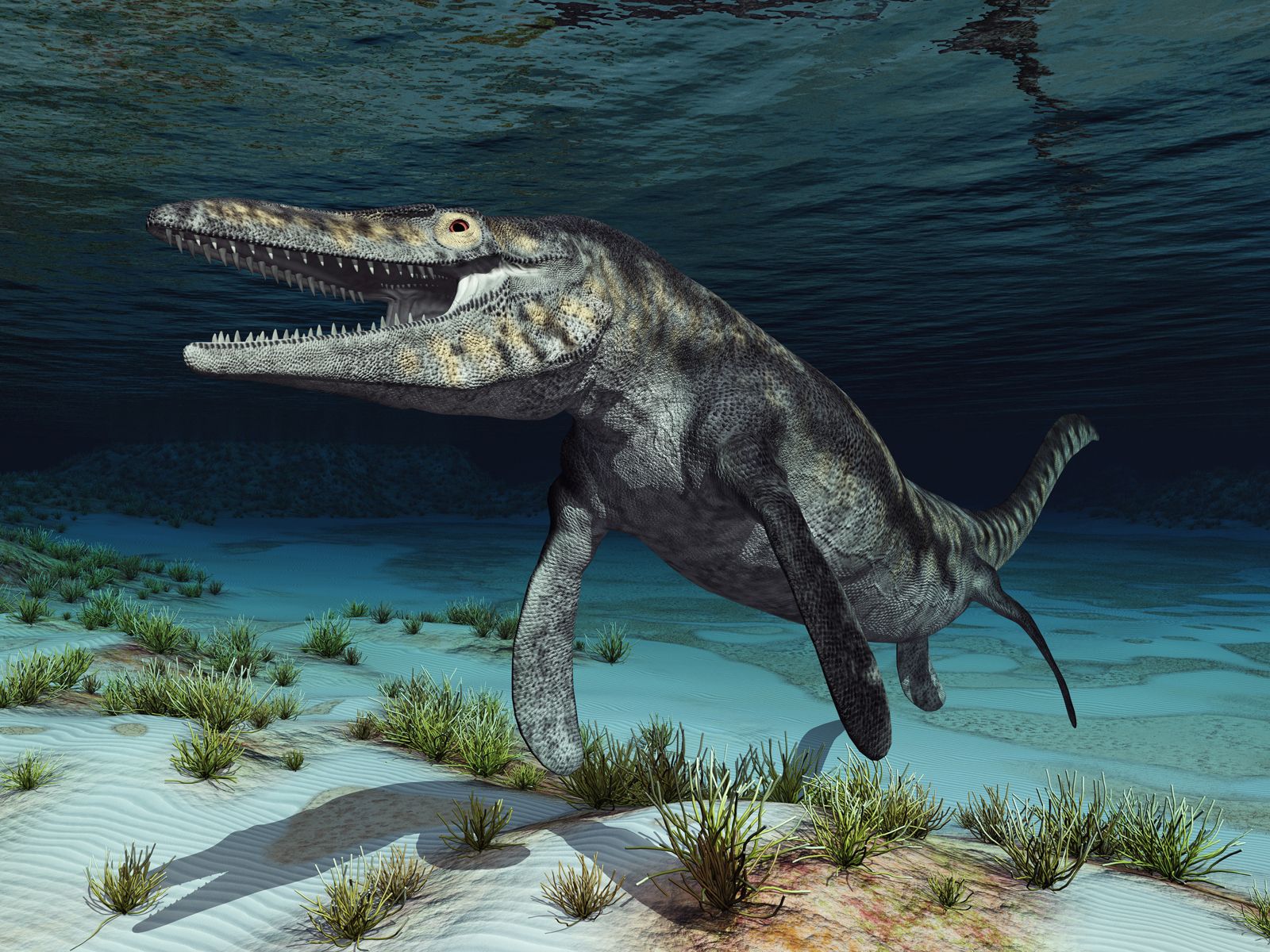
More than sixty-six million years ago, during the final chapter of the Age of Dinosaurs, the oceans of Earth were ruled by a creature so immense and formidable that it seemed almost mythological. Its jaws were lined with rows of dagger-like teeth. Its body moved through the water with the power of a giant serpent crossed with a shark. Its eyes watched silently from the dim blue depths, waiting for prey to wander too close. This animal was Mosasaurus, one of the most extraordinary marine predators that ever lived.
Although often mistaken for a dinosaur, Mosasaurus belonged to a different group entirely. It was a marine reptile, part of a family called mosasaurs that thrived during the Late Cretaceous period. These animals dominated the oceans roughly between 98 and 66 million years ago, and Mosasaurus itself was among the largest and most powerful members of this family.
The name Mosasaurus means “lizard of the Meuse River,” a reference to the river valley in the Netherlands where the first fossils were discovered in the late eighteenth century. That discovery ignited scientific curiosity and helped shape early paleontology. Over time, the fossil record revealed that Mosasaurus was not merely a large reptile but a true titan of the seas, capable of reaching lengths of up to fifteen to eighteen meters, rivaling some of the largest marine predators in Earth’s history.
When Mosasaurus glided through ancient oceans, it lived in a world dramatically different from our own. Continents were arranged differently, sea levels were higher, and much of what is now dry land lay beneath warm, shallow seas. In those vast marine ecosystems, Mosasaurus was an apex predator, a creature that hunted other marine reptiles, fish, sharks, and even members of its own kind.
To understand Mosasaurus is to step into a vanished world—a time when reptilian giants ruled the oceans and the boundaries between myth and reality seemed blurred beneath the waves.
Discovery of a Fossil Legend
The story of Mosasaurus begins not in the ocean but in the stone quarries of Maastricht in the Netherlands. In the 1760s, workers digging limestone along the Meuse River uncovered a massive skull embedded in rock. At the time, the science of paleontology did not yet exist in any modern sense. Fossils were mysterious curiosities, sometimes believed to be remnants of biblical creatures or unknown animals.
The skull was extraordinary. It possessed long jaws and enormous teeth unlike those of any living animal known to European scholars. The fossil eventually came to the attention of scientists who struggled to classify it. Some initially believed it belonged to a giant crocodile, while others suggested it might be a whale.
During the turmoil of the French Revolutionary Wars in the 1790s, the fossil became famous. When French troops captured Maastricht in 1794, the skull was transported to Paris, where it was studied by the renowned naturalist Georges Cuvier. Cuvier was one of the founders of comparative anatomy and paleontology, and he recognized that the fossil represented a previously unknown type of marine reptile.
Cuvier’s analysis was revolutionary. He demonstrated that extinct animals were real, challenging the long-held belief that all species created by nature still existed somewhere on Earth. Mosasaurus became one of the first widely recognized examples of extinction, helping transform scientific understanding of life’s history.
From that moment onward, Mosasaurus captured the imagination of scientists and the public alike. Fossils discovered in Europe, North America, Africa, and Antarctica revealed that these giant predators had inhabited oceans across the globe.
Anatomy of a Marine Predator
Mosasaurus possessed a body built for dominance in the water. At first glance, its shape might remind modern observers of a large monitor lizard crossed with a shark or a marine crocodile. Yet it was uniquely adapted for life in the ocean.
Its skull was long and powerful, with flexible joints that allowed the jaws to open wide. The teeth were conical, slightly curved, and extremely sharp, ideal for seizing slippery prey. Unlike the slicing teeth of some carnivorous dinosaurs, Mosasaurus teeth were designed to grip and hold.
One of the most fascinating features of mosasaurs was the presence of a second row of teeth on the roof of the mouth. These palatal teeth helped pull prey deeper into the throat once it had been captured. Similar structures exist in some modern reptiles, such as snakes, which swallow prey whole.
The body of Mosasaurus was long and streamlined, covered in scales like those of modern reptiles. Its limbs had evolved into paddle-like flippers used for steering rather than propulsion. The main engine of movement came from its powerful tail.
For many years, scientists believed mosasaurs swam like giant eels, undulating their entire bodies through the water. However, more recent fossil discoveries have revealed that Mosasaurus possessed a large, crescent-shaped tail fin similar to that of sharks. This suggests it was a highly efficient swimmer capable of bursts of speed when pursuing prey.
The spine and tail were designed for powerful propulsion, while the flippers provided stability and control. Together, these features made Mosasaurus one of the most formidable marine hunters of the Late Cretaceous seas.
Relatives on Land
Despite its fully aquatic lifestyle, Mosasaurus had surprising relatives living on land. Paleontological research has shown that mosasaurs were closely related to squamates, the reptile group that includes modern lizards and snakes.
In fact, many scientists believe mosasaurs evolved from land-dwelling lizards that gradually adapted to life in the sea. Their closest modern relatives are thought to be monitor lizards and possibly snakes.
Early mosasaurs still possessed features indicating their terrestrial ancestry. Their skeletons showed limb structures similar to lizards, and their bodies were not yet fully streamlined for ocean life. Over millions of years, natural selection transformed these semi-aquatic reptiles into powerful marine predators.
This evolutionary transition mirrors other remarkable shifts in Earth’s history. Just as whales evolved from land mammals into ocean giants, mosasaurs represent reptiles returning to the sea after their ancestors had once lived entirely on land.
The transformation was dramatic. Limbs became flippers. Tails developed fins. Bodies grew larger and more hydrodynamic. By the Late Cretaceous, mosasaurs had become the dominant predators in marine ecosystems across the planet.
Life in the Cretaceous Oceans
The world Mosasaurus inhabited during the Late Cretaceous period was rich with marine life. Warm temperatures and high sea levels created vast inland seas and shallow coastal waters teeming with organisms.
One of the most famous of these environments was the Western Interior Seaway, a massive body of water that once divided North America into two landmasses. This sea stretched from the Arctic Ocean down to the Gulf of Mexico and served as a thriving habitat for mosasaurs and countless other marine species.
Within these waters lived enormous fish, squid-like ammonites, turtles, sharks, and other marine reptiles. Plesiosaurs, with their long necks and paddle-like limbs, shared the seas with mosasaurs. Ichthyosaurs, dolphin-shaped marine reptiles that had dominated earlier periods, were disappearing by this time, leaving ecological opportunities for mosasaurs to expand.
Mosasaurus occupied the top of this food web. It hunted aggressively, using its speed, size, and powerful jaws to overpower prey. Fossil evidence shows that mosasaurs consumed a wide variety of animals, including fish, seabirds, turtles, ammonites, and even other mosasaurs.
The oceans of the Late Cretaceous were vibrant ecosystems, and Mosasaurus stood at the apex of their complex food chains.
The Hunt Beneath the Waves
Imagining Mosasaurus in action reveals a predator of extraordinary power. As it cruised through the ancient seas, its body moved with graceful efficiency. Its large eyes scanned the water for movement, while sensitive sensory systems may have helped detect vibrations from potential prey.
When Mosasaurus attacked, the strike was likely sudden and violent. With a rapid burst of speed from its tail, it could close the distance between itself and its target in seconds. Its jaws snapped shut with tremendous force, impaling prey with curved teeth.
Once captured, the prey had little chance of escape. The backward-facing palatal teeth prevented animals from slipping free. Mosasaurus could swallow smaller prey whole or tear larger victims into pieces.
Some fossilized mosasaur stomach contents reveal the remains of fish, turtles, birds, and ammonites. In certain cases, bite marks found on other mosasaur fossils indicate that cannibalism may have occurred, especially among large individuals competing for food.
In the vast underwater world of the Cretaceous oceans, Mosasaurus was a relentless hunter.
Growth, Reproduction, and Life Cycle
Like many reptiles, Mosasaurus likely began life as a relatively small hatchling. Evidence suggests that mosasaurs gave birth to live young rather than laying eggs on land. Fossils of pregnant mosasaurs and juvenile skeletons discovered in marine sediments support this conclusion.
Live birth would have been a crucial adaptation for animals fully committed to life in the ocean. Returning to land to lay eggs would have been dangerous and inefficient for such large marine reptiles.
Young mosasaurs probably grew rapidly, feeding on smaller prey as they matured. Over time they developed into powerful hunters capable of challenging large animals.
The lifespan of Mosasaurus is still uncertain, but growth patterns in bones suggest they may have lived for several decades. As apex predators, adult mosasaurs likely faced few natural threats aside from other large marine reptiles.
Diversity Within the Mosasaur Family
Although Mosasaurus itself was among the largest and most famous members of its family, mosasaurs were a diverse group. More than forty genera have been identified, ranging in size from relatively small forms only a few meters long to giants exceeding fifteen meters.
Some mosasaurs specialized in crushing hard-shelled prey such as mollusks and turtles. Others had slender jaws suited for catching fish. Their ecological diversity allowed them to occupy many niches within marine ecosystems.
Mosasaurus belonged to the group known as mosasaurines, characterized by robust skulls and powerful jaws. These animals were among the most formidable predators in the oceans during the Late Cretaceous.
Their widespread distribution demonstrates how successful mosasaurs were. Fossils have been discovered on nearly every continent, showing that these reptiles inhabited seas across the globe.
The Catastrophe That Ended Their Reign
For millions of years, Mosasaurus ruled the seas. But like many other creatures of the Late Cretaceous, its dominance would come to an abrupt and devastating end.
Around sixty-six million years ago, Earth experienced one of the most catastrophic events in its history. A massive asteroid struck the region that is now the Yucatán Peninsula in Mexico, creating the Chicxulub crater. The impact released enormous energy, triggering global wildfires, earthquakes, and tsunamis.
Dust and debris filled the atmosphere, blocking sunlight and disrupting ecosystems worldwide. Photosynthesis collapsed, food chains broke down, and countless species vanished.
This event marked the boundary between the Cretaceous and Paleogene periods and is widely associated with the extinction of the non-avian dinosaurs. Marine reptiles such as mosasaurs and plesiosaurs also disappeared.
The oceans that had once belonged to Mosasaurus were suddenly empty of these ancient giants. In the aftermath of the extinction, new groups of animals—including modern sharks and marine mammals—would eventually rise to fill the ecological roles left behind.
Fossils and the Window Into Deep Time
The legacy of Mosasaurus survives today in the fossil record. Skeletons preserved in rock allow scientists to reconstruct the anatomy, behavior, and environment of these prehistoric predators.
Some of the most spectacular mosasaur fossils have been found in North America, particularly in the chalk deposits of Kansas and South Dakota. These sediments formed in the Western Interior Seaway and have yielded remarkably complete specimens.
Advances in paleontology have provided deeper insights into mosasaur biology. Studies of bone structure reveal growth patterns and metabolism. Fossilized skin impressions show scale patterns. Chemical analysis of teeth can even indicate diet and habitat preferences.
Each fossil discovery adds another piece to the puzzle of Mosasaurus and the world it inhabited.
Mosasaurus in Popular Culture
In modern times, Mosasaurus has captured public imagination as a symbol of prehistoric ocean power. Its immense size and terrifying jaws make it a natural candidate for stories, documentaries, and films about ancient life.
One of the most famous portrayals appears in the Jurassic World film series, where a gigantic Mosasaurus inhabits a marine lagoon and performs spectacular feats of predation. While the film exaggerates the creature’s size and behavior for dramatic effect, it has introduced millions of viewers to this extraordinary prehistoric reptile.
Scientific reconstructions continue to refine our understanding of how Mosasaurus truly looked and lived. Unlike the exaggerated monsters of fiction, the real animal was a product of natural evolution—no less awe-inspiring for being real.
The Legacy of the Cretaceous Sea Monster
Mosasaurus represents one of nature’s most impressive evolutionary achievements. From land-dwelling ancestors, it evolved into a master of the oceans, perfectly adapted for life in a vast marine world.
Its story illustrates the dynamic nature of life on Earth. Ecosystems rise and fall. Dominant species appear, flourish, and eventually vanish. Yet each leaves traces that scientists can uncover millions of years later.
The fossilized bones of Mosasaurus remind us that the oceans once belonged to creatures very different from those we know today. They reveal a time when reptiles ruled the seas and the balance of life was shaped by entirely different forces.
Today, as humans explore the deep ocean and search for life beyond our planet, the story of Mosasaurus continues to inspire wonder. It reminds us that the history of life is far richer, stranger, and more dramatic than we often imagine.
In the silent stone layers of ancient seas, the sea monster of the Cretaceous still sleeps—waiting for curious minds to bring its story back to life.