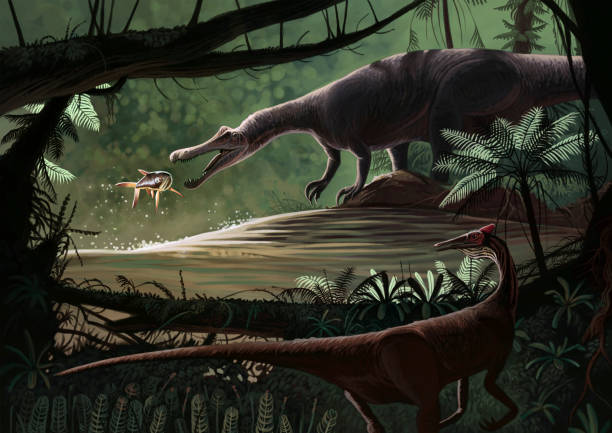
The Earth of the Late Jurassic period was a world both strange and magnificent. Vast floodplains stretched beneath towering conifer forests. Ferns and cycads blanketed the ground, and enormous dinosaurs wandered across ancient landscapes that would one day become parts of North America, Europe, and Africa. Among these giants lived creatures of staggering size—long-necked herbivores that could weigh as much as modern whales and armored dinosaurs built like living fortresses.
But in that ancient world, every giant needed to fear a hunter.
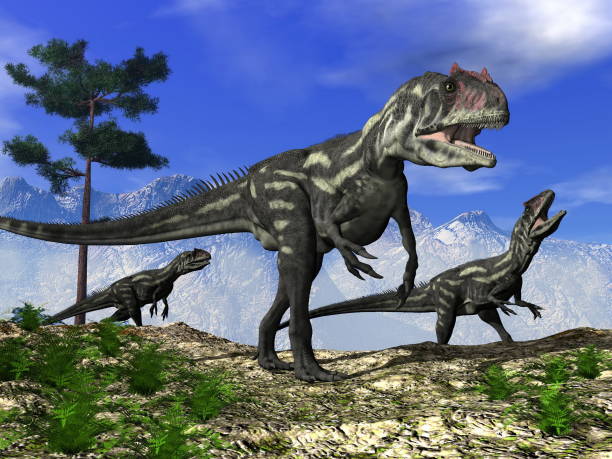
At the top of this prehistoric food chain prowled one of the most formidable predators of its time: Allosaurus. Sleek, powerful, and terrifyingly efficient, this carnivorous dinosaur ruled the Jurassic ecosystems much like a lion dominates the African savanna today. Because of its position as the dominant predator of its environment, paleontologists often refer to Allosaurus as the “Lion of the Jurassic.”
Allosaurus was not merely another dinosaur among many. It was a creature perfectly shaped by evolution to hunt, kill, and survive in a landscape filled with gigantic prey and fierce competitors. Through fossils buried for more than 150 million years, scientists have gradually pieced together the story of this extraordinary predator—its anatomy, its behavior, its environment, and its role in the prehistoric world.
Understanding Allosaurus means stepping back into a time when dinosaurs ruled the planet, when continents were arranged differently, and when the ecosystems of Earth were dominated by animals unlike anything alive today.
The Meaning Behind the Name
The name Allosaurus carries a story within it. It comes from the Greek words “allos,” meaning “different,” and “sauros,” meaning “lizard.” The name therefore translates roughly as “different lizard.”
This unusual name was given by the American paleontologist Othniel Charles Marsh in 1877. Marsh noticed that the vertebrae—the bones of the spine—had a distinctive structure unlike those of other known dinosaurs. Their unusual shape inspired him to name the animal Allosaurus.
The species most commonly discussed is Allosaurus fragilis. The species name “fragilis” refers to the delicate appearance of certain bones, although the animal itself was anything but fragile.
At the time Marsh described Allosaurus, paleontology was still a young science. The late nineteenth century saw intense competition between American fossil hunters in a period sometimes called the “Bone Wars.” Fossils discovered in the American West were revealing a prehistoric world far richer and stranger than scientists had ever imagined.
Among the dinosaurs uncovered during that era, Allosaurus quickly became one of the most famous.
The World of the Late Jurassic
To truly understand Allosaurus, one must first imagine the world in which it lived. The Late Jurassic period lasted roughly from 163 million to 145 million years ago. During this time, the supercontinent Pangaea had already begun to break apart, creating new coastlines, inland seas, and diverse ecosystems.
Large portions of what is now western North America formed a vast environment known as the Morrison Formation. This region contained rivers, floodplains, forests, and seasonal wetlands. The climate was generally warm, though many areas experienced alternating wet and dry seasons.
This landscape teemed with dinosaurs. Massive plant-eating species wandered the plains, including long-necked sauropods such as Diplodocus and Apatosaurus. These animals could reach lengths of over 25 meters and weighed tens of tons.
Armored herbivores also roamed the land. One of the most recognizable was Stegosaurus, whose distinctive back plates and spiked tail made it one of the strangest dinosaurs ever to evolve.
Among all these herbivores moved the predators. Smaller carnivorous dinosaurs hunted insects and small animals, but one predator towered above them all in power and influence: Allosaurus.
In this ecosystem, Allosaurus played the role of apex predator—the top hunter of its environment.
Discovery and Fossil Evidence
The story of Allosaurus began with the discovery of fossilized bones in the American West during the late 1800s. Early discoveries were scattered and incomplete, but they hinted at a large carnivorous dinosaur unlike those known before.
Over time, more complete skeletons were found in Colorado, Utah, Wyoming, and other parts of the Morrison Formation. Some of the most spectacular discoveries came from a remarkable fossil site known as the Cleveland-Lloyd Dinosaur Quarry.
This quarry contains the remains of dozens of Allosaurus individuals—more than any other dinosaur at the site. The abundance of these fossils has provided scientists with extraordinary insights into the anatomy and possible behavior of this predator.
Fossils show that Allosaurus was widespread and successful. Remains have also been found in Portugal and possibly other regions, suggesting the dinosaur inhabited multiple continents when they were connected.
These discoveries transformed Allosaurus from a mysterious fossil into one of the best-understood carnivorous dinosaurs of the Jurassic.
Physical Appearance and Size
Allosaurus was an imposing animal. The average adult measured around 8.5 to 10 meters in length and stood about 3 to 4 meters tall at the hips. Some individuals may have grown even larger.
The body of Allosaurus followed the classic theropod design. It walked on two powerful hind legs, balancing its body with a long muscular tail. Its front limbs were shorter but still strong, each ending in three sharp claws capable of gripping prey.
The skull was large, lightly built, and filled with dozens of serrated teeth. These teeth were curved backward like steak knives, perfect for slicing flesh.
One of the most distinctive features of Allosaurus was the pair of bony ridges located above its eyes. These ridges gave the dinosaur a fierce, almost horned appearance. Scientists are not entirely sure what purpose they served. They may have been used for display, species recognition, or even protecting the eyes during feeding.
Compared with later predators like Tyrannosaurus rex, Allosaurus had a lighter skull and different hunting adaptations. While Tyrannosaurus relied on an incredibly powerful bite, Allosaurus likely used a different strategy to subdue prey.
Its anatomy suggests speed, agility, and flexibility—traits well suited to an active hunter.
Teeth, Jaws, and Feeding Strategy
The teeth of Allosaurus reveal much about how it hunted and fed. These teeth were not designed for crushing bone like those of Tyrannosaurus. Instead, they were sharp and serrated, ideal for slicing through flesh.
Fossil evidence suggests that Allosaurus may have used a “slash and tear” feeding strategy. Its flexible neck and lightly built skull may have allowed it to swing its head downward like a hatchet, driving its teeth into prey and tearing chunks of flesh.
This method would have been effective against large herbivores. Even a single deep wound could weaken a massive dinosaur over time.
Some fossils show bite marks consistent with Allosaurus teeth on the bones of herbivorous dinosaurs. These marks provide direct evidence of predator-prey interactions during the Jurassic.
Scientists have also discovered broken and healed bones in Allosaurus skeletons, suggesting these predators sometimes suffered injuries while hunting dangerous prey.
Hunting enormous dinosaurs was risky, but the rewards were immense.
Hunting Behavior and Ecology
Allosaurus occupied the top predator role in its environment, but the details of its hunting behavior remain an active area of research.
Some paleontologists believe Allosaurus may have hunted in groups. The large number of individuals found together at certain fossil sites hints at possible social behavior. Cooperative hunting could have allowed these predators to target the gigantic sauropods of their ecosystem.
Other scientists argue that the fossil evidence may instead represent predators gathering around carcasses rather than organized hunting packs.
Regardless of whether they hunted alone or in groups, Allosaurus was clearly capable of attacking large prey. Its claws, teeth, and agility would have made it a formidable opponent.
It likely preyed upon juvenile sauropods or weaker individuals, though it may also have scavenged when opportunities arose.
Like modern lions or wolves, Allosaurus probably balanced hunting with opportunistic feeding.
The Brain and Senses of Allosaurus
Although dinosaurs are often imagined as slow and unintelligent, the brain of Allosaurus suggests a more capable animal.
Endocasts—internal molds of the skull cavity—indicate that Allosaurus had well-developed sensory regions. Its sense of smell was probably strong, allowing it to detect carcasses or prey from long distances.
The forward placement of its eyes suggests that it had at least some degree of binocular vision. This overlap in vision would have helped judge distances when attacking prey.
Balance and coordination were also important. The inner ear structure indicates Allosaurus had good control over head movement and body orientation.
While it was not as intelligent as modern mammals or birds, Allosaurus was likely a capable and alert predator well suited to its environment.
Growth and Life Cycle
Fossil evidence suggests that Allosaurus grew rapidly during its early years. Like many dinosaurs, it may have experienced a period of accelerated growth during adolescence.
Young individuals were smaller and more lightly built than adults. Their diets and behaviors may have differed as well, possibly focusing on smaller prey before graduating to larger animals as they matured.
Bone studies indicate that Allosaurus individuals could live for several decades, though life in the Jurassic was undoubtedly harsh. Predators faced injuries, competition, disease, and environmental challenges.
The presence of healed injuries in many fossils suggests that Allosaurus individuals often survived serious wounds, evidence of both resilience and a dangerous lifestyle.
Allosaurus in Popular Culture
Few dinosaurs capture the imagination like powerful predators, and Allosaurus has appeared in many documentaries, books, and films.
Though it is often overshadowed by Tyrannosaurus rex in popular culture, Allosaurus remains one of the most iconic dinosaurs from the Jurassic period.
Its role as the dominant predator of its era gives it a special place in paleontology. Long before Tyrannosaurus ruled the Late Cretaceous, Allosaurus dominated the ecosystems of the Jurassic world.
Why Allosaurus Is Called the “Lion of the Jurassic”
The comparison between Allosaurus and lions is not simply poetic. In many ways, the analogy reflects the ecological role the dinosaur played.
Lions dominate African savannas as top predators, controlling herbivore populations and shaping ecosystems. Allosaurus likely played a similar role in Jurassic landscapes.
It hunted large herbivores, scavenged carcasses, and competed with other predators. Its presence influenced the behavior and survival strategies of other dinosaurs.
Just as lions symbolize power and dominance in modern ecosystems, Allosaurus symbolized those traits in the prehistoric world.
The Continuing Mystery of Allosaurus
Even after more than a century of study, Allosaurus continues to fascinate scientists. Each new fossil discovery adds detail to its story.
Researchers still debate aspects of its hunting behavior, social structure, and growth patterns. Advances in technology—such as CT scanning and biomechanical modeling—allow scientists to study fossils in ways that were impossible in the past.
Through these methods, paleontologists are slowly reconstructing the life of one of the most important predators in dinosaur history.
A Predator Frozen in Deep Time
More than 145 million years have passed since Allosaurus walked the Earth. The landscapes it once dominated have changed beyond recognition. Rivers shifted, mountains rose, continents drifted apart, and entire ecosystems vanished.
Yet in stone and fossilized bone, traces of that ancient predator remain.
Allosaurus stands as a reminder of the dynamic history of life on Earth. It was not merely a monster of the past but a living creature shaped by evolution, environment, and survival.
The “Lion of the Jurassic” once ruled a world filled with giants, and through the patient work of science, its story continues to emerge from the rocks of deep time.