Long before humans built cities, long before forests were cleared for farms and highways cut across the continent, North America was home to a creature that seemed almost mythical in its power and presence. Towering above most animals of its time and moving with unsettling speed for something so massive, the short-faced bear was one of the most formidable predators the continent had ever seen. Known to science as Arctodus simus, this Ice Age giant roamed vast stretches of land during the Pleistocene epoch, dominating ecosystems with its sheer size and intimidating presence.
The world in which this bear lived was dramatically different from the one we know today. Mammoths and mastodons walked across open plains. Giant ground sloths lumbered through forests. Saber-toothed cats stalked prey in the tall grass. And among these giants, the short-faced bear stood as one of the most awe-inspiring—and perhaps most terrifying—animals of them all.
Its very name sparks curiosity. The “short-faced” label comes from the unique structure of its skull, which appears flattened compared with modern bears. But the name can be misleading. In life, the animal’s face was not actually short in the way most people imagine. Instead, its snout was relatively broad and its skull deep, giving it a distinctive appearance unlike any living bear.
What truly made this animal remarkable, however, was not simply its face but its size, strength, and ecological role. At its peak, this bear may have stood over twelve feet tall when upright, towering over humans and even many Ice Age predators. It was not merely large; it was built to dominate.
To understand the short-faced bear is to step into the strange and dramatic world of Ice Age North America, a time when ecosystems were filled with giants and survival demanded extraordinary adaptations.
The Ice Age World It Inhabited
The short-faced bear lived during the Pleistocene, a period that stretched from roughly 2.6 million years ago until about 11,700 years ago. This epoch was defined by repeated ice ages, when massive glaciers advanced and retreated across large parts of the Northern Hemisphere.
During colder periods, enormous ice sheets covered much of northern North America. When the climate warmed, the ice retreated, opening new habitats. These cycles dramatically shaped the continent’s landscapes and wildlife.
The world of the Pleistocene was rich with large animals known as megafauna. Herds of Mammuthus wandered across open grasslands. Massive Mammut americanum browsed in forests. Enormous ground sloths such as Megatherium moved slowly but powerfully through vegetation.
Predators were equally impressive. The famous Smilodon fatalis hunted large herbivores with its long curved teeth. The powerful Panthera atrox prowled the plains. Packs of the Canis dirus pursued prey across open landscapes.
Within this dramatic ecological theater, the short-faced bear occupied a unique role. It was not simply another predator among many. It may have been the largest carnivorous mammal in North America at the time, capable of challenging even the most powerful hunters.
A Giant Among Bears
To appreciate the true scale of the short-faced bear, one must compare it to the largest bears alive today.
The modern Ursus maritimus is considered the largest living bear. Adult males can weigh up to 700 kilograms and stand over three meters tall when upright. The Ursus arctos, including the famous grizzly bear, is also immensely powerful.
Yet the short-faced bear was likely even larger.
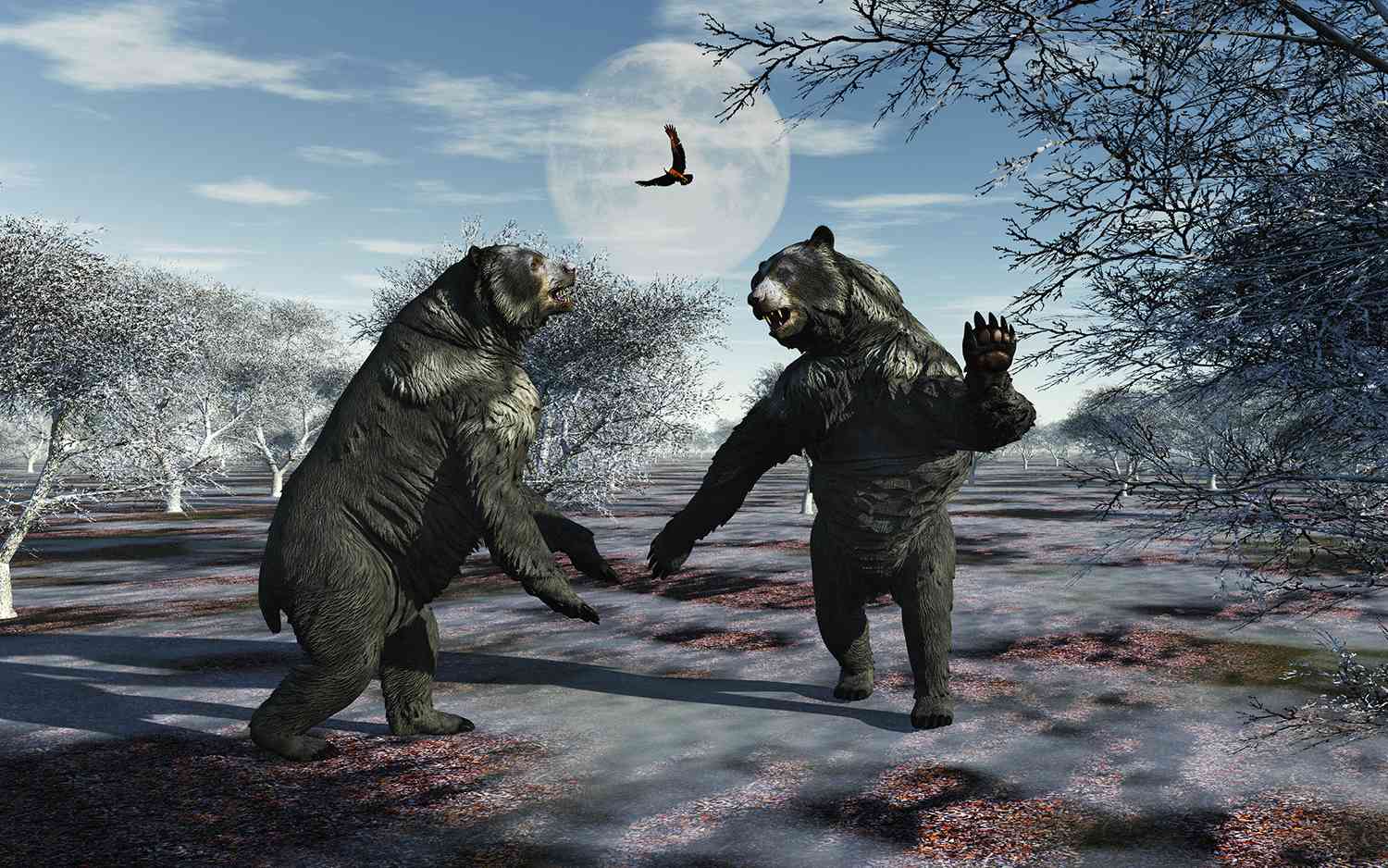
Estimates suggest that some individuals of Arctodus simus may have weighed between 700 and 1,000 kilograms, and possibly more in exceptional cases. When standing on its hind legs, it could reach heights exceeding 3.5 meters. Its shoulders alone may have stood over 1.6 meters high.
But its size was not merely about bulk. The body structure of the short-faced bear was different from that of modern bears. Its legs were unusually long and slender compared with its body. Its skull was large and powerful, and its limbs suggested an animal capable of covering vast distances.
These proportions created an animal that looked almost unfamiliar to those accustomed to modern bears. It was taller, longer-legged, and more imposing.
In life, encountering such an animal on the Ice Age plains would have been an unforgettable—and likely terrifying—experience.
The Mystery of the “Short Face”
The unusual skull of Arctodus simus gave rise to the common name “short-faced bear.” Paleontologists noticed that the snout seemed shortened compared to modern bears.
However, closer examination reveals a more complex story. The skull is actually deep rather than truly short. The region between the eyes and nose is compact, giving the appearance of a flattened face.
This structure may have provided mechanical advantages for powerful biting. A deep skull allows stronger muscle attachment, meaning the bear could generate significant bite force.
The teeth of the short-faced bear were also impressive. Its large canines and robust molars suggest it could process tough meat and bone. Some scientists believe it may have been capable of crushing bones much like modern hyenas.
The combination of skull structure and dental anatomy suggests a predator well equipped to handle large carcasses.
Predator or Scavenger?
For decades, scientists debated the ecological role of the short-faced bear. Was it primarily an active predator, or was it more of a scavenger that relied on carcasses killed by other animals?
Early theories suggested the bear might have been a specialized scavenger. Its long legs and powerful sense of smell could have allowed it to travel great distances across open landscapes in search of carcasses.
In this scenario, the bear would have dominated feeding sites simply through intimidation. Few predators would risk confronting such an enormous animal. A short-faced bear arriving at a kill made by wolves or saber-toothed cats could easily have forced them away.
However, later research challenged the idea that it was only a scavenger.
The bear’s limb structure suggests it was capable of relatively fast movement for its size. Its powerful build and large claws indicate it could have hunted large prey directly.
Many paleontologists now believe that the short-faced bear likely combined both strategies. Like modern bears, it probably hunted when opportunities arose and scavenged when it could.
In the unpredictable ecosystems of the Ice Age, such flexibility would have been a powerful advantage.
Speed and Mobility
One of the most striking features of Arctodus simus is its long legs. Compared with the shorter limbs of modern bears, its legs appear almost disproportionate.
These long limbs likely allowed the bear to travel efficiently across open terrain. Ice Age North America included vast grasslands and steppe environments where long-distance movement was essential.
Some researchers suggest the short-faced bear may have been capable of running faster than modern bears, at least over short distances. While exact speeds remain uncertain, its body structure suggests impressive mobility for such a large animal.
This ability to move quickly across large areas would have been valuable for both hunting and scavenging. A bear capable of detecting a carcass from kilometers away and reaching it quickly would have had a significant advantage.
The open landscapes of the Pleistocene may have favored such adaptations.
A Fearsome Competitor
The Ice Age predator community was crowded and competitive. Large carnivores constantly competed for food, territory, and survival.
In this environment, size could be a decisive advantage.
A fully grown short-faced bear would have been difficult for most predators to challenge. Even powerful hunters like the American lion or saber-toothed cat might have avoided direct confrontation.
The bear’s sheer mass and strength would have made it capable of driving other predators away from carcasses. This behavior is seen in modern ecosystems when large carnivores dominate feeding sites.
For example, a large grizzly bear today can easily displace wolves or mountain lions from their kills. The short-faced bear may have played a similar role, but on an even more dramatic scale.
Its presence alone may have reshaped the behavior of other predators across Ice Age landscapes.
Fossils and Discovery
The story of the short-faced bear comes from fossils discovered across North America. Remains have been found in many regions, including Alaska, Canada, and the continental United States.
One of the most famous fossil sites associated with Ice Age animals is Rancho La Brea Tar Pits. These natural asphalt deposits trapped countless animals over thousands of years, preserving their bones in remarkable detail.
Fossils from sites like these allow scientists to reconstruct the anatomy and lifestyle of extinct animals. Skull fragments, limb bones, and teeth provide clues about diet, movement, and evolutionary relationships.
Through careful study of these remains, paleontologists have gradually built a picture of what Arctodus simus looked like and how it lived.
Each fossil discovery adds another piece to the puzzle of this extraordinary animal’s life.
Evolution of the Short-Faced Bears
Arctodus simus belonged to a broader group known as short-faced bears, members of the subfamily Tremarctinae. This lineage includes several extinct species as well as one living relative.
The modern Tremarctos ornatus of South America is the last surviving member of this once-diverse group. Though much smaller and more herbivorous than its ancient relatives, it carries genetic echoes of the same lineage.
The ancestors of short-faced bears evolved millions of years ago in the Americas. Over time, different species adapted to various environments, some becoming large omnivores or predators.
Arctodus simus represents the most extreme expression of this evolutionary trend toward size and power.
Its enormous body and specialized anatomy reflect millions of years of adaptation to Ice Age ecosystems.
The Disappearance of a Giant
Around 11,000 years ago, at the end of the Pleistocene epoch, many of North America’s megafaunal species disappeared. Mammoths, mastodons, saber-toothed cats, and the short-faced bear all vanished within a relatively short geological period.
Scientists continue to debate the causes of this extinction event.
Climate change played a major role as the Ice Age ended. Warming temperatures transformed ecosystems, altering vegetation and animal populations.
At the same time, humans were spreading across the continent. Early human hunters may have placed additional pressure on large animals already struggling with environmental change.
For massive predators like the short-faced bear, the disappearance of large prey species would have been devastating. As mammoths and other megafauna declined, the bear’s food sources likely dwindled.
The combination of environmental shifts and ecological disruption may have sealed the fate of this extraordinary animal.
Imagining an Encounter
To imagine meeting a short-faced bear in the wild is to glimpse a world very different from our own.
Picture standing on an open Ice Age plain as the wind sweeps through tall grasses. In the distance, mammoths move slowly across the landscape.
Then a towering figure appears on the horizon.
At first it might seem like a moving hill. But as it approaches, the shape becomes clear. Long legs carry a massive body forward with surprising grace. Its head swings slowly from side to side as it scans the environment.
When it rises briefly onto its hind legs, it becomes a living tower of muscle and fur.
In that moment, the meaning of the Ice Age becomes vivid. This was a world of giants, and the short-faced bear was one of its most impressive inhabitants.
The Legacy of the Short-Faced Bear
Though it vanished thousands of years ago, the short-faced bear continues to fascinate scientists and the public alike. Its fossils remind us that Earth’s ecosystems have changed dramatically over time.
The study of extinct animals like Arctodus simus also helps scientists understand how ecosystems function and how species respond to environmental change.
Every bone uncovered in ancient sediments tells part of the story of life’s long journey on Earth.
The short-faced bear stands as a symbol of a lost world—a time when massive predators walked the land and survival demanded strength, speed, and adaptability.
Its story is not just about extinction. It is about evolution, adaptation, and the complex web of life that once thrived across the continent.
In the silent halls of museums and the careful work of paleontologists, the giant bear of the Ice Age still lives on—an echo of a world that was once wild beyond imagination.