Long before cities, long before written history, long before agriculture reshaped landscapes and civilizations rose from fertile river valleys, humanity lived in a world of ice and wind. Vast glaciers crept across continents, forests gave way to open tundra, and enormous animals roamed the frozen plains. Among these creatures stood one of the most iconic animals of the prehistoric world—the mammoth.
Towering above the grasses of the Ice Age steppe, mammoths were enormous relatives of modern elephants. Their long curved tusks, shaggy coats, and massive bodies made them perfectly adapted to a cold and unforgiving environment. For early humans, these animals represented both an extraordinary opportunity and a terrifying challenge.
The relationship between humans and mammoths was not merely predator and prey. It was a story of survival, ingenuity, cooperation, and courage. To hunt a mammoth required intelligence, planning, and teamwork on a scale rarely seen among other predators. And in many ways, the struggle between humans and mammoths shaped the development of human culture, technology, and social organization.
The story of how early humans hunted these Ice Age giants is not only a tale of danger and bravery, but also one of scientific discovery, revealed through archaeology, anthropology, and paleontology.
The Ice Age World
During the last Ice Age, also known as the Pleistocene epoch, vast portions of Earth were colder and drier than today. Massive ice sheets covered large parts of North America, Europe, and Asia. Beyond these frozen regions stretched enormous grasslands known as the mammoth steppe.
This ecosystem was unlike anything that exists today. Instead of dense forests, much of the landscape consisted of cold, windswept plains dominated by hardy grasses, herbs, and low shrubs. The mammoth steppe supported an astonishing diversity of large animals, including woolly rhinoceroses, giant deer, bison, horses, cave lions, and mammoths.
Among these animals, the most famous was the woolly mammoth, scientifically known as Woolly Mammoth. Covered in thick fur and protected by layers of fat, these giants could survive temperatures far below freezing.
Adult mammoths could stand up to four meters tall at the shoulder and weigh as much as six to eight tons. Their curved tusks could grow several meters long, and their trunks allowed them to grasp vegetation beneath snow.
For early humans living in the harsh climates of the Ice Age, mammoths represented something extraordinary: an enormous source of food, clothing, tools, and shelter.
The Rise of Human Hunters
By the time mammoths roamed the northern continents, several species of humans had already evolved. Among them were the Neanderthals and later modern humans, known scientifically as Homo sapiens.
These humans were not physically stronger than mammoths, nor were they faster or more powerful. Instead, their advantage lay in something unique: intelligence and cooperation.
Early human hunters possessed large brains capable of planning complex strategies. They communicated with language, shared knowledge across generations, and developed specialized tools.
Over thousands of years, humans evolved from opportunistic scavengers into skilled hunters capable of targeting some of the largest animals on Earth.
This transformation required innovation, patience, and courage. Facing a mammoth directly would have been extremely dangerous. A single swing of a mammoth’s tusks or a powerful stomp could easily kill a human.
Therefore, success in mammoth hunting depended not on strength alone but on strategy.
The Tools of Ice Age Hunters
One of the most important factors in the success of early human hunters was their technology. Even simple tools could dramatically increase hunting efficiency.
Stone tools were among the earliest weapons used by humans. Carefully shaped flint points were attached to wooden shafts to create spears. These weapons could pierce the thick skin of large animals if used correctly.
Archaeological discoveries show that humans produced a wide variety of hunting tools, including stone blades, spear points, and cutting implements.
Later innovations included spear-throwing devices that allowed hunters to launch projectiles with greater force and distance. These tools multiplied the effectiveness of human hunters, allowing them to strike animals from safer distances.
Evidence of such tools has been discovered at numerous prehistoric sites across Europe, Asia, and North America.
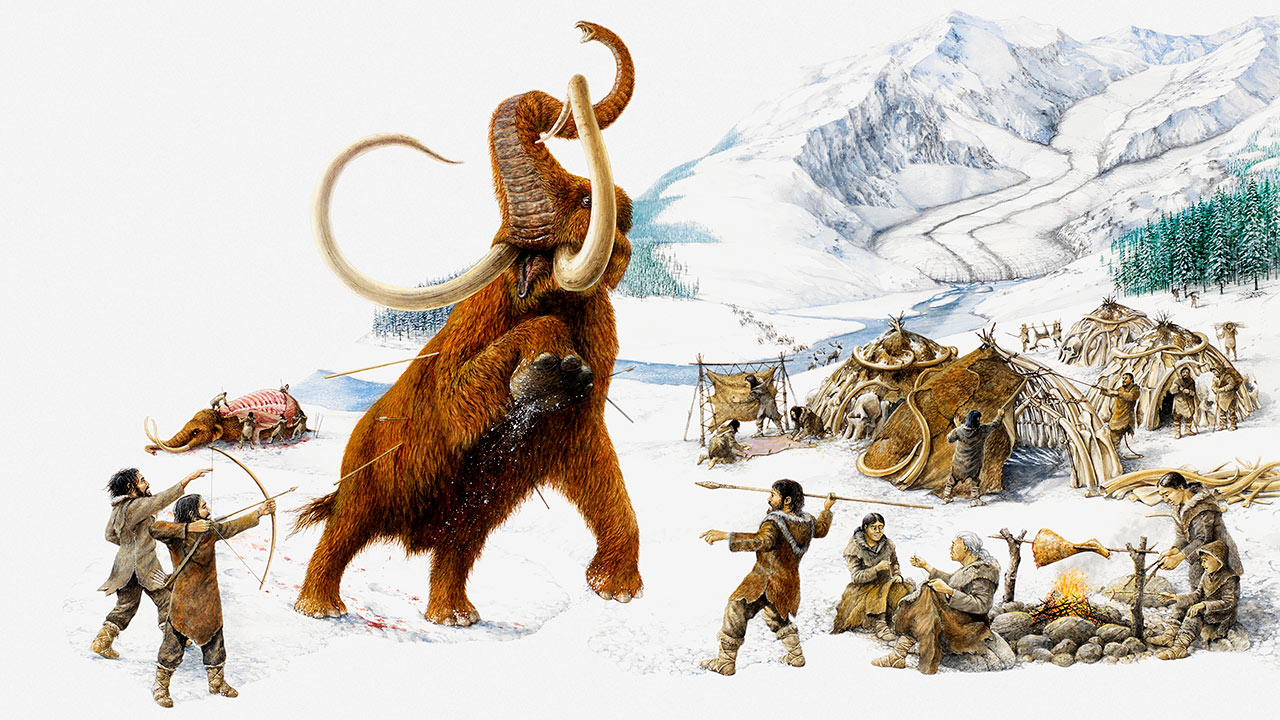
One of the most famous sites associated with mammoth hunting is the ancient settlement at Mezhirich Mammoth Bone Settlement, where researchers found dwellings constructed from mammoth bones and tusks.
These structures demonstrate not only hunting success but also the importance of mammoths in human life.
Cooperation and Social Intelligence
No single human could kill a mammoth alone. Successful hunts required cooperation among groups of hunters.
Anthropologists believe that early human groups worked together in coordinated teams. Some hunters may have driven mammoths toward traps or dangerous terrain, while others waited in strategic positions with spears.
Communication played a critical role. Hunters had to coordinate movements, anticipate the animal’s reactions, and respond quickly to changing conditions.
This level of cooperation suggests that mammoth hunting helped strengthen social bonds within human communities. Shared risks and shared rewards reinforced cooperation and trust.
The hunt itself was not merely an act of survival but a social event that required organization, leadership, and collective effort.
Driving Mammoths into Traps
One effective strategy used by early hunters was to drive mammoths into natural traps.
Cliffs, ravines, bogs, and steep slopes could become deadly obstacles for massive animals. Humans could exploit these features by frightening or guiding mammoths toward them.
Archaeological sites in North America reveal locations where large numbers of mammoths appear to have fallen from cliffs. These sites suggest that hunters may have deliberately stampeded herds over steep edges.
Such strategies required careful planning. Hunters had to approach the herd quietly, coordinate their movements, and create enough noise or pressure to push the animals in the desired direction.
Once a mammoth fell or became trapped, hunters could approach more safely and deliver killing blows.
These methods allowed relatively small groups of humans to bring down animals many times their size.
The Danger of the Hunt
Despite their clever strategies, mammoth hunting was extremely dangerous.
Mammoths were intelligent and powerful animals capable of defending themselves. A charging mammoth could easily scatter hunters and cause serious injuries.
Hunters had to remain cautious, avoiding the animal’s tusks and massive feet. Even a wounded mammoth could remain dangerous for a long time.
Evidence of broken bones and traumatic injuries in prehistoric human skeletons suggests that hunting accidents were common.
Yet the rewards were immense.
A single mammoth could provide thousands of kilograms of meat, enough to feed a group for weeks or even months. The animal’s hide could be used for clothing and shelter, while its bones and tusks could be shaped into tools, weapons, and building materials.
In the harsh environment of the Ice Age, such resources could mean the difference between survival and starvation.
Processing the Giant
After a successful hunt, the real work began.
Butchering a mammoth was a massive task. Hunters used sharp stone blades to cut through skin, fat, and muscle.
The meat was often sliced into manageable pieces and transported back to camp. In cold climates, natural freezing helped preserve the meat for extended periods.
Bones were cracked open to extract nutritious marrow, while fat provided valuable calories essential for survival in cold environments.
Tusks and bones were not discarded. Instead, they became raw materials for tools and construction.
Archaeological sites show evidence of mammoth bone huts, where large bones were arranged into circular frames covered with hides.
These shelters protected humans from wind and cold, demonstrating how thoroughly mammoths were integrated into human life.
Cultural and Spiritual Meaning
For Ice Age humans, mammoths were more than just food.
Evidence from prehistoric art suggests that these animals held deep cultural and spiritual significance.
Magnificent cave paintings in Europe depict mammoths alongside other Ice Age animals. These artworks reveal how carefully humans observed the animals around them.
One remarkable example appears in the caves of Chauvet Cave, where ancient artists painted animals with extraordinary realism.
The presence of mammoths in such art suggests that these creatures held an important place in human imagination.
Some researchers believe that rituals or ceremonies may have surrounded the hunt. Success against such powerful animals may have been seen as a profound and meaningful achievement.
The Spread of Humans and Mammoth Decline
As humans spread across continents, mammoths gradually declined.
The arrival of humans in new regions often coincided with the disappearance of large animals, including mammoths. Some scientists believe that overhunting contributed to their extinction.
Climate change also played a major role. As the Ice Age ended, temperatures warmed, glaciers retreated, and the mammoth steppe ecosystem began to disappear.
Grasslands transformed into forests and wetlands, reducing the habitats mammoths depended on.
The combination of environmental change and human hunting pressure likely pushed mammoth populations toward extinction.
The last known populations of woolly mammoths survived on isolated islands thousands of years after mainland populations vanished.
Scientific Evidence of Mammoth Hunting
Modern archaeologists have uncovered compelling evidence of human interaction with mammoths.
At numerous sites, mammoth bones have been discovered alongside stone tools, spear points, and butcher marks. These marks indicate that humans cut the meat from mammoth carcasses using sharp blades.
One significant site is Clovis Site, associated with the Clovis culture of early North America.
Clovis spear points have been found embedded in mammoth bones, providing direct evidence that humans hunted these animals.
These discoveries confirm what many researchers suspected: early humans were capable of hunting some of the largest animals on Earth.
Mammoths in the Modern Imagination
Even though mammoths vanished thousands of years ago, they continue to capture the human imagination.
Frozen carcasses preserved in Arctic permafrost have provided scientists with astonishing insights into these animals. In some cases, hair, skin, and even stomach contents remain intact.
These discoveries allow researchers to reconstruct mammoth diets, genetics, and behavior.
Some scientists have even explored the possibility of reviving mammoths through genetic engineering using DNA from preserved remains and the genomes of modern elephants.
While such efforts remain controversial and technically challenging, they highlight the enduring fascination humans have with these ancient giants.
The Legacy of the Mammoth Hunt
The struggle between humans and mammoths represents one of the most dramatic chapters in prehistoric history.
It reveals the ingenuity of early humans who survived in harsh environments through cooperation, innovation, and determination.
Mammoth hunting shaped the development of human culture, technology, and social organization. It required planning, communication, and shared effort—qualities that would later support the growth of complex societies.
The bones of mammoths, scattered across ancient landscapes, tell a story of courage and adaptation.
They remind us that long before cities and civilization, humanity faced immense challenges and overcame them through intelligence and unity.
In the frozen winds of the Ice Age, armed with stone tools and collective courage, small groups of humans stood against giants—and changed the course of history.