More than half a billion years ago, long before the first dinosaurs walked the Earth and long before forests covered the land, our planet’s oceans were home to creatures so strange that even modern scientists struggled to recognize them when their fossils were first discovered. Among the most extraordinary of these ancient animals was Anomalocaris, a predator that ruled the seas during one of the most dramatic evolutionary moments in Earth’s history. With its large compound eyes, grasping frontal appendages, circular mouth, and powerful swimming body, Anomalocaris was unlike anything that had existed before it. In many ways, it was the world’s first apex predator.
To understand Anomalocaris is to travel back to a time when life itself was experimenting with entirely new forms. The oceans of the Cambrian Period were not yet dominated by familiar animals such as fish, sharks, or marine reptiles. Instead, the seas were filled with alien-looking creatures whose body plans were just beginning to evolve into the diversity of modern animal life. In that strange and creative era, Anomalocaris stood out as a powerful hunter, a fast swimmer, and one of the largest animals on Earth.
Its discovery changed the way scientists think about early ecosystems, predator-prey relationships, and the explosive diversification of life known as the Cambrian Explosion. What once appeared to be a collection of unrelated fossil fragments eventually revealed the anatomy of a single remarkable creature. Today, Anomalocaris is recognized not only as one of the most iconic animals of the Cambrian seas but also as a symbol of the evolutionary revolution that transformed Earth more than 500 million years ago.
A World Before Predators
For most of Earth’s history, life was microscopic. The planet formed about 4.54 billion years ago, and for the first three billion years, the biosphere was dominated by single-celled organisms such as bacteria and archaea. These microscopic life forms slowly transformed the atmosphere and oceans, producing oxygen and creating the chemical conditions necessary for more complex organisms to evolve.
Multicellular life eventually appeared, but for a long time it remained relatively simple. During the late Precambrian, particularly in the Ediacaran Period about 635 to 541 million years ago, the oceans hosted soft-bodied organisms that resembled quilted mats, fronds, and strange discs embedded in the seafloor. Many of these organisms had no clear modern relatives, and most appear to have lived passive lifestyles, absorbing nutrients directly from the water.
What these early ecosystems largely lacked were active predators. There were few animals capable of chasing prey, grasping it, and consuming it. Without predators, evolution moved slowly. Many organisms had little need for protective shells, fast movement, or complex sensory systems.
Then something extraordinary happened.
Around 541 million years ago, the Cambrian Period began, and life on Earth entered one of the most dramatic evolutionary episodes in its history. This event, known as the Cambrian Explosion, saw the rapid emergence of most major animal groups. Hard shells appeared, complex body structures evolved, and animals developed advanced senses and locomotion. The rise of predation played a critical role in driving this evolutionary arms race.
It was in this dynamic and increasingly competitive world that Anomalocaris emerged.
The Cambrian Seas
To imagine the life of Anomalocaris, we must picture the Cambrian oceans. At that time, the continents were arranged very differently from today. Much of the land lay near the equator, and shallow seas covered large portions of the continental shelves. These warm, sunlit waters provided ideal conditions for marine life to flourish.
The seafloor was populated by an astonishing variety of creatures. Trilobites crawled across the sediment with their segmented bodies and jointed legs. Worm-like animals burrowed through the mud. Sponges filtered microscopic food particles from the water. Strange armored organisms such as Wiwaxia and Halkieria grazed on microbial mats.
Some animals swam through the water column, while others clung to rocks or buried themselves in the seabed. Many species were only a few centimeters long, and the ecosystem was dominated by relatively small creatures.
In this environment, the arrival of a large, fast-swimming predator would have been a transformative force.
Anomalocaris was one of the first animals capable of actively hunting other complex organisms. Its appearance signaled a new ecological reality: survival would now depend not only on finding food but also on avoiding becoming food.
The Puzzle of the Fossils
The story of Anomalocaris is as fascinating as the creature itself. When its fossils were first discovered in the 19th century, scientists did not realize they belonged to a single animal. Instead, different body parts were interpreted as entirely separate species.
The first piece of the puzzle appeared in 1892 when paleontologist Joseph Frederick Whiteaves described a strange fossil from the Burgess Shale of British Columbia. The fossil looked like a curved, segmented appendage with spines along its inner edge. Whiteaves believed it belonged to a crustacean and named it Anomalocaris, meaning “abnormal shrimp.”
Later, other fossils were discovered that resembled circular, tooth-lined structures. These were interpreted as the mouths of jellyfish. Still other fossils looked like flattened, segmented bodies and were classified as entirely different animals.
For decades, these pieces remained scattered across scientific literature, their true relationship hidden. It was not until the 1970s that paleontologist Harry B. Whittington and his colleagues reexamined the Burgess Shale fossils and realized something remarkable.
The so-called shrimp appendage, the jellyfish mouth, and the segmented body all belonged to the same organism.
Anomalocaris had been hiding in plain sight, its anatomy misunderstood because it was unlike anything scientists had previously encountered.
The Anatomy of a Cambrian Predator
Once the fossil pieces were assembled, the anatomy of Anomalocaris began to emerge in striking detail. It was a creature both elegant and formidable, built for active predation in the open water.
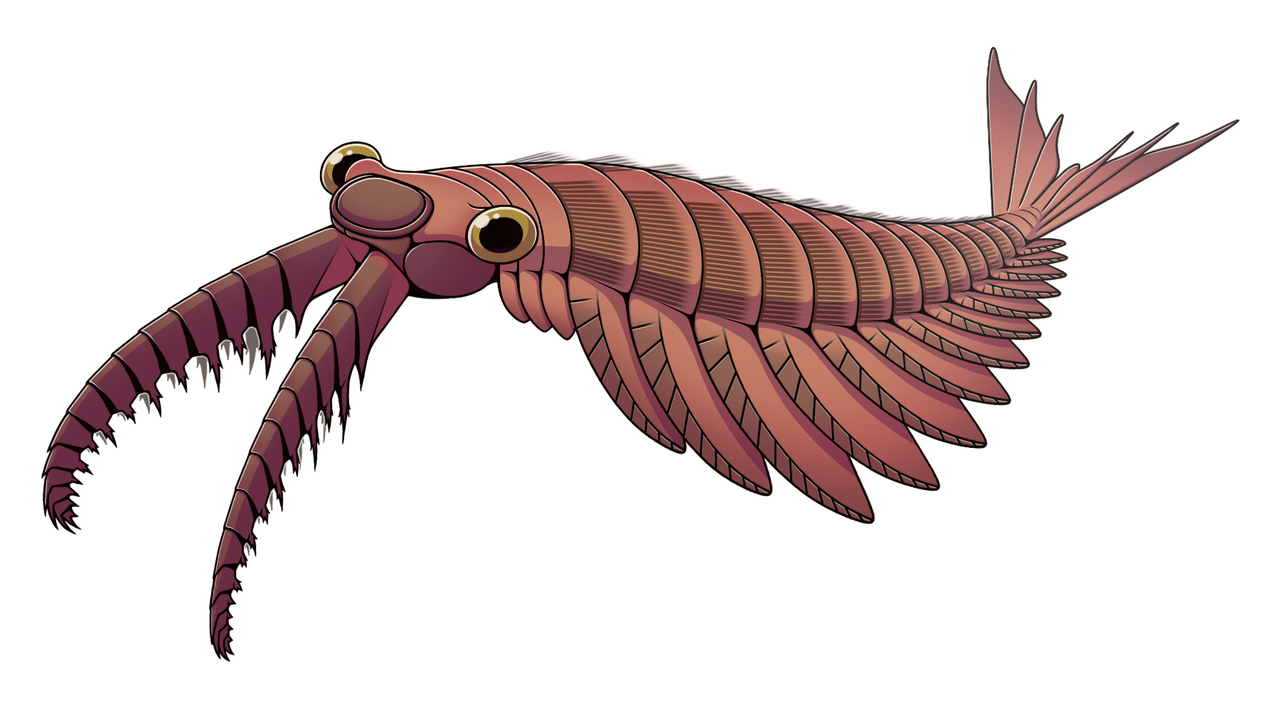
At the front of its body were two large, flexible appendages. These structures were segmented and lined with curved spines, forming powerful grasping tools. They could bend inward, allowing the animal to seize prey and bring it toward its mouth.
The mouth itself was one of the most unusual features ever discovered in a fossil animal. It formed a circular structure composed of hardened plates arranged in a pattern that resembled a pineapple slice or camera aperture. This structure is often called the oral cone.
Behind the mouth lay a long, streamlined body divided into segments. Each segment carried a pair of lateral flaps that extended outward like wings. These flaps undulated in a coordinated wave, propelling the animal through the water with remarkable efficiency.
Above the head sat a pair of enormous compound eyes mounted on stalks. These eyes were among the most advanced visual organs known from the Cambrian Period. Fossil evidence suggests they contained thousands of individual lenses, allowing Anomalocaris to detect movement and track prey in the dim light of the ancient seas.
The overall body length of Anomalocaris varied depending on the species, but some individuals may have reached lengths of up to one meter. In the Cambrian world, where many animals were only a few centimeters long, this made it a giant.
Its size, speed, and sensory capabilities made it one of the most formidable predators of its time.
Movement Through the Water
One of the most remarkable aspects of Anomalocaris was its method of swimming. Unlike modern fish, which rely on tail propulsion, Anomalocaris used a series of lateral flaps running along the sides of its body.
These flaps moved in a coordinated wave, similar to the way manta rays or cuttlefish swim today. The undulating motion created thrust while maintaining stability, allowing the animal to glide gracefully through the water.
Recent studies using computer simulations and robotic models suggest that this method of propulsion was highly efficient. The wave-like motion minimized turbulence and allowed the animal to move quickly while conserving energy.
This ability would have been crucial for a predator that needed to chase prey across open water. It also allowed Anomalocaris to maneuver with precision, adjusting its direction as it tracked moving targets.
The tail region likely helped with steering, while the body flaps provided the main propulsive force.
In the Cambrian seas, this swimming ability gave Anomalocaris a major advantage over slower, bottom-dwelling organisms.
Vision in the Ancient Ocean
Predators depend heavily on their senses, and for Anomalocaris, vision appears to have been particularly important.
Fossilized compound eyes discovered in deposits such as the Emu Bay Shale in Australia reveal that these organs were remarkably sophisticated. Some specimens contain more than 16,000 individual lenses.
Such complexity suggests that Anomalocaris possessed one of the sharpest visual systems of any animal in the Cambrian oceans.
Large compound eyes would have allowed the predator to detect movement over wide fields of view. They would also have helped it judge distance and track prey in three dimensions.
In the dim, murky waters of ancient seas, visual acuity could make the difference between a successful hunt and an empty stomach.
The evolution of advanced vision also had broader ecological consequences. Once predators could see their prey clearly, prey species faced stronger pressure to develop defenses. Some evolved protective shells, while others developed spines, camouflage, or burrowing behavior.
Thus the rise of visually guided predators like Anomalocaris likely helped drive the rapid diversification of life during the Cambrian Explosion.
What Did Anomalocaris Eat?
For many years, scientists believed that Anomalocaris fed primarily on trilobites, the armored arthropods that dominated Cambrian seafloors. This interpretation was based partly on the predator’s large size and partly on the presence of damaged trilobite fossils that seemed to show bite marks.
However, more recent research suggests that the feeding habits of Anomalocaris may have been more complex.
The circular mouth structure appears poorly suited for crushing hard shells. Its plates likely lacked the strength needed to break the mineralized exoskeletons of trilobites. Instead, it may have been better adapted for grasping and tearing softer prey.
Some scientists propose that Anomalocaris targeted soft-bodied animals such as worms, early arthropods, and other swimming organisms. Its spiny appendages could capture prey, while the oral cone processed the food before ingestion.
Fossil evidence also indicates that different species within the broader anomalocaridid group may have had slightly different feeding strategies. Some may have specialized in small prey, while others may have scavenged or filtered food particles from the water.
The Cambrian ocean was a complex ecosystem, and predators like Anomalocaris likely adapted their diets to the opportunities available.
The Burgess Shale and the Preservation of Wonders
Much of what we know about Anomalocaris comes from one of the most extraordinary fossil deposits on Earth: the Burgess Shale in the Canadian Rockies.
Discovered in 1909 by Charles Doolittle Walcott, the Burgess Shale preserves an ancient marine community from about 508 million years ago. What makes this site remarkable is the preservation of soft-bodied organisms, which normally decay before they can fossilize.
Fine-grained mud buried these creatures rapidly, protecting delicate tissues and structures that would otherwise have vanished from the fossil record.
Because of this exceptional preservation, scientists can study the anatomy of Cambrian animals in extraordinary detail. Features such as eyes, digestive systems, and appendages are visible in fossils that are more than half a billion years old.
Without the Burgess Shale and similar deposits, Anomalocaris might still be known only from isolated fragments, its true nature hidden forever.
Evolutionary Significance
Anomalocaris belongs to a broader group of extinct animals known as radiodonts. These early arthropod relatives possessed frontal appendages and segmented bodies with swimming flaps.
Radiodonts represent an important stage in the evolution of arthropods, the group that today includes insects, spiders, and crustaceans.
Studying these animals helps scientists understand how modern arthropods evolved their characteristic body structures. The segmented body plan, specialized appendages, and complex sensory organs seen in radiodonts provide clues about the early evolution of this enormously successful group.
Anomalocaris also demonstrates how predation can shape ecosystems. Once predators appear, prey species must adapt quickly or face extinction. This dynamic leads to the development of defensive structures, faster movement, and new survival strategies.
The Cambrian Explosion was not merely a burst of new species; it was the beginning of an ecological arms race that continues to this day.
The Legacy of the First Apex Predator
Although Anomalocaris eventually disappeared from the fossil record, its legacy endures in the structure of modern ecosystems.
Today’s oceans are filled with predators that occupy roles similar to the one Anomalocaris played in the Cambrian seas. Sharks, tuna, and squid are the modern equivalents of fast-swimming hunters that dominate marine food webs.
The evolutionary innovations pioneered by early predators helped shape the trajectory of life on Earth. Complex eyes, active swimming, grasping limbs, and advanced sensory systems all became key features in later animal groups.
In many ways, Anomalocaris represents the dawn of a new ecological order. It was one of the first animals to fully exploit the role of a large, mobile predator.
Its existence marked the beginning of a world where survival depended not only on endurance but also on speed, perception, and strategy.
A Window Into Deep Time
When scientists study Anomalocaris, they are not merely reconstructing an extinct creature. They are peering into a moment when the fundamental architecture of life was still being assembled.
Half a billion years may seem unimaginably distant, yet the evolutionary experiments of the Cambrian still echo in the biology of modern animals.
Our own bodies carry traces of that ancient heritage. The segmented structures of arthropods, the complexity of eyes, the organization of nervous systems—all reflect evolutionary pathways that began in oceans inhabited by creatures like Anomalocaris.
To imagine that world is to glimpse a chapter of Earth’s history when life was discovering its potential.
The Enduring Mystery
Despite decades of research, Anomalocaris continues to fascinate scientists and the public alike. Each new fossil discovery adds detail to the story, refining our understanding of its anatomy, behavior, and ecological role.
Yet many questions remain. How exactly did it capture prey? How fast could it swim? How did its nervous system process visual information? What environmental changes eventually led to the decline of radiodont predators?
Paleontology is a science of fragments, and every fossil is a message from a vanished world. Anomalocaris reminds us that even the strangest creatures once played vital roles in the unfolding drama of life.
A Predator From the Dawn of Animals
In the end, Anomalocaris is more than a curiosity from deep time. It is a symbol of a transformative era in Earth’s history. When it swam through the Cambrian seas, life was entering a new phase—one defined by complexity, interaction, and competition.
The rise of predators like Anomalocaris changed the rules of evolution. It forced organisms to innovate, adapt, and diversify. The ripple effects of that ancient arms race continue to shape ecosystems today.
More than 500 million years after its time, the fossil remains of this extraordinary creature still inspire wonder. They remind us that the story of life is filled with unexpected chapters, strange experiments, and astonishing transformations.
In the quiet stone layers of the Burgess Shale and other ancient rocks, the ghost of the world’s first great predator still waits, telling its story to anyone curious enough to listen.