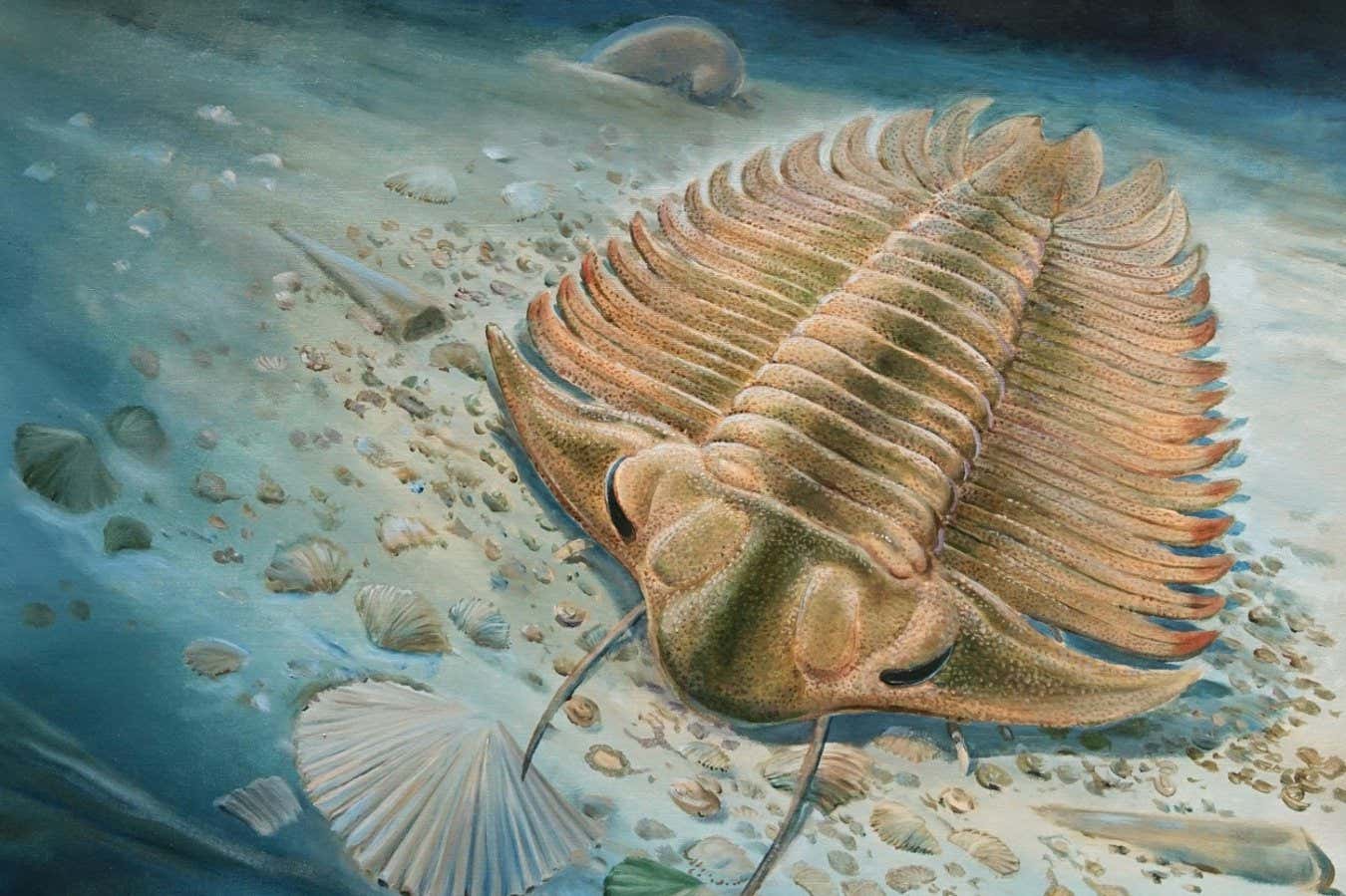
Long before dinosaurs thundered across continents, before birds filled the skies, and even before the first forests spread across land, Earth’s oceans were dominated by creatures that today exist only as fossils pressed into stone. Among the most remarkable of these ancient animals were trilobites—arthropods that ruled the seas for hundreds of millions of years. Their story is one of extraordinary success, astonishing diversity, and eventual disappearance. If survival across deep time is a measure of evolutionary triumph, trilobites stand among the most successful animals the planet has ever known.
Trilobites lived for an astonishing span of geological time. They appeared in the fossil record more than 520 million years ago during the Cambrian Period and survived until about 252 million years ago, at the end of the Permian Period. For roughly 270 million years—far longer than dinosaurs existed—they flourished in oceans around the world. During that immense stretch of time they evolved into thousands of species, adapted to countless ecological niches, and became one of the most recognizable fossils ever discovered.
Yet their story is more than just one of longevity. Trilobites represent a window into the earliest complex ecosystems on Earth. Their fossils preserve intricate details of anatomy, behavior, and evolution, allowing scientists to reconstruct life in the distant Paleozoic seas with remarkable clarity.
What Exactly Were Trilobites?
Trilobites were marine arthropods, members of the same broad group that includes insects, spiders, and crustaceans. Their bodies were protected by a hard exoskeleton made primarily of calcite and chitin, which fossilized easily and explains why trilobite remains are so abundant in ancient rocks.
The name “trilobite” means “three lobes,” referring to the distinct division of their bodies into three longitudinal sections. Running down the center was the axial lobe, flanked on both sides by two pleural lobes. This three-part structure gave trilobites a characteristic appearance that makes them easy to recognize even after hundreds of millions of years.
Their bodies were also divided into three main segments along their length. At the front was the cephalon, or head, which housed the mouth, eyes, and sensory organs. Behind it lay the thorax, composed of multiple articulated segments that allowed flexibility. At the rear was the pygidium, or tail shield, where several segments were fused together.
This modular body plan allowed trilobites to move efficiently across the seafloor, burrow into sediment, and even roll themselves into tight balls for protection. The design was both simple and incredibly versatile, one reason trilobites were able to diversify so successfully.
The Cambrian Explosion and the Rise of Trilobites
To understand trilobites, one must travel back to the Cambrian Period, roughly 541 to 485 million years ago. This era witnessed one of the most dramatic events in the history of life: the Cambrian Explosion.
During this relatively brief geological interval, a staggering variety of complex animals suddenly appeared in the fossil record. Organisms evolved hard skeletons, specialized organs, and sophisticated body plans. The seas teemed with new forms of life—early predators, burrowers, swimmers, and filter feeders.
Trilobites were among the earliest animals to develop mineralized exoskeletons, which provided both protection and structural support. This adaptation proved enormously advantageous in a world where predators were becoming increasingly common. Their shells not only shielded them but also fossilized exceptionally well, making trilobites one of the most abundant fossils from Cambrian rocks.
Within a few million years of their first appearance, trilobites spread across the globe. Fossils of early trilobites have been found on every continent, from North America to Antarctica. Their rapid expansion suggests they were highly adaptable and capable of thriving in a wide range of marine environments.
Anatomy of a Remarkable Creature
The anatomy of trilobites reveals a sophisticated design that combined strength, flexibility, and sensory capability. Their calcified exoskeleton formed a protective armor, but it was also segmented, allowing the animals to move with surprising agility.
Each segment of the thorax bore a pair of appendages. These limbs were typically biramous, meaning they had two branches. One branch was used for walking or crawling along the seafloor, while the other likely functioned as a gill or swimming structure. This dual-purpose design enabled trilobites to breathe and move efficiently at the same time.
The mouth was located on the underside of the cephalon, surrounded by specialized appendages used to manipulate food. Depending on the species, trilobites could feed in various ways. Some were predators or scavengers that consumed small organisms or organic debris. Others filtered particles from the water or grazed on microbial mats covering the seabed.
The exoskeleton periodically shed during growth in a process called molting. Trilobites would split their shells along predetermined lines, wriggle out, and form a new larger exoskeleton. Many trilobite fossils found today are actually these discarded shells rather than the remains of the animals themselves.
The First Eyes of Stone
One of the most fascinating features of trilobites is their eyes. Trilobite eyes are among the earliest complex visual organs known in the fossil record, and they display an extraordinary level of sophistication.
Unlike the soft tissues of most eyes, trilobite eyes were made of calcite, the same mineral that formed their exoskeleton. Each eye consisted of numerous lenses arranged in a compound structure, similar to the eyes of modern insects. These lenses focused light onto underlying sensory cells, allowing trilobites to detect movement and shapes in the water.
In some species the lenses were large and widely spaced, while in others they were tiny and numerous. Certain trilobites had thousands of lenses in each eye, giving them a broad field of vision. This variation suggests that trilobites occupied many different visual environments, from bright shallow waters to dim depths.
Some trilobites even evolved unique optical systems. A group known as phacopid trilobites developed complex eyes in which each lens acted as a miniature telescope, an extraordinary evolutionary innovation. These adaptations show how important vision had become in the increasingly competitive Cambrian seas.
Masters of the Ancient Ocean Floor
Trilobites were primarily bottom-dwellers, living on or within the sediments of ancient oceans. Their flattened bodies were well suited for crawling across the seabed, searching for food among sand and mud.
Some species were active predators that hunted small invertebrates. Others were scavengers, feeding on dead organic material. Many likely sifted through sediment, extracting nutrients and microscopic organisms.
Fossilized trackways preserved in ancient rock reveal how trilobites moved. These traces show rows of tiny footprints and drag marks left by their limbs and tails. Some trails indicate leisurely crawling, while others suggest sudden bursts of movement, perhaps when escaping predators.
Certain trilobites burrowed beneath the surface of the seabed, leaving behind distinctive trace fossils. Burrowing provided protection from predators and environmental disturbances. It also allowed access to organic-rich sediments, a valuable food source.
A World of Extraordinary Diversity
Over their long evolutionary history, trilobites diversified into an astonishing array of forms. Paleontologists have identified more than 20,000 species, and new ones continue to be discovered.
Some trilobites were small, only a few millimeters long, while others reached lengths of more than 70 centimeters. Their shapes varied dramatically. Certain species were smooth and streamlined, while others bore elaborate spines, ridges, or bumps.
These spines may have served multiple purposes. They could deter predators, stabilize the animal on soft sediment, or even aid in swimming. In some trilobites the spines grew so long and delicate that they appear almost ornamental, though they likely had functional roles.
Different trilobites adapted to different ecological niches. Some thrived in shallow coastal waters, while others inhabited deeper marine environments. Certain species swam freely above the seabed, while others remained firmly attached to it.
This diversity allowed trilobites to dominate Paleozoic marine ecosystems for millions of years. In many fossil beds they are the most abundant and varied organisms present.
Rolling Into Defense
One of the most iconic behaviors associated with trilobites is their ability to roll up into a ball. This behavior, known as enrollment, resembles the defensive strategy used by modern pill bugs.
When threatened, a trilobite could curl its flexible thoracic segments inward, bringing its head and tail together. This formed a tight protective sphere, shielding its vulnerable underside beneath the hard exoskeleton.
Fossils preserved in this enrolled position provide dramatic snapshots of ancient defensive reactions. Some specimens even show trilobites curled together in groups, suggesting they may have gathered for protection.
Enrollment was a powerful survival strategy in the predator-filled seas of the Paleozoic. It allowed trilobites to withstand attacks from early marine hunters such as anomalocaridids and other large arthropods.
Trilobites and the Story of Evolution
Trilobites are invaluable to scientists studying evolution. Because their fossil record is so rich and detailed, researchers can trace changes in their anatomy across millions of years.
Gradual shifts in features such as eye structure, segment number, and spine arrangement reveal how trilobites adapted to changing environments. These patterns provide evidence for natural selection operating over geological timescales.
Trilobites are also important index fossils. Certain species existed only during specific intervals of geological time. By identifying these fossils in rock layers, geologists can determine the relative age of the rocks and correlate formations across continents.
Through trilobites, scientists can reconstruct ancient oceans, track the movement of continents, and study the rise and fall of entire ecosystems.
The Long Decline
Despite their early success, trilobites did not remain dominant forever. Beginning in the late Paleozoic, their diversity gradually declined.
Several factors likely contributed to this downturn. New predators evolved, including more advanced fish and cephalopods. Competition from other marine organisms increased. Environmental changes altered the habitats trilobites depended on.
Major extinction events also played a role. The Ordovician–Silurian extinction around 444 million years ago eliminated many trilobite groups. Another extinction during the Devonian Period further reduced their diversity.
By the Carboniferous Period, trilobites had become far less common than in their earlier glory days. Only a handful of lineages remained.
The Final Catastrophe
The end of trilobites came during the greatest mass extinction in Earth’s history. Around 252 million years ago, the Permian–Triassic extinction wiped out an estimated 90 percent of marine species.
This catastrophic event likely resulted from massive volcanic eruptions in what is now Siberia. These eruptions released enormous quantities of carbon dioxide and other gases, triggering severe climate change, ocean acidification, and widespread oxygen depletion in marine environments.
The fragile ecosystems of the time collapsed. Trilobites, already diminished in number and diversity, could not survive the upheaval. The last of their kind disappeared from the fossil record at the boundary between the Permian and Triassic periods.
After nearly 270 million years of success, the age of trilobites was over.
Fossils That Tell a Story
Today trilobites exist only as fossils, but these fossils are among the most beautiful and informative remnants of ancient life.
Their calcified exoskeletons preserved fine details of anatomy, from delicate eye lenses to intricate surface patterns. Some fossils even capture evidence of injuries, molting, or predation.
Exceptional fossil sites known as Lagerstätten have revealed trilobites with soft tissues preserved, including antennae and gill structures. These rare discoveries provide insights into their biology that would otherwise remain hidden.
Trilobite fossils are found on every continent, embedded in sedimentary rocks that once formed the floors of ancient oceans. For geologists and paleontologists, they are invaluable records of life during the Paleozoic Era.
A Window Into Deep Time
Holding a trilobite fossil is like touching a fragment of deep time. The rock that encases it may be hundreds of millions of years old, formed long before dinosaurs, flowering plants, or mammals existed.
These fossils remind us that Earth’s history is far longer and more complex than human imagination once conceived. Entire worlds of life have risen, flourished, and vanished before the first human ancestor walked upright.
Trilobites were among the earliest complex animals to dominate the seas. Their story bridges vast stretches of geological time, linking the Cambrian Explosion to the greatest extinction the planet has ever known.
Were Trilobites the Most Successful Animals?
Determining the “most successful” animals in Earth’s history depends on how success is measured. If longevity is the criterion, trilobites certainly rank among the champions. Their 270-million-year reign surpasses that of dinosaurs and rivals many other long-lived groups.
If diversity is considered, trilobites also performed remarkably well. With tens of thousands of species adapting to numerous ecological roles, they demonstrated extraordinary evolutionary flexibility.
Yet their ultimate extinction reminds us that no lineage is immune to change. Even the most successful groups can disappear when environments shift dramatically.
Perhaps the true legacy of trilobites lies not in being the single most successful animals, but in illustrating how life evolves, adapts, and persists across unimaginable spans of time.
Echoes of an Ancient Ocean
Today the oceans are filled with fish, crustaceans, mollusks, and countless other creatures. Trilobites are gone, yet their distant relatives—arthropods—remain among the most diverse animals on Earth.
Insects dominate terrestrial ecosystems, while crabs, shrimp, and lobsters populate the seas. These modern arthropods carry forward a body plan that first proved successful hundreds of millions of years ago.
Trilobites represent one of the earliest chapters in that story. Their fossils whisper of ancient seas lit by unfamiliar suns, of strange creatures crawling across muddy seabeds, of evolutionary experiments unfolding over immense ages.
Though the trilobites themselves vanished long ago, their imprint on the history of life remains unmistakable. They were pioneers of complex marine ecosystems, masters of Paleozoic oceans, and enduring symbols of life’s capacity to flourish in even the most ancient worlds.