In the immense tapestry of Earth’s history, few creatures inspire the same sense of wonder as the Brachiosaurus. This colossal dinosaur, with its towering neck and massive body, seems almost mythical—an animal that could lift its head toward the treetops like a living crane, browsing leaves where few other creatures could reach. When people imagine the age of dinosaurs, the picture that often rises in their minds is that of a vast green landscape where giant sauropods slowly move across the horizon, their long necks swaying above the forest canopy. Among these giants, Brachiosaurus stands apart as one of the most distinctive and awe-inspiring.
Brachiosaurus lived during the Late Jurassic Period, roughly 154 to 150 million years ago, a time when dinosaurs dominated the land and the continents were arranged very differently from today. Vast conifer forests stretched across warm landscapes, rivers wound through fern-covered plains, and the air buzzed with insects and primitive flying reptiles. In that ancient world, Brachiosaurus was a true titan—one of the tallest animals ever to walk on land.
Its very name tells part of its story. The word “Brachiosaurus” comes from Greek roots meaning “arm lizard.” This unusual name refers to one of the dinosaur’s most striking anatomical features: its front legs were longer than its hind legs. This gave the animal a sloping back and an upright stance that lifted its neck high into the air, allowing it to reach vegetation far above the ground. No other large dinosaur had quite this posture.
To understand Brachiosaurus is to step into a vanished world and explore one of the most extraordinary evolutionary experiments ever produced by life on Earth.
The Discovery of a Colossal Dinosaur
The story of Brachiosaurus began in the early twentieth century, during a period sometimes called the “Golden Age of Dinosaur Discovery.” In 1900, an American paleontologist named Elmer S. Riggs was exploring rock formations in western Colorado. These rocks belonged to the Morrison Formation, a vast geological layer famous for preserving fossils from the Late Jurassic.
Riggs and his team uncovered enormous bones that clearly belonged to a giant dinosaur unlike any previously known. The limb bones were massive, but what caught Riggs’ attention most was the structure of the forelimbs. Unlike most dinosaurs, whose hind legs were larger and stronger than their front legs, this creature had forelimbs that were longer than its hind limbs. The anatomy suggested an animal that held its body differently from other sauropods.
In 1903 Riggs formally described the new species and gave it the name Brachiosaurus altithorax. The species name, meaning “deep chest,” referred to the enormous rib cage that once housed powerful lungs and a large digestive system.
The discovery immediately captured the imagination of scientists. Brachiosaurus appeared to represent a new type of giant dinosaur, one that was adapted for feeding high above the ground rather than sweeping its neck low across vegetation.
Later discoveries would reveal related dinosaurs in Africa and elsewhere, expanding the understanding of this remarkable group of long-necked giants.
Life in the Late Jurassic World
To picture Brachiosaurus properly, one must imagine the environment in which it lived. The Late Jurassic world was warm and humid, with no polar ice caps and extensive forests covering large regions of the continents.
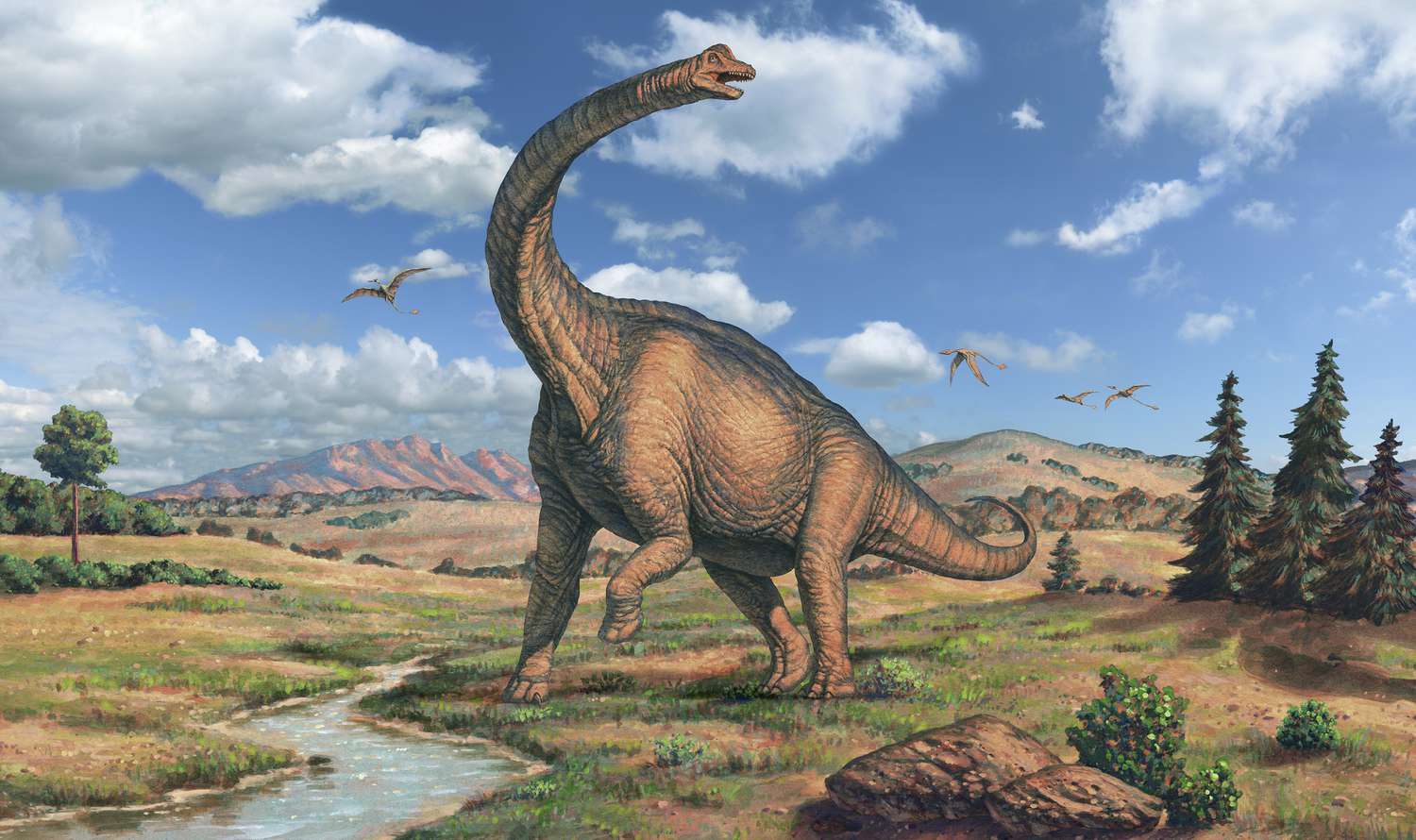
North America during this time looked very different from the modern landscape. The Morrison Formation region was likely a broad floodplain with rivers, lakes, and seasonal wetlands. Vegetation consisted primarily of conifers, cycads, ginkgo trees, and vast fields of ferns. Flowering plants had not yet evolved, so the forests were dominated by ancient plant lineages.
These ecosystems supported an astonishing variety of dinosaurs. Alongside Brachiosaurus lived other enormous sauropods such as Diplodocus and Apatosaurus. Massive predators like Allosaurus roamed the plains, hunting herbivorous dinosaurs. Armored stegosaurs browsed on low vegetation, their plated backs shimmering in the sunlight.
Within this dynamic environment, Brachiosaurus occupied a unique ecological niche. Its extraordinary height allowed it to feed from the upper levels of trees, reducing competition with other herbivores that fed closer to the ground.
This specialization helped Brachiosaurus thrive in a world already crowded with giant plant-eaters.
Anatomy of a Towering Titan
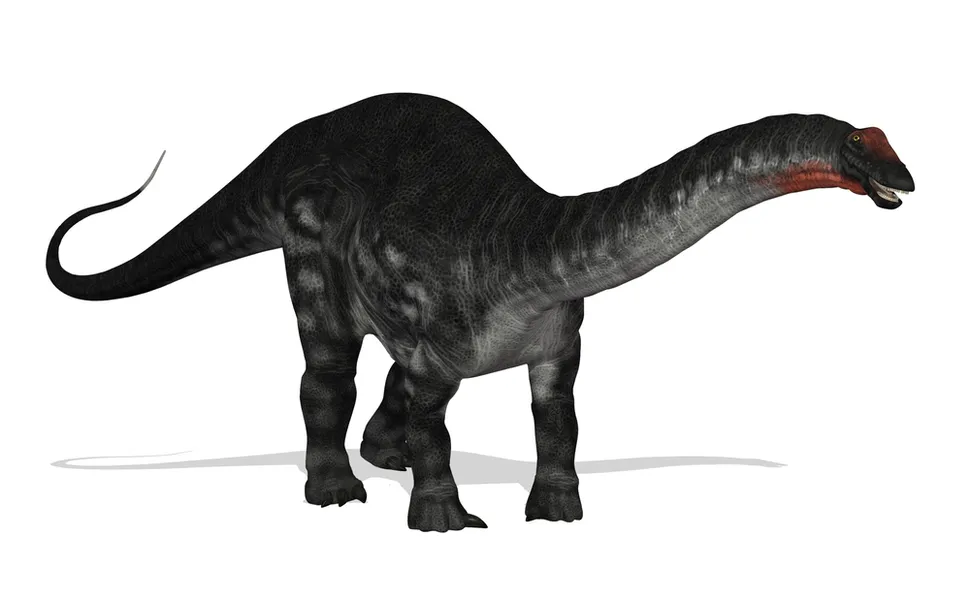
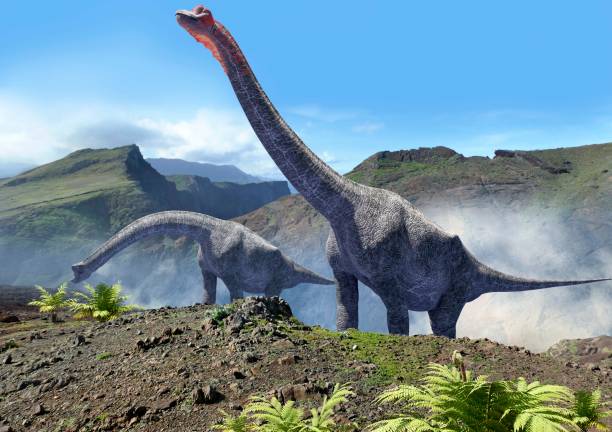
The most immediately recognizable feature of Brachiosaurus is its towering neck. When fully extended, the neck could elevate the animal’s head many meters above the ground. Estimates vary, but many paleontologists believe that Brachiosaurus could reach heights comparable to a four-story building.
Its skeleton reveals how such a massive structure was possible. The neck vertebrae were elongated and filled with air spaces, making them lighter without sacrificing strength. This adaptation is similar to the air-filled bones found in modern birds, which are the closest living relatives of dinosaurs.
The skull of Brachiosaurus was relatively small compared to its enormous body. Its nostrils were positioned high on the skull, though earlier ideas that they sat atop a fleshy trunk-like structure are no longer supported by evidence. Instead, the nostrils likely opened near the front of the snout.
The teeth were spoon-shaped and well suited for stripping leaves from branches. Unlike the teeth of predators, they were not designed for tearing flesh but for grasping vegetation.
Perhaps the most distinctive anatomical trait was the proportion of the limbs. The long forelegs lifted the front of the body higher than the hips, giving Brachiosaurus a giraffe-like posture. This orientation tilted the body upward toward the neck, making it easier to reach tall vegetation.
The tail, although long, was shorter relative to the body than in some other sauropods. It likely served as a counterbalance to the long neck and helped stabilize the dinosaur’s movement.
How Big Was Brachiosaurus?
The scale of Brachiosaurus is difficult to grasp. Even among giant dinosaurs, it was exceptional. Estimates suggest that adults could reach lengths of around 25 meters or more from nose to tail. Their height, thanks to the elevated neck and long forelimbs, may have exceeded 12 meters.
Weight estimates vary widely depending on the method used, but many scientists place Brachiosaurus between 30 and 60 metric tons. That is comparable to several adult elephants combined.
Yet despite this enormous mass, Brachiosaurus was likely a relatively graceful mover for such a large animal. Its column-like legs supported its weight efficiently, much like the legs of modern elephants.
The skeletal structure suggests that its bones were built to withstand immense stresses. Each step would have transmitted enormous forces through the limbs and into the ground.
Still, the animal’s movement was probably slow and deliberate, conserving energy as it moved through its environment in search of food.
Feeding at the Top of the Forest
Brachiosaurus was a herbivore, meaning its diet consisted entirely of plants. But unlike many other plant-eating dinosaurs, it had access to vegetation far above the ground.
Its long neck allowed it to browse on leaves from tall conifer trees and other high-growing plants. This feeding strategy is sometimes called “high browsing.”
By reaching above other herbivores, Brachiosaurus could exploit food sources that were inaccessible to most dinosaurs. This likely reduced competition for resources and helped sustain its enormous body.
However, feeding such a massive animal would have required enormous quantities of vegetation. Paleontologists estimate that large sauropods may have consumed hundreds of kilograms of plant matter each day.
Their digestive systems were probably adapted for processing large volumes of low-nutrient plant material. Like modern herbivores such as cows, they may have relied on microbial fermentation within their guts to break down tough plant fibers.
Some scientists believe sauropods swallowed stones called gastroliths to help grind plant matter in their stomachs, though the evidence for this behavior remains debated.
Breathing and Blood Flow in a Giant
One of the greatest mysteries surrounding Brachiosaurus involves the challenge of supplying blood to its elevated head. If the animal raised its head high above the heart, the circulatory system would have needed to overcome significant gravitational pressure.
Some researchers suggest that Brachiosaurus may have had a powerful heart capable of pumping blood through long arteries up the neck. Others propose that the animal may have kept its neck at more moderate angles most of the time, raising it fully only occasionally.
The respiratory system may also have played an important role. Like birds, many dinosaurs appear to have possessed air sacs connected to their lungs. These structures would have allowed highly efficient breathing, supplying oxygen to support a massive body.
Air sacs also helped reduce body weight by extending into hollow spaces within the bones. This adaptation was essential for animals with such long necks.
Growth and Life Cycle
Brachiosaurus did not begin life as a giant. Like all dinosaurs, it hatched from eggs and started life as a relatively small animal. However, sauropods were among the fastest-growing vertebrates known.
Young Brachiosaurus likely grew rapidly, increasing in size year by year until reaching adulthood. Fossil evidence from other sauropods suggests growth rates comparable to those of large mammals, though sustained over longer periods.
The eggs themselves were probably modest in size compared to the adults that emerged from them. This meant that juvenile dinosaurs had to survive in a world filled with predators.
It is possible that young Brachiosaurus lived in groups or remained in safer environments until they grew large enough to defend themselves.
Once fully grown, adults would have been largely immune to predation due to their immense size.
Predators and Survival
Despite its size, Brachiosaurus shared its environment with formidable predators. Large theropod dinosaurs such as Allosaurus were capable hunters and likely preyed upon smaller or weaker animals.
An adult Brachiosaurus, however, would have been an extremely difficult target. Its height and mass alone would have deterred most attacks. A swipe of its powerful tail could potentially deliver a dangerous blow.
Predators may have focused instead on juveniles or sick individuals. This pattern is common in modern ecosystems, where large predators often target the most vulnerable members of prey populations.
The sheer scale of Brachiosaurus served as its greatest defense.
Fossils and Global Discoveries
Although the original Brachiosaurus fossils were found in North America, closely related dinosaurs have been discovered in other parts of the world. In Tanzania, a spectacular skeleton discovered in the early 20th century was once classified as Brachiosaurus but is now recognized as a separate genus called Giraffatitan.
This African giant shares many similarities with Brachiosaurus but also exhibits distinct anatomical differences.
These discoveries reveal that brachiosaurid dinosaurs were more widespread than originally thought, inhabiting multiple continents during the Jurassic.
Fossils of these animals help scientists reconstruct ancient ecosystems and understand how giant herbivores evolved.
Brachiosaurus in Popular Imagination
Few dinosaurs have captured the public imagination as strongly as Brachiosaurus. Its towering silhouette has become a symbol of prehistoric life.
Museum displays around the world feature enormous skeletons that allow visitors to stand beneath the arching necks of these giants. These displays create a powerful sense of scale, reminding viewers that Earth once hosted animals far larger than any land creature alive today.
Brachiosaurus has also appeared prominently in books, documentaries, and films. Its calm, majestic presence often represents the grandeur of the dinosaur age.
The image of a long-necked dinosaur rising above a forest canopy has become iconic.
Scientific Debates and Ongoing Research
Even today, scientists continue to debate aspects of Brachiosaurus biology. Questions remain about its posture, metabolism, and behavior.
Some paleontologists argue that sauropods were warm-blooded or at least possessed high metabolic rates. Others believe they had slower metabolisms similar to reptiles.
Computer modeling and new fossil discoveries continue to refine our understanding. Advances in technology allow scientists to study bone structure, growth patterns, and even the chemical composition of fossils.
Each new discovery adds another piece to the puzzle of how these giants lived.
The Legacy of the High-Reaching Giant
Brachiosaurus represents one of the most remarkable achievements of evolution. Its body was shaped by millions of years of natural selection, producing a creature perfectly adapted to its environment.
By reaching high into the forest canopy, it occupied a niche that few other animals could fill. Its towering form transformed the landscape around it, shaping vegetation patterns and influencing entire ecosystems.
The story of Brachiosaurus is also the story of scientific discovery. From the dusty fossil beds of the American West to modern laboratories using advanced imaging techniques, our understanding of this dinosaur has grown steadily over more than a century.
Yet the sense of wonder it inspires remains unchanged.
A Window Into Earth’s Deep Past
When we study Brachiosaurus, we are not merely examining bones in stone. We are glimpsing a chapter of Earth’s history that unfolded millions of years before humans existed.
The Jurassic world was a place of vast forests, giant reptiles, and dynamic ecosystems. Brachiosaurus stood among the tallest inhabitants of that world, quietly browsing treetops as rivers flowed and predators prowled below.
Its existence reminds us that life on Earth has taken forms more extraordinary than we often imagine.
The towering silhouette of Brachiosaurus, rising above the ancient forests, remains one of the most powerful symbols of the deep past—a reminder that our planet has always been a place of astonishing diversity and boundless evolutionary creativity.