High in the mist-covered Andes Mountains of Peru, where jagged peaks rise like ancient sentinels and clouds drift slowly across deep green valleys, lies one of the most breathtaking archaeological sites on Earth: Machu Picchu. Often called the “Lost City of the Incas,” this remarkable place is far more than a collection of stone ruins. It is a testament to human ingenuity, spiritual belief, political power, and the enduring mystery of a civilization that flourished long before modern history began to record its story.
To understand Machu Picchu is to step into a world where mountains were sacred, where the sun was worshipped as a divine force, and where engineering and astronomy were intertwined with religion and daily life. It is also to confront the legacy of the Inca Empire, one of the most sophisticated and expansive empires in the Americas before European contact.
Machu Picchu is not simply a destination. It is a doorway into the past, into the heart of the Incan world, and into the broader story of human civilization.
Geography and the Sacred Landscape
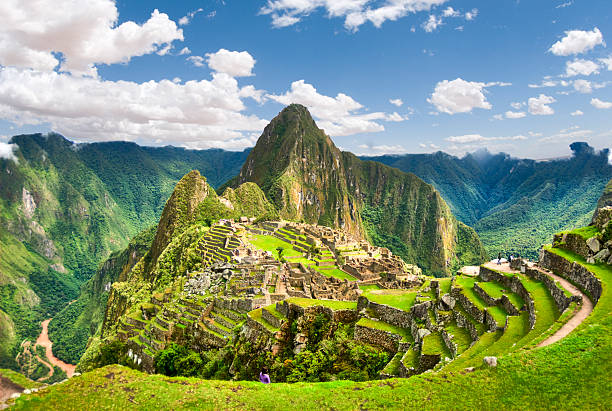
Machu Picchu is located on a narrow ridge between two peaks—Machu Picchu Mountain and Huayna Picchu—at an elevation of about 2,430 meters above sea level. Below, the Urubamba River winds through a deep canyon, encircling the site on three sides like a natural moat.
This location was not chosen by accident. The Incas viewed the landscape as sacred. Mountains, or “apus,” were considered powerful spiritual entities that influenced weather, fertility, and the fate of communities. Rivers were seen as life-giving veins connecting the earth to the heavens.
Machu Picchu sits at the intersection of these sacred elements. Its placement aligns with surrounding peaks and celestial events, reflecting a worldview in which nature, spirituality, and human existence were inseparable.
The region itself is part of the Andes, the longest continental mountain range in the world. Its steep slopes, unpredictable weather, and seismic activity would seem to make it an unlikely place for a city. Yet the Incas transformed this challenging environment into a masterpiece of architecture and agriculture.
The Rise of the Inca Empire
To understand Machu Picchu, one must first understand the civilization that built it. The Inca Empire emerged in the early 15th century in the highlands of South America. Within a relatively short period, it expanded to become the largest empire in pre-Columbian America, stretching from present-day Ecuador to Chile.
The capital of this vast empire was Cusco, a city considered the center of the world in Incan cosmology. From Cusco, a network of roads extended across mountains, deserts, and forests, connecting distant regions and enabling efficient administration.
The Incas did not have a written language in the traditional sense. Instead, they used a system of knotted cords known as quipu to record information. Their society was highly organized, with a centralized government, a structured labor system, and advanced agricultural techniques.
At the heart of Incan society was a deep respect for nature and a belief in the divine power of celestial bodies, particularly the sun.
Pachacuti and the Vision of Empire
The transformation of the Inca state into a powerful empire is closely associated with the ruler Pachacuti, who reigned in the 15th century. His name means “earth-shaker” or “world transformer,” and it reflects the dramatic changes he brought to Incan society.
Under Pachacuti’s leadership, the Incas expanded their territory, reorganized their government, and initiated ambitious construction projects. It is widely believed that Machu Picchu was built during his reign, possibly as a royal estate or a ceremonial center.
Machu Picchu reflects the vision of Pachacuti—a place where political power, religious significance, and architectural brilliance converge. It was not merely a settlement but a symbol of imperial authority and spiritual connection.
The Architecture of Perfection
One of the most astonishing aspects of Machu Picchu is its construction. The city is built almost entirely of stone, yet the precision of its masonry rivals modern engineering.
The Incas used a technique known as ashlar masonry, in which stones are cut to fit together so perfectly that no mortar is needed. The stones are shaped with such accuracy that even a thin blade cannot be inserted between them.
This method was not only aesthetically impressive but also practical. The Andes are prone to earthquakes, and the tightly fitted stones allow structures to move slightly during seismic activity without collapsing.
The city is divided into two main areas: the agricultural sector and the urban sector. Terraces carved into the mountainside create flat surfaces for farming while preventing soil erosion. These terraces also help manage water flow, an essential feature in a region with heavy rainfall.
In the urban sector, buildings are arranged around plazas, with temples, residences, and storage structures forming a cohesive layout. The design reflects both functionality and symbolic meaning.
Engineering Against the Odds
Machu Picchu is often described as an engineering marvel, and for good reason. The site demonstrates an extraordinary understanding of geology, hydrology, and environmental adaptation.
The Incas constructed an elaborate drainage system beneath the city. Layers of stone and gravel allow rainwater to flow away from structures, preventing flooding and erosion. This hidden infrastructure has helped preserve the site for centuries.
Water was carefully managed through a system of channels and fountains. A natural spring provided a reliable water source, which was distributed throughout the city in a series of cascading fountains.
The Incas also built roads and stairways that connect different parts of the site. These pathways are integrated seamlessly into the landscape, following the natural contours of the mountain.
Every element of Machu Picchu reflects a deep understanding of the environment and a commitment to harmony with nature.
The Spiritual Heart of Machu Picchu
Machu Picchu was not just a physical space; it was a spiritual landscape. Many of its structures are believed to have had religious or ceremonial purposes.
One of the most iconic features is the Intihuatana, often referred to as the “Hitching Post of the Sun.” This carved stone is thought to have been used for astronomical observations or ritual practices related to the sun.
Another important structure is the Temple of the Sun, which is aligned with the sun during the solstices. This alignment suggests that the Incas carefully observed celestial events and incorporated them into their architecture.
The Room of the Three Windows is another significant site, possibly representing the Incan origin myth involving three caves.
These structures reflect a worldview in which the physical and spiritual realms were deeply interconnected. The movements of the sun, the shape of the mountains, and the flow of water all held symbolic meaning.
Daily Life in the Incan City
Although Machu Picchu is often seen as a ceremonial site, it was also a place where people lived and worked. Archaeological evidence suggests that a relatively small population resided there, possibly including nobles, priests, artisans, and servants.
The residents of Machu Picchu relied on agriculture, supported by the terraces that surrounded the city. Crops such as maize and potatoes were likely grown, along with other Andean staples.
Trade and communication connected Machu Picchu to the wider Inca Empire. Goods and information would have traveled along the extensive road network that linked the empire’s regions.
Life in Machu Picchu was shaped by the rhythms of nature and the demands of the empire. It was a place of both daily activity and sacred ritual.
The Spanish Conquest and the Disappearance
In the 16th century, the arrival of Spanish conquistadors brought dramatic changes to the Inca Empire. Led by Francisco Pizarro, the Spanish forces captured the Incan ruler and began dismantling the empire.
The conquest was aided by internal conflicts and the spread of diseases brought from Europe. Within a few decades, the once-powerful Inca Empire had collapsed.
Machu Picchu, however, was never discovered by the Spanish. Its remote location and hidden position in the mountains likely protected it from destruction.
Over time, the site was abandoned. The reasons for this remain uncertain, but it may have been related to the broader collapse of the empire.
As the jungle reclaimed the city, Machu Picchu faded from memory, becoming a lost chapter in history.
Rediscovery and Global Recognition
In 1911, the American historian Hiram Bingham brought international attention to Machu Picchu. Guided by local residents, he reached the site and began documenting its structures.
Although local communities were already aware of the ruins, Bingham’s expedition introduced Machu Picchu to the global stage. His work sparked widespread interest and led to further archaeological studies.
Over the years, Machu Picchu has become one of the most famous archaeological sites in the world. It is recognized as a UNESCO World Heritage Site and attracts visitors from across the globe.
Its beauty, mystery, and historical significance continue to captivate the imagination.
Scientific Study and Archaeological Insights
Modern archaeology has revealed much about Machu Picchu, but many questions remain unanswered. Researchers use advanced techniques such as radiocarbon dating, soil analysis, and remote sensing to study the site.
These methods have helped determine the approximate time of construction, the origins of its inhabitants, and the functions of various structures.
Scientific study also highlights the environmental knowledge of the Incas. Their agricultural terraces, water management systems, and architectural techniques demonstrate a sophisticated understanding of sustainability.
Machu Picchu serves as a valuable case study in how ancient civilizations adapted to challenging environments.
The Cultural Legacy of the Incas
The legacy of the Inca Empire lives on in the culture, language, and traditions of the Andean region. Indigenous communities continue to preserve aspects of Incan heritage, including agricultural practices and spiritual beliefs.
Machu Picchu stands as a symbol of this legacy. It represents not only the achievements of the Incas but also the resilience of their culture.
The site reminds us that history is not just about the past; it is a living connection to the present.
The Mystery That Endures
Despite decades of research, Machu Picchu still holds mysteries. Why was it built in such a remote location? What was its exact purpose? Why was it abandoned?
These questions continue to inspire exploration and debate. Each discovery adds a new piece to the puzzle, yet the full picture remains elusive.
Perhaps this is part of what makes Machu Picchu so compelling. It is not just a place of answers but a place of questions.
A Timeless Wonder
Machu Picchu is more than an archaeological site. It is a testament to human creativity, resilience, and the desire to connect with the natural and spiritual world.
Perched high above the clouds, it invites us to look beyond our own time and place, to imagine a civilization that saw the universe in a profoundly different way.
Through its stones, its terraces, and its alignment with the heavens, Machu Picchu tells a story—a story of an empire that rose, flourished, and vanished, leaving behind a legacy carved into the mountains.
And in that story, we find not only the history of the Incas but a reflection of humanity itself: always building, always seeking, always reaching toward the sky.