There is something haunting about the idea of a city swallowed by the ocean. Streets once filled with footsteps now lie silent beneath waves. Temples that echoed with prayers are covered in coral. Homes that sheltered generations have become reefs for fish and silent corridors for divers. These lost cities stir the imagination because they sit at the edge of memory and mystery. They remind us that coastlines are not fixed, that seas rise and fall, and that human civilization, for all its ambition, remains vulnerable to the restless forces of nature.
Across thousands of years, earthquakes have shaken foundations, rivers have shifted their courses, storms have unleashed fury, and sea levels have crept upward. Some cities were destroyed suddenly in catastrophic events; others slowly surrendered to erosion and subsidence. Thanks to underwater archaeology, sonar mapping, and marine geology, scientists have begun to uncover these submerged worlds with increasing clarity. What once seemed like legend is often revealed as layered history preserved beneath sand and saltwater.
Here are ten ancient cities that were swallowed by the ocean, each with its own story of rise, glory, and submergence.
1. Thonis-Heracleion, Egypt
For centuries, Thonis-Heracleion was believed to be a myth. Ancient Greek historians described a grand Egyptian port city near the mouth of the Nile, a place where ships gathered and cultures mingled. Then it vanished from historical records, and many assumed it never truly existed.
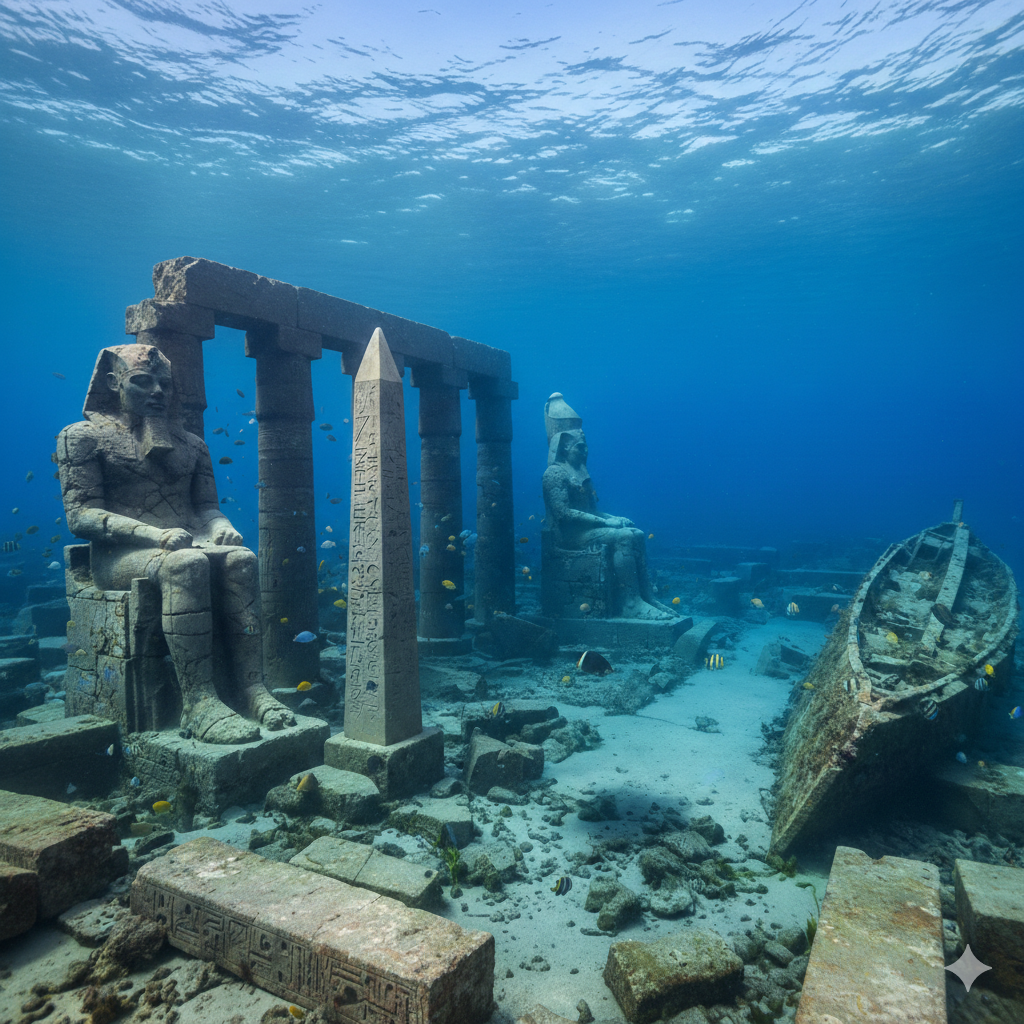
In the year 2000, underwater archaeologists confirmed its reality. Off the coast of modern-day Egypt in the Mediterranean Sea, divers discovered massive statues, temple ruins, anchors, and entire districts resting beneath the seabed. Thonis-Heracleion had been a vital trading hub between Egypt and the Greek world, flourishing around the first millennium BCE.
Geological studies suggest that the city sank due to a combination of factors. The Nile Delta is composed of soft, water-saturated sediments. Over time, these sediments compacted and became unstable. Earthquakes likely triggered liquefaction, causing buildings to collapse and the ground to subside. Gradually, the Mediterranean claimed the city.
Today, colossal stone statues of gods and pharaohs lie underwater, preserved by sand and silt. The rediscovery of Thonis-Heracleion demonstrates how dynamic river deltas can reshape human history and how science can recover what seemed lost forever.
2. Pavlopetri, Greece
Off the southern coast of Greece lies Pavlopetri, considered one of the oldest known submerged cities in the world. Dating back at least 5,000 years to the Bronze Age, Pavlopetri offers a remarkably detailed glimpse into early urban planning.
Underwater surveys reveal streets, houses, courtyards, and even tombs laid out in an organized grid. The preservation is extraordinary; the city’s layout can still be traced with clarity. Archaeologists believe it was an important trading center connecting mainland Greece with the wider Aegean world.
Pavlopetri likely sank due to a combination of tectonic activity and gradual sea-level rise. The region sits in an area prone to earthquakes, and shifting land may have caused parts of the coastline to subside. At the same time, post–Ice Age sea-level rise slowly encroached upon low-lying settlements.
Unlike cities destroyed by sudden catastrophe, Pavlopetri appears to have slipped beneath the sea in stages. Its quiet submergence left a time capsule of early Mediterranean life, now preserved in shallow waters.
3. Dwarka, India
Along the western coast of India near Gujarat, underwater structures discovered in the Arabian Sea have sparked intense interest. Many associate them with the ancient city of Dwarka, mentioned in Indian texts as the kingdom of Krishna.
Marine archaeological explorations have uncovered stone blocks, walls, and artifacts suggesting an ancient settlement once stood along the coast. Radiocarbon dating indicates human activity in the area thousands of years ago, though interpretations vary among scholars.
Sea-level changes and coastal erosion likely played significant roles in the submergence of settlements in this region. The Indian coastline has shifted repeatedly over millennia, influenced by monsoon patterns, sediment movement, and tectonic processes.
While debates continue about the precise age and identification of the submerged structures, there is strong scientific consensus that ancient coastal settlements existed here and were eventually claimed by the sea. Dwarka stands at the intersection of mythology and marine archaeology, where cultural memory meets geological reality.
4. Atlit Yam, Israel
Atlit Yam lies off the coast of Israel in the Mediterranean Sea and dates back approximately 9,000 years to the Neolithic period. It is one of the oldest known submerged settlements in the world.
Discovered in the 1980s, Atlit Yam contains stone houses, wells, and even a mysterious stone circle. Human skeletons found at the site have provided valuable insight into early agricultural communities.
Researchers believe that rising sea levels after the last Ice Age submerged the settlement. Around 10,000 years ago, melting glaciers caused global sea levels to rise significantly. Coastal communities like Atlit Yam were gradually inundated.
There is also evidence suggesting that a massive tsunami may have struck the area, possibly triggered by volcanic activity in the Mediterranean. Such an event could have devastated the settlement, accelerating its abandonment.
Atlit Yam offers a rare glimpse into humanity’s transition from hunting and gathering to farming—a pivotal moment in history—frozen beneath the waves.
5. Baiae, Italy
Once a luxurious Roman resort town, Baiae was famed for its villas, baths, and elite visitors. Roman emperors and aristocrats vacationed there, enjoying its warm climate and natural hot springs.
Today, much of ancient Baiae lies underwater in the Bay of Naples. Marble floors, mosaics, statues, and villa foundations can be explored by divers in what has become an underwater archaeological park.
The city did not sink due to rising seas alone. Instead, it was affected by a geological phenomenon known as bradyseism—slow vertical movement of the Earth’s crust caused by volcanic activity. The area sits within a volcanic caldera near Mount Vesuvius. Over centuries, land subsidence gradually lowered parts of Baiae below sea level.
Baiae illustrates how even the wealth and engineering prowess of Rome could not protect a city from geological forces operating over generations.
6. Port Royal, Jamaica
Port Royal was once one of the richest and most notorious cities in the Caribbean during the 17th century. It served as a hub for trade and privateering, earning a reputation as a place of immense wealth and moral excess.
On June 7, 1692, a powerful earthquake struck Jamaica. The sandy soil beneath Port Royal underwent liquefaction, causing buildings to collapse and large sections of the city to slide into the sea. Within minutes, much of the city was submerged.
Unlike cities lost slowly to erosion, Port Royal was swallowed almost instantly. Archaeological investigations have found streets, buildings, and everyday objects preserved underwater, offering a vivid snapshot of colonial life frozen in time.
Port Royal’s sudden destruction is a stark reminder of how seismic events can reshape coastlines in moments.
7. Shi Cheng, China
Shi Cheng, known as the “Lion City,” was founded during the Han Dynasty and later expanded. It stood in China’s Zhejiang Province for over a thousand years.
In 1959, the city was intentionally flooded during the construction of the Xin’an River Dam, creating Qiandao Lake. Though not lost to natural forces in the traditional sense, Shi Cheng became a submerged time capsule.
Beneath the lake’s waters, intricate wooden beams, stone archways, and decorative carvings remain remarkably well preserved due to the still, fresh water environment. The flooding preserved the city in a way that few ancient sites experience.
Shi Cheng reminds us that submergence can occur not only through natural change but also through human engineering.
8. Alexandria’s Eastern Harbor, Egypt
Parts of ancient Alexandria, founded by Alexander the Great, now lie underwater in the Mediterranean. Earthquakes and tsunamis over centuries caused sections of the city’s royal quarter and harbor to collapse into the sea.
Underwater excavations have uncovered colossal statues, sphinxes, and remnants of grand architecture believed to be associated with the Ptolemaic dynasty. Geological studies indicate that seismic activity played a major role in the city’s submergence.
Alexandria’s underwater ruins reveal how even one of the greatest cities of antiquity was vulnerable to tectonic forces and coastal instability.
9. Yonaguni Monument, Japan
Off the coast of Yonaguni Island in Japan lies a massive underwater rock formation that has sparked debate. Some researchers argue it is a natural geological structure shaped by erosion; others suggest it may have been modified by humans thousands of years ago.
The structure features terraces and flat surfaces that resemble architectural forms. However, there is no definitive archaeological evidence confirming it as a city.
What is certain is that sea levels were lower during the last Ice Age, meaning that areas now underwater were once dry land. If human activity occurred there, it would date back many millennia.
Yonaguni remains a subject of ongoing research, highlighting the challenges of distinguishing natural formations from potential human constructions beneath the sea.
10. Olous, Greece
Olous was an ancient Greek city located on the coast of Crete. It thrived during the Classical and Hellenistic periods and was known for its harbor and temples.
Today, ruins of Olous can be seen underwater in shallow coastal waters. Walls, streets, and foundations lie just beneath the surface.
Tectonic activity and gradual subsidence likely contributed to its submergence. Crete lies in a seismically active region where land levels have shifted over time.
Olous serves as another example of how Mediterranean civilizations, deeply connected to the sea for trade and culture, were also at the mercy of its changing boundaries.
The Science Behind Submerged Cities
The ocean does not simply swallow cities out of cruelty or chance. There are clear scientific mechanisms behind these events. Sea-level rise, driven historically by melting glaciers after the last Ice Age, has flooded vast coastal areas. Tectonic subsidence can lower land over time. Earthquakes can trigger sudden collapses. Tsunamis can devastate settlements in hours.
In river deltas, soft sediments can compact and sink under the weight of buildings. Coastal erosion gradually eats away at shorelines. Volcanic processes can raise or lower land over centuries.
Underwater archaeology uses advanced technologies such as sonar mapping, remotely operated vehicles, and sediment analysis to study these submerged worlds. Each discovery expands our understanding of ancient life and environmental change.
Echoes Beneath the Waves
These ten cities tell stories of ambition, adaptation, and vulnerability. They reveal that human civilization has always lived in partnership—and tension—with the natural world. Coasts are fertile and strategic, but they are also dynamic and unstable.
Today, as global sea levels rise due to climate change, these ancient stories take on new relevance. Modern coastal cities face risks similar to those that doomed their predecessors. The past becomes a warning written in stone and saltwater.
Yet there is also hope in these submerged cities. Though they were lost, they were not forgotten. Science has brought their stories back to light. Divers descend through shimmering water and find streets still waiting. Statues still gaze upward. Walls still outline rooms where lives once unfolded.
The ocean may cover cities, but it does not erase them entirely. Beneath the waves, history rests—silent, patient, and ready to be rediscovered.