Long before humans walked upright, long before mammals ruled forests or birds traced arcs across the sky, Earth experimented with life in forms so strange that if we encountered them today, we might assume they had arrived from another world. The fossil record preserves not only giants like dinosaurs but also creatures whose shapes defy our everyday expectations of biology. They carried spines like alien antennas, eyes arranged like segmented armor, mouths shaped like rotating drills, and bodies that seemed to belong in science fiction.
These organisms were not mistakes. They were not monsters in a mythical sense. They were real, living beings shaped by evolution and natural selection, perfectly adapted to their environments. Their “alien” appearance reflects not fantasy, but the incredible creative power of life over deep time.
In this journey through ancient oceans and prehistoric landscapes, we will meet eight bizarre prehistoric creatures that look like aliens. Each one lived in a different chapter of Earth’s history. Each one reveals something profound about evolution, adaptation, and the endless experimentation of life.
1. Anomalocaris: The Ocean’s Apex Predator Before Fish
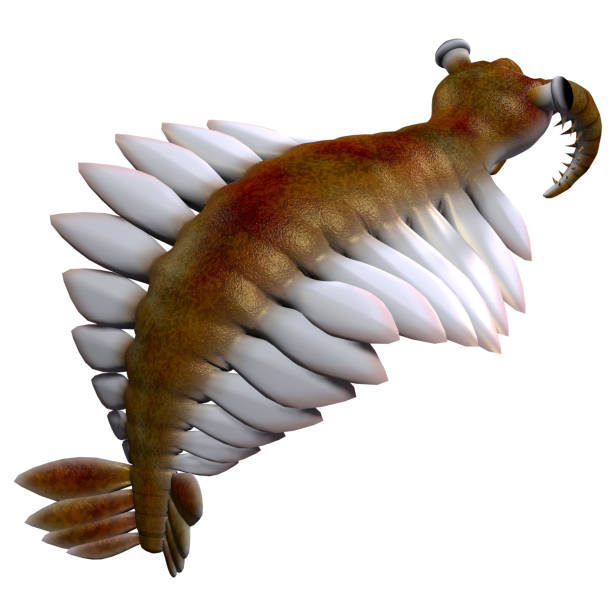
More than 500 million years ago, during the Cambrian period, Earth’s oceans were filled with unfamiliar forms. Among them swam a predator unlike anything alive today: Anomalocaris.
This creature, whose name means “unusual shrimp,” was anything but a shrimp. It could grow up to about one meter in length, making it one of the largest animals of its time. Its body was segmented and lined with flexible flaps that allowed it to swim with undulating grace. At the front were two large, spiny appendages that functioned like grasping arms. In the center of its head was a circular mouth lined with hardened plates arranged like a pineapple ring, forming a rotating feeding structure. On either side were large compound eyes, among the most sophisticated visual organs known from the Cambrian fossil record.
Anomalocaris lived during the Cambrian explosion, a period when most major animal groups first appeared. Fossils discovered in places such as the Burgess Shale in Canada revealed that early marine ecosystems were far more complex than once imagined. Anomalocaris was likely an apex predator, feeding on trilobites and other early arthropods.
For a long time, paleontologists misinterpreted its fossils. Different body parts were found separately and thought to belong to different species. Only later did scientists realize they were pieces of the same animal. This reconstruction was itself a scientific detective story, showing how even alien-looking organisms obey the same evolutionary principles as modern life.
Anomalocaris reminds us that the earliest ecosystems were not primitive in a simple sense. They were vibrant, competitive, and filled with evolutionary innovation.
2. Hallucigenia: The Creature That Defied Orientation
If Anomalocaris was the hunter of the Cambrian seas, Hallucigenia was one of its strangest contemporaries. Discovered in the same Burgess Shale deposits, Hallucigenia looked so bizarre that its original reconstruction was later overturned.
This small worm-like animal had a slender body supported by pairs of stiff spines along its back. Beneath the body were softer, tentacle-like appendages used for walking. When first described, paleontologists mistakenly reconstructed it upside down, imagining the spines as legs and the tentacles as feeding organs.
Later discoveries, including better-preserved fossils from China, clarified its anatomy. The spines were defensive structures, likely protecting it from predators like Anomalocaris. The soft appendages were indeed legs, and its head bore simple eyes and a small mouth with teeth.
Hallucigenia lived about 508 million years ago and belonged to a group related to modern velvet worms and arthropods. Its strange design demonstrates how different early animal body plans were from what we see today. Many Cambrian animals explored forms that left no direct descendants.
Its very name reflects the sense of disbelief it inspired. Yet it was no hallucination. It was a real, functioning organism shaped by natural selection in a world radically different from ours.
3. Opabinia: The Five-Eyed Mystery
Among Cambrian oddities, Opabinia stands out as one of the most visually astonishing. This small marine animal possessed five eyes arranged on top of its head and a long, flexible proboscis ending in a claw-like structure.
Opabinia lived around 505 million years ago. Its body was segmented, with lateral flaps used for swimming. The proboscis likely helped it capture food from the sea floor, transferring it to a mouth located beneath its head.
When paleontologist Harry Whittington presented a reconstruction of Opabinia in the 1970s, the audience reportedly laughed, thinking the image must be a joke. Five eyes seemed excessive, almost absurd. But careful study of the fossils confirmed the anatomy.
The five eyes may have provided a wide field of vision, useful for detecting predators or prey in complex Cambrian ecosystems. Opabinia illustrates how early evolution experimented with sensory systems before settling into more standardized designs.
Today, no animal has five stalked eyes arranged like Opabinia’s. It represents a lineage that vanished, leaving behind only its fossilized imprint as evidence of nature’s bold experimentation.
4. Dunkleosteus: The Armored Sea Titan
Jump forward to the Devonian period, about 360 to 380 million years ago, and the oceans were ruled by a terrifying fish: Dunkleosteus.
Unlike modern fish with flexible jaws and bony skeletons, Dunkleosteus was a placoderm, an armored fish with thick bony plates covering its head and upper body. It could grow up to ten meters in length. Instead of teeth, it had sharp, bony plates that formed a powerful biting mechanism capable of slicing through prey.
Biomechanical studies suggest that Dunkleosteus had one of the strongest bite forces of any fish, living or extinct. Its jaws could open and close with extraordinary speed, creating suction that pulled prey inward before crushing it.
Its armor made it appear almost mechanical, like a biological tank cruising ancient seas. Yet this design was the result of evolutionary adaptation. During the Devonian, often called the “Age of Fishes,” marine ecosystems became increasingly complex, and predators evolved new strategies for hunting.
Dunkleosteus did not survive past the Devonian extinction. Its lineage disappeared, but its fossils reveal a time when armored giants dominated the oceans long before sharks took over.
5. Jaekelopterus: The Sea Scorpion Giant
Imagine standing on the shore of a Silurian lagoon about 390 million years ago. Beneath the surface lurks Jaekelopterus, one of the largest arthropods ever to live.
This creature belonged to the eurypterids, commonly called sea scorpions. Jaekelopterus could reach lengths of over two meters. It had a segmented body, paddle-like appendages for swimming, and large pincers for grasping prey. Its appearance combines features of scorpions, lobsters, and something entirely unfamiliar.
Eurypterids were not true scorpions but distant relatives within the arthropod family. Some species lived in marine environments; others inhabited brackish or freshwater habitats. Jaekelopterus likely occupied a top predatory role in its ecosystem.
Its size was partly possible because atmospheric oxygen levels were higher during certain Paleozoic periods, allowing arthropods to grow larger than most modern species. The respiratory systems of arthropods rely on diffusion, and oxygen concentration can influence maximum body size.
Though terrifying in appearance, Jaekelopterus represents a natural extension of arthropod evolution. It demonstrates how environmental conditions can shape biological possibilities.
6. Helicoprion: The Spiral-Toothed Enigma
Among prehistoric fish, Helicoprion is one of the most perplexing. Living during the Permian period over 250 million years ago, this shark-like fish possessed a structure that baffled scientists for decades: a spiral whorl of teeth.
Early fossil discoveries showed only the tooth whorl, resembling a circular saw blade. For years, paleontologists debated where it belonged. Some imagined it protruding from the snout like a buzz saw. Others placed it along the dorsal fin.
Modern imaging techniques, including CT scanning, revealed that the tooth spiral was located in the lower jaw. As new teeth formed, older ones were pushed inward, creating a continuous spiral. The structure likely functioned in slicing soft-bodied prey such as squid.
Helicoprion belonged to an extinct group of cartilaginous fish called eugeneodontids, related to modern sharks and rays. Its bizarre dental arrangement was not random but an adaptation to a specific ecological niche.
The spiral jaw gives Helicoprion an unmistakably alien appearance. Yet it was a predator shaped by evolutionary pressures in Permian seas, following the same biological principles that govern modern marine life.
7. Therizinosaurus: The Scythe-Clawed Dinosaur
When most people imagine dinosaurs, they think of massive predators with sharp teeth or gentle herbivores with long necks. Therizinosaurus defies both expectations.
Living during the Late Cretaceous period around 70 million years ago, Therizinosaurus was a large, bipedal dinosaur with an unusual combination of traits. It had a bulky body, a long neck, and a small head. But its most striking feature was its enormous claws—up to one meter long—curving like scythes from its forelimbs.
At first, paleontologists thought the claws belonged to a giant turtle. Later discoveries revealed that Therizinosaurus was a theropod dinosaur, related to carnivorous species like Tyrannosaurus. However, evidence suggests it was primarily herbivorous.
Its claws may have been used to pull down branches, defend against predators, or display dominance. Feathers likely covered parts of its body, as many theropods are now known to have had plumage.
Therizinosaurus looks like a creature designed by imagination: part bird, part predator, part gentle giant. Its existence highlights how dinosaur evolution was far more diverse than early fossil discoveries suggested.
8. Tullimonstrum: The Tully Monster’s Puzzle
In the Carboniferous period about 300 million years ago lived one of paleontology’s most mysterious creatures: Tullimonstrum, commonly called the Tully Monster.
Discovered in the Mazon Creek fossil beds of Illinois, Tullimonstrum had a long, soft body, a proboscis ending in a claw-like mouth, and a horizontal bar across its head with eyes at each end. Its anatomy did not fit neatly into any known animal group.
For decades, scientists debated whether it was a mollusk, an arthropod, or something else entirely. More recent studies have suggested it may have been a vertebrate related to lampreys, based on evidence of a notochord and possible gill structures. However, its classification remains debated.
The Tully Monster’s strange combination of features makes it appear almost extraterrestrial. Yet it was a product of Earth’s evolutionary history, living in shallow coastal waters long before the rise of dinosaurs.
Its mystery illustrates an important truth: not all evolutionary experiments are easy to categorize. The tree of life has branches that twist and vanish, leaving only faint clues.
The Alien Within the Familiar
What makes these creatures seem alien is not that they came from elsewhere, but that they reveal how limited our everyday perspective is. We are accustomed to the body plans that survived to the present. We think of animals as fitting into familiar categories: fish, reptiles, mammals, insects.
The fossil record shows that life once explored far stranger designs. Some lineages flourished briefly and vanished. Others gave rise to modern descendants in modified forms. Evolution is not a straight line; it is a branching process filled with experiments.
Scientific accuracy demands that we see these organisms not as monsters, but as adaptations. Their forms were shaped by natural selection, genetic variation, and environmental pressures. Each structure, no matter how bizarre, had a function.
The “alien” appearance arises from distance in time. Hundreds of millions of years separate us from these creatures. In that span, ecosystems transformed, continents drifted, climates shifted, and extinctions reshaped life.
The Deeper Meaning of Prehistoric Strangeness
Studying these bizarre organisms does more than satisfy curiosity. It deepens our understanding of evolution’s flexibility. It challenges assumptions about what life “should” look like. It informs our search for life beyond Earth, reminding us that unfamiliar does not mean impossible.
Astrobiologists often consider the range of forms life might take on other planets. The fossil record demonstrates that even on Earth, under shared chemistry and physics, life has produced extraordinary diversity.
Physics and biology intertwine here. The laws of chemistry constrain possible molecules. Gravity influences body size. Oxygen levels affect respiration. Climate shapes ecosystems. Within these constraints, evolution innovates.
The alien-looking creatures of Earth’s past were not violations of natural law. They were expressions of it.
Conclusion: Earth’s Forgotten Worlds
To look at Anomalocaris, Hallucigenia, Opabinia, Dunkleosteus, Jaekelopterus, Helicoprion, Therizinosaurus, and Tullimonstrum is to glimpse forgotten worlds. Oceans teeming with segmented predators. Swamps alive with soft-bodied enigmas. Forests shadowed by feathered giants with scythe-like claws.
These creatures remind us that Earth has always been dynamic. Entire ecosystems have risen and fallen. Dominant groups have vanished. Evolution has no predetermined destination.
What we call alien may simply be unfamiliar. The deeper we dig into the fossil record, the more we realize that imagination often underestimates reality.
Life on Earth has been stranger, more inventive, and more astonishing than fiction. And if we ever encounter life beyond our planet, we should not be surprised if it, too, seems bizarre. After all, our own planet has already shown us what is possible.