In the long and dramatic story of dinosaurs, certain predators seem almost legendary. Among them stands Utahraptor, a creature whose name alone evokes images of speed, power, and terrifying intelligence. It was not merely another carnivorous dinosaur roaming ancient landscapes. Utahraptor was the largest known member of a group of predators that popular culture has come to know simply as “raptors.” Long before cinema transformed smaller relatives into icons of suspense, Utahraptor had already ruled its environment with formidable strength and predatory skill.
Living approximately 135 to 125 million years ago during the Early Cretaceous period, Utahraptor inhabited a world far older than the famous Late Cretaceous dinosaurs like Tyrannosaurus rex or Triceratops. Its ecosystem existed in what is now the western United States, particularly the region that today forms the state of Utah. At that time, the land looked very different from the desert landscapes seen today. Lush floodplains, river systems, forests of conifers, and fern-filled undergrowth created an environment teeming with life.
In this ancient world, Utahraptor was one of the most powerful predators walking on two legs. Larger than most of its close relatives and equipped with devastating hunting tools, it represented the peak of evolution within the dromaeosaurid family. These animals were agile, intelligent, and specialized hunters, but Utahraptor elevated those qualities to a new scale. It combined the swift body plan of smaller raptors with the mass and strength of a large carnivore.
The story of Utahraptor is more than a tale of a prehistoric killer. It is also a story of discovery, scientific curiosity, and the ever-evolving understanding of dinosaur biology. From its dramatic fossils buried in Utah’s rock formations to the insights it provides about dinosaur evolution, Utahraptor has become one of the most fascinating predators ever uncovered.
Discovery in the Red Rock Desert
The discovery of Utahraptor in the early 1990s electrified the paleontological world. At the time, the public imagination was already beginning to focus on swift, intelligent dinosaur predators, largely due to the rising cultural fascination with dromaeosaurs. But what scientists uncovered in Utah went far beyond expectations.
The fossils were discovered in the Cedar Mountain Formation, a geological layer in eastern Utah known for preserving Early Cretaceous fossils. This formation represents ancient river systems and floodplains that existed over one hundred million years ago. Over time, sediments buried the remains of animals that died there, preserving them as fossils waiting to be uncovered.
When paleontologists began examining the bones, it quickly became clear that they belonged to a member of the dromaeosaurid family. However, something about these fossils was unusual. The bones were far larger than those of other known raptors. The limb bones suggested a powerful animal, and the curved claws were enormous compared to previously known species.
In 1993, the dinosaur was formally named Utahraptor ostrommaysorum. The name honors both the state where it was discovered and two influential figures in dinosaur research: John Ostrom and Chris Mays. John Ostrom had been instrumental in recognizing the significance of dromaeosaurs decades earlier, particularly through his study of Deinonychus, which revolutionized ideas about dinosaur behavior.
The discovery of Utahraptor came at a moment when scientists were beginning to rethink dinosaurs not as sluggish reptiles but as dynamic, active animals. The massive size of this new raptor reinforced the idea that dromaeosaurs were among the most formidable predators of their time.
Anatomy of a Giant Raptor
Utahraptor was enormous compared to its relatives. Estimates suggest it reached lengths of around six to seven meters, or roughly twenty to twenty-three feet, from head to tail. Its weight may have approached 500 kilograms, making it dramatically larger than the famous Velociraptor.
Despite its size, Utahraptor retained the distinctive body structure characteristic of dromaeosaurs. It walked on two powerful hind legs, held its body horizontally, and balanced itself with a long, stiff tail. The tail was reinforced with specialized bones that limited its flexibility but provided stability, acting almost like a counterbalance when the animal moved quickly or turned sharply.
Its arms were relatively long and strong, ending in sharp claws capable of grasping prey. The hands were flexible and likely allowed the animal to hold struggling victims while delivering lethal strikes with its feet.
But the most iconic feature of Utahraptor was its massive sickle-shaped claw on the second toe of each foot. This claw, curved and razor-sharp, could reach lengths of more than 20 centimeters. Unlike the claws used for walking, this specialized weapon was held raised off the ground as the animal moved.
When hunting, Utahraptor could bring this claw down with tremendous force. Scientists believe it was used to slash or pierce prey, possibly opening deep wounds or helping the predator latch onto its victim.
The skull of Utahraptor was large and filled with serrated teeth designed for slicing flesh. These teeth were curved backward, preventing prey from escaping once bitten. The skull structure also suggests a strong bite force, though not as powerful as that of larger carnivores like tyrannosaurs.
Taken together, Utahraptor’s anatomy reveals a predator built for speed, agility, and lethal efficiency.
Feathers and the Appearance of Utahraptor
One of the most fascinating aspects of dromaeosaurs is their connection to birds. Modern research strongly supports the idea that birds evolved from small feathered theropod dinosaurs, and many species within the raptor family show clear evidence of feathers.
Although direct fossil evidence of feathers on Utahraptor itself has not yet been found, its close relatives provide compelling clues. Numerous smaller dromaeosaurs, including species discovered in China, have preserved feather impressions.
Because Utahraptor belonged to the same family and shared many anatomical features with these feathered dinosaurs, most paleontologists believe it likely possessed feathers as well.
These feathers probably did not enable flight, given Utahraptor’s massive size. Instead, they may have served other purposes such as insulation, display, or balance while running.
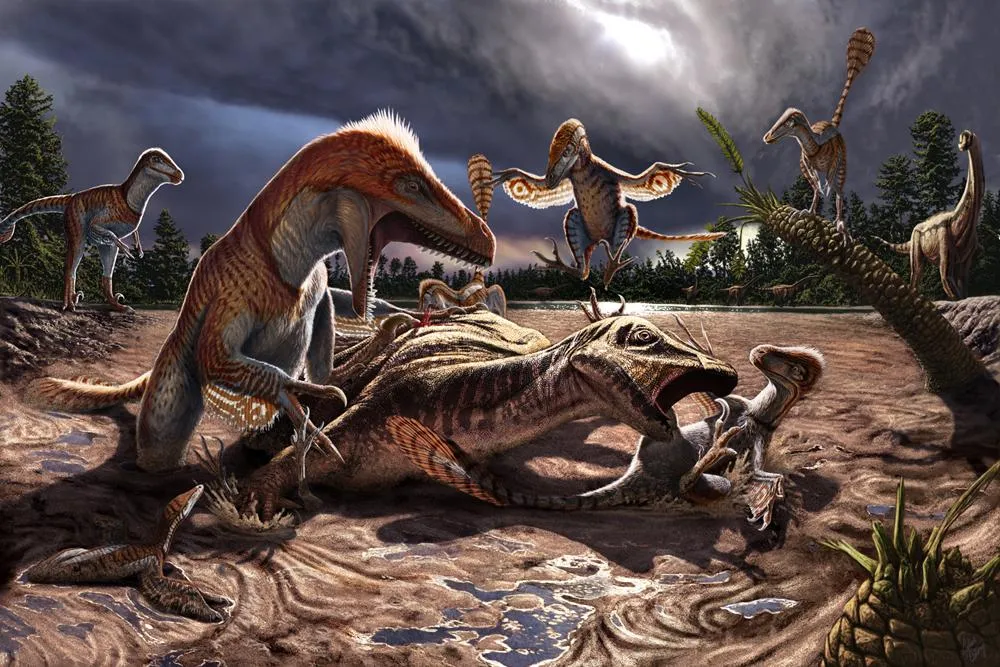
Imagining Utahraptor with a feathered body dramatically changes its appearance compared to the scaly monsters once depicted in early dinosaur illustrations. Instead of a reptilian skin-covered predator, Utahraptor may have looked somewhat bird-like, covered in a coat of feathers that helped regulate its body temperature.
This feathered appearance also strengthens the evolutionary link between dinosaurs and modern birds, showing how traits we associate with birds originated long before the first true birds appeared.
Life in the Early Cretaceous Ecosystem
The world Utahraptor inhabited was rich and diverse. During the Early Cretaceous, the region that is now Utah was part of a vast landscape shaped by rivers, lakes, and forests. The climate was warmer than today, supporting a wide variety of plants and animals.
Large herbivorous dinosaurs roamed these environments, providing potential prey for predators like Utahraptor. Among them were iguanodonts, plant-eating dinosaurs that could grow quite large and likely formed herds for protection.
Armored dinosaurs also existed in this ecosystem, including early relatives of ankylosaurs and nodosaurs. These animals possessed thick armor plates and defensive spikes, making them difficult targets for predators.
Smaller dinosaurs, mammals, reptiles, and early birds added complexity to the food web. Insects buzzed through forests, while crocodile-like reptiles lurked in waterways.
Within this ecosystem, Utahraptor occupied a high position in the food chain. Its size and weaponry suggest it could challenge relatively large prey, though it likely targeted animals smaller than itself whenever possible.
Life in this environment would have been dynamic and dangerous. Predators and prey were locked in an evolutionary arms race, each developing new adaptations for survival.
Hunting Strategies and Behavior
One of the most intriguing questions about Utahraptor concerns how it hunted. Dromaeosaurs are often portrayed as highly intelligent pack hunters, but the extent of their social behavior remains a topic of scientific debate.
Some paleontologists believe Utahraptor may have hunted in groups, using coordination to bring down larger prey. This idea stems partly from comparisons with modern predators such as wolves, which use teamwork to subdue animals larger than themselves.
However, direct fossil evidence for pack hunting among dromaeosaurs is limited. Some discoveries suggest that multiple individuals may have gathered around carcasses, but this does not necessarily mean they cooperated during hunts.
Regardless of whether Utahraptor hunted alone or in groups, its physical adaptations indicate a predator capable of rapid bursts of speed and powerful attacks.
The sickle-shaped claw likely played a key role in subduing prey. One hypothesis suggests that the claw functioned similarly to the talons of modern birds of prey. Rather than slicing prey open immediately, the claw may have helped the dinosaur grip and pin its victim while delivering fatal bites.
This strategy would have allowed Utahraptor to maintain control over struggling prey, reducing the risk of injury.
Intelligence and Sensory Abilities
Dromaeosaurs are often regarded as among the most intelligent dinosaurs. Studies of their braincases show relatively large brain sizes compared to body mass, suggesting advanced sensory capabilities.
Utahraptor likely possessed keen eyesight, an important trait for a predator that relied on tracking moving prey. Its forward-facing eyes may have provided depth perception, allowing it to judge distances accurately while hunting.
The inner ear structure in related species suggests good balance and coordination, essential for maintaining stability during fast movement.
These sensory abilities would have allowed Utahraptor to navigate complex environments, track prey through vegetation, and react quickly during high-speed pursuits.
Growth and Development
Understanding how Utahraptor grew from hatchling to adult remains an ongoing area of research. Like many dinosaurs, it likely began life as a small, vulnerable animal that required rapid growth to reach its formidable adult size.
Young Utahraptors may have looked somewhat different from adults, with proportionally longer legs and lighter bodies that allowed them to move quickly and avoid predators.
As they matured, their bones thickened and muscles developed, gradually transforming them into the powerful predators seen in fossil reconstructions.
Bone histology studies in dinosaurs often reveal growth patterns similar to those of modern birds, suggesting rapid development during early life stages.
The Significance of Utahraptor in Dinosaur Evolution
Utahraptor occupies an important place in the evolutionary history of dromaeosaurs. Its large size suggests that this group of dinosaurs experimented with a wide range of body forms, from small agile hunters to massive predators.
The discovery of Utahraptor also highlighted the diversity of dinosaur ecosystems during the Early Cretaceous, a period that had previously received less attention compared to the famous Late Cretaceous.
By studying Utahraptor and its relatives, scientists gain insight into how predatory dinosaurs evolved, adapted, and interacted with their environments.
Utahraptor in Popular Culture
Although smaller raptors like Velociraptor became famous through films and novels, Utahraptor has gradually gained recognition as an even more formidable predator.
Its impressive size and dramatic hunting tools make it a favorite subject for documentaries, books, and scientific illustrations. Many depictions emphasize its feathered appearance and bird-like features, reflecting modern scientific understanding.
The growing popularity of Utahraptor has helped introduce audiences to the real diversity of dromaeosaurs beyond the simplified portrayals often seen in fiction.
Continuing Discoveries
Even today, research on Utahraptor continues. New fossil discoveries and advanced technologies such as CT scanning allow scientists to study its bones in greater detail.
These investigations may reveal more about its anatomy, movement, and evolutionary relationships with other dinosaurs.
Paleontology is a constantly evolving science, and each new discovery has the potential to reshape our understanding of ancient life.
The Legacy of the Largest Raptor
Utahraptor stands as one of the most awe-inspiring predators of the dinosaur age. It combined the agility of smaller raptors with the size and strength of a giant carnivore, creating a hunter unlike any other.
Yet beyond its fearsome reputation, Utahraptor represents something deeper: the remarkable complexity of life that once thrived on Earth. Its fossils remind us that the world we inhabit today is only the latest chapter in a story billions of years in the making.
Through the study of creatures like Utahraptor, we glimpse ancient ecosystems, evolutionary transformations, and the dynamic processes that shaped the history of life.
In the silent rocks of Utah’s deserts, the bones of this giant raptor waited for millions of years. When they were finally uncovered, they revealed not just a predator but a window into a vanished world—one where feathered hunters roamed forests, rivers flowed across prehistoric plains, and the drama of survival unfolded under the ancient Cretaceous sun.