Few dinosaurs have had such a profound impact on science as Deinonychus. Long before the public became fascinated with swift, intelligent “raptors” through movies and novels, Deinonychus was quietly rewriting the scientific understanding of dinosaurs. It was not merely another fossil species added to the catalog of prehistoric life. Instead, it was a revelation—an animal whose anatomy, movement, and behavior forced scientists to rethink what dinosaurs truly were.
For much of the early twentieth century, dinosaurs were imagined as slow, lumbering reptiles, creatures doomed by their own evolutionary shortcomings. Museums depicted them dragging their tails through swamps, their bodies heavy and sluggish. The dominant view suggested that dinosaurs were evolutionary failures—cold-blooded giants that eventually faded into extinction because they could not adapt.
Then came Deinonychus.
Discovered in the mid-twentieth century and formally described in 1969 by paleontologist John Ostrom, this dinosaur transformed the scientific conversation. Deinonychus looked nothing like the slow reptiles of earlier imagination. Its skeleton suggested speed, agility, and predatory intelligence. It had long arms with grasping claws, a stiff tail for balance, and most famously, a large curved claw on each hind foot that appeared designed for lethal precision.
Suddenly, dinosaurs did not look like failures anymore. They looked alive—fast, energetic, and frighteningly capable.
Today, Deinonychus stands as one of the most influential dinosaur discoveries in the history of paleontology. It inspired the “dinosaur renaissance,” helped reshape the scientific view of dinosaur biology, and ultimately became the real-world animal behind the famous cinematic “Velociraptors.”
To understand Deinonychus is to understand how science changes when new evidence arrives. It is also to glimpse a predator that once ruled ancient landscapes with speed and deadly grace.
The Meaning Behind the Name
The name Deinonychus carries a dramatic meaning that reflects its most famous anatomical feature. Derived from Greek words meaning “terrible claw,” the name refers to the striking sickle-shaped claw that curved from the second toe of each foot.
This claw was unlike anything previously seen in dinosaurs. It was long, sharply curved, and retractable. When the animal walked, the claw likely stayed lifted off the ground to keep it sharp. When hunting or attacking prey, it could be brought down like a knife.
When John Ostrom examined the fossils of this animal in the 1960s, he realized that this claw was not a decorative feature. It was a weapon.
The name Deinonychus therefore captured both the anatomy and the terrifying efficiency of the predator. It was not simply a dinosaur with claws. It was a dinosaur defined by them.
Yet the claws alone were only part of the story. The entire body of Deinonychus appeared designed for speed, agility, and precision. Every bone seemed to contribute to a lifestyle very different from the lumbering dinosaurs imagined in earlier decades.
The name “terrible claw” hinted at danger, but the deeper truth was even more fascinating. Deinonychus represented a new vision of dinosaurs themselves.
Discovery in the American West
The story of Deinonychus began in the rugged landscapes of the western United States. In the early 1960s, paleontologist John Ostrom from Yale University traveled to Montana to study Early Cretaceous rock formations known for preserving ancient life.
In 1964, his team uncovered an unusual set of fossils within the Cloverly Formation, rocks dating roughly 115 to 108 million years ago. These fossils did not belong to any dinosaur known at the time. The skeleton was slender, lightweight, and clearly adapted for movement.
The bones suggested a predator about three meters long, standing roughly one meter tall at the hip. Its arms were long and flexible. Its legs were powerful and built for running. Most striking of all was the enormous sickle claw on each hind foot.
Ostrom spent several years studying the fossils carefully before publishing his groundbreaking description in 1969. The announcement introduced Deinonychus antirrhopus to the scientific world.
The species name antirrhopus means “counterbalance,” referring to the animal’s stiffened tail. The tail was reinforced with long rod-like bones and tendons that made it rigid. This design helped stabilize the animal while running and turning, acting like a balancing pole.
The discovery immediately captured scientific attention. Deinonychus did not look like the slow reptiles depicted in textbooks. Instead, its anatomy suggested a fast, active predator.
Ostrom began to propose a radical idea. Dinosaurs might have been energetic, warm-blooded animals more similar to birds than reptiles.
At the time, this idea was controversial. But the skeleton of Deinonychus made it increasingly difficult to ignore.
Anatomy of a Predator
Deinonychus was a mid-sized theropod dinosaur belonging to a group known as dromaeosaurids. These dinosaurs were characterized by slender bodies, sharp teeth, grasping hands, and the famous sickle claw.
The skull of Deinonychus was long and narrow, filled with sharp, serrated teeth. These teeth were designed for slicing flesh rather than crushing bone. The jaws could close quickly, allowing the predator to deliver rapid bites to struggling prey.
Its neck was flexible and muscular, giving it the ability to strike quickly. The arms were long and powerful, ending in three fingers tipped with curved claws. These hands were capable of grasping and holding prey.
The legs were perhaps the most impressive feature of all. Deinonychus had long, strong hind limbs that allowed it to run quickly across the landscape. The raised sickle claw on the second toe could be extended during attacks, likely used to slash or pin prey.
The tail, stiffened with elongated bones and tendons, acted as a dynamic stabilizer. When the animal ran or leaped, the tail helped maintain balance, allowing sharp turns without losing control.
Every aspect of the skeleton suggested speed and coordination. Deinonychus was not a sluggish reptile. It was a predator built for pursuit.
The entire body functioned like a living machine designed for hunting.
The Famous Sickle Claw
The most iconic feature of Deinonychus is its large curved claw on each hind foot. This claw could reach lengths of more than ten centimeters and had a shape reminiscent of a predator’s talon.
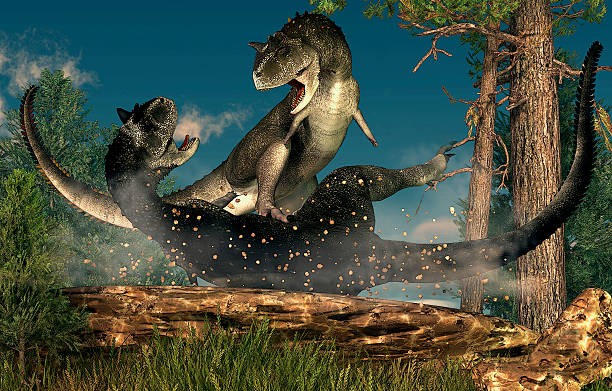
Early interpretations imagined Deinonychus slashing prey open with this claw like a knife. Later research suggested a more complex function. Some scientists proposed that the claw acted more like a hook or grappling tool, allowing the animal to latch onto prey while delivering bites.
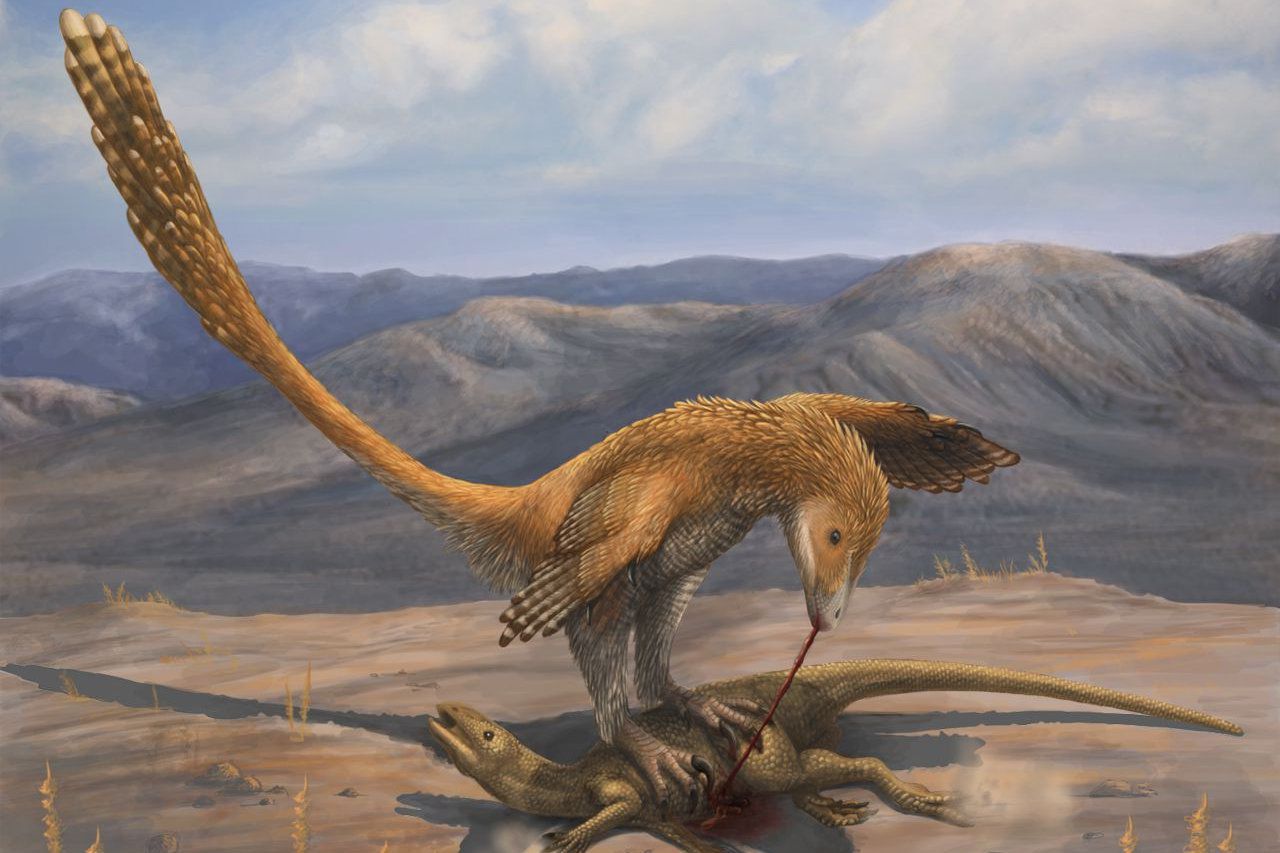
One modern interpretation compares the hunting behavior of dromaeosaurids to that of birds of prey. According to this view, Deinonychus might have leapt onto larger animals, using its claws to grip tightly while biting repeatedly.
The claw was also retractable in a sense. Because the second toe was held off the ground during walking, the claw remained sharp rather than becoming worn down by constant contact with the earth.
This adaptation suggests that the claw was not incidental. It was an essential tool for hunting.
The sickle claw became one of the defining symbols of dromaeosaur dinosaurs and played a major role in shaping public imagination about prehistoric predators.
Speed, Balance, and Movement
The skeleton of Deinonychus reveals a creature built for agility. Its limbs were proportioned for rapid movement, and its body was relatively lightweight compared to larger theropods.
Biomechanical studies suggest that Deinonychus could run quickly and maneuver effectively. The stiff tail acted as a counterbalance during movement, stabilizing the body during turns and leaps.
Unlike earlier reconstructions of dinosaurs dragging their tails behind them, Deinonychus held its tail elevated and rigid. This posture allowed the animal to maintain balance while running.
The hips and legs were also adapted for dynamic movement. The joints allowed a wide range of motion, and the muscles attached to the bones indicate strong propulsion during running.
All these features combined to produce an image of a fast and active predator.
Deinonychus likely relied on speed and coordination rather than brute strength. It was not the largest predator of its environment, but it may have been among the most efficient.
Its body tells the story of an animal that hunted with precision rather than overwhelming force.
Feathers and the Bird Connection
One of the most fascinating aspects of Deinonychus is its close relationship with birds. Modern paleontology recognizes that birds are the descendants of theropod dinosaurs, and dromaeosaurids like Deinonychus are among their closest relatives.
Although direct fossil evidence of feathers on Deinonychus itself is limited, closely related species have preserved feather impressions. Because of these discoveries, scientists strongly suspect that Deinonychus possessed feathers as well.
These feathers likely covered parts of its body and arms, perhaps forming wing-like structures. However, Deinonychus was too large to fly.
Instead, the feathers may have served other functions. They could have helped regulate body temperature, display signals during courtship, or assist with balance during movement.
The presence of feathers reinforces the idea that many dinosaurs were more bird-like than previously imagined.
Rather than cold reptilian monsters, they were active, dynamic animals with complex biology.
The line between dinosaur and bird is now understood to be much thinner than once believed.
Hunting and Behavior
Understanding how Deinonychus hunted has been a major focus of paleontological research. Fossil evidence suggests that it was a carnivorous predator that targeted other dinosaurs.
One famous fossil site revealed the remains of Deinonychus alongside a large herbivorous dinosaur called Tenontosaurus. Some scientists interpret this as evidence that Deinonychus hunted these larger animals.
There has been debate over whether Deinonychus hunted in packs. Early interpretations suggested cooperative group hunting, which would allow multiple individuals to bring down larger prey.
However, modern research remains cautious about this conclusion. While multiple Deinonychus fossils have been found near prey animals, this does not necessarily prove coordinated hunting. The animals might simply have been attracted to the same food source.
Regardless of whether it hunted alone or in groups, Deinonychus clearly occupied a high position in its ecosystem. Its sharp teeth, grasping hands, and deadly claws made it one of the most formidable predators of its time.
The Dinosaur Renaissance
Perhaps the greatest impact of Deinonychus was not merely biological but intellectual.
Before its discovery, dinosaurs were widely viewed as evolutionary dead ends. They were imagined as sluggish creatures unable to compete with mammals.
The anatomy of Deinonychus challenged that view.
John Ostrom argued that dinosaurs were active, energetic animals. His ideas inspired a new generation of scientists, including paleontologist Robert Bakker, who championed the concept of warm-blooded dinosaurs.
This movement became known as the dinosaur renaissance. It transformed paleontology during the late twentieth century.
Dinosaurs were reimagined as dynamic, complex animals. They walked upright, moved quickly, and behaved in sophisticated ways. Many possessed feathers, and birds were recognized as living dinosaurs.
Deinonychus stood at the center of this revolution.
Without it, our modern understanding of dinosaurs might have developed much more slowly.
The Real Animal Behind the Movie Raptors
The famous “Velociraptors” seen in popular films were actually modeled largely on Deinonychus.
In reality, Velociraptor itself was a smaller dinosaur, about the size of a large turkey. Deinonychus, however, was closer to the size depicted in films.
The cinematic raptors share several characteristics with Deinonychus, including the sickle claw, grasping hands, and agile movement.
However, the movie versions also exaggerate certain traits and omit others. For example, modern research strongly suggests that these dinosaurs had feathers, which are rarely shown in film portrayals.
Despite these inaccuracies, the films helped popularize the idea of intelligent, fast-moving dinosaurs—an idea that traces directly back to the scientific work inspired by Deinonychus.
In this way, Deinonychus influenced both science and popular culture.
Life in the Early Cretaceous
Deinonychus lived during the Early Cretaceous period, more than 100 million years ago. At that time, the landscapes of North America were very different from today.
The region that is now Montana and Wyoming consisted of river systems, floodplains, and forests. These environments supported a rich diversity of plants and animals.
Large herbivorous dinosaurs roamed the land, including Tenontosaurus, which may have been one of the primary prey species of Deinonychus.
Other predators also shared the environment, creating a complex ecosystem where competition and survival shaped evolution.
Deinonychus occupied an important role in this ecosystem as a fast and agile carnivore.
Its presence would have influenced the behavior and evolution of other species, just as modern predators shape their environments today.
The Continuing Study of Deinonychus
Even decades after its discovery, Deinonychus remains a subject of active scientific research.
New fossil discoveries continue to refine our understanding of its anatomy and behavior. Advances in technology, such as computer modeling and biomechanical analysis, allow scientists to explore how the animal moved and hunted.
Comparisons with other dromaeosaur species have revealed an entire family of similar predators spread across ancient continents.
Each discovery adds another piece to the puzzle of how these animals lived and evolved.
Deinonychus continues to stand as one of the most important dinosaurs ever discovered—not because it was the largest or most powerful, but because it changed how scientists think about dinosaurs as a whole.
The Legacy of a Terrible Claw
The story of Deinonychus is ultimately a story about scientific transformation. A set of bones discovered in the American West challenged long-held assumptions and reshaped an entire field of study.
Through its anatomy, scientists glimpsed a new vision of dinosaurs: fast, intelligent, dynamic creatures closely related to birds.
Today, museum exhibits, textbooks, and documentaries reflect this modern understanding. Dinosaurs are no longer portrayed as slow reptiles but as vibrant animals that dominated Earth for millions of years.
At the center of that transformation stands Deinonychus.
Its terrible claw is more than a weapon from a lost world. It is a symbol of how science evolves—how new evidence can overturn old ideas and reveal deeper truths about the history of life on Earth.
And through that process, the ancient predator continues to hunt—not through forests of the Cretaceous, but through the imagination of everyone who wonders what the world was like when dinosaurs ruled the Earth.