Among the countless creatures that once walked the Earth, few dinosaurs capture the imagination quite like Carnotaurus. With its powerful legs, compact body, and a pair of striking horns above its eyes, this predator appears almost mythological. Its name alone carries an aura of mystery and strength. Derived from Latin, Carnotaurus means “meat-eating bull,” a name that perfectly reflects the animal’s fierce appearance. Although it lived tens of millions of years ago, the story of Carnotaurus continues to fascinate scientists and dinosaur enthusiasts alike.
Carnotaurus was not the largest predator of its time, nor was it the most heavily armed with teeth or claws. Yet its unusual anatomy and remarkable adaptations set it apart from nearly every other known dinosaur. It was built for speed, equipped with incredibly tiny arms, and possessed a skull that combined power with elegance. The more paleontologists study Carnotaurus, the more it reveals about the diversity and creativity of evolution during the age of dinosaurs.
The tale of Carnotaurus is not simply about a dinosaur with horns. It is a window into the ecosystems of ancient South America, the dynamics of prehistoric predators, and the ongoing scientific quest to reconstruct life from fragments of bone buried in stone.
Discovery of a Predator from Ancient Patagonia
The modern story of Carnotaurus began in the 1980s in the windswept landscapes of Patagonia, a region in southern Argentina known for its rich fossil beds. In 1984, a remarkable discovery was made by the Argentine paleontologist José Fernando Bonaparte, one of the most influential dinosaur researchers in South America. Bonaparte uncovered the nearly complete skeleton of a previously unknown dinosaur embedded in ancient rock formations.
This discovery was extraordinary. Dinosaur fossils are often incomplete, scattered pieces of bone that must be painstakingly assembled into a possible shape. But the Carnotaurus fossil was unusually well preserved. Much of the skeleton remained intact, allowing scientists to study its anatomy in remarkable detail.
The fossil came from the La Colonia Formation of Patagonia, rocks dating back to the Late Cretaceous period roughly 70 million years ago. At that time, the region looked very different from the dry plains seen today. Instead of arid landscapes, Patagonia was home to rivers, forests, and floodplains teeming with life.
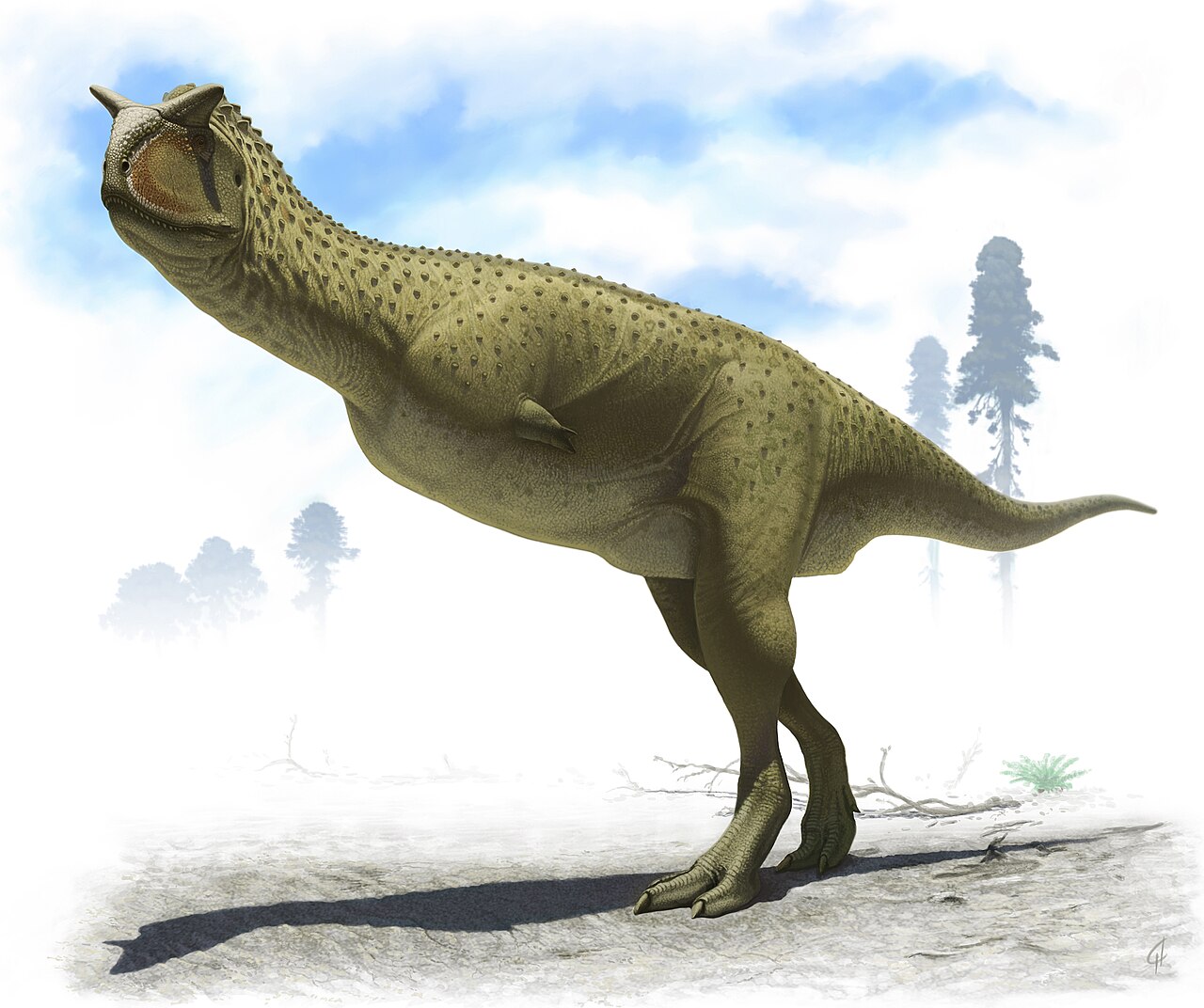
When Bonaparte examined the skull of the new dinosaur, he noticed something extraordinary. Two thick, horn-like structures rose above the eyes. No other known large carnivorous dinosaur possessed such prominent horns. This distinctive feature inspired the name Carnotaurus sastrei, honoring Ángel Sastre, the landowner on whose property the fossil was discovered.
From the moment of its discovery, Carnotaurus stood out as one of the most unusual predators of the dinosaur world.
The Meaning Behind the Name “Meat-Eating Bull”
The name Carnotaurus captures the essence of the animal’s appearance. The first part of the name, “carno,” comes from the Latin word for flesh or meat, highlighting its carnivorous diet. The second part, “taurus,” means bull, a reference to the horns that gave the dinosaur a somewhat bull-like profile.
Unlike the horns of herbivorous dinosaurs such as ceratopsians, which were often large and elaborate, the horns of Carnotaurus were relatively short and thick. They projected upward and slightly outward from the skull. Their exact function remains a subject of scientific debate.
Some paleontologists believe the horns may have been used in combat between individuals of the same species, perhaps during territorial disputes or mating competitions. Others suggest the horns were primarily for display, helping individuals recognize each other or attract mates.
Whatever their purpose, the horns gave Carnotaurus a distinctive silhouette, making it one of the most recognizable carnivorous dinosaurs ever discovered.
A Predator Built for Speed
One of the most fascinating aspects of Carnotaurus is its body design. Compared to other large carnivorous dinosaurs, Carnotaurus had a relatively lightweight build. Its legs were long and powerful, suggesting that it was an exceptionally fast runner.
Biomechanical studies of the dinosaur’s skeleton indicate that Carnotaurus may have been among the fastest large predators of its time. Its thigh bones and lower leg bones were proportioned in a way that would have allowed rapid strides and efficient locomotion.
Speed would have been a crucial advantage in the ecosystems of Late Cretaceous South America. Many herbivorous dinosaurs of the time were agile and quick, and predators needed to keep up with their prey. Carnotaurus likely relied on bursts of speed to chase down animals across open floodplains.
The tail of Carnotaurus also played an important role in its movement. Its tail was stiffened by interlocking bones that helped maintain balance during running. This structure allowed the dinosaur to stabilize its body as it sprinted, much like the tail of a modern cheetah helps it maintain balance while chasing prey.
These features suggest that Carnotaurus was not just a powerful predator but also an agile one.
The Mystery of Its Tiny Arms
If Carnotaurus was built for speed and strength, one part of its body seems almost puzzling: its arms. Among all large theropod dinosaurs, Carnotaurus possessed some of the smallest forelimbs relative to body size.
Its arms were extremely short and slender, even smaller than those of the famous predator Tyrannosaurus rex. In fact, the arms of Carnotaurus were so reduced that they would have been nearly useless for grasping prey.
The forearms had only four fingers, and the bones were thin and weak compared to the powerful legs and jaws. This unusual anatomy has sparked considerable scientific curiosity.
Why would a predator evolve such tiny arms?
One explanation is that Carnotaurus relied almost entirely on its jaws for capturing and subduing prey. Its head and neck were strong enough to deliver powerful bites and rapid strikes, making the arms unnecessary.
Another possibility is that the reduction of the arms allowed for greater balance and speed during running. By minimizing weight at the front of the body, the dinosaur may have improved its ability to sprint and maneuver.
Whatever the reason, the tiny arms of Carnotaurus remain one of its most striking features.
The Skull and Bite of Carnotaurus
The skull of Carnotaurus is both elegant and formidable. It was relatively short but deep, giving it a powerful bite. The jaws were lined with sharp, curved teeth designed for slicing flesh.
Unlike some larger theropods with extremely strong crushing bites, Carnotaurus likely relied on rapid head movements to tear into prey. Studies of the skull suggest that it was built for quick, slashing bites rather than prolonged grappling.
The eye sockets of Carnotaurus faced slightly forward, providing a degree of binocular vision. This would have helped the predator judge distances accurately while hunting.
The horns above the eyes were made of thick bone and covered in keratin, the same material that forms horns in modern animals. These structures added strength to the skull and may have helped protect the head during impacts or combat.
Together, the skull and teeth of Carnotaurus formed an effective hunting weapon.
Skin Impressions and the Dinosaur’s Appearance
One of the most remarkable aspects of the Carnotaurus fossil is the preservation of skin impressions. In many dinosaur fossils, the bones are all that remain. But the Carnotaurus specimen included patches of fossilized skin, providing rare insight into how the animal may have looked in life.
These impressions show that the skin of Carnotaurus was covered in small, pebble-like scales. Scattered among these scales were larger bumps known as osteoderms, which created a rough, textured surface.
Unlike some dinosaurs that may have had feathers, there is no evidence that Carnotaurus possessed any feather-like covering. Its skin appears to have been entirely scaly.
The pattern of scales suggests that the dinosaur may have had a complex skin texture, perhaps similar to modern reptiles such as lizards or crocodiles.
Although the exact coloration of Carnotaurus remains unknown, scientists often speculate that it may have possessed camouflage patterns suitable for hunting in its environment.
Carnotaurus in Its Ancient Ecosystem
Carnotaurus lived during the Late Cretaceous period, a time when dinosaurs dominated ecosystems across the globe. South America was home to a unique collection of species, many of which evolved independently from dinosaurs in other continents.
Carnotaurus belonged to a group of theropods known as abelisaurids, a family of carnivorous dinosaurs that thrived in the southern continents. Other members of this group included the formidable predator Abelisaurus comahuensis.
These predators occupied ecological roles similar to those of tyrannosaurs in North America and Asia. They were among the top hunters in their environments.
The prey of Carnotaurus likely included smaller dinosaurs, young sauropods, and possibly other reptiles inhabiting river systems and forests. Fossil evidence from the region suggests a diverse ecosystem filled with herbivorous dinosaurs, crocodile-like reptiles, turtles, and early mammals.
In this vibrant prehistoric world, Carnotaurus stood as a swift and specialized hunter.
Evolution and the Abelisaurid Dynasty
Carnotaurus was part of an evolutionary lineage that flourished in Gondwana, the ancient southern supercontinent that included present-day South America, Africa, Antarctica, India, and Australia.
Abelisaurids evolved distinctive features that set them apart from other theropods. Many species possessed short skulls, reduced forelimbs, and ornamental structures on their heads, such as horns or crests.
Carnotaurus represents one of the most extreme examples of this evolutionary trend. Its horns, tiny arms, and streamlined body illustrate how natural selection can shape animals in unexpected ways.
These dinosaurs dominated southern ecosystems for millions of years, demonstrating the remarkable diversity of predatory dinosaurs beyond the more famous tyrannosaurs and velociraptors.
Carnotaurus in Popular Culture
Despite being discovered relatively recently, Carnotaurus has quickly become one of the most recognizable dinosaurs in popular culture. Its dramatic horns and sleek body make it visually striking, perfect for books, documentaries, and films.
Carnotaurus gained widespread recognition through its appearance in various media portrayals of prehistoric life. Although these depictions sometimes exaggerate its size or abilities, they have helped introduce millions of people to this fascinating dinosaur.
The popularity of Carnotaurus reflects a broader fascination with dinosaurs. These ancient animals continue to inspire curiosity about the deep history of life on Earth.
What Carnotaurus Teaches Us About Evolution
The study of Carnotaurus highlights how evolution experiments with different body designs. Not every predator evolves massive arms or enormous size. Some develop speed, others develop specialized skulls, and some—like Carnotaurus—develop unusual horns.
Each adaptation reflects the pressures of survival in a specific environment. Over millions of years, natural selection shaped Carnotaurus into a predator perfectly suited to its ecosystem.
The fossil record preserves these evolutionary experiments, allowing scientists to trace how life changes over time.
The Continuing Mystery of Carnotaurus
Even though the Carnotaurus fossil is one of the most complete theropod skeletons discovered in South America, many questions remain unanswered.
Scientists continue to investigate how exactly the horns were used, how fast the dinosaur could run, and what specific prey it hunted. New discoveries of related species may provide further clues about its lifestyle and behavior.
Every fossil is a fragment of a larger story, and Carnotaurus is no exception. As paleontologists explore more fossil beds and develop new technologies for studying ancient bones, our understanding of this remarkable predator continues to grow.
The Legacy of the Horned Predator
Carnotaurus stands as a symbol of the extraordinary diversity that once existed among dinosaurs. It was not the largest predator, nor the most heavily armed, but it possessed a combination of traits unlike any other dinosaur known.
Its horns gave it the appearance of a prehistoric bull. Its long legs made it a swift hunter. Its tiny arms puzzled scientists and challenged assumptions about predator anatomy.
More than seventy million years after it roamed the ancient plains of Patagonia, Carnotaurus continues to capture the imagination. Its fossil reminds us that Earth’s past was filled with creatures as strange and fascinating as anything in mythology.
Through the careful work of paleontologists and the silent testimony of ancient bones, the story of Carnotaurus lives on—a reminder that evolution’s creativity knows no bounds, and that the history of life on Earth is far richer and more surprising than we once imagined.