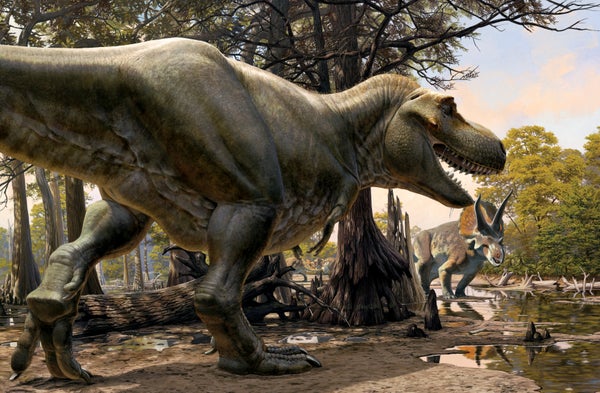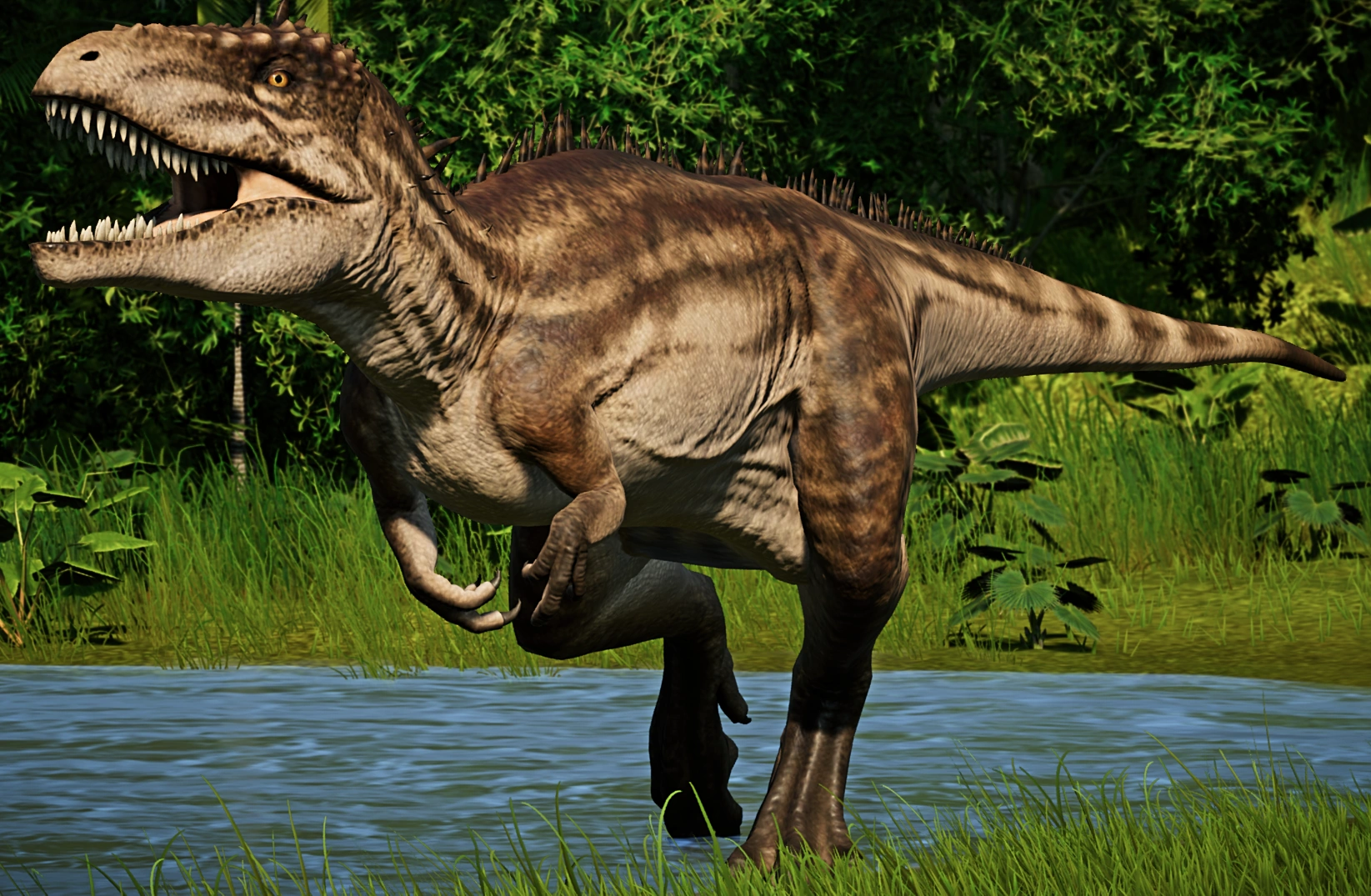
In the immense prehistoric landscapes of northern Africa, long before deserts stretched across the continent and long before humans walked the Earth, a colossal predator ruled the river valleys and lush floodplains. This predator was not the famous tyrant of North America, nor the swift hunters of Asia. Instead, it was something equally formidable, perhaps even more mysterious—a giant carnivorous dinosaur known as Carcharodontosaurus, the “shark-toothed lizard.”
The name itself evokes something ancient and terrifying. The teeth of this dinosaur were long, curved, and serrated like the blades of a shark. Paleontologists who first examined them immediately noticed their resemblance to the teeth of great predatory sharks. That resemblance inspired the name Carcharodontosaurus, combining Greek words meaning “shark,” “tooth,” and “lizard.”
Yet the story of Carcharodontosaurus is not merely about its terrifying teeth. It is a story about lost fossils, rediscovery, ancient ecosystems, and one of the most powerful predators that ever lived on land. Its remains whisper of a vanished world where giant rivers carved through tropical landscapes, where enormous plant-eating dinosaurs wandered in herds, and where massive carnivores stalked them through dense vegetation and muddy floodplains.
Understanding Carcharodontosaurus means stepping into that ancient African world and piecing together the life of a predator that rivaled the largest meat-eaters ever known.
The Discovery of a Lost Giant
The story of Carcharodontosaurus begins in the early twentieth century, during a time when paleontology was rapidly expanding across the globe. European explorers and scientists were searching deserts and mountains for fossils that could illuminate the distant past of life on Earth.
In 1925, German paleontologist Ernst Stromer described fossils discovered in the Bahariya Oasis of Egypt. Among them were massive teeth and fragments of a giant carnivorous dinosaur. The teeth were unlike anything Stromer had seen before—long, blade-like, and serrated with a striking resemblance to the teeth of the prehistoric shark Carcharodon.
Stromer named the animal Carcharodontosaurus saharicus, the “shark-toothed lizard from the Sahara.”
For paleontologists of the time, this discovery hinted that Africa had once been home to enormous predatory dinosaurs comparable to those found in North America. However, tragedy soon struck the scientific community. During World War II, the museum in Munich where Stromer’s fossils were stored was bombed, destroying the original remains of Carcharodontosaurus.
For decades afterward, the dinosaur existed mostly as a memory recorded in Stromer’s drawings and descriptions. Many scientists wondered whether the animal had truly been as large and impressive as Stromer believed. Without fossils, its true nature remained uncertain.
Then, in the 1990s, paleontologists made an extraordinary rediscovery. New fossils found in Morocco revealed a nearly complete skull of a giant predator identical to Stromer’s descriptions. Suddenly, the shark-toothed lizard returned to life in scientific understanding, confirming that one of the largest carnivorous dinosaurs had indeed roamed Africa.
The Meaning Behind the Name
The name Carcharodontosaurus captures something essential about this predator. It literally means “lizard with teeth like Carcharodon,” the genus that includes great white sharks.
This comparison was not poetic exaggeration. The teeth of Carcharodontosaurus were remarkably similar to those of large predatory sharks. They were long, thin, and flattened from side to side, forming sharp cutting edges. Each tooth carried fine serrations along its edges, functioning almost like the teeth of a steak knife.
Such teeth were perfect for slicing through flesh. Unlike the thick, crushing teeth of some predators, the teeth of Carcharodontosaurus were designed to cut deep wounds and tear large pieces of meat from prey.
The similarity between dinosaur teeth and shark teeth is a striking example of convergent evolution. These animals lived in completely different environments—one in the ocean, the other on land—but evolved similar tools for similar purposes: efficient predation.
The shark-toothed design suggests that Carcharodontosaurus relied heavily on slashing attacks rather than bone-crushing bites. It likely inflicted massive wounds on its prey, causing severe blood loss and shock.
The Size and Power of the Predator
Carcharodontosaurus was among the largest carnivorous dinosaurs ever discovered. Estimates suggest that it could reach lengths of around thirteen meters, making it comparable in size to the famous giant predators of other continents.
Its skull alone measured more than one and a half meters long. This enormous head housed dozens of sharp teeth capable of delivering devastating bites.
Unlike some massive predators with extremely thick bodies, Carcharodontosaurus appears to have had a relatively balanced build. Its body combined great size with agility, suggesting it was capable of active hunting rather than merely scavenging.
Its legs were long and powerful, designed for walking and possibly running over considerable distances. The tail acted as a counterbalance to the massive head, helping the animal maintain stability while moving.
The arms of Carcharodontosaurus were smaller than its legs but still functional. They likely possessed three fingers with sharp claws that could help grasp struggling prey.
All these features together paint the picture of a powerful predator adapted to dominate its ecosystem.
The Skull: A Weapon of Evolution
The skull of Carcharodontosaurus is one of the most impressive structures in the fossil record. It was long, deep, and filled with large openings that reduced weight while maintaining strength.
These openings allowed the skull to remain relatively lightweight despite its enormous size. This was crucial because a lighter skull meant the animal could move its head quickly during attacks.
The jaws were lined with dozens of serrated teeth that could grow up to twenty centimeters long. When the dinosaur bit into prey, these teeth acted like blades, slicing through flesh with terrifying efficiency.
Unlike the bone-crushing bite of certain predators, the bite of Carcharodontosaurus may have relied on repeated slashing motions. The dinosaur could bite, pull back, and rip open large wounds in its prey.
This method of hunting might have caused massive bleeding, weakening the victim until it collapsed.
The skull also contained large eye sockets, suggesting that Carcharodontosaurus had good vision. Keen eyesight would have been essential for spotting prey across the vast landscapes of its environment.
The World of the Mid-Cretaceous
To understand Carcharodontosaurus, one must imagine Africa as it existed around 95 to 100 million years ago during the mid-Cretaceous period.
The Sahara Desert did not exist then. Instead, northern Africa was a warm and lush region filled with rivers, wetlands, and dense vegetation. Enormous river systems carved through forests and floodplains, creating habitats rich with life.
This environment supported an extraordinary diversity of dinosaurs. Massive plant-eating species wandered across the landscape, feeding on abundant vegetation. Crocodile-like reptiles thrived in the rivers, and enormous fish swam beneath the surface.
In this world of giants, Carcharodontosaurus stood near the top of the food chain.
The abundance of prey likely allowed multiple large predators to coexist. The ecosystem of ancient Africa may have supported several species of giant carnivores, each occupying slightly different ecological roles.
Hunting in an Ancient Ecosystem
Carcharodontosaurus likely hunted some of the largest herbivorous dinosaurs in Africa. These prey animals included enormous sauropods, the long-necked giants that could reach lengths exceeding twenty meters.
Hunting such massive animals required strength, strategy, and perhaps patience. A predator like Carcharodontosaurus may have targeted young or weak individuals within herds.
Another possibility is that it attacked prey with quick, slashing bites designed to weaken the victim over time.
The predator’s teeth were ideal for cutting flesh rather than crushing bone. This suggests that it relied on slicing attacks that caused catastrophic wounds.
In addition to giant herbivores, Carcharodontosaurus may have hunted medium-sized dinosaurs or scavenged carcasses when the opportunity arose.
Large predators often behave opportunistically, taking advantage of whatever food sources are available.
Rivals in the Prehistoric World
One of the most fascinating aspects of the Carcharodontosaurus ecosystem is the presence of other giant predators in the same region.
Among them was a strange sail-backed dinosaur known as Spinosaurus, one of the largest carnivorous dinosaurs ever discovered. Unlike Carcharodontosaurus, Spinosaurus appears to have specialized in hunting fish and aquatic prey.
Another large predator known from African fossils is Bahariasaurus, a long-legged theropod that may have pursued smaller prey across open terrain.
The presence of multiple large carnivores suggests that the ecosystem was incredibly rich. Each predator likely focused on different food sources or habitats to avoid direct competition.
Carcharodontosaurus may have specialized in large terrestrial prey, dominating the role of land-based apex predator.
The Body and Movement
Although much attention focuses on the skull and teeth of Carcharodontosaurus, the rest of its body was equally impressive.
The dinosaur’s body was built for balance and power. Its long tail helped stabilize its movements, especially while running or turning.
The hind legs were muscular and well suited for supporting its massive weight. These legs also allowed the dinosaur to move efficiently across long distances while searching for prey.
Despite its enormous size, Carcharodontosaurus was probably capable of relatively quick bursts of speed. Such speed would have been useful when ambushing prey or chasing wounded animals.
The overall design of the body reflects the evolutionary success of large theropod predators.
The Teeth That Inspired the Name
The teeth of Carcharodontosaurus remain one of the most distinctive features of the animal. Each tooth was curved slightly backward, allowing it to grip flesh effectively.
Fine serrations along the edges acted like microscopic saw blades. When the dinosaur bit into prey and pulled back, these serrations sliced through tissue.
This slicing action created deep wounds that could disable prey quickly.
The shape of the teeth also suggests they were frequently replaced. Like many dinosaurs, Carcharodontosaurus likely grew new teeth throughout its life, replacing those that broke or wore down during feeding.
This constant renewal ensured that the predator always had sharp weapons ready for hunting.
Growth and Life Cycle
Although fossils of juvenile Carcharodontosaurus are rare, scientists believe that the dinosaur underwent significant growth during its lifetime.
Young individuals would have been much smaller and likely hunted smaller prey until they grew large enough to challenge giant herbivores.
As they matured, their skulls became larger and stronger, and their teeth grew longer and more formidable.
Reaching full size would have taken many years, during which the dinosaur gradually rose to the top of its ecosystem.
Fossils and Scientific Reconstruction
Reconstructing the life of Carcharodontosaurus requires careful analysis of fossils and comparison with related species.
Paleontologists examine bone structures to understand how muscles were attached and how the animal moved. Teeth reveal information about diet, while the structure of the skull provides clues about bite mechanics.
Computer simulations and biomechanical studies allow scientists to estimate how powerful the dinosaur’s bite might have been and how it used its jaws during feeding.
Each new fossil discovery helps refine our understanding of this ancient predator.
A Rival to the Greatest Carnivores
Carcharodontosaurus is often compared to other giant predators such as Tyrannosaurus and Giganotosaurus.
Although these dinosaurs lived on different continents and in different time periods, they shared similar roles as apex predators.
Carcharodontosaurus represents Africa’s contribution to this group of giant carnivores.
Its massive size, razor-sharp teeth, and powerful jaws made it one of the most formidable hunters in dinosaur history.
The Legacy of the Shark-Toothed Lizard
Today, the deserts of northern Africa appear barren and silent. Yet beneath the sands lie the fossils of a world that once teemed with life.
Carcharodontosaurus is one of the most dramatic reminders of that lost ecosystem. Its fossils tell a story of immense predators roaming lush landscapes filled with towering dinosaurs and winding rivers.
The rediscovery of its fossils after decades of absence also highlights the resilience of scientific exploration. Even when evidence is lost, new discoveries can revive ancient stories.
Carcharodontosaurus stands as one of the greatest predators ever to walk the Earth. Its shark-like teeth, colossal skull, and powerful body reveal the extraordinary evolutionary paths that life has taken over millions of years.
Through fossils, research, and imagination, scientists continue to bring this ancient hunter back to life in our understanding, reminding us that Earth’s history is far richer and more dramatic than we might ever have imagined.