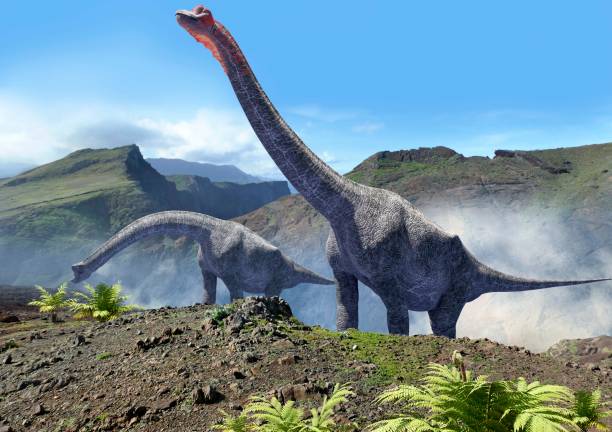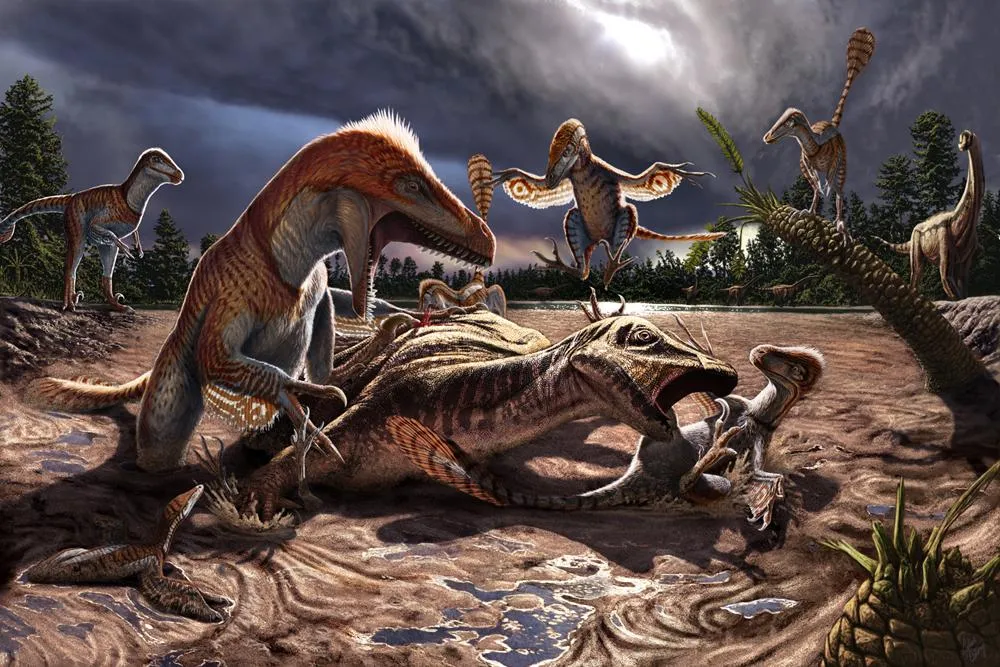
Sixty-six million years ago, the Earth was alive with giants. Vast floodplains trembled under the footsteps of towering herbivores. Predators with serrated teeth stalked forests dense with flowering plants. In the skies, pterosaurs soared on warm thermals. The continents were arranged differently, the climate was warmer, and the oceans teemed with ancient reptiles and ammonites. For over 160 million years, dinosaurs had dominated the land. They had survived shifting continents, rising and falling seas, volcanic upheavals, and evolutionary competition. They seemed unstoppable.
And then, in geological terms, they were gone.
The extinction that ended the Age of Dinosaurs was not a slow fading into obscurity. It was a turning point in the history of life, marking the boundary between the Cretaceous and Paleogene periods. Known as the Cretaceous–Paleogene extinction event, it eliminated about three-quarters of all species on Earth. Non-avian dinosaurs vanished entirely, along with many marine reptiles, ammonites, and countless microscopic organisms.
But how did this happen? How did creatures that ruled the Earth for millions of years disappear so suddenly? The answer lies in a story written in rock layers, chemical signatures, impact craters, and fossil records. It is a story of cosmic violence, planetary upheaval, and the fragile balance of ecosystems.
The Evidence in the Rocks
The first clues emerged not from dinosaur bones but from a thin layer of clay found in rock formations around the world. In the late twentieth century, scientists studying sedimentary layers noticed a striking pattern. At the boundary between Cretaceous and Paleogene rocks, there was an unusually high concentration of iridium, a metal rare in Earth’s crust but more common in meteorites.
This iridium anomaly was discovered by a team led by physicist Luis Alvarez and geologist Walter Alvarez. Their measurements revealed iridium levels hundreds of times higher than normal crustal values. The implication was dramatic. Something from space had struck the Earth, depositing extraterrestrial material globally.
The presence of shocked quartz provided additional evidence. These quartz grains showed microscopic deformation patterns that form under intense pressure, such as that generated by a massive impact or nuclear explosion. Volcanic activity can produce heat, but it does not produce the same pressure signatures found in shocked quartz.
Soon, tiny glassy spheres called tektites and spherules were identified in the boundary layer. These droplets formed when rock was vaporized and ejected into the atmosphere, cooling as it fell back to Earth. Their global distribution suggested an impact of enormous scale.
The evidence was accumulating. A catastrophic event had occurred at the end of the Cretaceous. But where was the crater?
The Chicxulub Impact
The answer emerged in the Yucatán Peninsula of Mexico. In the late twentieth century, geophysical surveys revealed a buried circular structure beneath the town of Chicxulub. This structure, now known as the Chicxulub crater, measures roughly 180 kilometers in diameter. It is one of the largest confirmed impact craters on Earth.
Dating of rocks from the crater showed that it formed about 66 million years ago, precisely at the time of the mass extinction. The alignment of timing, chemical evidence, and crater size provided a compelling link between the impact and the extinction event.
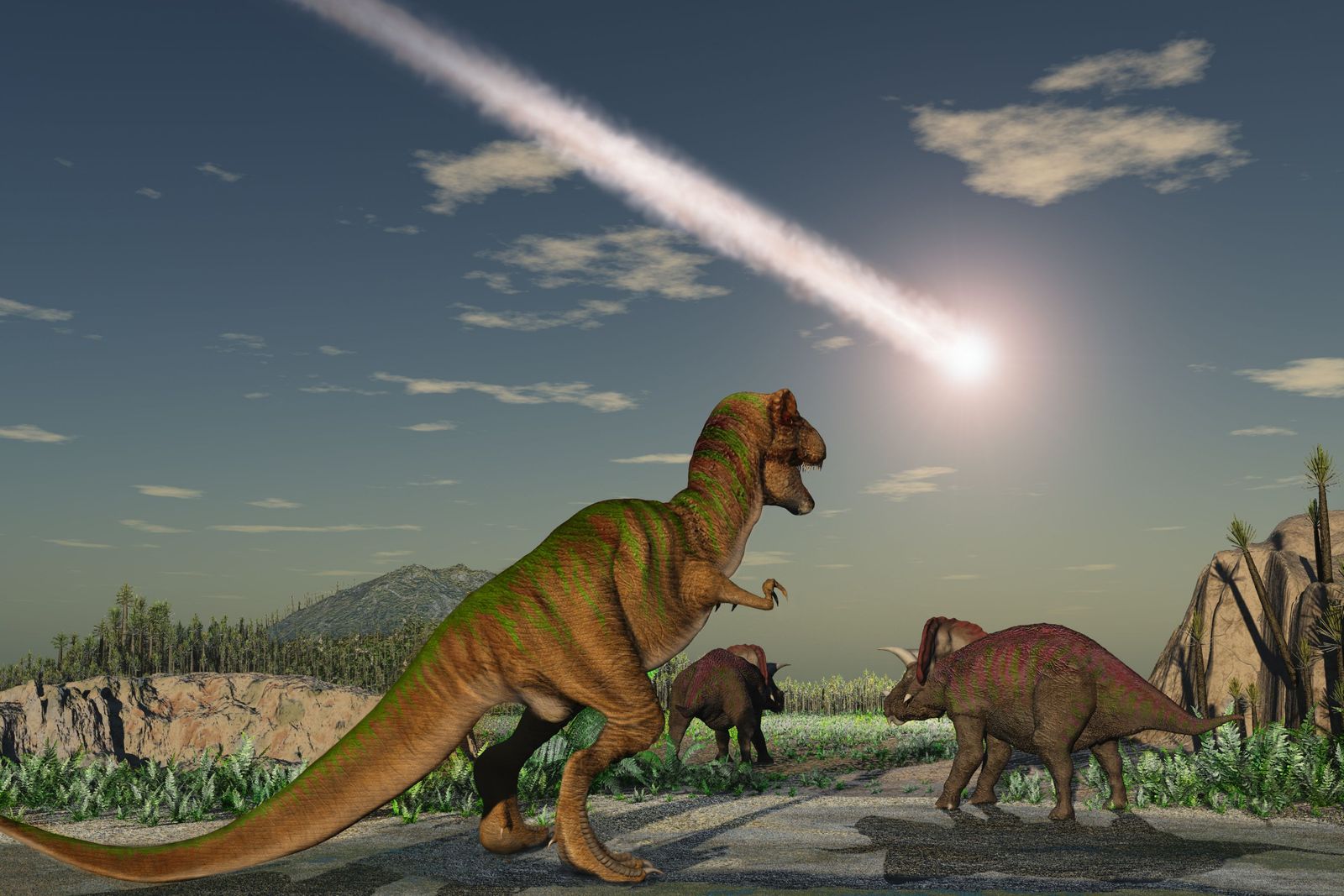
The asteroid that struck Earth is estimated to have been about 10 kilometers in diameter. Traveling at tens of kilometers per second, it would have released energy equivalent to billions of atomic bombs. Upon impact, it excavated vast amounts of rock, vaporized itself and surrounding material, and triggered immediate devastation across the region.
Within minutes, shockwaves would have radiated outward. An intense thermal pulse, generated by superheated debris re-entering the atmosphere, likely ignited wildfires across large portions of the planet. Tsunamis hundreds of meters high would have surged across nearby coastlines.
But the most profound effects unfolded in the atmosphere.
Darkness at Noon
The impact lofted enormous quantities of dust, soot, and sulfur-rich aerosols into the stratosphere. Unlike lower atmospheric particles that settle quickly, stratospheric debris can remain suspended for years. This veil would have blocked sunlight on a global scale.
Without sunlight, photosynthesis would have collapsed. Plants, both on land and in the oceans, form the base of most food chains. If primary producers fail, herbivores starve. If herbivores decline, predators follow. The intricate web of life unravels.
Climate models suggest that global temperatures may have dropped dramatically in the aftermath, producing what scientists sometimes call an “impact winter.” Surface cooling could have persisted for months to years. At the same time, chemical reactions involving sulfur compounds may have produced acid rain, further stressing ecosystems.
Marine environments were equally vulnerable. The reduction of sunlight would have affected phytoplankton, the microscopic organisms forming the foundation of oceanic food webs. The fossil record shows a severe decline in planktonic foraminifera at the boundary, indicating widespread marine disruption.
The extinction pattern supports this scenario. Large animals dependent on abundant food resources were especially vulnerable. Non-avian dinosaurs, many of which required significant daily intake, would have struggled to survive prolonged food scarcity.
Yet not all life vanished. Birds, the avian descendants of certain theropod dinosaurs, survived. So did mammals, crocodilians, turtles, and many other groups. Survival likely depended on factors such as body size, diet flexibility, and ecological niche.
Volcanic Fire and the Deccan Traps
While the impact hypothesis provides a powerful explanation, it is not the only factor under consideration. Around the same time as the extinction event, massive volcanic eruptions were occurring in what is now India. These eruptions formed the Deccan Traps, a vast region of layered basalt covering hundreds of thousands of square kilometers.
The Deccan volcanism released large quantities of carbon dioxide and sulfur dioxide into the atmosphere. Carbon dioxide can drive long-term warming, while sulfur dioxide can lead to short-term cooling and acid rain. The eruptions were not a single event but occurred in pulses over hundreds of thousands of years, spanning the extinction boundary.
Some scientists propose that the volcanic activity stressed ecosystems before the asteroid struck, making them more vulnerable. Others suggest that seismic waves from the impact may have intensified volcanic eruptions, increasing their output.
Determining the relative contributions of impact and volcanism has been an active area of research. Precise dating techniques have refined the timeline, and many studies indicate that while Deccan volcanism influenced climate and ecosystems, the impact was the primary driver of the sudden mass extinction.
The pattern in the fossil record shows a sharp boundary consistent with a rapid event rather than a slow decline. While some species may have been under stress before the impact, the asteroid appears to have delivered the decisive blow.
The Selective Survival of Life
One of the most fascinating aspects of the extinction is not only who died, but who survived. Crocodilians endured. Turtles persisted. Small mammals emerged from burrows to inherit a transformed world. Birds continued to evolve, eventually diversifying into thousands of species.
Why did these groups survive while non-avian dinosaurs did not?
Size likely played a role. Smaller animals require less food and can reproduce more quickly. Some mammals and birds may have survived by feeding on seeds, insects, or detritus, resources available even when plant life was severely reduced.
Burrowing behavior could have offered protection from the immediate thermal pulse and wildfires. Aquatic environments may have buffered temperature extremes compared to terrestrial habitats.
The extinction was not random. It followed ecological patterns shaped by physiology, diet, habitat, and adaptability. The event reshaped the evolutionary trajectory of life. In the absence of dinosaurs dominating terrestrial ecosystems, mammals diversified. Over millions of years, they gave rise to primates, and eventually, to humans.
In this sense, the extinction was both an end and a beginning.
A World Reborn
After the dust settled and sunlight returned, the Earth entered a new chapter. Forests gradually regrew. Oceans recovered. Ecosystems reassembled, though never exactly as before.
The Paleogene world was different. Mammals increased in size and diversity. Birds radiated into niches once occupied by pterosaurs and non-avian dinosaurs. Flowering plants continued to expand their dominance.
Recovery took hundreds of thousands to millions of years. The fossil record shows that biodiversity gradually rebounded, though some groups, such as ammonites and large marine reptiles, were gone forever.
The extinction event serves as a reminder of Earth’s vulnerability to cosmic events. Impacts have shaped planetary surfaces throughout the solar system. Earth’s atmosphere and active geology have erased many ancient craters, but the scars remain in deep time.
How We Know What We Know
Our understanding of dinosaur extinction is built on interdisciplinary research. Geologists analyze rock layers and isotope ratios. Paleontologists study fossil distributions. Geochemists measure elemental concentrations. Climate scientists model atmospheric effects. Physicists examine impact dynamics.
Radiometric dating techniques, such as uranium-lead and argon-argon dating, allow precise determination of ages. Seismic imaging reveals buried crater structures. Drilling projects have extracted core samples from the Chicxulub site, confirming impact-generated rocks.
Science advances by accumulating converging lines of evidence. The asteroid hypothesis was once controversial. Today, it is widely accepted as the primary cause of the Cretaceous–Paleogene extinction, supported by geochemical signatures, global distribution of impact debris, crater identification, and extinction patterns.
Yet science remains open to refinement. Research continues to explore how exactly the atmosphere responded, how long darkness persisted, and how ecosystems recovered.
Could It Happen Again?
Asteroid impacts are not relics of the distant past. Earth continues to be struck by small meteoroids, though large impacts are rare on human timescales. Space agencies monitor near-Earth objects to assess potential risks. Understanding past impacts informs planetary defense strategies.
The extinction of the dinosaurs reminds us that life’s history includes abrupt catastrophes. Evolution does not proceed only through gradual change. At times, it is punctuated by sudden upheavals that reset the stage.
The resilience of life is equally striking. Despite massive loss, life endured. It adapted, diversified, and flourished again.
The Emotional Weight of Deep Time
When we imagine the final days of the dinosaurs, it is tempting to picture a single dramatic moment: a flash in the sky, a thunderous impact, immediate annihilation. The reality was more complex and more haunting. Some animals likely perished instantly near the impact site. Others survived the first hours, only to face weeks of darkness and months of hunger.
The extinction was not just an event; it was a process unfolding over years. It was the gradual collapse of ecosystems, the silence of forests once alive with calls, the emptying of oceans once filled with ancient swimmers.
Yet from that silence emerged new songs. Birds took to the skies. Mammals explored new habitats. The world did not end; it transformed.
Understanding how the dinosaurs died deepens our appreciation for Earth’s history. It reveals the interplay between cosmic forces and biological evolution. It shows that even dominant species are not immune to environmental change.
Conclusion: The Truth Written in Stone
How did the dinosaurs actually die? The weight of evidence points to a massive asteroid impact at Chicxulub, which triggered global environmental collapse through darkness, cooling, wildfires, and acid rain. Volcanic activity from the Deccan Traps may have compounded stresses, but the impact was the pivotal event that marked the end of the Age of Dinosaurs.
The story is scientifically grounded in geology, chemistry, paleontology, and physics. It is etched into rock layers and encoded in isotopes. It is confirmed by crater structures and fossil boundaries.
It is also a story of fragility and resilience. It reminds us that Earth’s history includes chapters of sudden loss and astonishing recovery. The extinction that ended the dinosaurs opened ecological space for mammals, eventually leading to our own existence.
In asking how the dinosaurs died, we are really asking how worlds change. And in the answer, we find both warning and wonder, written across 66 million years of deep time.