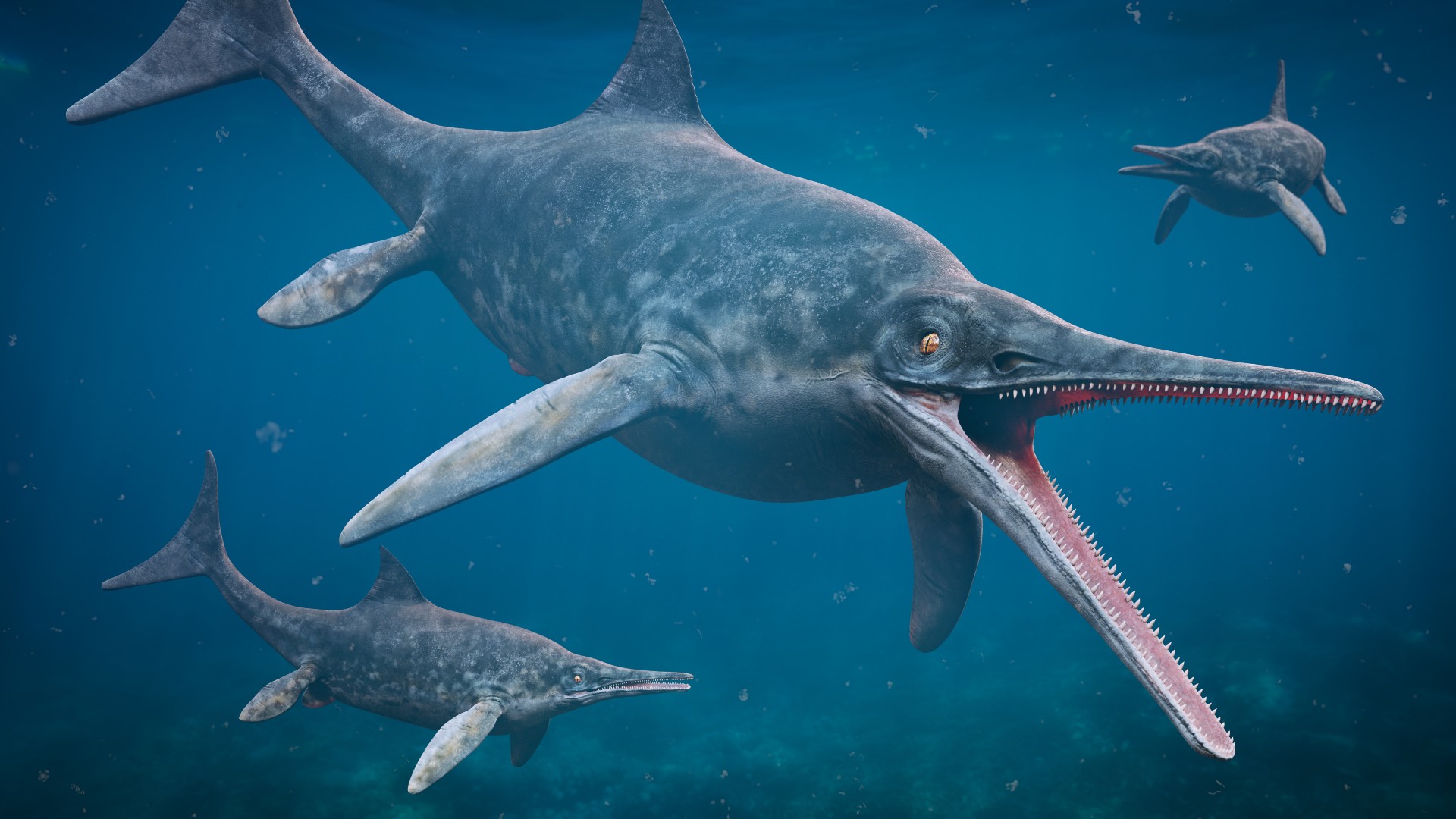
More than two hundred million years ago, long before whales sliced through the oceans and dolphins leapt across sunlit waves, another group of extraordinary marine animals ruled the seas. They moved with sleek grace through warm prehistoric waters, their bodies shaped like torpedoes, their long snouts filled with sharp teeth designed for hunting fish and squid. Their enormous eyes stared through dim depths, detecting movement in the dark waters of ancient oceans.
These creatures were the ichthyosaurs.
The name “ichthyosaur” means “fish lizard,” a name that captures both their reptilian ancestry and their fishlike appearance. Yet ichthyosaurs were neither fish nor dinosaurs. They were marine reptiles—animals that had once walked on land but had returned to the sea and evolved into masters of the ocean. In form and movement, they resembled modern dolphins so closely that many early fossil discoveries were mistaken for ancient mammals.
Ichthyosaurs were among the first great marine predators of the Mesozoic Era. They appeared not long after the greatest mass extinction in Earth’s history and survived for more than 150 million years. During that immense span of time they evolved into many shapes and sizes, ranging from dolphin-sized hunters to giants longer than modern buses.
Their story is one of adaptation, survival, and mystery—a tale written in stone along cliffs and buried beneath ancient seabeds across the world.
The Aftermath of Catastrophe
To understand ichthyosaurs, one must begin with a catastrophe that reshaped life on Earth. Around 252 million years ago, at the end of the Permian Period, the planet experienced the most devastating mass extinction known. This event, often called the Permian–Triassic extinction, wiped out the vast majority of marine species and a large portion of life on land.
Entire ecosystems collapsed. Coral reefs vanished. Trilobites, which had existed for hundreds of millions of years, disappeared forever. Oceans that had once teemed with life became strangely empty.
Yet extinction creates opportunity. In the ecological vacuum that followed, new groups of animals began to evolve and diversify. Among them were early reptiles that ventured into the seas.
From this evolutionary experimentation emerged the first ichthyosaurs during the Early Triassic Period, roughly 250 million years ago. Their ancestors were almost certainly land-dwelling reptiles, but the exact lineage remains a subject of scientific investigation.
The early ichthyosaurs were not yet the streamlined swimmers we recognize today. Their bodies were more elongated, their tails less specialized, and their limbs not fully transformed into flippers. But evolution would refine them rapidly, sculpting them into one of the most efficient marine predators the world had ever seen.
The Transformation from Land to Sea
The transition from land to ocean is one of the most dramatic transformations in the history of vertebrate life. Creatures that once walked on solid ground must adapt to a world where buoyancy replaces gravity’s constraints and water resistance demands new forms of movement.
Ichthyosaurs underwent this transformation with remarkable speed in evolutionary terms.
Their limbs gradually evolved into paddle-like flippers made of tightly packed bones that provided stability and steering. Their tails developed a powerful vertical fin that propelled them through the water. Their bodies became streamlined, reducing drag and allowing swift movement through the sea.
Perhaps most striking was their resemblance to modern dolphins. This similarity is an example of convergent evolution, a phenomenon in which unrelated groups evolve similar shapes because they face similar environmental challenges.
Dolphins are mammals, descended from land animals that returned to the sea tens of millions of years after ichthyosaurs had already disappeared. Yet both groups evolved nearly identical body plans because hydrodynamics favors certain shapes for fast swimming in open water.
The ocean, it seems, encourages efficiency—and efficiency often leads to the same solutions.
The Shape of a Perfect Marine Hunter
The mature ichthyosaur body was a masterpiece of evolutionary engineering. Its long, tapered snout housed rows of conical teeth ideal for gripping slippery prey. The skull was elongated, allowing room for powerful jaw muscles that snapped shut with speed and precision.
Behind the head, the body narrowed into a torpedo-like form designed to slice through water with minimal resistance. The dorsal fin, though rarely preserved in fossils because it was made of soft tissue, helped stabilize the animal during swimming.
The tail was perhaps the most distinctive feature. Unlike the tails of fish, which are usually symmetrical, ichthyosaur tails had a distinctive crescent shape supported by a downward bend in the vertebral column. This structure suggests powerful propulsion generated by sweeping tail movements.
Their flippers were broad and rigid, used for steering rather than propulsion. The bones inside these flippers were numerous and tightly packed, forming a strong paddle capable of controlling direction during high-speed swimming.
This combination of features made ichthyosaurs exceptionally fast and agile predators in the ocean.
Eyes of the Deep
One of the most extraordinary features of ichthyosaurs was their enormous eyes. Some species possessed eyes nearly the size of dinner plates, among the largest of any vertebrate known.
These giant eyes were surrounded by a ring of bony plates called sclerotic rings, which helped support the eyeball and maintain its shape under pressure. This structure allowed ichthyosaurs to withstand the intense pressures of deep-water environments.
Large eyes are particularly useful in low-light conditions. Many scientists believe that some ichthyosaurs hunted in deep or murky waters where sunlight barely penetrated. Their exceptional vision would have allowed them to detect prey in dim environments where other predators might struggle.
This adaptation suggests a lifestyle similar to that of modern deep-diving marine mammals such as sperm whales. The ancient seas were not only wide and vast but also layered with ecological niches—from sunlit shallows to shadowy depths—and ichthyosaurs evolved to exploit them.
Masters of the Triassic Oceans
During the Triassic Period, ichthyosaurs rapidly diversified into a variety of forms. Some species were small and slender, ideal for chasing swift fish through shallow waters. Others were larger and more robust, capable of tackling bigger prey.
The oceans of the Triassic were undergoing dramatic change. Marine ecosystems were recovering from the Permian extinction, and new groups of animals were evolving to fill vacant ecological roles.
Ammonites spiraled through the water, their shells coiling in beautiful geometric patterns. Early marine reptiles such as nothosaurs and placodonts occupied coastal environments. Coral reefs began to rebuild themselves, providing habitat for countless marine organisms.
Within this dynamic environment, ichthyosaurs rose to dominance. Their speed, vision, and predatory efficiency allowed them to thrive in open-water ecosystems.
Some species grew several meters long, while others remained relatively small. Their diversity mirrored that of modern marine mammals, ranging from fast pursuit hunters to potentially deep-diving specialists.
The Triassic seas belonged to them.
Feeding in the Ancient Oceans
The diet of ichthyosaurs varied depending on species, size, and habitat. Fossil evidence—including preserved stomach contents—reveals that many ichthyosaurs fed primarily on fish and squid-like cephalopods.
Their long jaws and sharp teeth were perfectly suited for seizing slippery prey. Some species had robust teeth capable of crushing harder-shelled animals, while others possessed more delicate teeth designed for gripping softer prey.
The presence of belemnites, extinct squid-like animals with bullet-shaped internal shells, in fossilized stomach contents provides a vivid glimpse into their feeding habits. These cephalopods were abundant in Mesozoic seas and likely formed a major part of ichthyosaur diets.
In some cases, paleontologists have discovered bite marks on bones that suggest larger ichthyosaurs may have preyed upon smaller marine reptiles. The ancient ocean was a complex food web, and ichthyosaurs were often near its top.
Their streamlined bodies allowed them to chase prey across long distances, much like modern dolphins and tuna. Speed and agility were their greatest weapons.
Birth in the Ocean
One of the most fascinating discoveries about ichthyosaurs came from exceptionally preserved fossils that revealed something extraordinary: they gave birth to live young.
This adaptation is crucial for animals that spend their entire lives in the ocean. Returning to land to lay eggs would have been difficult or impossible for fully aquatic reptiles with flipper-like limbs.
Fossils of pregnant ichthyosaurs have been found with embryos inside their bodies, sometimes even caught in the act of birth. In several specimens, the babies are positioned tail-first, suggesting that they were born this way to reduce the risk of drowning during delivery.
Live birth, known as viviparity, is also seen in modern marine mammals such as whales and dolphins. Again, evolution arrived at a similar solution for animals living permanently in the ocean.
This reproductive strategy allowed ichthyosaurs to remain fully aquatic throughout their lives, freeing them from the need to return to land.
Giants of the Jurassic Seas
As the Triassic Period gave way to the Jurassic, ichthyosaurs continued to evolve and flourish. Some species became enormous, rivaling modern whales in length.
Among the largest were members of the genus Shonisaurus, which could reach lengths exceeding fifteen meters. These giants cruised through ancient seas, their immense bodies propelled by powerful tails.
During the Jurassic Period, marine ecosystems became even more complex. New predators such as plesiosaurs and marine crocodiles appeared. Yet ichthyosaurs remained among the most successful marine reptiles.
Fossils from Jurassic deposits in Europe, North America, and Asia reveal beautifully preserved skeletons, sometimes so complete that the outlines of soft tissues such as fins and skin impressions remain visible.
These fossils allow scientists to reconstruct ichthyosaurs in remarkable detail. Skin impressions suggest that some species had smooth, scaleless skin similar to that of modern dolphins—another example of convergent evolution driven by the demands of fast swimming.
The Jurassic seas were vibrant, dangerous places filled with predators and prey locked in ancient evolutionary battles.
The Global Fossil Record
Ichthyosaur fossils have been discovered on nearly every continent, providing evidence of their widespread distribution. Their remains have been found in Europe, North America, South America, Asia, and even Antarctica.
Many of the most famous fossils come from the limestone cliffs of southern England, particularly the Jurassic Coast in Dorset. In the early 19th century, fossil hunter Mary Anning made groundbreaking discoveries there, uncovering some of the first complete ichthyosaur skeletons known to science.
Her discoveries played a crucial role in shaping early paleontology. At a time when the idea of extinction was still controversial, the strange skeletons she unearthed revealed that entire groups of animals had once existed and then vanished from Earth.
Ichthyosaur fossils are often preserved in marine sedimentary rocks that formed at the bottom of ancient seas. Over millions of years, sediments buried the remains, gradually turning them into stone.
When erosion later exposed these rocks, the fossils emerged once again, offering glimpses into a world long gone.
Competition in the Cretaceous
By the time the Cretaceous Period arrived, marine ecosystems had changed dramatically. New groups of marine reptiles, particularly mosasaurs and advanced plesiosaurs, began to dominate the oceans.
Ichthyosaurs, once among the most successful marine predators, began to decline. Their diversity decreased, and fewer species remained.
Scientists continue to debate the reasons for this decline. Some researchers suggest that changing ocean ecosystems and new competitors may have played a role. Others propose that environmental changes during the mid-Cretaceous altered marine food webs in ways that disadvantaged ichthyosaurs.
Whatever the cause, the group gradually faded from the fossil record.
Around ninety million years ago, the last ichthyosaurs disappeared. Their extinction occurred long before the famous asteroid impact that ended the age of dinosaurs sixty-six million years ago.
By the time mosasaurs ruled the seas and tyrannosaurs walked the land, the dolphin-like reptiles of the Triassic and Jurassic were already gone.
Rediscovering a Forgotten World
For millions of years after their extinction, ichthyosaurs lay buried beneath layers of rock, their bones silent witnesses to a vanished age. Their rediscovery in the early nineteenth century marked a turning point in our understanding of Earth’s history.
The first scientifically described ichthyosaur fossils astonished scholars. Their strange mixture of reptilian bones and fishlike form challenged traditional ideas about the natural world.
Gradually, as more fossils were discovered, a clearer picture emerged. These were not monsters or mythical creatures but real animals that had once thrived in ancient oceans.
Paleontologists began to piece together their anatomy, their evolutionary relationships, and their place within the broader story of life on Earth.
Each new fossil discovery added another chapter to the story.
The Legacy of Ichthyosaurs
Today, ichthyosaurs remain among the most iconic marine reptiles of the Mesozoic Era. Their dolphin-like forms capture the imagination, bridging the gap between ancient reptiles and modern marine life.
They represent one of evolution’s most striking experiments—land animals transforming into fully aquatic predators and converging upon the same body design later seen in whales and dolphins.
Their fossils remind us that the oceans we know today are only the latest version of Earth’s marine ecosystems. Before whales sang through the deep and sharks dominated open waters, other creatures ruled the seas.
Ichthyosaurs were among the earliest of these rulers.
They swam through warm Triassic oceans, chased prey through Jurassic waters, and left behind a legacy written in stone along cliffs and seabeds around the world.
In their sleek forms we glimpse the power of evolution, the adaptability of life, and the endless creativity of nature.
Though they vanished millions of years ago, the story of the ichthyosaurs continues to inspire curiosity about the deep past and the ever-changing history of life on our planet.