Long before humans walked the Earth, before cities rose and civilizations flourished, the world belonged to giants. Vast forests stretched across ancient continents, rivers wound through warm valleys, and enormous creatures roamed landscapes that today exist only in fossils and imagination. Among these giants was one of the most iconic dinosaurs ever discovered—Apatosaurus, a massive long-necked herbivore whose name once thundered through the scientific world and popular culture alike.
The story of Apatosaurus is not simply the tale of a dinosaur. It is also a story of discovery, confusion, scientific rivalry, and eventually correction. For more than a century, people believed they knew this creature under another name—Brontosaurus, the famous “thunder lizard.” But the truth behind Apatosaurus is far more fascinating than the myth.
Understanding Apatosaurus means traveling back nearly 150 million years to the Jurassic Period, a time when dinosaurs ruled the Earth and evolution produced some of the largest land animals that ever existed.
A Giant of the Jurassic World
Apatosaurus lived during the Late Jurassic Period, roughly 152 to 145 million years ago. During this era, the continents were arranged differently than today. North America was part of a massive landmass with warm climates, seasonal rainfall, and ecosystems dominated by conifer forests, ferns, cycads, and early flowering plants.
Within this lush environment, gigantic sauropod dinosaurs thrived. Apatosaurus belonged to this remarkable group—long-necked, long-tailed herbivores that could reach enormous sizes. Sauropods were among the largest animals ever to walk on land, and Apatosaurus was one of the most powerful members of this lineage.
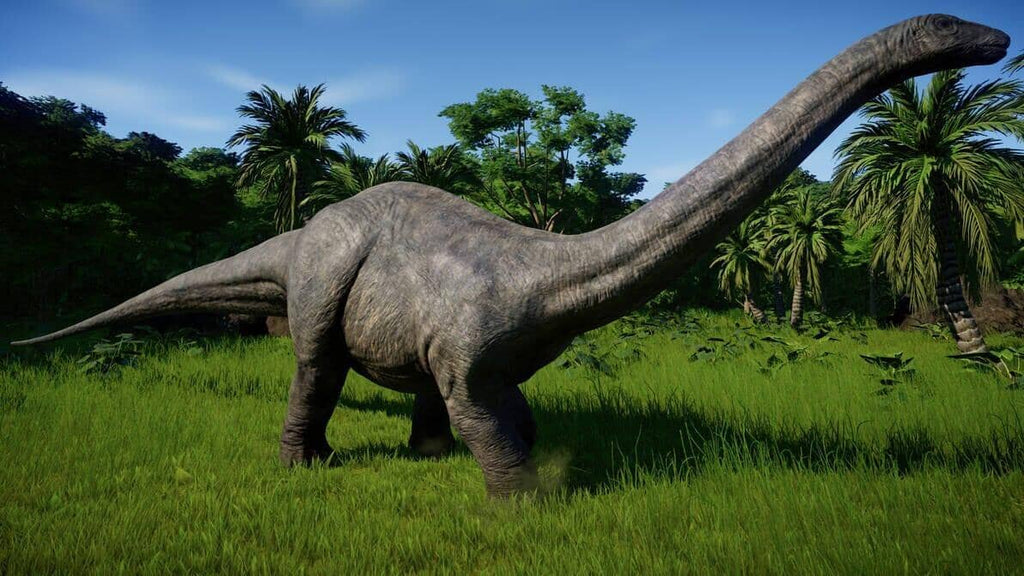
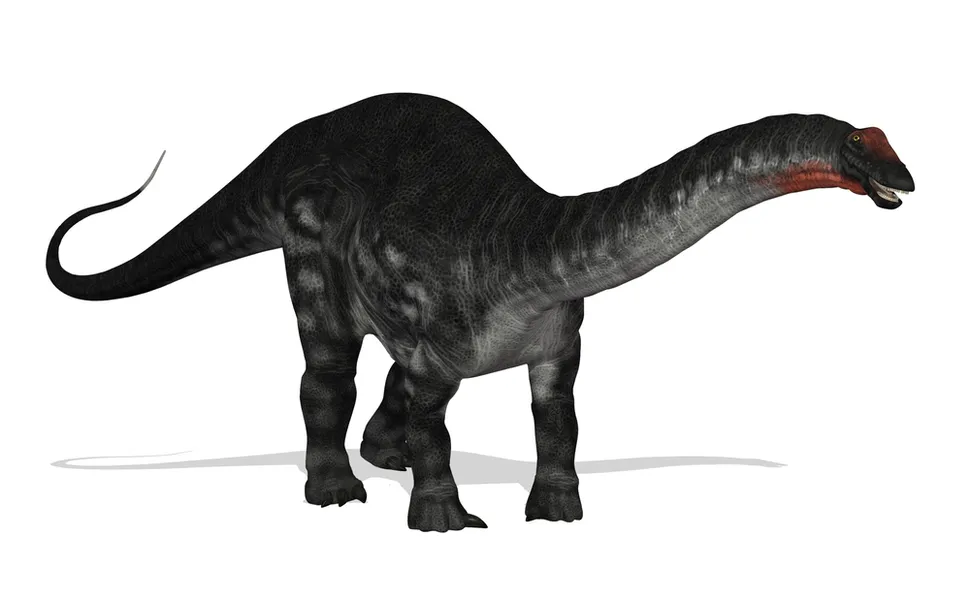
An adult Apatosaurus could grow more than 22 meters (about 72 feet) long and weigh over 20 metric tons. Its body was built like a living suspension bridge, supported by four massive pillar-like legs. Its neck stretched forward in a graceful arc, while its long tail extended behind it like a gigantic whip.
Despite its immense size, Apatosaurus was a plant eater. It spent its days browsing on vegetation, stripping leaves from tall trees and dense forests. Its long neck allowed it to reach food sources that smaller animals could not access.
When such an animal walked across the ancient ground, its footsteps must have produced vibrations that traveled through the earth. Perhaps that is why early scientists imagined it as a creature that shook the land like thunder.
The Meaning Behind the Name
The name Apatosaurus comes from Greek words meaning “deceptive lizard.” The name was chosen because early paleontologists believed its bones resembled those of another marine reptile, making them initially confusing to identify.
The dinosaur was first scientifically described in 1877 by the American paleontologist Othniel Charles Marsh during a period known as the Bone Wars—a fierce scientific rivalry that dramatically shaped the early history of dinosaur discovery.
Marsh and his rival, Edward Drinker Cope, were locked in an intense competition to discover, describe, and name as many dinosaur species as possible. Their rivalry pushed paleontology forward at a breathtaking pace but also led to rushed research, naming mistakes, and scientific confusion.
Apatosaurus became one of the most famous victims of that chaotic era.
The Birth of the “Thunder Lizard”
Just two years after naming Apatosaurus, Marsh discovered another giant dinosaur skeleton in Wyoming. Believing it represented a different genus, he named it Brontosaurus, meaning “thunder lizard.”
At the time, paleontology was still a young science. Fossils were often incomplete, and skeletons had to be reconstructed from scattered bones. Without the detailed comparative studies used today, scientists sometimes believed similar animals were entirely separate species.
Marsh’s Brontosaurus reconstruction quickly captured public imagination. Museums displayed enormous skeletons labeled “Brontosaurus,” and the name spread through books, films, and popular culture.
For generations, people grew up believing the thunder lizard was one of the most magnificent dinosaurs ever discovered.
But science, unlike mythology, is always subject to revision.
The Great Name Correction
In 1903, paleontologist Elmer Samuel Riggs carefully reexamined the fossils and concluded that Brontosaurus was not a separate genus at all. Instead, it was actually the same dinosaur Marsh had already named Apatosaurus.
According to the rules of scientific naming, the earliest valid name must take priority. Since Apatosaurus had been named first in 1877, Brontosaurus became scientifically invalid.
For scientists, the thunder lizard officially disappeared.
Yet outside academic circles, the name Brontosaurus refused to die. Museums continued displaying skeletons labeled with the famous name, and the public continued using it. In fact, the Brontosaurus identity became so deeply rooted in culture that many people still use it today.
Interestingly, modern research has revisited this issue. Some paleontologists argue that certain fossils once classified as Apatosaurus may actually represent distinct species deserving the Brontosaurus name again. The debate remains ongoing, demonstrating how scientific understanding continues to evolve.
The Physical Structure of Apatosaurus
To truly understand Apatosaurus, one must imagine its immense physical presence.
Its body was massive and barrel-shaped, supported by thick legs that resembled enormous columns. Unlike the slender limbs of many dinosaurs, sauropod legs were built for strength rather than speed. These legs had to support tens of tons of weight every day.
The neck of Apatosaurus was long but heavily built compared to other sauropods. It contained numerous vertebrae, each hollowed with air sacs that reduced weight while maintaining strength. This adaptation allowed the neck to extend forward without becoming too heavy to support.
At the back of the body stretched an incredibly long tail, which likely served several purposes. The tail acted as a counterbalance to the long neck, helping maintain stability. Some scientists believe the tail could even produce whip-like cracking sounds when swung quickly.
The skull of Apatosaurus was relatively small compared to its enormous body. Its mouth contained peg-shaped teeth designed for stripping vegetation rather than chewing. Like many herbivorous dinosaurs, it probably swallowed plant material whole and relied on its digestive system to break it down.
Some paleontologists suggest that Apatosaurus may have swallowed stones called gastroliths, which helped grind food inside the stomach.
Feeding the Giant
The daily life of Apatosaurus revolved around one essential activity: eating.
An animal weighing more than 20 tons required enormous amounts of food to survive. Apatosaurus likely spent much of its day moving slowly through forests and floodplains, consuming leaves, ferns, and other vegetation.
Its long neck allowed it to reach plants at various heights without moving its massive body constantly. It could browse low vegetation near the ground or extend its neck upward to reach taller branches.
Unlike mammals, dinosaurs did not chew their food thoroughly. Apatosaurus probably ripped leaves from branches and swallowed them whole. Inside its digestive system, microbes and stomach acids would gradually break down the tough plant fibers.
The digestive process may have taken days, but the enormous gut of a sauropod provided the necessary space for fermentation and nutrient absorption.
Movement and Behavior
Despite its enormous size, Apatosaurus was not a sluggish animal. Studies of fossilized footprints and bone structures suggest that it could move steadily across the landscape, though probably not at high speeds.
Its legs were positioned directly beneath its body, unlike the sprawling posture of reptiles such as crocodiles. This upright stance provided greater support and efficiency for carrying immense weight.
The long tail likely helped maintain balance while walking. Combined with the forward-reaching neck, it created a stable body structure capable of supporting massive proportions.
Some researchers believe Apatosaurus may have lived in groups or loose herds. Herd behavior could provide protection against predators and help individuals locate food resources.
Fossil trackways discovered in ancient rock layers sometimes show multiple sauropod footprints moving in similar directions, suggesting at least occasional group movement.
Predators of the Jurassic
Even a giant like Apatosaurus was not completely safe in the Jurassic world.
Large carnivorous dinosaurs shared its environment, including the formidable Allosaurus. Allosaurus was a powerful hunter capable of attacking large prey, though it likely targeted juveniles or weakened individuals rather than healthy adults.
A full-grown Apatosaurus would have been a challenging target for any predator. Its sheer size alone provided significant protection. Additionally, its tail could potentially serve as a defensive weapon.
Some scientists suggest the whip-like tail might have been capable of delivering powerful strikes, discouraging attackers.
Young Apatosaurus, however, were far more vulnerable. Juveniles likely faced constant danger from predators, which may explain why herd behavior could be advantageous.
The Fossil Evidence
Everything scientists know about Apatosaurus comes from fossil discoveries. These fossils are primarily found in the famous Morrison Formation, one of the richest dinosaur fossil deposits in the world.
The Morrison Formation stretches across several U.S. states, including Colorado, Utah, Wyoming, and Montana. It represents ancient floodplains and river systems where countless dinosaurs once lived.
Over millions of years, sediment buried the remains of animals that died in these environments. Minerals gradually replaced organic material, turning bones into stone while preserving their shapes.
Today, paleontologists carefully excavate these fossils, using delicate tools and detailed documentation to reconstruct ancient skeletons.
Every bone discovered adds another piece to the puzzle of Apatosaurus’ life.
Changing Ideas About Sauropods
For much of the 20th century, scientists misunderstood sauropods like Apatosaurus. Early researchers believed these dinosaurs were slow, swamp-dwelling animals that spent most of their time submerged in water.
This idea emerged partly because their enormous size seemed too heavy to support on land. Some scientists imagined sauropods using water buoyancy to support their bodies.
However, later research disproved this theory. Detailed studies of bone structure, trackways, and biomechanics showed that sauropods were fully terrestrial animals.
Their skeletons were strong enough to support their weight, and their lungs and air sacs would not function well underwater.
Modern paleontology now views Apatosaurus as a land-dwelling giant capable of moving across forests and plains.
The Evolution of Sauropods
Apatosaurus belonged to a larger family of dinosaurs known as diplodocids. These dinosaurs were characterized by long necks, elongated bodies, and extremely long tails.
Other members of this family included the famous Diplodocus, another enormous herbivore that lived in the same ecosystems.
Sauropods evolved from smaller early dinosaurs during the Triassic Period. Over millions of years, natural selection favored larger body sizes, longer necks, and specialized digestive systems capable of processing vast amounts of plant matter.
Gigantism offered several advantages. Large size protected animals from predators and allowed them to reach abundant vegetation. It also helped regulate body temperature and energy use.
By the Late Jurassic, sauropods had become the dominant herbivores in many ecosystems.
Apatosaurus in Museums and Culture
Few dinosaurs have captured the public imagination as powerfully as Apatosaurus and its famous alias, Brontosaurus.
One of the most iconic dinosaur skeletons ever displayed was mounted in 1905 at the American Museum of Natural History. The skeleton, labeled Brontosaurus at the time, became a symbol of prehistoric life.
Images of the thunder lizard soon appeared in books, educational materials, cartoons, and films. Generations of children grew up recognizing the long-necked giant.
Even after scientists corrected the name to Apatosaurus, the Brontosaurus legend remained deeply embedded in culture.
In many ways, Apatosaurus became a gateway dinosaur—an introduction to paleontology and the wonders of ancient life.
Scientific Research Today
Modern paleontology continues to study Apatosaurus using advanced technologies unimaginable in the 19th century.
CT scans allow scientists to examine the internal structure of fossil bones without damaging them. Computer models simulate how dinosaurs moved, breathed, and balanced their massive bodies.
Researchers analyze microscopic bone tissue to estimate growth rates and age. Chemical analysis can reveal clues about diet and environmental conditions.
Through these techniques, scientists continue refining our understanding of how Apatosaurus lived, grew, and interacted with its environment.
Every new discovery adds depth to the story.
The Legacy of the Thunder Lizard
The story of Apatosaurus illustrates how science evolves. What began as a naming mistake during the Bone Wars eventually became one of the most famous episodes in paleontological history.
More importantly, Apatosaurus reminds us that knowledge is not fixed. Scientific understanding grows through questioning, evidence, and correction.
The thunder lizard may have changed names, but its significance remains enormous. It represents a time when Earth was ruled by giants and when evolution produced creatures beyond human imagination.
Through fossils, museums, and research, Apatosaurus continues to inspire curiosity about the deep past of our planet.
A Window into a Lost World
When we look at the skeleton of Apatosaurus in a museum hall, we are not merely seeing old bones. We are witnessing a fragment of a vanished world.
These fossils connect us to a time nearly 150 million years ago, when towering dinosaurs walked beneath unfamiliar skies and ancient forests stretched across prehistoric continents.
Apatosaurus once moved through those forests with slow, powerful steps, feeding on leaves and shaping the ecosystems around it. Its life was part of a vast natural story that eventually led, through countless evolutionary paths, to the world we inhabit today.
The thunder of its footsteps faded long ago, but its legacy endures—in stone, in science, and in the human imagination.
And in that enduring presence, Apatosaurus remains exactly what it has always been: one of the most magnificent giants the Earth has ever known.