More than seventy million years ago, in a lush landscape that is now part of southern South America, a colossal creature walked slowly across floodplains and forests. Each step shook the ground. Trees bent as it passed. Rivers reflected the enormous silhouette of a living mountain moving across the land. This creature was not a myth or a legend. It was a real animal that once lived on Earth—one of the largest dinosaurs ever discovered.
Its name was Dreadnoughtus.
The name itself carries a powerful meaning. Derived from the word “dreadnought,” which once described enormous armored battleships that feared nothing in battle, the dinosaur’s name essentially means “fear nothing.” It is an appropriate title for a creature so massive that almost no predator on Earth could realistically challenge it. When paleontologists first studied its bones, they realized they were looking at one of the most extraordinary animals that ever lived.
But Dreadnoughtus is more than just a giant dinosaur. It represents a remarkable story of discovery, biology, and evolution. Its fossils reveal clues about how gigantic dinosaurs lived, how they grew, and how they dominated ancient ecosystems. Understanding this animal helps scientists understand the limits of life on land, the mysteries of dinosaur growth, and the incredible diversity that once filled Earth’s prehistoric world.
The Discovery of a Giant
The story of Dreadnoughtus begins in Patagonia, a region in southern Argentina known for its windswept plains and rich fossil deposits. For decades, paleontologists had suspected that this region held the remains of enormous dinosaurs. Layers of rock from the Late Cretaceous period preserved the ancient environments where these animals once lived.
In the early 2000s, a team led by paleontologist Kenneth Lacovara began exploring these rock formations. Their goal was to uncover fossils that might shed light on the massive long-necked dinosaurs known as sauropods. What they eventually found exceeded all expectations.
Buried in the rock were enormous bones—vertebrae the size of barrels, ribs as long as small trees, and limb bones so massive they required heavy equipment to move. Excavating the fossils was not easy. The site was remote, and the bones were deeply embedded in stone. Over several years, the team carefully removed tons of rock and transported the fossils back to laboratories for study.
When the skeleton was finally assembled and analyzed, scientists realized they had discovered something extraordinary. The fossilized remains represented one of the most complete giant titanosaur skeletons ever found. The dinosaur was given the name Dreadnoughtus schrani, honoring the giant size of the animal and the support of a fossil enthusiast who helped fund the research.
The discovery captured the imagination of scientists and the public alike. It offered a rare glimpse into the life of one of the largest animals to ever walk the Earth.
A Member of the Titanosaur Family
Dreadnoughtus belonged to a group of dinosaurs known as titanosaurs. These animals were part of the broader sauropod lineage—the famous long-necked, long-tailed dinosaurs that included giants such as Diplodocus and Brachiosaurus. Titanosaurs lived during the later part of the dinosaur age and spread across many continents.
Titanosaurs were among the last surviving sauropods before the mass extinction that ended the age of dinosaurs. They evolved unique features that distinguished them from earlier sauropods. Some had armor-like plates embedded in their skin. Others had unusual body proportions or specialized adaptations for feeding.
What made titanosaurs remarkable was their incredible size. Many species were enormous, but Dreadnoughtus stood out even among giants. Its body structure suggests a creature that was both massive and powerful, capable of supporting extraordinary weight while still moving across ancient landscapes.
The study of titanosaurs is challenging because their fossils are often incomplete. Many species are known only from fragments of bone. That is why the discovery of a relatively complete skeleton like Dreadnoughtus is so important. It allows scientists to reconstruct the animal’s body with far greater confidence than is usually possible.
The Size of a Living Mountain
Trying to imagine the size of Dreadnoughtus is difficult because there is nothing like it alive today. The largest land animals in the modern world are elephants, but even the biggest elephant would appear small next to this dinosaur.
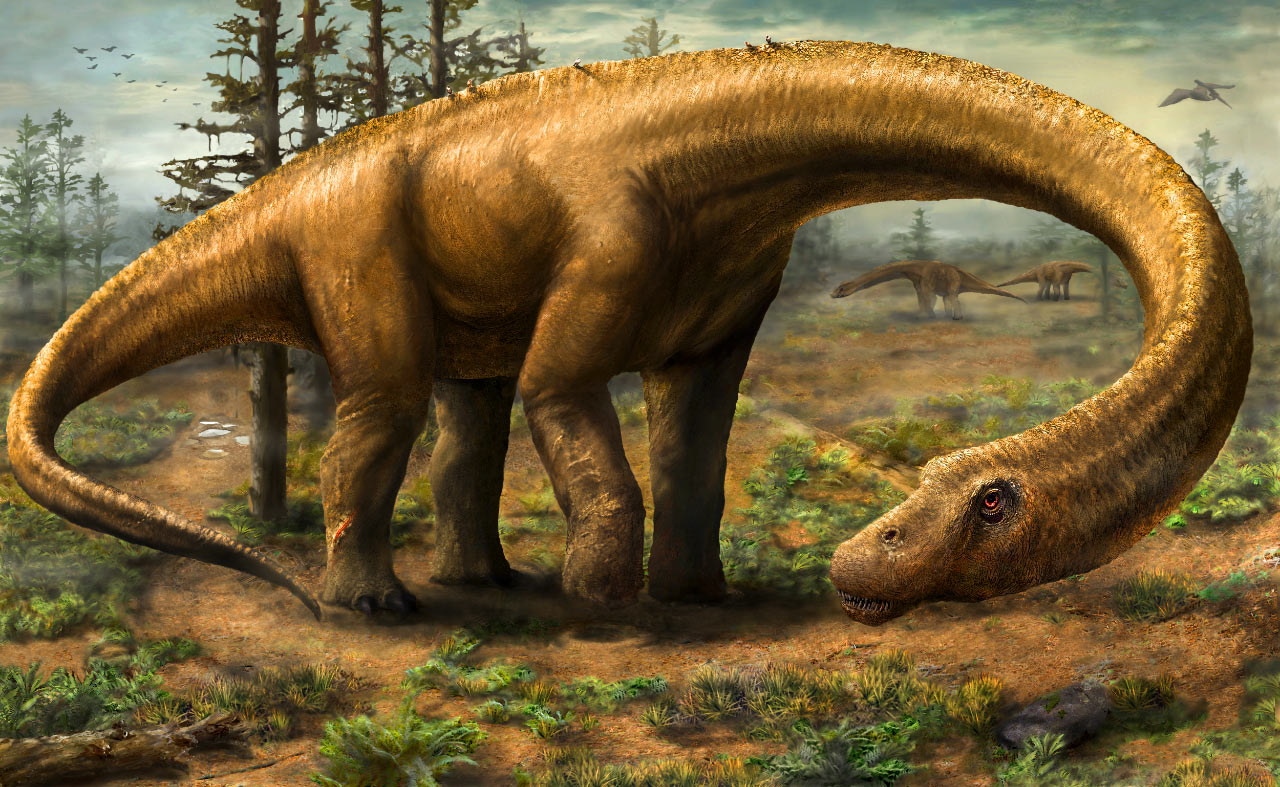
Estimates suggest that Dreadnoughtus measured roughly twenty-six meters in length, which is about eighty-five feet. Its weight may have reached around sixty tons, though scientists continue to debate the exact figure. To put that into perspective, this is roughly the weight of several large African elephants combined.
Its neck alone stretched many meters, allowing it to reach high vegetation without needing to move its enormous body constantly. Its tail extended far behind it, acting as a counterbalance to the long neck. Together, these features created a body shape that is instantly recognizable as a sauropod.
The limbs of Dreadnoughtus were pillars of bone designed to support tremendous weight. The femur—the thigh bone—was longer than the height of many adult humans. These bones were incredibly thick and strong, reflecting the mechanical challenges of supporting such a gigantic animal on land.
Yet despite its immense size, Dreadnoughtus was not a sluggish creature. Its anatomy suggests that it could move steadily across its environment, using powerful muscles and a balanced body structure to maintain stability.
A Herbivore Giant
Despite its intimidating size, Dreadnoughtus was not a predator. Like all sauropods, it was a herbivore. Its diet consisted primarily of plants—likely including ferns, conifers, and flowering plants that grew during the Late Cretaceous period.
Its long neck was a crucial adaptation for feeding. Instead of walking constantly in search of food, the dinosaur could simply sweep its neck across wide areas, pulling leaves from trees and shrubs. This feeding strategy allowed it to gather large amounts of vegetation with minimal movement.
The teeth of Dreadnoughtus were relatively simple compared to the teeth of carnivorous dinosaurs. They were shaped for stripping leaves rather than chewing food thoroughly. After swallowing plant material, the dinosaur likely relied on its digestive system to break down the tough fibers.
Some scientists believe sauropods may have swallowed stones called gastroliths. These stones would remain in the stomach and help grind plant material, somewhat like the gizzard stones used by modern birds. Whether Dreadnoughtus used this strategy remains uncertain, but it is a possibility based on comparisons with other dinosaurs.
Because such a massive animal required enormous amounts of food, Dreadnoughtus probably spent much of its time feeding. Vast floodplains filled with vegetation would have been essential to support creatures of this size.
Growth on an Extraordinary Scale
One of the most fascinating aspects of Dreadnoughtus is what its bones reveal about growth. When scientists examined the microscopic structure of its bones, they discovered something surprising. The animal appeared to still be growing at the time of its death.
This means the enormous dinosaur preserved in the fossil record may not have even reached its full adult size. The idea that such a gigantic creature was still growing challenges our understanding of how dinosaurs developed.
Sauropods are believed to have grown rapidly compared to many modern animals. Starting as small hatchlings, they could increase their body size dramatically over time. Rapid growth would have helped young dinosaurs escape predators quickly, as larger body size offered greater protection.
Studying growth patterns in dinosaurs helps scientists understand how such massive animals could exist on land. The biology required to support this kind of growth is extraordinary and may differ significantly from the growth patterns seen in modern reptiles or mammals.
The Environment of Ancient Patagonia
During the Late Cretaceous period, the region that is now Patagonia looked very different from the dry landscapes seen today. Instead of windswept plains, the area contained rivers, forests, and wetlands rich with life.
The climate was warmer, and vegetation flourished. Ferns, flowering plants, and conifers formed dense plant communities that could support large herbivores. In this environment, Dreadnoughtus shared its world with many other creatures.
Predatory dinosaurs likely lived nearby, though attacking a fully grown Dreadnoughtus would have been extremely dangerous. Smaller dinosaurs, early birds, reptiles, and mammals also inhabited the ecosystem. Insects buzzed through the air, and ancient rivers carried sediment across the landscape.
The presence of such a massive herbivore would have influenced the entire ecosystem. By consuming large quantities of plants and moving through forests, Dreadnoughtus may have shaped the environment around it, much like elephants influence ecosystems today.
Defense Through Size
The name Dreadnoughtus suggests fearlessness, but the animal did not need aggression to survive. Its greatest defense was simply its size.
A fully grown Dreadnoughtus would have been extraordinarily difficult for predators to attack. Even large carnivorous dinosaurs would likely avoid confronting such a massive animal. The risk of injury would have been too high.
Its long tail may also have served as a defensive weapon. If swung with enough force, the tail could potentially injure or deter predators. Combined with the dinosaur’s sheer mass and height, this made it a formidable presence in its environment.
Young individuals would have been more vulnerable, and they may have relied on speed, group behavior, or hiding in vegetation to survive until they reached safer sizes.
Fossils as Windows Into the Past
The fossils of Dreadnoughtus provide scientists with a rare opportunity to study a giant dinosaur in detail. Because so much of the skeleton was preserved, researchers can analyze its anatomy with remarkable precision.
Digital scans of the bones allow scientists to reconstruct the dinosaur in three dimensions. Computer models help estimate its weight, posture, and movement. These techniques are transforming paleontology, turning fossils into dynamic sources of information about ancient life.
Each bone tells part of a story. The shape of the vertebrae reveals how the neck and tail moved. The structure of the limbs shows how the dinosaur supported its weight. Even tiny microscopic patterns inside the bones reveal how quickly the animal grew.
In this way, fossils are more than just stone remnants of ancient creatures. They are records of life itself, waiting for careful study to unlock their secrets.
The Legacy of Giants
Dreadnoughtus represents one of the greatest examples of evolutionary success in Earth’s history. It shows that life can achieve astonishing sizes and adapt to environments in ways that seem almost unbelievable.
The study of giant dinosaurs also raises fascinating questions about the limits of biology. How large can land animals become? What anatomical and physiological systems are required to support such size? Why did these giants disappear?
While the mass extinction at the end of the Cretaceous period ended the age of dinosaurs, their legacy continues through modern birds and through the fossils that reveal their past.
A Symbol of the Age of Dinosaurs
When people imagine the age of dinosaurs, they often picture enormous long-necked creatures walking slowly across prehistoric landscapes. Dreadnoughtus embodies that image perfectly.
It reminds us that Earth’s history is far older and more dramatic than human experience alone suggests. Entire worlds existed long before our species appeared—worlds filled with creatures of astonishing scale and diversity.
Studying these ancient animals is not just about curiosity. It helps us understand evolution, ecosystems, and the deep history of life on our planet.
The Continuing Mystery
Even with the remarkable fossils of Dreadnoughtus, many questions remain unanswered. Scientists continue to debate its exact weight, posture, and lifestyle. New discoveries may reveal related species or provide further insight into titanosaur biology.
Each new fossil discovery has the potential to reshape our understanding of the dinosaur world. What seems certain today may change tomorrow as new evidence emerges.
That is the nature of science. Knowledge grows gradually, built on careful observation and constant questioning.
The Dinosaur That Feared Nothing
In the end, Dreadnoughtus stands as a symbol of prehistoric power and natural wonder. It was not a monster from fiction but a real animal that lived, grew, and walked across ancient Earth.
Its immense body, towering neck, and powerful limbs represent one of evolution’s most spectacular achievements. The name “fear nothing” captures the essence of a creature so large and so dominant that few threats could challenge it.
Yet even giants are part of nature’s story, shaped by the same processes that shape all living things. The rise and fall of Dreadnoughtus remind us that life on Earth is constantly changing, evolving, and adapting.
And through the study of fossils, we can still hear the echoes of those distant footsteps—giant steps that once shook the ground in a world long vanished, but never truly forgotten.