Millions of years ago, long before cities rose and civilizations flourished, the landscapes of the Americas were home to creatures that today seem almost mythical. Among them walked an animal so massive, so unusual in appearance, that early scientists struggled to believe it had ever existed. Imagine a sloth—but not the quiet tree-dweller lazily hanging from rainforest branches. Imagine instead a towering, shaggy beast that could stand as tall as an elephant when upright, armed with powerful claws and built like a living fortress. This was Megatherium, one of the most extraordinary mammals to ever roam the Earth.
The name Megatherium means “great beast,” and the title fits perfectly. This enormous ground sloth lived during the Ice Age and dominated much of South America’s prehistoric ecosystems. Its immense body, immense strength, and slow but deliberate movements made it both an ecological giant and a symbol of a lost world. Though extinct today, Megatherium continues to fascinate scientists, historians, and anyone captivated by the strange creatures of the past.
The story of Megatherium is not only about a gigantic animal. It is also about scientific discovery, ancient ecosystems, dramatic climate shifts, and the mysteries surrounding the extinction of the Ice Age giants. Through fossil evidence and careful research, paleontologists have reconstructed the life of this remarkable creature, revealing a world far different from our own.
The Discovery That Shocked the Scientific World
The scientific history of Megatherium begins in the late eighteenth century, during a time when the idea of extinct animals was still controversial. Fossils had been discovered before, but many scholars believed they belonged to animals still living somewhere in unexplored parts of the world.
Everything changed when large fossil bones were discovered in South America and eventually studied by the Spanish naturalist Juan Bautista Bru. In 1788, he produced one of the first scientific descriptions and skeletal reconstructions of Megatherium based on fossils found in Argentina. The bones were enormous—far larger than any known sloth.
Soon afterward, the famous French naturalist Georges Cuvier examined these fossils and recognized their significance. Cuvier concluded that the bones belonged to a species that no longer existed, helping establish the concept of extinction in modern science.
At the time, the idea that entire species could vanish from the Earth was revolutionary. Megatherium became one of the earliest examples proving that the natural world had changed dramatically over time.
A Giant Among Mammals
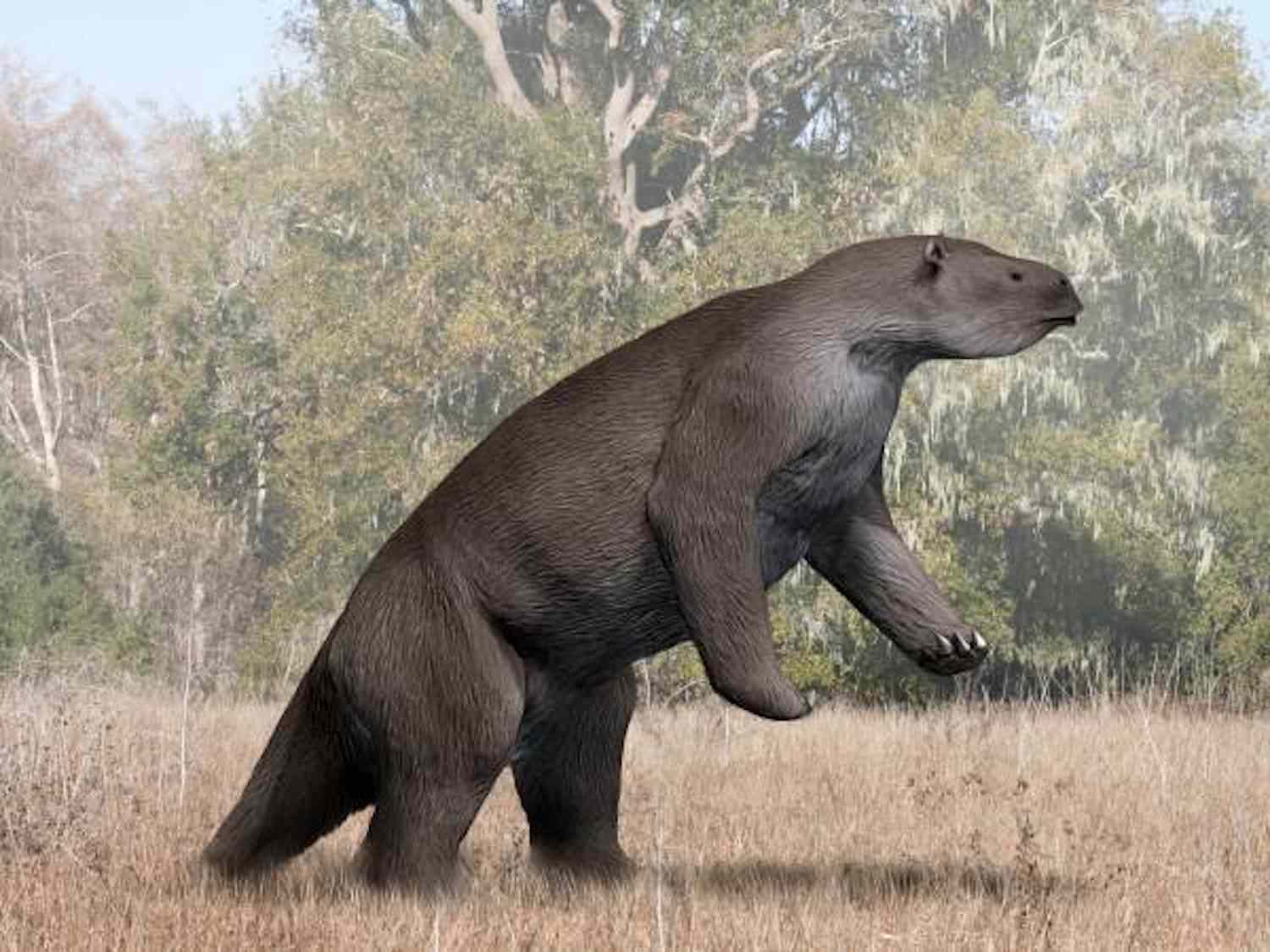
Megatherium was truly enormous. The largest individuals could reach about six meters in length from head to tail and weigh several tons. When standing on its hind legs, it could reach heights comparable to a modern elephant.
Unlike the small tree sloths that live today, Megatherium was built for life on the ground. Its body was massive and muscular, supported by thick limbs designed to carry great weight. Its bones were extremely dense, giving the animal both stability and protection.
The skull of Megatherium was long and relatively narrow, with teeth adapted for grinding tough vegetation. Unlike many mammals, it lacked sharp incisors or canine teeth. Instead, it possessed rows of peg-like molars that slowly wore down as the animal chewed plants.
Its tail was another remarkable feature. Thick and powerful, it functioned almost like a third leg. When Megatherium stood upright, it could balance on its hind legs and tail, forming a stable tripod posture. This position allowed it to reach branches and leaves far above ground level.
But perhaps the most striking feature of Megatherium was its claws. These enormous curved claws, sometimes more than thirty centimeters long, were attached to powerful forelimbs. Though intimidating in appearance, they were primarily tools for feeding and defense rather than weapons for hunting.
Life in the Ancient Landscapes of South America
Megatherium lived during the Pleistocene epoch, a period spanning from about 2.6 million years ago until roughly 11,700 years ago. This was the age of Ice Age megafauna, when giant mammals roamed many parts of the world.
South America during this time was a dynamic and diverse environment. Grasslands stretched across vast plains, while forests and shrublands provided rich vegetation. Rivers and wetlands supported thriving ecosystems.
Megatherium was one of the dominant herbivores in this landscape. It likely spent much of its time moving slowly across open areas, feeding on leaves, branches, shrubs, and possibly roots.
The size of Megatherium gave it several advantages. Few predators could challenge such a massive animal. Adult individuals were probably safe from most attacks, though young sloths may have been vulnerable to large carnivores.
The presence of Megatherium also shaped the environment itself. By feeding on vegetation and possibly knocking down trees, these giant sloths helped influence plant communities. In this way, they functioned as ecosystem engineers, altering the landscape around them.
The Evolution of Ground Sloths
Megatherium belonged to a larger group of animals known as ground sloths. Unlike modern sloths, which are small and arboreal, ground sloths evolved to live on land and grow to enormous sizes.
These animals were part of the superorder Xenarthra, a group of mammals that also includes anteaters and armadillos. Xenarthrans are unique in many ways, possessing specialized skeletal structures that give their spines extra stability.
Ground sloths first appeared in South America tens of millions of years ago. For much of that time, South America was an isolated continent, allowing its wildlife to evolve in unusual ways. Giant herbivores like Megatherium developed in the absence of large grazing mammals such as horses or elephants.
When the Isthmus of Panama formed around three million years ago, North and South America became connected. This event, known as the Great American Biotic Interchange, allowed animals from both continents to migrate.
Some ground sloths traveled northward into North America. Fossils of related species have been found as far north as the southern United States. However, Megatherium itself remained primarily in South America.
A Body Built for Strength
The anatomy of Megatherium reveals an animal designed for power rather than speed. Its limbs were thick and muscular, capable of supporting tremendous weight. The forelimbs were especially strong, suggesting they played an important role in feeding behavior.
The claws likely allowed Megatherium to pull branches toward its mouth or strip bark from trees. Some scientists believe the animal could even topple small trees to access leaves.
The structure of its hips and tail suggests that standing upright was a common posture. In this position, Megatherium could reach vegetation several meters above the ground, expanding its feeding range.
Its skin may also have provided protection. Some studies suggest that ground sloths possessed small bony deposits within their skin, known as osteoderms, similar to those found in armadillos. These structures would have added an extra layer of defense against predators.
Despite its size, Megatherium was likely a slow-moving animal. But slowness was not necessarily a disadvantage. Its sheer mass made it difficult to attack, and its claws could deter even determined predators.
What Did Megatherium Eat?
Megatherium was a herbivore, meaning its diet consisted entirely of plants. Fossil teeth and jaw structures indicate that it specialized in consuming tough vegetation.
The grinding molars of Megatherium were well suited for crushing leaves and stems. Unlike animals that chew sideways, ground sloths likely chewed in a vertical motion, grinding plant matter between their teeth.
The ability to stand upright allowed Megatherium to browse vegetation beyond the reach of most herbivores. This feeding strategy may have been similar to that of modern giraffes or elephants, though Megatherium used its claws rather than a long neck or trunk to gather food.
Its digestive system was probably highly specialized as well. Like many herbivores, it may have relied on microbial fermentation to break down cellulose in plants. This process would have allowed Megatherium to extract nutrients from tough vegetation that other animals could not easily digest.
Megatherium and Its Predators
Although adult Megatherium were enormous, they did not live entirely without threats. The Pleistocene landscapes of South America were home to powerful predators.
One of the most formidable was Smilodon, often known as the saber-toothed cat. With its long canine teeth and muscular build, Smilodon was capable of hunting large prey.
Another predator was Arctotherium, a massive bear that may have competed with other carnivores for food.
While these predators were formidable, attacking a fully grown Megatherium would have been extremely dangerous. Its powerful claws and enormous strength could deliver devastating blows.
Young individuals or weakened animals may have been more vulnerable, but adult Megatherium were likely among the safest animals in their environment.
The Ice Age World
Megatherium lived during a time when Earth’s climate was dramatically different from today. The Pleistocene epoch was characterized by repeated glacial cycles, with massive ice sheets advancing and retreating across the planet.
These climate changes affected ecosystems around the world. Grasslands expanded and contracted, forests shifted, and animals had to adapt to new conditions.
Despite the name “Ice Age,” many regions where Megatherium lived were not covered in ice. Instead, they experienced cooler and sometimes drier climates than today.
Megatherium thrived in these environments for hundreds of thousands of years, demonstrating its ability to adapt to changing conditions.
Encounters With Early Humans
One of the most intriguing aspects of Megatherium’s story is its possible interaction with early humans. Archaeological evidence suggests that humans arrived in the Americas near the end of the Pleistocene epoch.
As human populations spread across the continents, they encountered many large animals that had never before faced human hunters.
Some fossil sites indicate that humans may have hunted or scavenged giant ground sloths. Cut marks on bones and associated stone tools suggest that these animals sometimes became part of the human diet.
Whether human hunting played a major role in the extinction of Megatherium remains debated among scientists. However, the timing of human expansion and megafaunal extinction has led many researchers to consider the possibility.
The Mystery of Extinction
Around 10,000 to 12,000 years ago, Megatherium disappeared from the fossil record. This extinction occurred during a broader wave of megafaunal losses across the Americas.
Many large animals vanished during this time, including mammoths, giant armadillos, and saber-toothed cats.
Several explanations have been proposed for this extinction event. Climate change may have altered habitats and food sources, making survival more difficult for large herbivores.
Human hunting may also have contributed, especially if slow-reproducing animals like Megatherium could not recover from sustained hunting pressure.
Most scientists believe that a combination of environmental change and human impact likely caused the extinction of many Ice Age giants.
Megatherium in Culture and Imagination
The discovery of Megatherium fossils captured the imagination of scientists and the public alike. Early reconstructions of the animal appeared in museums and scientific publications across Europe.
These fossils helped inspire new ideas about Earth’s history and the evolution of life. They demonstrated that the world had once been populated by creatures very different from those living today.
Megatherium has since appeared in books, documentaries, and educational displays around the world. Its immense size and unusual appearance make it one of the most memorable animals of the prehistoric past.
For many people, it represents the wonder of paleontology—the ability to reconstruct entire worlds from fragments of bone buried in ancient sediments.
Reconstructing the Life of a Giant
Modern paleontology continues to reveal new insights into Megatherium. Advances in technology allow scientists to analyze fossils in greater detail than ever before.
Computer modeling helps researchers understand how the animal moved and balanced its enormous body. Isotopic analysis of fossil teeth can reveal information about diet and environment.
Each new discovery adds another piece to the puzzle, helping scientists better understand the life of this extraordinary creature.
Although Megatherium has been extinct for thousands of years, its fossils still speak. They tell stories of ancient landscapes, evolutionary innovation, and the complex interplay between animals and their environments.
A Window Into the Lost World of Giants
Megatherium stands as one of the most iconic animals of the Ice Age. It reminds us that Earth’s history is filled with astonishing creatures that once dominated ecosystems but are now gone.
Studying these animals is not merely an exercise in curiosity. It helps scientists understand how ecosystems function, how species adapt to environmental change, and how extinction events reshape life on Earth.
In a time when modern species face environmental pressures of their own, the story of Megatherium carries an important message. The natural world is dynamic, fragile, and constantly changing.
The giant ground sloth may have vanished, but its legacy endures—in museum halls, scientific research, and the enduring human fascination with the deep past.
Megatherium was more than just a giant sloth. It was a living monument to the power of evolution, a towering presence in ancient ecosystems, and a reminder that the history of life on Earth is far richer and stranger than we often imagine.