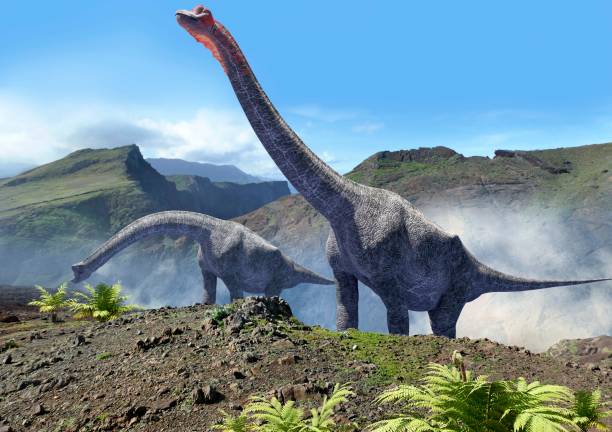
Few creatures from Earth’s deep past capture the imagination as powerfully as Brachiosaurus. Even among dinosaurs—animals already famous for their extraordinary size—Brachiosaurus stands apart. It is one of the most recognizable prehistoric animals ever discovered, often depicted towering above forests, slowly sweeping its long neck across treetops like a living crane.
To many people, Brachiosaurus represents the ultimate dinosaur: enormous, mysterious, and almost otherworldly. Yet behind its familiar image lies a fascinating scientific story. Every bone, every fossil, every reconstruction reveals something remarkable about how life once evolved on our planet.
Brachiosaurus lived during the Late Jurassic period, roughly 154 to 150 million years ago, long before humans or even mammals became dominant on Earth. Its world was a lush landscape of ferns, conifers, and primitive flowering plants, populated by predators like Allosaurus and other gigantic plant-eating dinosaurs.
But Brachiosaurus was no ordinary herbivore. Its anatomy, lifestyle, and evolutionary adaptations make it one of the most extraordinary animals that has ever lived.
Below are ten mind-blowing facts about Brachiosaurus that reveal why this towering giant continues to fascinate scientists and dinosaur lovers alike.
1. Brachiosaurus Was One of the Tallest Dinosaurs Ever
Brachiosaurus is often described as one of the tallest dinosaurs that ever walked the Earth. While some dinosaurs may have been longer, very few matched its incredible vertical reach.
The name “Brachiosaurus” means “arm lizard,” a reference to its unusually long front limbs. Unlike most dinosaurs, whose back legs were longer than their front legs, Brachiosaurus had forelimbs significantly longer than its hind limbs. This gave its body a distinctive sloping posture, with shoulders higher than hips.
This unique body structure allowed Brachiosaurus to hold its neck high above the ground. When fully extended, the animal could reach heights of around 12 to 13 meters, roughly the height of a four-story building. Its head alone may have risen higher than modern giraffes.
This towering height allowed Brachiosaurus to browse vegetation that few other animals could reach. It likely fed on the tops of conifer trees, cycads, and other tall plants that dominated Jurassic forests.
In ecosystems where food competition was intense, height became an advantage. By feeding where other herbivores could not, Brachiosaurus occupied a unique ecological niche.
Imagine standing beneath such a creature. Its head would loom far above the treetops, slowly moving as it searched for fresh leaves. The scale of this animal is difficult to fully grasp. Even its shoulder height alone exceeded that of most large mammals alive today.
2. Its Front Legs Were Longer Than Its Back Legs
One of the most distinctive features of Brachiosaurus is the unusual proportion of its limbs. Most dinosaurs, including other long-necked sauropods, had hind legs longer than their front legs. Brachiosaurus reversed this pattern.
Its front legs were remarkably long and powerful, creating a body posture that sloped downward toward the tail. This configuration raised its shoulders high above the ground and allowed its neck to extend upward efficiently.
This skeletal design had important functional advantages. With a higher body position, Brachiosaurus could reach tall vegetation without needing to raise its neck excessively or rear up on its hind legs. It was essentially built for vertical feeding.
The long forelimbs also supported its immense weight. Sauropods were among the largest land animals ever to exist, and their skeletons had to balance strength with efficiency. Brachiosaurus evolved strong limb bones capable of carrying enormous mass while maintaining mobility.
The limb structure also influenced the dinosaur’s gait. Brachiosaurus likely moved with a slow, steady walk, supported by column-like legs that functioned somewhat like the legs of modern elephants.
Every step would have been deliberate. The ground beneath its feet might have trembled as this colossal animal moved through ancient forests.
3. Brachiosaurus Could Weigh More Than 50 Tons
Size alone does not capture the full magnitude of Brachiosaurus. Its mass was equally astonishing.
Estimates vary depending on the specific specimen and reconstruction, but many scientists believe that Brachiosaurus weighed between 35 and 50 metric tons. Some estimates suggest even greater weights.
To put this into perspective, that is roughly equivalent to eight to ten adult African elephants combined.
Supporting such enormous mass required extraordinary biological adaptations. The bones of Brachiosaurus were massive yet relatively lightweight inside. Like many sauropods, its bones contained air spaces connected to the respiratory system, similar to the air sacs found in modern birds.
This system reduced the weight of the skeleton while maintaining structural strength.
Additionally, Brachiosaurus had a highly efficient digestive system capable of processing enormous amounts of plant material. Large herbivores today, such as elephants and giraffes, must consume vast quantities of vegetation daily. Brachiosaurus likely needed hundreds of kilograms of plant matter each day to sustain its massive body.
Its immense size also offered protection. Few predators could threaten a fully grown Brachiosaurus. Even the largest carnivorous dinosaurs would have struggled to attack such a giant.
4. It Lived During the Late Jurassic Period
Brachiosaurus lived approximately 154 to 150 million years ago during the Late Jurassic period. At that time, the continents were arranged very differently than they are today.
Much of the land was part of the supercontinent Pangaea, which was gradually breaking apart. Warm climates dominated the planet, and large regions were covered in dense forests.
North America, where Brachiosaurus fossils have been discovered, was home to a diverse dinosaur ecosystem. Other herbivores included Stegosaurus and Diplodocus, while predators like Allosaurus hunted across the landscape.
Rivers, floodplains, and forested valleys likely provided ideal habitats for large herbivores. These environments supported abundant vegetation, essential for feeding animals as large as Brachiosaurus.
The Jurassic world was vibrant and dynamic. Giant insects buzzed through humid air. Early birds were beginning to evolve. Massive dinosaurs dominated the land.
Within this ecosystem, Brachiosaurus was one of the most impressive giants.
5. Its Neck Was an Evolutionary Marvel
The neck of Brachiosaurus is one of its most iconic features. Stretching several meters long, it allowed the animal to access food high above the ground.
But building such a long neck is not as simple as elongating bones. Evolution had to solve several biological challenges.
First, the neck had to be strong enough to support its own weight while remaining flexible. The vertebrae of Brachiosaurus were elongated and contained internal air cavities, reducing their mass without sacrificing strength.
Second, the neck required powerful muscles and ligaments to control movement. Despite its length, the neck needed to move efficiently to allow feeding in different directions.
Third, blood circulation posed a major challenge. Pumping blood from the heart to the brain across such height differences would require significant pressure. Scientists debate how exactly sauropods managed this, but their cardiovascular systems must have been extraordinarily powerful.
The neck of Brachiosaurus represents one of the most remarkable structural achievements in vertebrate evolution.
6. Brachiosaurus Had an Unusually Small Head
Despite its enormous body, Brachiosaurus had a surprisingly small head.
This might seem strange at first, but it actually makes perfect sense from an evolutionary standpoint. A large head would have added extra weight at the end of the long neck, making it harder to move and support.
Instead, Brachiosaurus evolved a relatively lightweight skull. Its teeth were spoon-shaped and adapted for stripping leaves from branches rather than chewing them extensively.
Unlike mammals, dinosaurs such as Brachiosaurus did not chew their food thoroughly. Instead, they swallowed plant material and relied on their digestive systems to break it down.
Some scientists believe that sauropods swallowed stones known as gastroliths. These stones may have helped grind plant matter inside the stomach, similar to the way birds use gizzards today.
The small head was a clever solution that allowed Brachiosaurus to maintain an extremely long neck without excessive strain.
7. It Probably Lived in Herds
Although direct fossil evidence of Brachiosaurus herds is limited, many scientists believe that large sauropods may have lived in social groups.
Herd living offers several advantages. It provides protection against predators, allows individuals to share information about food sources, and helps care for young animals.
Tracks left by sauropods sometimes show multiple individuals moving together in the same direction. While not all trackways belong specifically to Brachiosaurus, they suggest that at least some giant herbivores traveled in groups.
Imagine a herd of Brachiosaurus moving slowly across a Jurassic floodplain. Dozens of towering animals stretching their necks toward treetops, their footsteps shaking the ground, their shadows stretching across ancient forests.
Such a scene would have been one of the most impressive spectacles in Earth’s prehistoric history.
8. Brachiosaurus Grew Extremely Fast
To reach such enormous size, Brachiosaurus had to grow rapidly.
Studies of dinosaur bone structure show growth rings similar to those found in trees. These rings indicate that many large dinosaurs experienced rapid growth during their early years.
Young Brachiosaurus may have grown several kilograms each day during certain stages of development.
Rapid growth would have been advantageous because it helped juveniles quickly reach sizes that protected them from predators. Smaller young animals would have been vulnerable to carnivorous dinosaurs, but as they grew larger, their risk decreased dramatically.
Within a few decades, a hatchling weighing only a few kilograms could transform into one of the largest animals ever to walk on land.
9. Its Fossils Were First Discovered in 1900
The first Brachiosaurus fossils were discovered in 1900 in Colorado, United States. The discovery was made by paleontologist Elmer Riggs during an expedition organized by the Field Museum of Natural History in Chicago.
Riggs recognized that the bones belonged to an entirely new type of dinosaur. In 1903, he officially described the species Brachiosaurus altithorax.
The discovery caused great excitement among scientists because it revealed a dinosaur unlike any previously known. Its unusual limb proportions and towering body structure set it apart from other sauropods.
Over the following decades, additional fossils helped scientists refine their understanding of the animal’s anatomy and lifestyle.
Today, Brachiosaurus remains one of the most famous dinosaurs ever discovered.
10. Brachiosaurus Became a Cultural Icon
Few dinosaurs have captured the public imagination the way Brachiosaurus has.
Its towering silhouette appears in books, museums, documentaries, and films. One of the most memorable depictions occurred in the film Jurassic Park, where characters encounter a herd of Brachiosaurus for the first time.
That moment became one of the most iconic scenes in cinematic history. The characters gaze upward in awe as the enormous dinosaur stands on its hind legs and stretches toward a treetop.
For many people, that scene perfectly captures the wonder of paleontology. It reminds us that these creatures were not just bones in museums but real animals that once lived and moved across ancient landscapes.
Brachiosaurus has become a symbol of prehistoric life—an ambassador from a world that vanished millions of years before humans existed.
The Lasting Legacy of a Jurassic Giant
Brachiosaurus represents more than just a giant dinosaur. It embodies the power of evolution, the complexity of ancient ecosystems, and the incredible diversity of life that has existed on Earth.
Through fossils buried in rock for millions of years, scientists can reconstruct the life of an animal that once towered above Jurassic forests. Each discovery brings new insights into how such enormous creatures lived, grew, and interacted with their environment.
When we imagine Brachiosaurus today, we are not merely picturing a dinosaur. We are looking back into deep time, into a world unimaginably different from our own.
And perhaps that is the most mind-blowing fact of all: long before humans walked the Earth, before mammals ruled the land, before continents took their modern shapes, giants like Brachiosaurus roamed the planet—quietly browsing treetops under a Jurassic sun.